Contents of the case
Media
Initial data
Whole works
- /01 Increase in orders via the form
- /02 Increase in calls
- /03 Increase in messages sent via instant messengers
- /04 Lead cost optimization
Issues and strategy
The client launched advertising independently, but encountered a number of critical problems: the Google Ads account was blocked due to a violation of the platform’s policy, and previous search campaigns launched on intermediate “bridge” sites worked without conversions and did not produce measurable results. The client’s business goals were to get new orders, build a steady stream of leads at an optimal cost, and develop demand from Europe, where the Ukrainian audience is located.
A preliminary audit confirmed two main problems: content non-compliance with policies and the lack of comprehensive analytics with accurate goal tracking. The main task was to relaunch advertising on the main website in full compliance with the rules, with transparent analytics and controlled CPA.
WEDEX’s strategy was formed from a series of steps:
- Content audit: identification and elimination of trigger phrases that led to blocking.
- Technical “reset” of risks: changing the domain (if necessary) and verifying the implementation of recommendations regarding content and structure.
- Clean environment for launch: creating a new, correctly configured Google Ads account.
- New analytics and goals: building a measurable funnel (calls, forms, messengers) to manage CPA campaigns.
- Search campaigns: launching relevant ad groups on the main site with a focus on user intent and policy compliance.
- Operational management and optimization: regular analysis of queries, negative keywords, budget reallocation, creative/landing page testing.
- Scaling: gradual expansion of the campaign structure (including regional EU targeting) after stabilization of indicators and confirmation of policy compliance.
This approach allows you to resume impressions on legal grounds, ensure transparent attribution of results, and manage lead costs, gradually increasing coverage in Ukraine and EU countries.
What has been done
1. Working with Google content and policies
The first step was to prepare technical specifications for changing the website content, with a focus on identifying and removing trigger phrases that could lead to the Google Ads account being blocked. This allowed us to bring the website into compliance with policies regarding “government documents and services.”
2. New Google Ads account
Since the old account was permanently blocked, we created a new Google Ads account, complying with all platform requirements to minimize the risk of future blocks.
3. New analytics and settings
New analytics were created and configured, which became the basis for correctly tracking all user interactions with the website.
4. Goals and conversion imports
We set up goals (forms, calls, other key actions) and imported them into analytics and Google Ads to be able to optimize advertising campaigns based on actual conversions rather than clicks or traffic.
5. Semantic core collection
A new, expanded semantic core was collected for all service categories. Keywords were distributed by clusters, which allowed us to build a logical and transparent structure for advertising campaigns.
6. Setting up search campaigns
Based on the collected semantics, we set up search advertising campaigns according to the principle of 1 campaign = 1 category. For each service category, we created a separate campaign with its own ad groups, which simplified further optimization and budget management.
7. Competitor analysis
At the same time, we analyzed competitors: the structure of their ads, USPs, landing pages, and approaches to geo- and audience targeting. This allowed us to adjust creatives and display strategy to compete effectively in the niche.
8. Advertising campaign optimization
After launching the campaigns, we moved on to regular optimization, which included:
- adjusting and redistributing budgets between campaigns;
- optimizing bidding strategies;
- continuous analysis of search queries and working with negative keywords;
- preparing weekly and monthly reports for the client with a focus on lead cost and performance dynamics.
9. Advertiser verification
To reduce the risk of blocking and increase trust from Google, we successfully completed the advertiser verification process, which is an important part of working with sensitive niches.
10. Cookiebot configuration for Europe
Since the client also targets audiences in Europe, we configured Cookiebot. This allowed us to:
- work with cookies correctly in accordance with GDPR requirements;
- track conversions of users from EU countries legally and technically correctly;
- avoid problems with ad impressions and analytics in the European market.
As a result, the client received a completely relaunched, “white” advertising infrastructure with a clean account, transparent analytics, correct goals, and a scalable search campaign structure.
Results
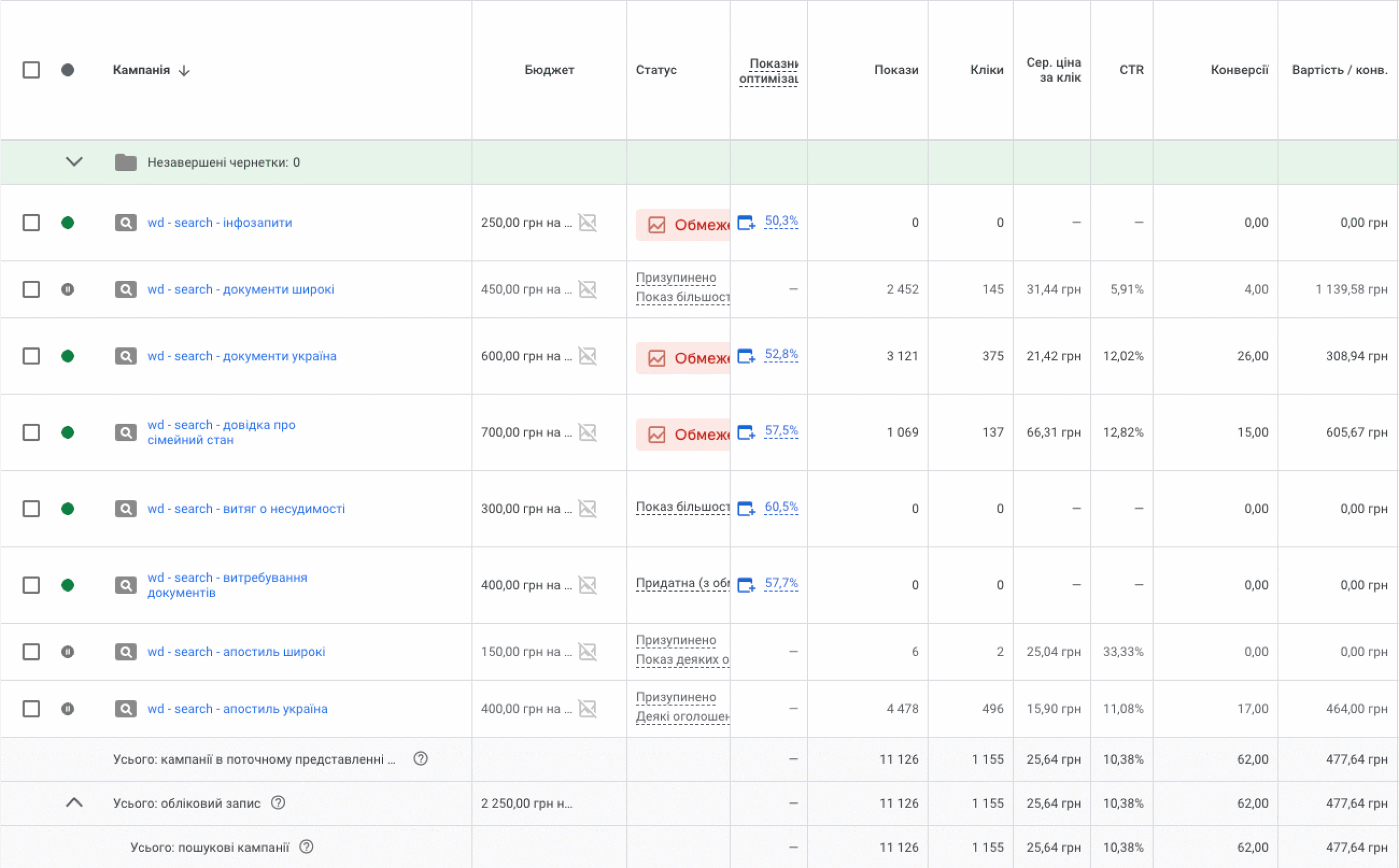
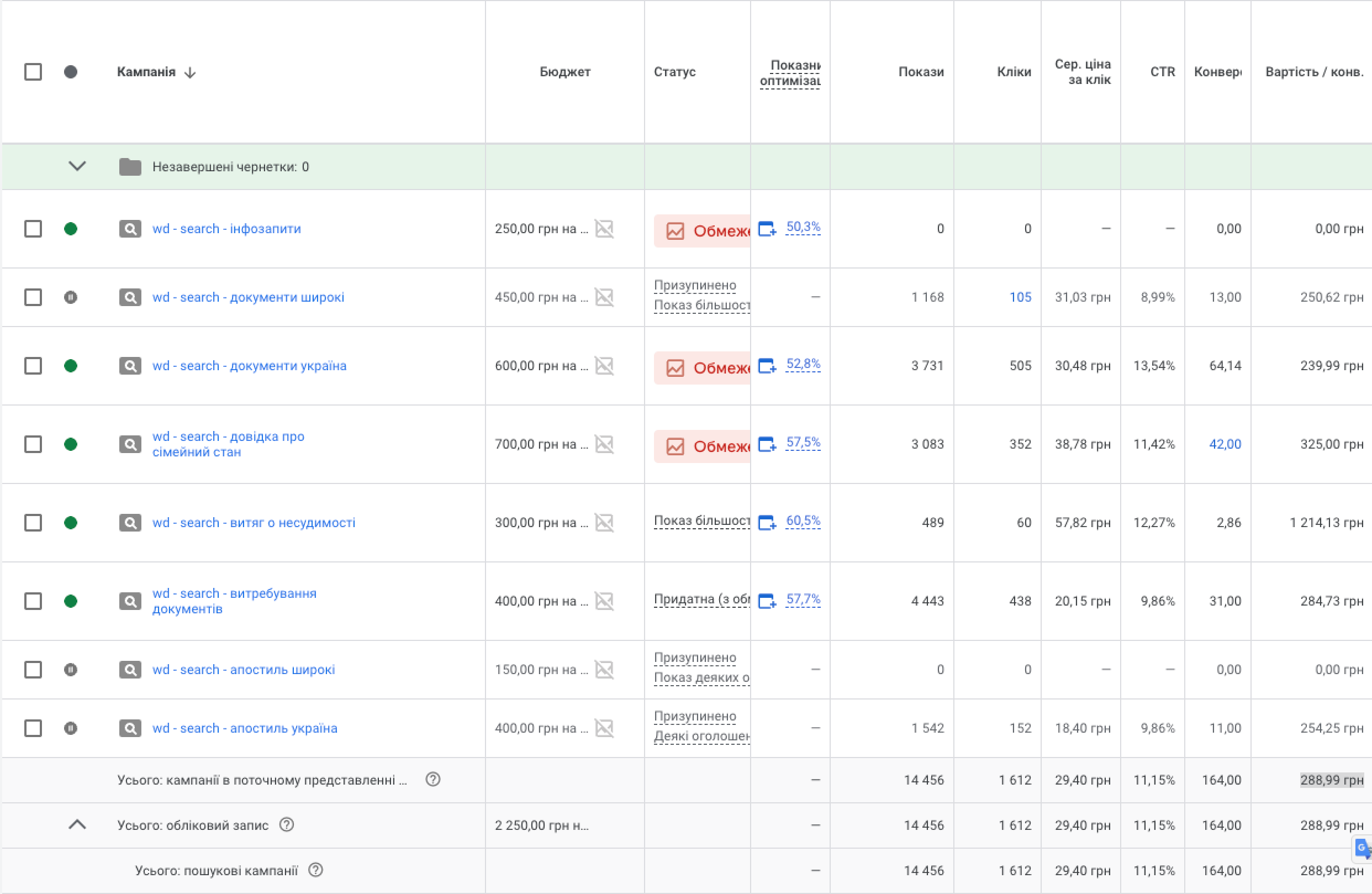
| Options | At the beginning of the work | After 1 month | Difference |
|---|---|---|---|
| Impressions | |||
| Impressions | 11126 | 14456 | +30% |
| Clicks | |||
| Clicks | 1155 | 1612 | +40% |
| Cost | |||
| Cost | 29613,94 UAH | 47394,20 UAH | +60% |
| CTR | |||
| CTR | 10,38% | 11,15% | +7% |
| CPA | |||
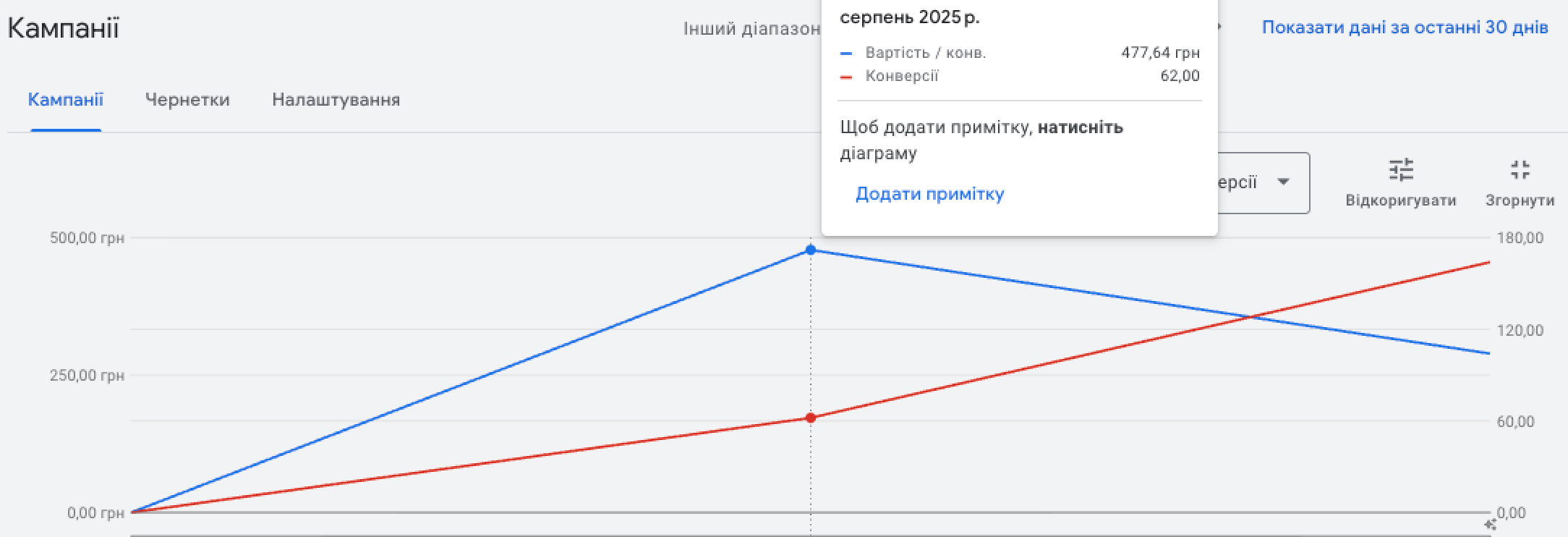
| CPA | 477,64 UAH | 288,99 UAH | -39% |
| Conversions | |||
| Conversions | 62 | 164 | +165% |