
Contents of the case
Media
Initial data
Whole works
- /01 Increase the number of transactions
- /02 Optimize advertising costs
- /03 Increase brand awareness
Issues and general strategy
The client came to us with a clear request: to increase the number of transactions and boost revenue from online sales. By the time we started working together, advertising was already being handled by other contractors, but since April 2025, PMax campaigns had stopped delivering results. Despite activity in the account, there was no effectiveness—and the main reason for this turned out to be incorrect analytics and conversion settings.
Instead of optimizing for purchases, the system learned from the “add to cart” event, which led to the attraction of non-commercial traffic and the actual absence of a final result.
As of July 2025, the project was stagnating: advertising was working, but it was not generating sales. The website also had a number of technical shortcomings that prevented Merchant Center and advertising in general from working properly.
The client’s main needs were:
- Restore advertising effectiveness and increase revenue.
- Implement the agency’s recommendations for website improvements.
- Obtain complete analytics and the ability to optimize based on actual transactions.
The strategy was based on a complete restart of the advertising system and included three key areas:
1. Technical foundation:
- usability audit;
- correction of critical website errors;
- updating and bringing Merchant Center into compliance with requirements;
- correct configuration of tracking for all key conversions.
2. Advertising account restructuring:
- launch of a separate PMax product campaign based on category clusters;
- launch of PMax media for coverage;
- launch of a DSA campaign to cover search queries by category;
- launch of a brand campaign to maintain positions;
- in September–October — distribution of feeds and ID replacement so that products do not compete with each other within PMax.
3. Scaling and regular optimization:
- analysis of seasonality and competitive USPs;
- Adaptation of advertising messages.
- Addition of videos, banners, and creatives.
- Weekly maintenance, budget optimization, negative keyword updates, and correction of geo and timing settings.
The strategy was aimed at a complete recovery of results, sales growth, and further profitable scaling.
What has been done
1. Website analysis, usability, and technical preparation
- We conducted a full usability audit and identified blocks that were hindering conversions.
- We prepared recommendations for technical improvements to the website necessary for the stable operation of Merchant Center.
- We made changes to the structure of pages, pop-ups, forms, and triggers to ensure accurate tracking of user interactions.
2. Analytics fixes and conversion settings
- We checked all event tracking channels and completely reconfigured analytics.
- We implemented accurate tracking of key conversions: purchases, additions to the cart, actions on product pages, and interactions with forms.
- We synchronized analytics with Google Ads and Merchant Center.
3. Merchant Center optimization
- We completely updated the Merchant Center profile.
- We fixed technical errors in the feed, including ID, GTIN, MPN, availability, price, and image_link attributes.
- We ensured that the site fully complies with Google’s requirements for product advertising.
4. Launch of a new advertising account structure
We created a comprehensive campaign system adapted for different audience segments:
- Separate product PMax (main sales campaign)
- Created clusters by category.
- PMax is focused exclusively on “purchase” conversions.
- Ensured maximum compliance of products in the feed with user queries.
- Media Performance Max
- Launched to expand reach and attract new users to the top of the funnel.
- DSA campaign
- Set up to cover search queries that did not fall into the clustered semantics.
- Provided additional coverage of categorical search intentions.
- Branded search campaign
- Created to strengthen the brand’s position and protect it from competitors in search.
5. Feed separation and ID replacement
In September–October, an important technical stage was implemented:
- Feeds were separated by category.
- Identifiers (IDs) were replaced to avoid internal competition between products in PMax.
6. Working on USPs and seasonality
- Competitor analysis was conducted.
- We identified the strengths and weaknesses of the market.
- We took into account seasonal fluctuations in demand and adapted advertising messages.
- We formed clear USPs, which we integrated into creatives, banners, videos, and ads.
7. Scaling and optimization with analytics
- We structured campaigns according to user behavior segments.
- Created and used custom audiences for remarketing, dynamic signals, and PMax.
- Regularly optimized:
- budgets,
- payment strategies,
- search terms and negative keywords,
- display times, and geolocations.
8. Continuous management and reporting
- We prepared weekly and monthly reports with performance analysis.
- We conducted regular reviews of feeds, signals, and ROAS/CPA metrics.
- We maintained account stability and promptly implemented data-driven changes.
Results
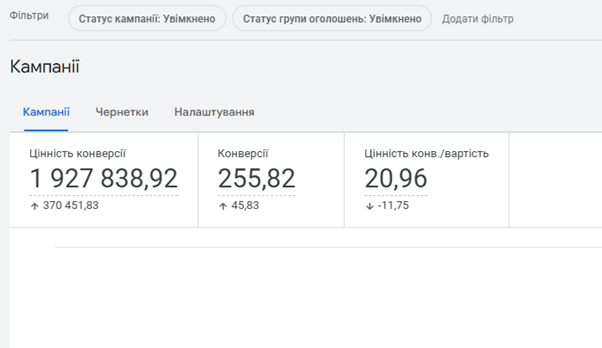
Thanks to a complete account restructuring, technical optimization, and clear analytics, we achieved a ROAS of 20.91, which indicates a profitable scaling of advertising investments.
The project, which had previously stagnated, has become a stable source of profit with a high-quality sales flow and increased transaction value.
| Options | At the beginning of work | In 2 months | Difference |
|---|---|---|---|
| Impressions | |||
| Impressions | 224335 | 429641 | +92% |
| Clicks | |||
| Clicks | 5895 | 14261 | +142% |
| CTR | |||
| CTR | 2,63% | 3,32% | +26% |
| Average cost per click | |||
| Average cost per click | 13,16 UAH | 6,45 UAH | -51% |
| Conversions | |||
| Conversions | 89 | 255 | +187% |
| ROAS | |||
| ROAS | 4,44 | 20,91 | +371% |