

 08/12/2025
  1388
1388


Інтернет-маркетинг
простою мовою
Content of the article
- /01 What is banner advertising?
- /02 Main formats of banner advertising
- /03 Standard banner sizes and types
- /04 Goals and objectives of banner advertising
- /05 Advantages and disadvantages of banner advertising
- /06 How to create an effective banner
- /07 Metrics and KPIs for banner ads
- /08 Current trends and the future of banner advertising
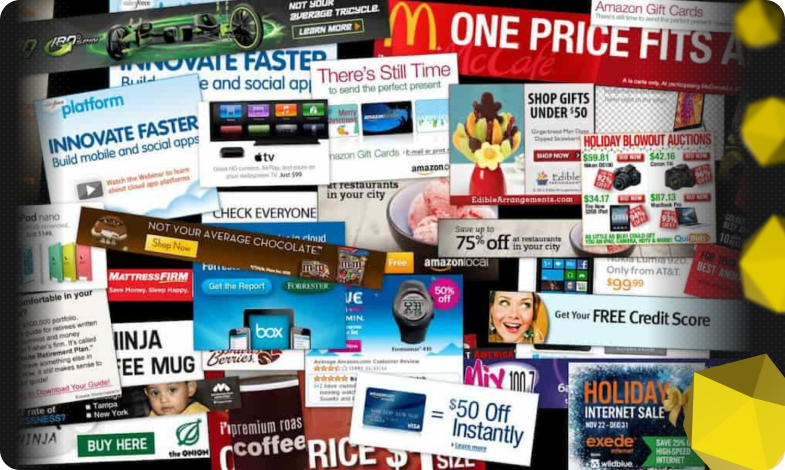
All about banner advertising: formats, goals, effectiveness

In the world of digital marketing, banner advertising remains one of those tools for attracting an audience and increasing sales that should not be ignored. Despite the development of new formats and promotion channels, banners continue to demonstrate their effectiveness in achieving marketing goals. In this article, we will analyze all aspects of banner advertising in detail: from basic principles to modern trends and optimization strategies.
What is banner advertising?
Banner advertising is a form of digital advertising that is based mainly on graphic elements combined with text messages. Unlike purely text-based advertising, banners use visuals to attract attention and convey an advertising message.
Modern advertising banners can be seen on almost any web resource: from news portals to specialized blogs. They are placed in different parts of the web page, in search results, social networks, and even in mobile applications. Banners are also actively used in email newsletters, where they help to increase the efficiency of communication with customers.
The main function of banner advertising is similar to traditional outdoor advertising: to attract the attention of a potential customer and encourage them to take certain actions. Clickable banners serve as a bridge between the ad location and the advertiser’s website, ensuring the attraction of targeted traffic.
Make banner advertising a tool that really works
WEDEX specialists will prepare creatives, select effective platforms, and optimize campaigns so that your advertising works for your business goals, not your expenses.
Main formats of banner advertising
Choosing the right banner format is the first step to creating a successful advertising campaign. Understanding the features of different types of banners allows you to make informed decisions about creative strategy and budget planning.

Let’s take a closer look at the main formats.
Static banners
Static banners are still images in PNG, JPEG, or WEBP formats. Despite their simplicity, they remain popular due to their low production cost and versatility. Static banners are ideal for companies with a limited budget or for campaigns where it is important to focus on a specific message without distractions.
Dynamic banners
Dynamic banners include animated elements or videos in HTML5, GIF, or Flash formats. These formats allow you to create more attractive content that naturally attracts users’ attention. HTML5 banners are especially popular due to their adaptability and ability to display correctly on different devices.
Video banners
Video banners represent the most modern format of banner advertising. They allow you to show a product in action, tell a brand story, or demonstrate services in dynamics. The video format is especially effective for emotional impact on the audience and increasing engagement.
Each of these formats can be effective if used correctly by marketers. No less important than the format is the right choice of banner size, which determines not only its visibility but also the cost of placement and the effectiveness of interaction with the audience.
Standard banner sizes and types
Understanding the standard sizes of banners is essential for effective planning of advertising campaigns. Each size has its own placement and efficiency features.
There are only four standard banner formats
- Square banners with a size of 250×250 pixels are ideal for placing in the side columns of websites. Their compact shape allows you to use space efficiently without interfering with the main content. Large square banners measuring 336×280 pixels provide greater visibility while maintaining proportionality.
- Standard horizontal banners of 468×60 pixels are traditionally placed at the top, middle, or bottom of a web page. Leaderboard banners of 728×90 pixels are most often placed in the header of a website, providing maximum visibility.
- Vertical banners, such as the 160×600 pixel skyscraper or 300×600 pixel wide skyscraper format, are ideal for sidebar placement. They provide long-lasting visibility while scrolling the page.
- Mobile banners have become critically important with the growth of mobile traffic. They should take into account the specific dimensions for mobile devices. A regular mobile banner with 320×50 pixels and a large mobile banner with 320×100 pixels are optimized for comfortable viewing on smartphones.
When planning an advertising campaign, it is recommended to create banners in 3-5 of the most popular sizes. This will ensure maximum audience reach and flexibility in choosing advertising platforms. Priority should be given to adaptive HTML5 formats that automatically adjust to the available space, especially for mobile devices where screen sizes can vary significantly.
Goals and objectives of banner advertising
The effectiveness of banner advertising largely depends on how accurately the goals are defined and how well they match the format features and capabilities of the selected placement platforms. Therefore, the main areas of using banner campaigns in modern digital marketing are as follows:

Let’s take a closer look.
One of the key tasks of banner advertising is to build and maintain brand awareness. Even if the user does not click on the banner, he or she sees the logo, company name, and main message. Regular presence of banners in relevant places strengthens the brand image in the minds of potential customers. To achieve this goal, it is important to ensure visual consistency across all advertising materials – uniform colors, fonts, and stylistic solutions will help create a coherent and memorable image.
Banners also effectively solve the task of attracting targeted traffic to the website. Correctly configured targeting allows you to show ads to those users who are most likely to be interested in the offer, which increases the quality of traffic and the likelihood of conversion. Remarketing is worth mentioning separately: repeated impressions to users who have already visited the site, as a rule, give a significantly higher conversion rate compared to working with a «cold» audience.
In addition, banner advertising serves as a tool to support sales. Banners with specific products, prices, and a call to action stimulate impulse purchases – this is especially true for e-commerce projects and seasonal sales.
Finally, banners are an efficient channel for informing the audience about new products, promotions, and changes in the company’s operations. Due to its visual expressiveness and wide reach, banner advertising allows you to quickly convey important information to your target audience.
Remember: there are no universal recipes – each target requires an individual approach to planning and implementing an advertising strategy.
Advantages and disadvantages of banner advertising
Of course, such advertising has both its pros and cons. It is worth knowing and understanding both sides to effectively use this channel of customer acquisition.
The advantages are as follows:
- Cost-effectiveness.
Banner advertising is highly cost-effective compared to traditional advertising channels. The cost-per-click (CPC) or cost-per-impression (CPM) model allows you to control costs and pay only for specific results.
- Precise targeting.
Modern advertising platforms provide ample opportunities for targeting the audience by demographic characteristics, interests, online behavior, and geography. This allows you to reach the right audience as accurately as possible and increase the effectiveness of your advertising campaigns.
- Detailed analytics.
The digital nature of banner advertising provides access to detailed analytics of campaign performance. Advertisers can track many metrics, which we will discuss below.
- Launch speed.
Banner campaigns can be launched almost instantly after creating creatives and setting up targeting. This allows you to quickly respond to market changes, launch tactical promotions, or test new offers.
- Flexibility and scalability.
Banner advertising is easily scalable depending on your business needs. You can start with a small budget and gradually increase investments in the most effective channels and creatives.
Despite all these significant advantages of using banner ads, there are also disadvantages. Namely:
- Banner blindness.
One of the main challenges of banner advertising is the phenomenon of «banner blindness» – when users subconsciously ignore ad units. This leads to a decrease in the effectiveness of campaigns and requires constant work on improving creatives. To get around this, you can
-
- update creatives more frequently: rotation and regular updates (new visuals, different headlines) reduce addiction;
- use unexpected placements and formats (native blocks, integrations, interactive elements) to break out of the template;
- apply personalization and dynamic creatives (DCO) – relevant material attracts attention better;
- test different «hooks» in the first 1-3 seconds of the video or the first pixels of the banner, do A/B testing of headlines and visuals;
- measure not only CTR, but also visibility and interaction time – sometimes users do not click, but remember the message.
- Ad blockers.
The growing popularity of ad blockers has a significant impact on audience reach. According to some estimates, about 30% of users use ad blockers, which means losing a significant portion of potential customers. To solve the issue, you should try the following:
-
- consider alternative channels: native integrations, sponsored materials, email campaigns, push notifications, SEO content;
- use direct placement with relevant platforms and media partnerships (content sponsorship) that bypass ad-blocks;
- implement tactics for detecting ad blocking and display a friendly message with a proposal to add the site to the white list, or offer a replacement value (for example, access to exclusive content);
- invest in primary data and create your own channels (mailing list, social media, community) – this reduces dependence on banners;
- use «lightweight» formats that are often not blocked (nonclickable native units, sponsored materials) and agreed «acceptable ads».
- Low CTRs.
Average click-through rates for banner ads are usually lower than for contextual ads. This requires more effort to optimize creatives and targeting settings. To get around this disadvantage, you can
-
- focus on relevance: targeting by interests, behavior, and remarketing gives you a better CTR;
- make a clear and attractive CTA, test different offers – sometimes a simple clarification of the benefit increases click-through rates;
- use the sequence of contacts: banner → remarketing → email or landing page (the user journey converts better with several touches);
- optimize landing pages for the expectations of the banner, because the coincidence of messages significantly increases the conversion rate after a click;
- reorient metrics: evaluate views, awareness, and further actions, not just CTR.
- Fraud and invalid traffic.
Banner ads often face problems with fraudulent traffic, when impressions or clicks are generated artificially. This leads to wasted budget and distortion of performance statistics. Therefore, we recommend the following:
-
- work through trusted ad networks and DSPs/SSPs with their own verification systems; use post-bid and pre-bid verification;
- connect third-party services for fraud detection (DoubleVerify, Integral Ad Science, Moat, etc.) and require reporting from partners;
- set targeting rules and frequency limits, block and white-lists of domains, as well as geo-filters;
- give preference to pay-per-performance (CPC/CPA) or hybrid contracts instead of pure CPM if you suspect low traffic quality;
- regularly analyze log data and anomalies (sudden spikes in clicks from one source, strange time patterns) and promptly block suspicious sites.
Banner advertising has objective advantages and limitations, but most problems are solved by a systematic approach. The main idea is not to rely on a banner as the only tool, but to integrate it into a multichannel strategy with clear metrics and a verification process.
How to create an effective banner
An effective banner is not just a beautiful picture, but a thoughtful combination of message, visuals, technical implementation, and testing mechanics. And what’s important, it all works for your business goal.

Below is a step-by-step, practical guide with principles and specific actions that will help you create a banner that attracts attention and gives results.
Step 1. Setting goals and key indicators.
First, you need to clearly articulate why you are creating a layout or advertising material: to increase the click-through rate, increase the number of applications, improve brand awareness, or reduce the time it takes for a client to make a decision. At this stage, key metrics are also defined to measure effectiveness.
Step 2. Analysis of the audience and context of use.
Before development, we study the target audience: its needs, behavioral patterns, and expectations. It is important to understand where users will see banners or other creatives: mobile devices, desktop, social networks, websites. This affects the format, size, and style of presentation.
Step 3. Formation of creative packages.
Several variants of visuals and texts with different calls to action are created. Each package includes: graphic elements, advertising messages adapted for different channels, and recommendations on the best CTA format. This allows you to quickly test several options and determine the most effective one.
Step 4. Testing and comparison.
In practice, A/B testing is launched, where different versions of creatives are shown to separate audience segments. This allows you to collect data on user reactions. That is, which banners get more clicks, which texts motivate users to follow the link better, which call to action works more often.
Step 5. Analysis of results and conclusions.
The collected data is compared with the metrics defined at the beginning. If the indicators do not reach the expected level, additional analysis of the reasons is done. For example, whether the hypothesis was correct, whether the format was appropriate for the audience, whether there were enough tests. Based on this, recommendations for further campaigns are formed.
Step 6. Optimization and scaling.
The most successful creative options are scaled to a wider audience and different channels. All developments are documented to further reduce the time for preparing new layouts and increase the effectiveness of campaigns.
Thus, the process includes a clear logic of actions. This helps to take a systematic approach to the creation of advertising materials and get stable measurable results, which we will discuss further.
Metrics and KPIs for banner ads
Measuring the effectiveness of banner advertising is based on a combination of quantitative and qualitative indicators. They allow you to evaluate the effectiveness of a particular campaign and understand its impact on the business as a whole.
Performance indicators:
|
CTR |
The percentage of users who clicked on a banner compared to the number of times it was displayed |
|
CPC (Cost Per Click) |
Cost per click, which allows to estimate the economic efficiency of the campaign |
|
CPM (Cost Per Mille) |
Cost per thousand impressions, used for campaigns focused on reach and brand awareness |
|
Conversion Rate |
The percentage of users who performed a targeted action after interacting with a banner, such as making a purchase or subscribing to a newsletter |
|
CPA |
The cost of acquiring one customer, which is critical for assessing the profitability of advertising |
|
Viewability |
An indicator of how much of the banners were actually seen by users |
|
Engagement Rate |
Includes clicks on interactive elements, video views, social media shares, or other actions that indicate active user interaction with the creative |
|
Brand Lift (increase in brand awareness) |
A qualitative metric that measures how banner ads influence brand attitudes, awareness, and willingness to buy. |
|
Frequency |
The average number of times one banner is displayed to one user |
|
Retention Rate |
The percentage of users who return or take a second action after the first contact with a banner |
|
View-Through Rate (VTR) |
The percentage of users who performed a targeted action after viewing a banner without a direct click |
|
Cost Per Lead (CPL) |
The cost of acquiring one lead, which is important for evaluating the effectiveness of lead generation campaigns |
|
Attribution Metrics |
Analysis of which channel or point of interaction contributed to the achievement of the goal, which allows you to more accurately assess the effectiveness of different stages of the customer journey |
|
Ad Fatigue |
An indicator of how often users see the same banner, which can lead to a decrease in the effectiveness of advertising
|
|
Cross-Device Performance |
An assessment of how banner ads work on different devices, such as mobile phones, tablets, and desktops |
This list of metrics is a comprehensive tool for assessing the effectiveness of banner advertising in 2025, taking into account current trends and technological changes. The balanced use of these metrics helps marketers assess both short-term results and long-term effects in the form of increased brand loyalty and awareness.
Current trends and the future of banner advertising
Banner advertising continues to evolve, adapting to new technologies and changes in user behavior. Artificial intelligence and machine learning are revolutionizing the approach to creating and optimizing advertising campaigns, allowing for automatic selection of creatives, optimization of bids and targeting in real time. AI makes it possible to predict user behavior, personalize advertising messages, and create more relevant content for each audience segment, which significantly increases the effectiveness of campaigns.
Augmented reality opens up new horizons of user experience by allowing interactive product demonstrations. Users can try on clothes, arrange furniture in their own interiors, or test cosmetics virtually, which creates a deeper interaction experience and increases the level of audience engagement. At the same time, interactive and dynamic banner formats are becoming the norm, as they allow for the display of personalized content, videos, and interactive elements, which directly affects conversions and increases campaign efficiency.
The development of voice technologies and the emergence of voice assistants create new opportunities for audio banners that can integrate with podcasts, music platforms, and voice applications. This allows reaching audiences in new formats where traditional visuals are no longer effective and opens up prospects for a comprehensive omnichannel advertising strategy.
Increased requirements for user privacy are leading to a shift to a «privacy first» approach to targeting. The use of contextual advertising, first-party data, and other technologies that do not require third-party cookies allows companies to effectively engage their audience while maintaining their privacy and trust. It is also important to control the frequency of impressions and avoid «banner blindness», which keeps users’ attention and increases the likelihood of interaction with the advertisement.
The future of banner advertising is associated with further personalization, integration of the latest technologies and development of new interactive formats. Companies that can effectively apply AI, AR, and innovative approaches to content will gain a significant competitive advantage. To achieve the maximum effect, it is important to combine technologies with high-quality creatives and precise targeting, as well as to constantly test new formats and approaches. At the same time, it should be remembered that banner advertising is not only a tool for driving traffic, but also a powerful tool for building a brand, forming long-term relationships with customers, and increasing audience loyalty. The right strategy and integrated approach can significantly increase the effectiveness of campaigns and accelerate the achievement of marketing goals.

commercial offer
Other articles by the author

28/11/2022
Google was officially launched 24 years ago in 1998. A lot has changed since then, but one thing hasn't. If you can just focus on the basics, you will still succeed online.
08/12/2025
In digital marketing, banner advertising remains one of the tools for attracting audiences and increasing sales that should not be ignored.

11/06/2024
Digital marketing is the marketing of goods or services through digital technology, primarily on the Internet, but also including mobile phones, display advertising, and any other digital medium.
Latest articles by #Useful tips

05/03/2026
Customer focus is a systematic approach where all parts of the business work for the convenience and benefit of the customer: product, processes, communications, and internal culture.

04/03/2026
A loyalty program is not just a discount tool, but a multidimensional business strategy.

04/03/2026
A workshop is an interactive event with a clearly defined task, facilitation, and practical results.