

 02/03/2026
  1151
1151


Інтернет-маркетинг
простою мовою
Content of the article
- /01 What is the target audience of a website?
- /02 Types of target audience
- /03 Why it is important to know the target audience of your website and online store
- /04 How to define your website target audience
- /05 Methods of analyzing the target audience of an online store
- /06 How to define your target audience with Google Analytics
- /07 Examples of well and poorly selected audiences
- /08 What is segmentation and why is it needed?
- /09 How to attract your target audience
- /10 How creating a portrait of the target audience helps businesses
How to determine the target audience of a website

The market for services and goods is increasingly moving online. That’s why your website is no longer just a shop window, but one of the main channels for sales, communication, and brand positioning. To make your website work effectively, you need to understand who exactly you are creating it for. In this article, we will analyze what the target audience of a website is, what types of it are, and why knowing the target audience is critical for business. How to define it step by step, what analysis methods to use, and other details about working with the target audience.
What is the target audience of a website?
The target audience of a website is a set of users who are most likely to be interested in your product or service and perform a targeted action on the website, such as ordering, leaving a request, subscribing, etc. It is important to understand that this is not an abstract «mass group» but specific segments of people with common characteristics, needs, and behavior. A clear definition of the target audience allows you to formulate a relevant offer, adjust UX and marketing channels, reducing the cost of ineffective contacts.
Types of target audience

First of all, there is a division into:
- The main target audience. These are the people who directly make the decision to buy or order a service. For them, the site should clearly state the benefits, have a clear commercial offer, and a minimum number of barriers to conversion. For example, if we are talking about a business that sells cosmetics in bulk, the main potential customers will be salon owners or managers responsible for purchases.
- Indirect or influential target audience. They are less likely to buy themselves, but they can significantly influence the final decision. These can be employees of the client company, craftsmen, consultants, or experts whose opinions are listened to. For this group, it’s not so much the price or terms that matter as the brand’s reputation, reviews, case studies, and expert content. Ignoring the indirect target audience often leads to a loss of potential sales, even if the main offer looks attractive.
Another important division is based on the width of coverage.
The most common mistake many businesses make is to start with an overly broad definition of the target audience, such as «everyone who might need the product». This approach creates the illusion of scale, but in practice reduces the effectiveness of the website and advertising.
A narrow target audience, clearly limited by need or use case, is much more effective. That is, instead of abstract «sports fans», buyers of goods for playing football. The more precisely the target audience is defined, the higher the relevance of messages and conversion.
Separate consideration should be given to the division by business model:
- B2B segment: The target audience is usually more stable. Decisions are made more slowly, often collectively, with an emphasis on rational arguments, such as reliability, terms of cooperation, and economic benefits;
- B2C segment: the behavior of potential customers changes faster, influenced by trends, social and economic factors, and emotions. That’s why it’s important for B2C projects to regularly review their understanding of their target audience and adjust communication at least once every few weeks.
For a website, it also matters what the users’ intentions are when they visit it. Part of the target audience is interested in content: they read articles, reviews, comparisons, and get to know the brand. Others are ready to make a purchase or are actively considering it. These groups require different approaches: the former need expertise and usefulness, while the latter need a clear page structure, clear terms, and a quick path to order.
Why it is important to know the target audience of your website and online store
Knowing the target group allows you to save your budget and increase the effectiveness of your website. So, what is important to know?
Targeted communications: precise messages yield better results
When you know the needs and motivations of your target audience, you can tailor your offer wording and advertising creatives to their specific pains and benefits. This increases ad CTR and conversion on landing pages: a relevant headline grabs attention, and a clear benefit leads to action. For example, the «benefits for beauty salons» section will work better for B2B audiences than general product descriptions.
Effective advertising budget means fewer wasted impressions
If you target advertising to a broad target group, most of the budget goes to users who will never buy. With a portrait of the target audience, you weed out unnecessary segments and reduce CPA: ads are shown to those who are more likely to make a purchase or request. This is especially noticeable in niches with a high cost per click.
Optimize product and UX for real expectations
The knowledge of a potential customer even affects how the product card looks like and what fields are in the order form. For a young mobile audience, quick buttons and one-click payment are important, while for corporate leads, detailed specifications and the ability to download a commercial offer are important. Knowing your target audience helps to remove unnecessary obstacles on the way to purchase and reduce the number of abandoned carts.
Planning the assortment and pricing policy
Different segments of the target group have different solvency and priorities. Understanding the audience allows you to shape the assortment to cover basic needs while offering premium solutions to those who are willing to pay more. This reduces the risk of product «downtime» in the warehouse and increases margins.
Analytics and result measurement become useful
KPIs work only when they are tied to segments of the target audience. For example, the average conversion rate across the entire site provides little information – it is much more important to look at the CR for key audiences, such as new visitors vs. repeat buyers or B2B leads vs. B2C customers. This allows you to determine exactly which hypotheses to test and which channels to scale.
So, without a clear portrait of the target audience, a website risks working sporadically, which is expensive and low in terms of profitability. Even a small investment of time in describing audiences and linking KPIs to segments returns in the form of better leads, lower advertising costs, and a higher average check.
How to define your website target audience
Start with what you already have: review the basic data and make initial hypotheses about your target audience based on it.

Collect basic demographic data
Demographics is the basis that tells you what the tone of communication should be and what channels to use. Collect data on age, gender, marital status, income level, and education from website analytics (GA4), CRM, and checkout fields. Don’t limit yourself to dry numbers: compare demographics with real sales, i.e. which groups bring more profit and which simply increase traffic. Based on this, determine whether you need separate landing pages for different age groups, different tariff options for business and private customers.
Record geodata
The place of residence, language, and even time zone determine many technical and marketing decisions: delivery terms, payment options, mailing times, and content localization. Collected geodata via IP, order data, delivery form, and language policy on the website will allow you to create local landing pages or set up regional advertising campaigns. For local services, geo-tuning often decides the success or failure of a campaign, while for large-scale online stores, it helps to manage logistics and the expectations of the target audience.
Take into account psychographic information
Psychographics are the answers to the question of «why» a person buys, not just «who they are.» Learn about the values, interests, lifestyles, and key pains of your audience through interviews, focus groups, and social listening. This will give you an idea of what messages resonate and what visual style works. During interviews, ask about real-life scenarios of product use, sources of information when making a choice, and factors that discourage purchase. This will allow you to build content that speaks the customer’s language rather than template descriptive blocks.

Collect behavioral data
The behavior of the target audience on the website shows not assumptions but real actions. Which pages users visit, which products turn into purchases, where visitors leave the funnel. Use GA4 to set up events and conversions, CRM to link online actions to real orders, and heatmaps and session recordings to see problem areas in UX. Compare traffic behavior from different channels to help determine which sources provide «quality» visitors and which are just a large but irrelevant stream.
Typical metrics to track:
- entry and exit pages;
- time on key pages;
- abandoned cart rate;
- user paths to conversion.
Find out the degree of loyalty
Distinguishing between new and repeat customers decides what offers to make and how to build communication. For newcomers, «inbound incentives» are effective: simple instructions, a discount on the first purchase, a short onboarding. For a loyal target audience, reward programs, personalized offers, and cross/upsell campaigns are effective. Data on LTV, frequency of repeat purchases, and response to promotions help determine where to invest – in attracting new customers or retaining existing ones.
Remember: the collected data is not the finish line, but the start for systematic work. An audience profile is a living document because the market and customer behavior are changing. The best results are obtained through constant measurement, testing, and correction, not a one-time «perfect» questionnaire.
Methods of analyzing the target audience of an online store
Methods of analyzing the target group should be considered as tools of the same set: each gives its own perspective.
The 5W method (Who, What, When, Where, Why)
The method provides depth for psychographics and helps to create personalized content. This is a list of simple questions that help to extract motivation and scenarios for using the product. The answers to these questions form a clear customer profile and give direction for messages.
For example, let’s take an online sneaker store.
- Who: active urban residents aged 20-35 who run 3-5 km three times a week.
- What: they are looking for lightweight sneakers for daily jogging and convenient for the city.
- When: purchases take place before the season (spring) or when a marathon is launched in the city.
- Where: usually come from social media and advertising carousels on Instagram.
- Why: the combination of «design + comfort» is important, they are ready to overpay for a brand that supports running initiatives.
The «backwards» method
This is a method of analyzing a completed conversion. You take a successful purchase and rewind the path backwards – how the user got to the site, what they were looking at, what doubts they had, and what convinced them to buy. This answers the question «what touchpoints and messages really work».
Select 10-20 transactions from different channels, collect event chains in GA4, supplement them with session recordings or screenshots of chats, and try to find common patterns.
Method of identifying possible target audience for a product
This approach starts with the product itself: what needs it addresses, what alternatives people are considering, and what unique value you offer. The result is a list of potential target audience segments that are worth checking out.
Write down the key benefits of the product, then list next to them who might care about these benefits. After that, prioritize the segments by purchase probability and margin.
Practical advice: this method is especially useful at the startup stage or when launching a new product line, as it provides a quick list of target segments for initial testing.
Method of determining the target audience from the market
This method takes a broader view: it analyzes the market, competitors’ behavior, and demand in search engines and social networks. It answers the question «where are the possible niches and which segments are underserved».
Study which segments are served by the main competitors, which offers are leading, and where there are weaknesses (price, service, assortment). Combine this with an analysis of key queries and trends on social media. This will show you where demand is growing and supply is weak. The method of determining the target audience from the market makes it possible to find a competitive advantage or a «white zone» for entering the market, as well as to justify the pricing policy.
The idea of using these target audience analysis methods is simple: combine them. Start with 5W and product analysis, confirm with behavioral data, and test your ideas using the backward method. Then test your hypotheses with competitor market analysis.
How to define your target audience with Google Analytics

Google Analytics (GA4) allows you to create audiences and segments based on demographics, interests, events, and user paths. Let’s consider a minimum practical set of actions.
- Set up the correct collection of events and conversions.
Before any analysis, it is important to make sure that GA4 captures key user actions. These are: completed purchase, request, intermediate steps. They allow you to understand the intentions of potential customers and distinguish interested users from casual visitors.
- Create audiences and segments in the Audiences section.
In GA4, you can create audiences based on various criteria: traffic source, specific pages or product categories, demographics, and behavioral indicators. Such segments help you see who interacts with your website and which user groups are most valuable to your business.
- Analyze behavioral and engagement reports.
These reports show how users move through the site and at what stages their attention is lost. Analyzing the user journey allows you to identify weaknesses: pages where mass exits occur or steps that cause difficulties. This is an important signal to refine the target group portrait and optimize the funnel.
- Use exports and integrations with CRM.
GA4 data becomes much more valuable when combined with information from CRM or other internal systems. Such a comparison allows you to see which user segments are not just visiting the site, but are actually generating revenue or returning repeatedly.
- Create audiences for remarketing and test hypotheses.
Based on the collected segments, you should launch remarketing campaigns and compare their effectiveness. Analyzing CTR, conversions, and cost per acquisition for different groups helps to test assumptions about the target audience and gradually refine its profile.
GA4 should be viewed not as a reporting tool but as a basis for making marketing decisions. Regular work with audiences and segments allows you to adapt your strategy to real user behavior and lay the foundation for more accurate targeting in the future.
Examples of well and poorly selected audiences
Let’s look at two conditional cases to clearly understand a properly compiled description of the target audience.
Let’s imagine an online clothing store that defines its audience as follows: «Anyone interested in fashion». On the surface, this approach seems logical – the niche is large, there are many options. In practice, it leads to typical problems:
- advertising creatives become generic and do not say «this is for you» to a specific person;
- landing pages show the entire assortment, not what a particular customer is looking for;
- as a result, many clicks turn into expenses.
Marketing sends traffic without motivation, UX is not adjusted to different purchase scenarios, and management receives a lot of low-quality requests – people come in, look, but don’t buy.
When the same situation is translated into a working tactic, everything changes. Instead of «everyone» the store identifies two priority segments:
- the conditional main audience – women aged 25-40 from cities with more than 100 thousand inhabitants who are looking for stylish things for work and weekends and appreciate fast delivery;
- the second segment is young people aged 18-24 who follow trends.
For the first target segment, the site receives specific elements: detailed size charts, options for office wardrobe packages, clear return policies, and expedited delivery options. For younger users, separate landing pages have been made with an emphasis on trendy collections, short videos in creatives, and a quick checkout.
SaaS for HR management
When a product «for HR» is aimed at «all HR managers» the sales line is filled with a large number of requests from people who do not have the authority to make decisions. Or they work in companies where SaaS functionality is simply not needed.
The sales team spends time qualifying leads, demos turn into training sessions, and conversion to a paying customer remains low. It’s expensive and inefficient: the company pays to drive traffic and at the same time pays people to spend time in their sales team.
To fix this, we start by clarifying the profile: the product is positioned not «for all HR» but for HR directors and owners of companies with 50-500 employees in specific industries where automation really gives a noticeable ROI (IT, logistics, or retail).
Specifying the target audience brings two practical benefits at the same time: improved traffic quality and better product experience. Therefore, investing time in refining the audience profile pays off in the form of better conversions, lower advertising costs, and more predictable growth.
What is segmentation and why is it needed?
Segmentation is the process of dividing the entire target audience of a website into separate, relatively homogeneous groups that have common characteristics, needs, or behavioral scenarios. Its main value is that businesses stop communicating with everyone in the same way and start speaking to each group in a language they understand.
How to segment users: a step-by-step plan
A competent approach is the basis for getting the expected result. So let’s consider what step-by-step actions should be taken to achieve this.
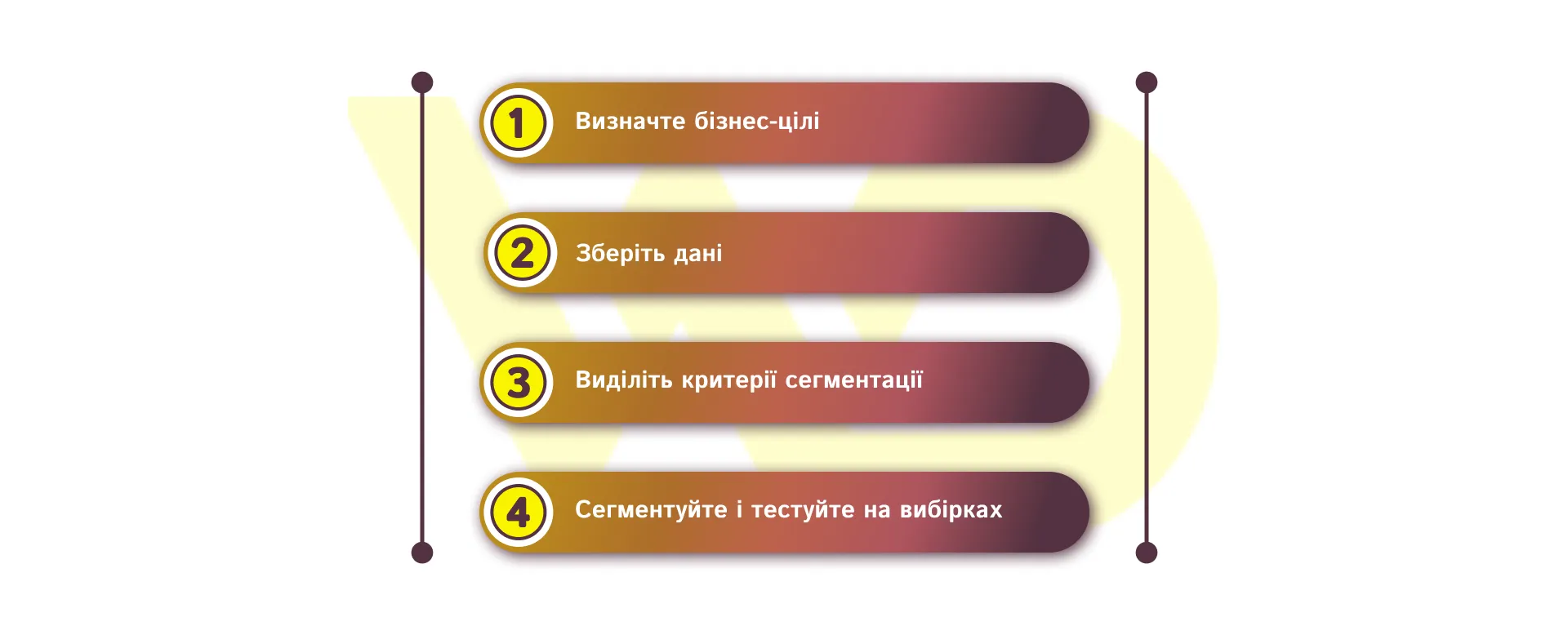
STEP 1: Define business goals
A clear understanding of what exactly you want to improve – average check, repeat purchases, cost per lead, or advertising effectiveness – determines the logic of further actions. Without this, segments risk becoming formal and not providing practical benefits.
STEP 2. Collect data
It is necessary to collect data from all available sources: website analytics, CRM, advertising accounts, surveys, or customer feedback. At this stage, it’s important not only to accumulate information but also to make sure it’s up-to-date and correct.
STEP 3. Select segmentation criteria
The next step is to select segmentation criteria. These can be demographics, website behavior, traffic sources, funnel stage, or previous experience with the brand. You should not use all the criteria at the same time – it is more effective to choose 1-2 key ones that are directly related to business goals.
STEP 4. Segment and test on samples
Segments are formed and tested in practice. Messages, landing pages, or ads are tested on specific groups of users to assess the real difference in behavior and conversions. Only after confirming the hypotheses does it make sense to scale the approach and implement automatic rules, such as separate remarketing scenarios for users who abandoned their carts or browsed certain product categories.
How to identify the needs and potential of each segment
To make segmentation work not formally but actually affect the results, it is important to understand not only who these users are, but also why they act the way they do and what can push them to the next step.
- You should start with questions to the audience. Surveys help to find out the expectations, doubts, and motivations of customers. It is important to ask not general, but clarifying questions: what prevents them from making a decision, what is missing in the product, what alternatives they are considering
- The second level is the analysis of real behavior. Search queries, history of support calls, chat and CRM correspondence provide more honest answers than direct surveys. It is here that recurring pains, common objections, and points of loss of interest are visible.
- Interviews with customers allow you to see the logic of decision-making, and heat maps and analysis of website behavior help you understand which elements attract attention and which are ignored.
As a result, such work with data allows you to move from intuitive decisions to informed actions. When the needs of each segment are understood, businesses can more accurately formulate offers, predict audience reactions, and allocate marketing resources more efficiently, focusing on the segments with the greatest growth potential.
How to create a persona
A persona is a generalized image of a typical segment representative that helps the team see a real person behind the numbers. It is not fiction, but a structured description based on data.

The persona begins with a name and role, for example, «Elena, HR Director of a medium-sized company». Next, you describe her demographics, field of activity, and work context to understand the conditions in which she makes decisions. A mandatory element is the key pains and needs that the product or service can address.
It is also important to record how a person makes a decision: how much time they need, what sources of information they trust, who else can influence their choice. The behavior on the website, i.e. the pages they view and the ones they ignore, helps to adapt the structure and content. The portrait is completed with a list of messages and arguments that work best for this particular segment.
This approach makes segmentation a practical tool and helps the team make more informed marketing decisions.
How to attract your target audience
Once the segment portraits have been formed, the practical question arises: where and how to communicate with them. There are no universal channels – the effectiveness depends on the level of consumer awareness, product type, budget, and planning horizon. Let’s analyze the key tools for attracting the target audience and the logic of their choice depending on business objectives.
- Contextual advertising.
Contextual advertising works best in situations where the user has already formed a clear need and is actively looking for a solution. It’s a tool for driving traffic quickly and testing hypotheses, especially for products with clear «here and now» value.
The WEDEX team will tailor contextual advertising to your product and business goals to attract your target audience, not random clicks.
Engage customers at the moment of search
It is important not to combine all requests into one campaign. Different segments may be looking for the same product with different motivations, so dividing campaigns by intent or product type allows you to more accurately manage bids, messages, and landing pages. The advantage of the channel is quick results, but without constant optimization, contextual advertising quickly becomes an expensive source of leads due to high competition.
- Search engine optimization (SEO) and organic search.
SEO is a long-term effort that generates a steady stream of targeted traffic in the long run. The most valuable are queries that reflect the user’s specific intent, not general interest in a topic.
The key point is the relevance of the content to the search intent. Informational queries require explanatory materials, analytics, or guides, while commercial queries require clear product or service pages. When the site structure and content logically meet the user’s expectations, organic traffic becomes not just massive, but high-quality.
- Work with specialized websites and partnerships.
Publications on specialized websites, partner materials, and collaborations with industry media allow you to engage your audience at the moment of trust building. This channel is especially effective for B2B areas and niches where decisions are made based on expertise, reputation, and recommendations.
In addition to direct traffic, such activities work for the brand image, strengthen the company’s expert position, and can support other channels, such as SEO and retargeting.
- Social media and targeted advertising.
Social platforms allow you to work with both cold and warm audiences, generating demand even before the moment of active search. The choice of channel directly depends on the type of business and the behavior of the target group. For example, LinkedIn is effective for professional B2B communications, while Instagram and Facebook are more suitable for B2C products and visual content.
Targeting allows you to flexibly segment into groups by interests, behavior, and funnel stage, gradually leading the user to the target action through a series of contacts with the brand.
Effective target audience engagement is not about choosing the «best» channel, but about the right combination of tools for specific segments and stages of interaction. It is a systematic approach to channels that allows you to build a stable flow of customers and support business growth in the long term.
How creating a portrait of the target audience helps businesses
Drawing up an accurate portrait of the target audience allows businesses to act in a targeted manner:

This is not a one-time action, but a continuous cycle: data collection → segmentation → testing → optimization. The more accurate the portrait, the more likely it is that the site will start working as a stable generator of sales and repeat business.

commercial offer
Other articles by the author

17/02/2026
Sitelinks are a set of internal links that Google sometimes displays below the main result in the search results.

29/01/2026
Search Generative Experience (SGE) is Google's approach to search that uses generative artificial intelligence to generate concise, coherent answers to user queries.
05/02/2026
Geotargeting is an algorithm that allows content or advertising messages to be shown to users based on their geographical location.
Latest articles by #Useful tips
02/03/2026
Your website is no longer just a showcase, but one of the main channels for sales, communication, and brand positioning.

02/03/2026
A community manager is responsible for building, developing, and maintaining a community around a brand, product, or project.

24/02/2026
Trust is a set of signals that show search engines and users how trustworthy a particular site is.