

 08/05/2026
  1579
1579

Інтернет-маркетинг
простою мовою
Content of the article
- /01 What is influencer marketing and how does it differ from traditional advertising
- /02 What business challenges does influencer marketing solve?
- /03 When influencer marketing works best
- /04 Types of influencers and how to distinguish them
- /05 How to Choose an Influencer for Your Brand
- /06 How to build a partnership: from goal to format
- /07 Influencer marketing formats that actually work
- /08 What businesses should consider before launching
All about influencer marketing: how to choose influencers for promotion

Influencer marketing has become one of the most important tools for businesses looking to promote products and services through trust, recommendations, and native communication. In this article, we’ll explore what influencer marketing is, how to choose influencers for promotion, what criteria to use to evaluate their effectiveness, and what to look for to ensure the collaboration truly delivers results.
What is influencer marketing and how does it differ from traditional advertising
Influencer marketing is a promotional format in which a brand collaborates with a content creator who already has an audience and influence within a specific niche. Its essence lies in conveying a message about a product or service through a person whom the audience already listens to. That is why this tool is often described as a digital version of «word-of-mouth» recommendations, where the message does not come directly from the company but through someone the followers trust.
Unlike traditional advertising, where the brand creates the message itself and promotes it through its own channels or paid media placements, the context of the message plays a key role in influencer marketing. What matters here is exactly what is said about the product, who is saying it, in what format, with what tone, and in what environment the audience will see it.
This means that advertising works better when it looks like a natural part of the content, rather than a separate, intrusive message. It is precisely this naturalness that is one of the reasons why influencer marketing is often perceived as softer and more persuasive than a classic advertisement.
Another key difference is the level of trust. Traditional advertising relies on the brand, its promise, and visual communication, whereas influencer marketing leverages the established authority of a specific individual. This is particularly important in segments where purchasing decisions are not made on the spot. According to Sprout Social, B2B companies use influencer marketing primarily to increase brand awareness, build trust and credibility, and engage their audience. This clearly demonstrates that in modern marketing, the influence of an opinion leader is valuable not only for traffic or sales but also for the ability to build trust in the brand even before the first contact with the sales department.
At the same time, influencer marketing is not «hidden advertising» in the simplistic sense. Transparency is particularly important in this model: if there is a material connection between the brand and the creator, it must be clearly disclosed trust is maintained when the collaboration is honestly labeled and does not undermine the sense of authenticity.
What business challenges does influencer marketing solve?
Influencer marketing for business is not just a way to draw attention to a brand. When part of a well-structured strategy, it helps solve several tasks at once: from introducing the product to building trust, driving sales, and gathering feedback from the audience. That’s why it should be viewed as a tool that works at various stages of communication with a potential customer.
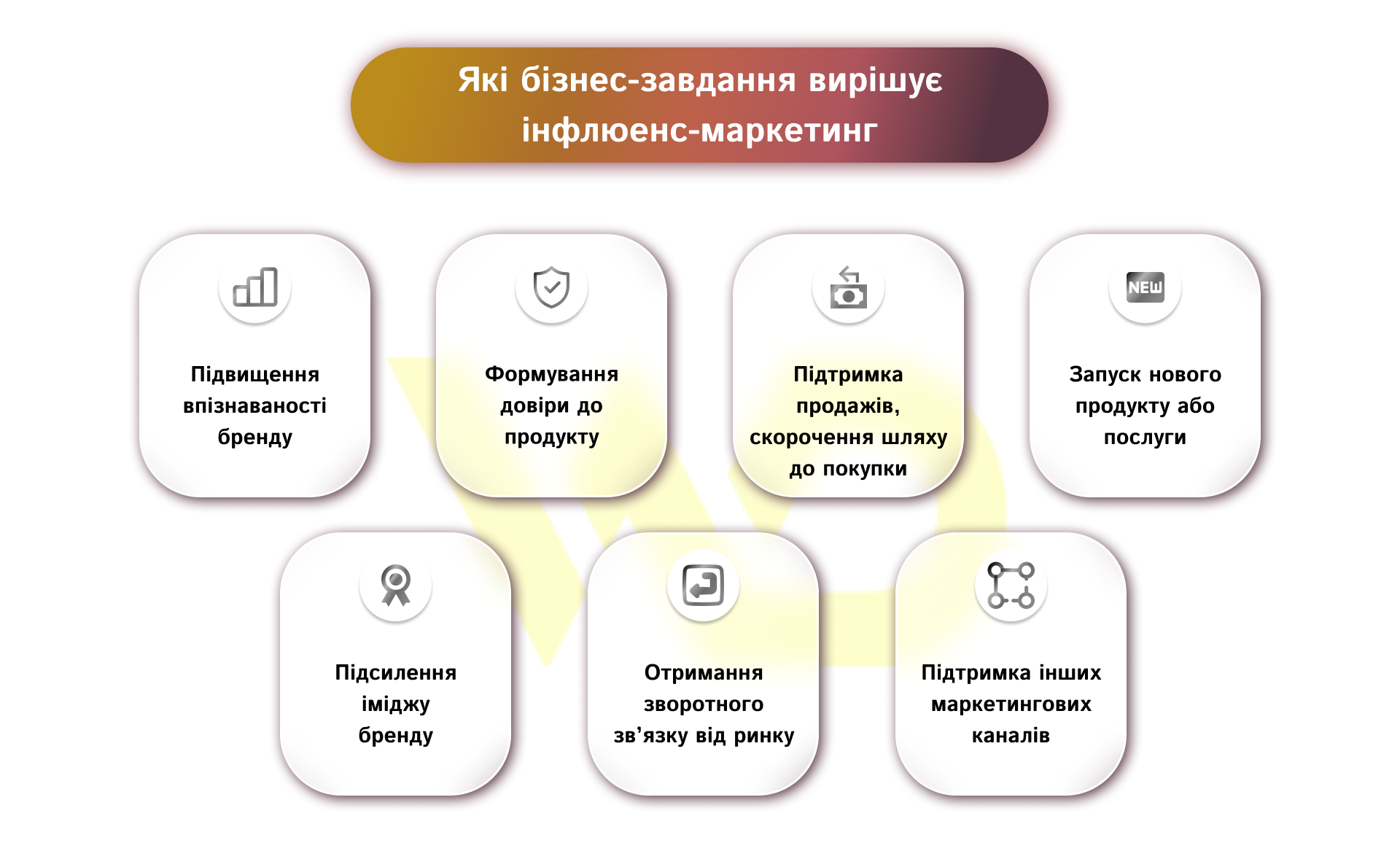
- Increasing brand awareness.
This is one of the core objectives most commonly set for an influencer campaign. When a trusted author in a specific niche talk about the brand, the information reaches the target audience more quickly. As a result, the company doesn’t just gain reach; it enters an already established information space where it begins to be recognized by its name, product, presentation style, or visual cues.
- Building trust in the product.
For many businesses, this is even more important than an immediate reaction in the form of clicks or inquiries. People are less likely to trust direct advertising messages but are more willing to listen to recommendations from someone they already read or watch. This is where the influencer acts not as an «advertising platform» but as a mediator between the brand and the audience, helping to alleviate some of the mistrust and present the product in a more natural context.
- Sales support and shortening the path to purchase.
Influencer marketing can work at both the top and bottom of the funnel. If the audience is already ready to buy, effective integration helps them take action faster. For example, visiting the website, opening a product page, using a promo code, or placing an order. In such cases, it’s important not just to showcase the product, but to give the person a clear reason to act right here and now.
- Launching a new product or service.
For new products or services, influencers often serve as the first way to introduce them to the audience. They help explain exactly what the brand offers, who needs it, and why the product is worth attention. This works especially well when a product or service has new functionality, an unusual presentation, or requires a brief explanation before purchase.
- Strengthening the brand image.
If an influencer aligns with the company’s values, this creates an association with quality, modernity, expertise, or customer care. That is why it is important for premium, niche, or reputation-sensitive brands to choose not just a popular creator, but one whose image naturally supports the desired positioning.
- Gathering market feedback.
In addition to its advertising effect, an influencer campaign provides valuable information about audience reaction. Comments, questions, saves, clicks, and discussions in direct messages or on other platforms reveal exactly how people perceive the product what sparks interest and what needs refinement. This can be a useful source of insights even before scaling the campaign or launching a new direction.
- Support for other marketing channels.
Influencer marketing rarely works in isolation. It often reinforces targeted advertising, SMM, PR, email campaigns, or content marketing. For example, a mention by an influencer can increase the effectiveness of subsequent brand interactions through advertising, and content created by a blogger can be used in future communications. In this case, influencer marketing becomes not a standalone campaign but part of a broader promotional strategy.
Once the objective is defined, it’s important not to try to cover everything with a single campaign. Each goal requires its own format, its own influencer, and its own method of evaluating results. The best results usually come not from the blogger’s most high-profile post, but from a precise alignment between the brand’s objective, the content’s theme, and the audience’s expectations.
When influencer marketing works best
Influencer marketing is not a one-size-fits-all solution, but in certain business scenarios, it delivers particularly significant results.
Mass market
For the mass market, this tool often serves as a way to quickly increase reach and make the brand familiar to a broad audience. Here, views, frequency of mentions, native presentation, and the ability to boost brand recognition across multiple touchpoints are key. Hootsuite shows that social commerce allows for direct purchases on social media, which shortens the path from first contact to action, particularly for broad, «fast-moving» product categories.
Niche products
For niche products, influencer marketing often yields even stronger results, as the audience here is typically more focused, attentive, and responsive to expert or experienced opinions. Sprout Social emphasizes that micro-influencers and niche communities form active audiences with genuine connections, and brands can use them to access niche segments, boost loyalty, and build authority. In such cases, it’s not just the creator’s popularity that matters, but precisely aligning with the community’s interests, where the product truly feels relevant.
Services and products with quick ordering
In this segment, influencer marketing works best when there are minimal steps between viewing the content and making a purchase. If the product is understandable at first glance and doesn’t require lengthy explanations, the user is more likely to make a decision immediately after seeing it. Therefore, offers that can be clearly demonstrated and immediately backed up with the ability to quickly proceed to checkout are the most effective.
Products with a long decision-making cycle
For products with a longer decision-making cycle, this tool serves as a way to gradually reduce mistrust and enhance the sense of security before purchase. So, it turns out that the more complex, expensive, or less obvious the choice is for the customer, the more valuable the author’s expertise, the consistency of their content, and their ability to explain the product through real-world experience rather than just an advertising promise become.
Influencer marketing works best not where there are simply «a lot of followers», but where there is the right combination of audience, trust, and purchase scenario. That is why, before launching a campaign, it is worth checking whether the content format, product type, and potential customer behavior align.
Types of influencers and how to distinguish them
Influencers are typically divided into five groups based on audience size: nano, micro, mid, macro, and mega. The boundaries may vary slightly depending on the platform or methodology, but the logic is the same in all cases: the larger the audience, the higher the reach and at the same time, the more expensive the collaboration. Hootsuite provides the following guidelines:
- nano — 1,000–10,000 followers;
- micro — 10,000–50,000;
- mid — 50,000–500,000;
- macro — 500,000–1,000,000;
- mega — over 1,000,000.
However, a larger audience doesn’t always mean better results, and nano- and micro-influencers often deliver higher engagement and better campaign ROI.
Nano-influencers
These are creators with a small but typically very active audience. Their strength lies in close contact with followers, high trust, and the feeling of a «genuine» recommendation. For a brand, this is often a good option when what’s needed isn’t mass visibility, but rather natural integration into a niche environment. Nano- and micro-influencers are particularly effective during the consideration and decision-making stages of the purchase process, when trust has the greatest influence on the purchase decision.
Micro-influencers
These are typically creators with a more visible but still sufficiently «engaged» audience. This category is often the most practical for businesses seeking to balance a reasonable budget with strong engagement. Micro-influencers are often more effective than larger creators in campaigns where relevance, trust, and conversions matter more than just broad reach. For a brand, this strikes a good balance between scale and precision in reaching the target audience.
Mid-tier influencers
This is an intermediate category between niche creators and major media personalities. They can already provide significant reach, but they haven’t necessarily lost their sense of connection with the audience. This format is appropriate when a company needs to simultaneously boost brand awareness without sacrificing the quality of engagement. Mid-tier influencers are often chosen by brands that want to test a campaign with a larger reach but don’t have a budget on par with macro- or mega-influencers.
Macro-influencers
These are major creators with a massive audience and strong reach potential. Sprout Social notes that macro- and mega-influencers are better suited for raising awareness and driving demand that is, for tasks where it’s crucial to quickly draw attention to a brand or product. For businesses, this is relevant during major launches, broad brand awareness campaigns, or when entering a new market. At the same time, it’s especially important not to confuse scale with precision: a large audience doesn’t guarantee that your message will reach exactly the people who need your product.
Mega-influencers
This is the largest segment, comprising highly famous bloggers, public figures, or media personalities. Their main advantage is maximum reach and a strong brand presence in the information space. In this category, the cost of collaboration is the highest, and the result is often tied to visibility rather than direct conversion. This is useful for businesses when they need to quickly create a broad informational impact, but for direct sales, this format isn’t always the most effective.
When a business chooses an influencer, focusing solely on the number of followers is a mistake. Let’s take a closer look at what really matters.
How to Choose an Influencer for Your Brand
Choosing an influencer is about ensuring a precise alignment between the brand, the audience, and the content format. That’s why, before starting a collaboration, it’s important to assess how the creator actually interacts with their community, how organic their content sounds, and whether it aligns with the campaign’s objectives. Let’s break down what’s important to check before beginning a collaboration.
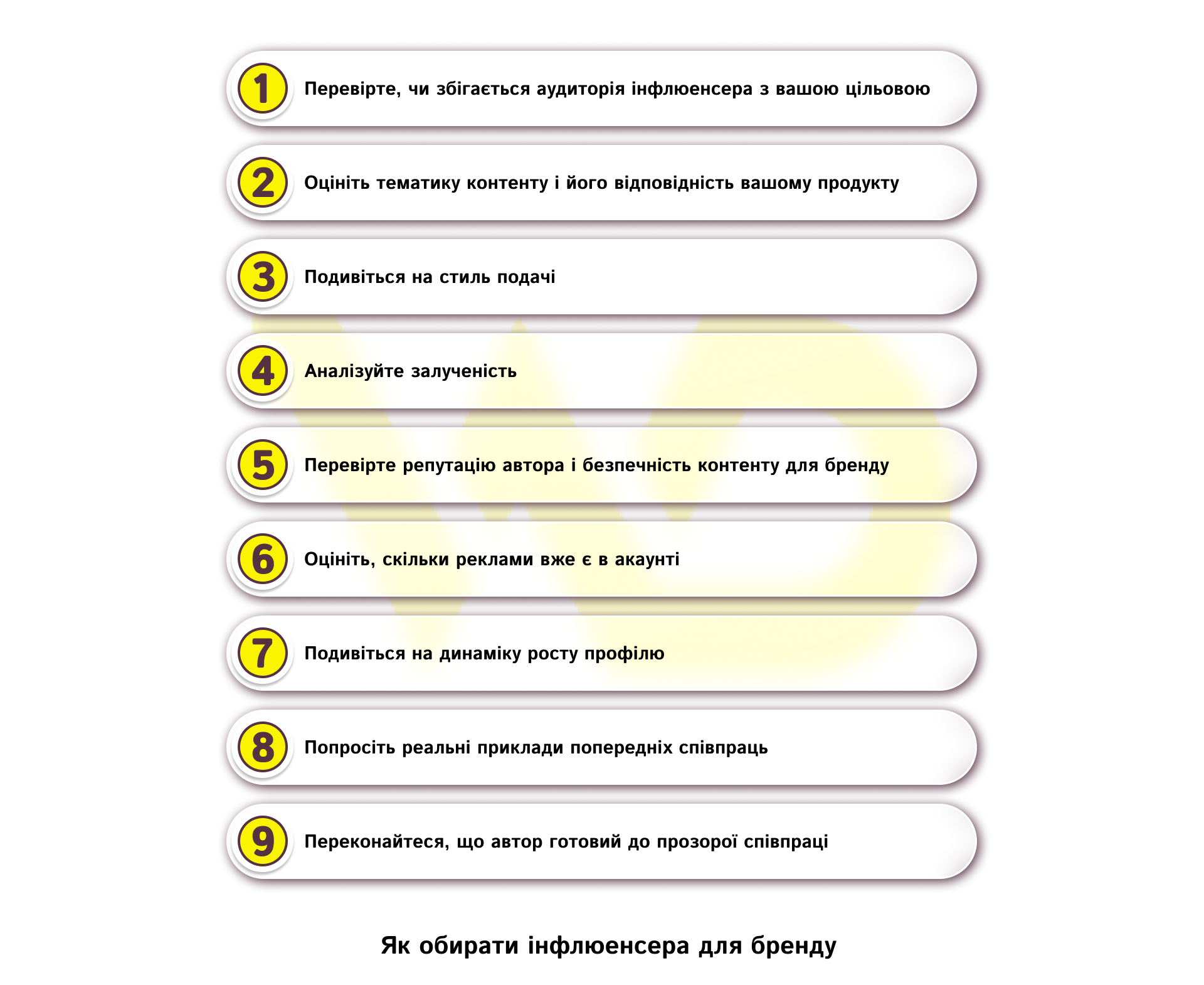
- Check whether the influencer’s audience matches your target audience.
First and foremost, it’s important to understand exactly who views or reads the creator’s content: age, location, interests, purchasing power, and professional background. If the influencer’s audience doesn’t match your customer profile, even high-quality content won’t deliver the expected results. Start by defining your own target audience, and then look for an influencer whose community matches it. Relevance comes first, then scale.
- Evaluate the content’s subject matter and how well it aligns with your product.
The influencer should speak to their audience in a context where your product sounds natural. If the person regularly creates content on related or completely different topics, the integration will look forced and be less effective. It is recommended to look for creators whose topics logically overlap with your brand, as this increases the chances of the recommendation being received organically. This is especially important in niches where trust is built slowly through repeated exposure, rather than a single mention.
- Pay attention to the presentation style.
The same product can look completely different depending on the creator: it can come across as helpful advice, part of everyday life, or outright advertising. It is the style of presentation that determines whether the brand will blend naturally into the content. Effective campaigns are built with creators who share the brand’s values and know how to speak the language of their audience. For a company, this means looking not only at videos or photos, but also at the tone, rhythm, structure of the presentation, and how the creator explains complex ideas in simple terms.
- Analyze engagement.
A high number of followers doesn’t guarantee real influence. It’s much more important to see if the creator has a lively audience reaction: comments, saves, replies, clicks, and direct messages. Hootsuite and Sprout Social emphasize that micro- and nano-influencers often deliver better engagement than large accounts, precisely because they have a closer connection with their community. For a brand, this is a sign that if the audience is passive, the campaign will likely have a weaker impact, even if the profile itself looks «big».
- Check the creator’s reputation and the safety of their content for the brand.
An influencer automatically projects part of their image onto the brand. If their content includes controversial topics, aggressive messaging, toxic discussions, or questionable associations, this can also affect your reputation. That’s why it’s important to review both their latest posts and their overall history of online activity. In terms of compliance, it’s also important that the collaboration with the brand is clearly labeled.
- Assess how much advertising is already present on the account.
If the author’s feed or Stories are oversaturated with advertising integrations, audience trust may decline. In that case, your campaign risks getting lost among other paid mentions. It’s worth focusing on the authenticity and long-term value of the collaboration, rather than a one-off post. In other words, it’s better to choose a creator whose promotional content appears in moderation and doesn’t detract from the organic feel of their content.
- Look at the profile’s growth dynamics.
A sharp or unnaturally rapid increase in followers doesn’t always indicate genuine influence. That’s why it’s important to assess how the account has developed over time, whether there’s stability in engagement, and whether the audience looks artificial. Profile growth is one way to understand how naturally the creator is building and retaining their community. For a brand, this is a useful filter that helps weed out accounts with a pretty facade but a low-quality audience.
- Ask for real examples of previous collaborations.
Case studies demonstrate the creator’s experience and ability to handle commercial projects. It’s worth examining how the influencer has presented the brand in the past, whether they maintained consistency in style, if the call to action was clear, and how the audience responded. For businesses, this allows you to assess the practical potential of the collaboration rather than a hypothetical one. If the creator has already worked with brands in a similar category, that’s a plus, but it’s important that past integrations don’t look formulaic and don’t contradict your positioning.
- Make sure the creator is ready for transparent collaboration.
A good collaboration with an influencer isn’t just about creativity, but also about following the rules. Even at the selection stage, you should understand whether the influencer is ready to work under clear agreements, label ads correctly, and adhere to the brand’s terms. For a company, this isn’t a formality, but part of protecting its reputation and the audience’s trust.
After the initial selection, it’s best not to rush into a full launch but to test the collaboration on a small scale. This approach allows you to assess the audience’s reaction, the quality of the content, and the creator’s actual ability to deliver business results without unnecessary risks.
How to build a partnership: from goal to format
Once the brand has selected a creator, the most important thing is not to rush the publication but to structure the collaboration itself as a clear process. The sequence of steps should be as follows:
- Define one main goal for the campaign. Don’t try to achieve brand awareness, leads, sales, and follower growth all at once. For each campaign, it’s better to choose one main outcome and build the collaboration around that.
- Prepare a brief with full context that includes not only the integration topic but also a brief product description, the desired focus, sample phrasing, deadlines, technical requirements, and expectations for the final result. This reduces the risk that the creator will present the product in a way that doesn’t align with the brand’s needs or will waste time on revisions.
- Agree on a presentation style that fits the author’s style. At this stage, it’s important to find a format where the message remains clear and natural. In other words, the company’s task is to provide clear meaning and boundaries, not to take away the author’s unique communication style.
- Establish deadlines, rights to the materials, and labeling rules. The collaboration should be not only creative but also legally and organizationally transparent. Even before the campaign begins, you should agree on exactly how the advertisement will be labeled, who can use the created content and for how long, and in what form it will appear on the author’s page.
- Set up a way to track results. Without measurement, a campaign quickly turns into a pretty but uninformative activity. For clicks from posts, Google Analytics recommends using UTM parameters in links to see which specific campaign drove traffic to the reports. Additionally, you can set up custom events or reports in GA to understand what users do after clicking through.
Once all the details have been agreed upon, it is essential to establish specific working principles for the team. This is particularly important when collaborating with an influencer, as clarity from the start saves both budget and time while mitigating reputational risks.
Influencer marketing formats that actually work
The choice of format depends on how a person consumes content and what they need to see to take the next step. Let’s look at the formats that work.
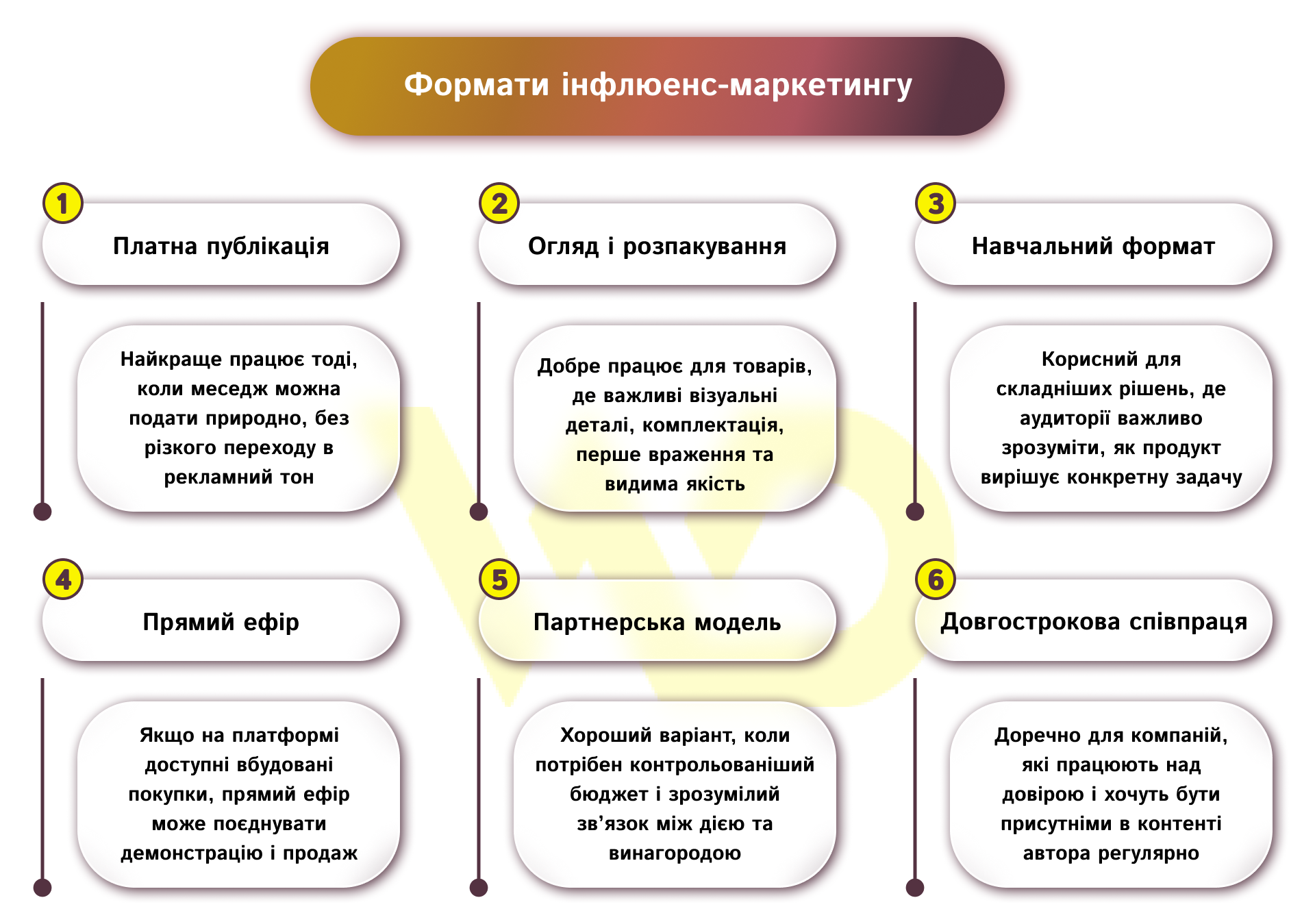
The right format always depends on what exactly needs to be explained to the audience: a brief idea, a complex product, a visual advantage, or a practical benefit. Therefore, it’s better to choose not the most popular, but the most appropriate scenario it’s the one that delivers a clearer and more predictable result.
What businesses should consider before launching
In practice, decisions should be based on the objective, not the format. If you need to test hypotheses, gauge audience reaction, or try out several approaches without significant costs, it makes more sense to start with micro-influencers, as they offer more predictable engagement and allow you to see real feedback faster. If, on the other hand, a brand has already found a working format and wants to solidify brand recognition and trust, it makes sense to move toward a longer-term collaboration with selected creators this is what creates a stable effect, rather than one-off spikes in attention.
At the same time, influencer marketing rarely delivers maximum results on its own. It works best as part of an overall promotion strategy. It enhances advertising, supports content marketing, and helps convert an already engaged audience more effectively. It is this comprehensive approach that allows you to turn individual integrations into a stable channel for influencing business results.

commercial offer
Other articles by the author

16/04/2026
This is particularly important in business content, as the text must not only be grammatically correct but also serve a specific purpose.

29/05/2026
A virtual SMS number is ideal for businesses that handle a high volume of inquiries, operate across multiple markets, and require in-depth analytics and reporting.
02/03/2026
A community manager is responsible for building, developing, and maintaining a community around a brand, product, or project.
Latest articles by #Useful tips

24/09/2026
While feeds were previously viewed as a purely technical feature for running contextual ads in Google Ads, today their quality directly determines the share of impressions across all sales channels.
23/09/2026
Access to technology is no longer a competitive advantage what matters is a team of experts’ ability to integrate these solutions into real-world business processes.
16/09/2026
Choosing between search engine optimization and pay-per-click advertising is one of the most critical decisions when developing a marketing strategy.