

 17/08/2026
  1101
1101

Інтернет-маркетинг
простою мовою
Content of the article
DMCA copyright infringement: consequences for website ranking

In the digital business world, unique content is one of the most valuable assets, directly generating organic traffic and revenue. Mass copying of text, photos, or videos not only reduces a website’s uniqueness but also creates legal and SEO-related risks.
In this article, we’ll examine how the DMCA works, its impact on a website’s Google rankings, the threats of unfair competition, and practical guidelines for protecting business content.
What is the DMCA and its role in Google
The Digital Millennium Copyright Act (DMCA) is a U.S. copyright law for the digital age, enacted to protect intellectual property on the internet. Since Google headquarters are located in California, the search engine is required to comply with the provisions of this law regarding all websites, regardless of their country of registration or domain zone.
The main feature of the DMCA mechanism is the ability to quickly remove infringing content from search results without lengthy legal proceedings. To do this, the rights holder simply needs to submit a valid complaint regarding the infringement.
To illustrate, let’s consider a situation that could happen to anyone. For example, a Ukrainian online store created original infographics and product descriptions. If a third-party website completely copies these materials, the owner of the original content can file a complaint via a special Google form, requesting that the plagiarizing pages be removed from the search index.
Thanks to this system, rights holders gain an effective means of exerting pressure on infringers. At the same time, understanding the principles of the DMCA is critically important for every website owner, since even unintentional use of third-party materials can lead to penalties.
The impact of DMCA complaints on search rankings
The consequences of receiving a DMCA complaint depend on the frequency and scale of the violations. Google distinguishes between isolated incidents and systematic copyright infringement. Isolated complaints result only in the removal of a specific URL from search results.
At the same time, a steady stream of valid complaints triggers a special algorithm the Google Pirate Update. It automatically demotes the entire domain in search results if it receives a critical number of confirmed complaints. As a result, the site loses its organic rankings for most keyword queries.
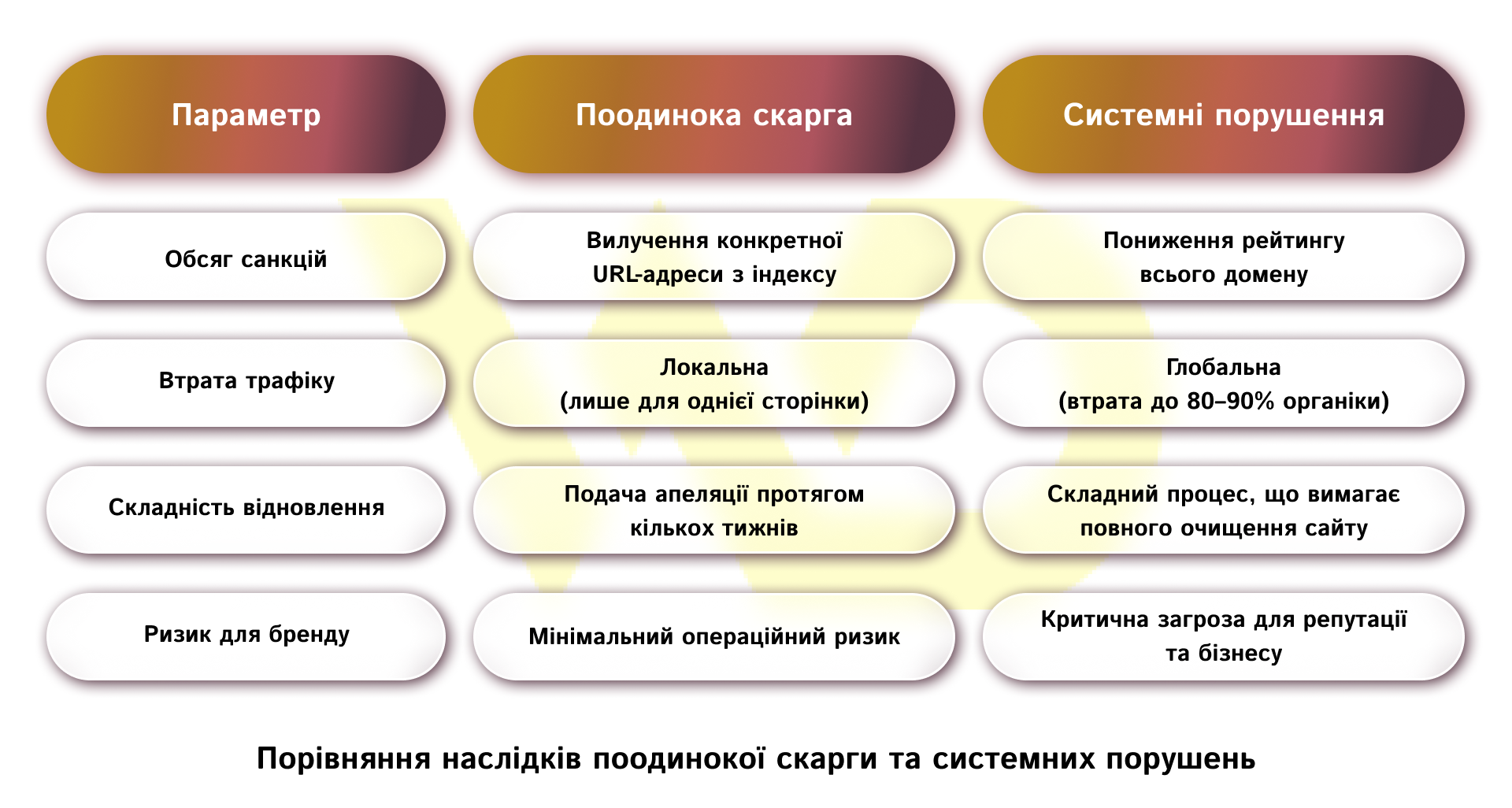
Thus, ignoring copyright issues turns SEO into a high-risk investment, since a single large wave of complaints can undo years of work on search engine optimization.
Protection against unfair competition
DMCA tools are sometimes used as part of «black hat» SEO. Unscrupulous competitors submit fake copyright infringement complaints to temporarily knock rival landing pages or product listings out of the top 10. While Google reviews the complaint, the victim’s site loses targeted traffic and customers.
If you receive a page removal notice in Google Search Console, you must act immediately. Here’s a step-by-step guide to protecting your rights:
- verify the validity of the complaint and document the dates of the original source;
- Gather evidence of authorship (source files, timestamps, contracts with contractors);
- prepare and submit a counter-notice via the Google form;
- monitor the status of your request in Google Search Console and the Lumen database.
Let’s look at this process using a hypothetical example. A competitor has filed a complaint against your most profitable services page, claiming that the text belongs to them. By providing Google with evidence that the material was published on your site before the competitor’s for example, data from a web archive or a contract with a copywriter you initiate the URL restoration process.
Filing knowingly false DMCA complaints entails legal liability under U.S. law.
A clear understanding of the procedure for filing counterclaims allows businesses to minimize forced downtime and quickly restore removed pages to search results.
Preventive protection and monitoring
Instead of dealing with the consequences of content theft, it is more beneficial for businesses to establish a preventive protection system in advance. All unique elements of a website require protection: text descriptions, original photographs, graphic materials, video content, and source code.
To monitor security and safeguard intellectual assets, it’s worth using specialized tools:
- protection badges (e.g., DMCA Protected): placing special badges on the website signals that rights are protected and deters potential plagiarists;
- the Lumen database: a public registry where you can check for the existence and content of complaints filed against your website or those of your competitors;
- Google Search Console: the primary channel for notifications from Google regarding detected copyright issues;
- Uniqueness-checking services: tools for regularly monitoring the web for unauthorized copying of your content.
For example, a software development company has integrated the «DMCA Protected» badge into its blog pages and conducts a monthly audit of content uniqueness. Upon discovering that one of its analytical articles has been republished on a third-party site, the marketing team immediately sends a takedown request, preventing any loss of content uniqueness.
Systematic monitoring allows you to detect instances of plagiarism at an early stage, which preserves the site’s SEO potential and prevents your brand from being diluted in search results.
How to build a secure content strategy for your business
Managing intellectual property requires management to adopt a systematic approach, where legal risks are mitigated as early as the publication planning stage. Completely refraining from using third-party materials without the appropriate license is a basic standard for the stable operation of a website. Purchasing stock photos, commissioning original content, and developing your own designs are significantly cheaper than restoring a website after Google penalties or facing lawsuits from rights holders.
Legal safety and myths about fair use
In the commercial sector, Google search engine makes virtually no exceptions for for-profit websites, so the popular notion of «fair use» often turns out to be an illusion. Even including an active hyperlink to the author or citing the original source does not exempt a website from liability for using someone else’s content without an official license.
The transfer of rights must be documented at every stage of content creation. Working with freelancers or outsourcing agencies without a clear contract creates a hidden risk, since legally, the contractor remains the rights holder. That is why contracts must include strict guarantees of originality and clauses regarding the full transfer of property rights to your company.
UGC monitoring and internal policies
If the platform features user-generated content (UGC) such as reviews with photos, comments, or forum posts the company must implement pre-moderation and clear DMCA Policy guidelines. This helps avoid liability for infringements committed by third parties and enables a prompt response to valid complaints.
To effectively organize processes and minimize operational risks for the business, the following rules should be implemented:
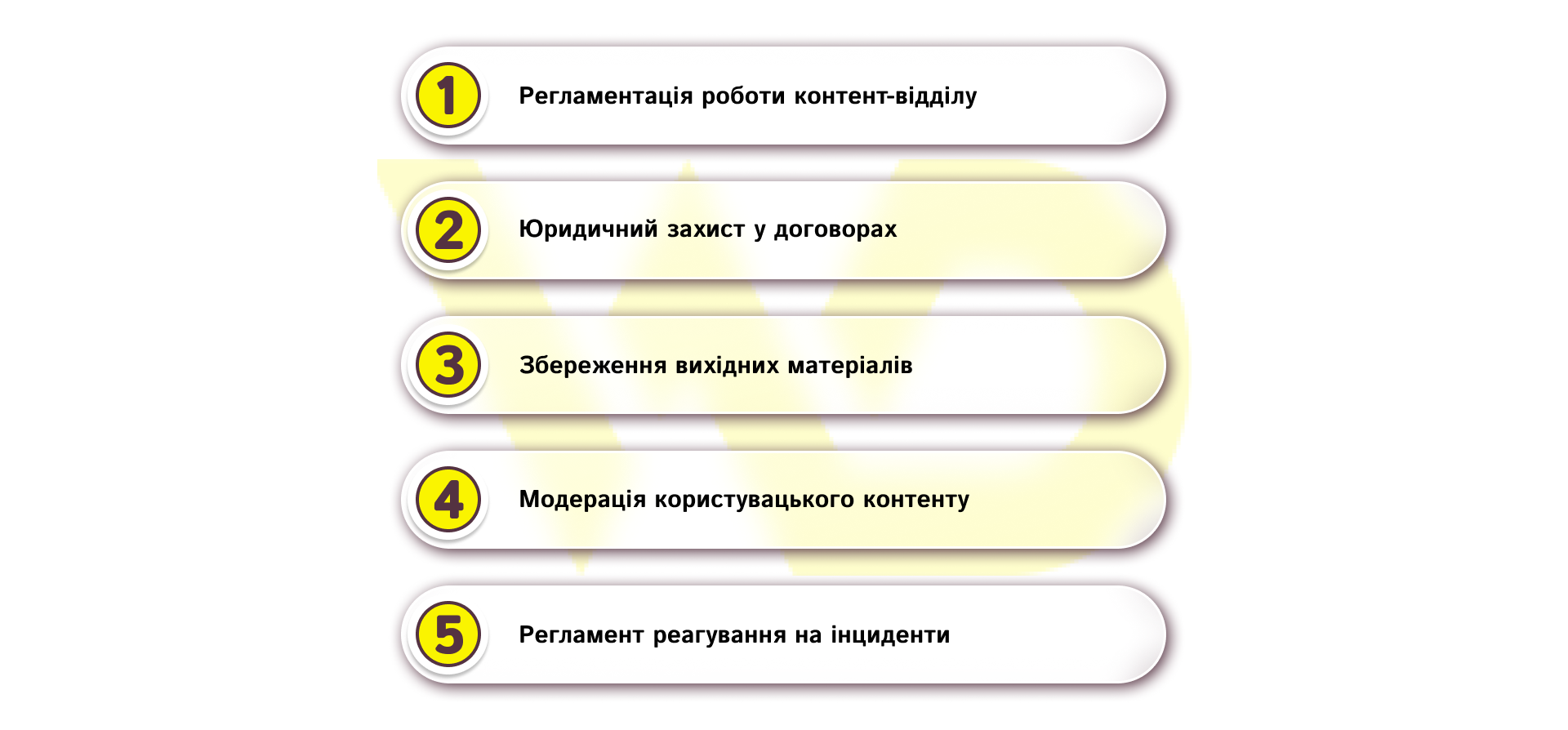
- Regulation of the content department’s operations. Approval of clear instructions for verifying license types for example, distinguishing between Creative Commons and commercial licenses prior to publishing media files.
- Legal protection in contracts. Mandatory inclusion of clauses regarding the transfer of intellectual property rights and the contractor’s financial liability in the event of providing material that is demonstrably plagiarized.
- Preservation of source materials. Creation of a corporate archive of evidence. This may include RAW photo files, text drafts with edit dates, design mockups, and receipts for license purchases.
- Moderation of user-generated content. Setting up a review process for client-submitted materials and posting a public form on the website for quick contact with the company’s DMCA agent.
- Incident response protocol. Designate responsible parties such as an SEO specialist, a lawyer, and a content director and establish deadlines for verifying the validity of complaints.
Implementing these procedures creates a reliable protective barrier that significantly reduces the likelihood of legal disputes and forced downtime for the website.
Building a transparent intellectual property management system is a fundamental component of overall cybersecurity and the resilience of a digital business. A comprehensive approach that combines legal protections in contracts, strict content creation guidelines, and regular process monitoring allows for the complete neutralization of potential threats. By investing in unique content and complying with digital law regulations, a company ensures a stable position in Google search results, protection against aggressive attacks by competitors, and the maintenance of a high level of trust from its target audience and partners.

commercial offer
Other articles by the author

24/03/2026
Today, artificial intelligence enables businesses to generate visuals quickly, scale creative options, and accelerate the iteration process.

29/06/2026
If you analyze search queries correctly, you can better understand your audience, design a more precise website structure, create relevant content, and improve your SEO results without unnecessary expenses.
15/07/2026
The Net Promoter Score (NPS) is a customer loyalty index that measures how likely people are to recommend a company, product, or service to their friends and family.
Latest articles by #Useful tips

29/09/2026
A content pipeline transforms the creation of content from a spontaneous creative process into a managed production system. In such a system, AI serves as a powerful assistant.
10/09/2026
The 4P model serves as an architectural foundation that transforms disparate marketing activities into a single, manageable system.

08/09/2026
Today, an influencer is a distinct media platform with its own editorial policy, a keen understanding of its audience, and an established level of trust.