

 24/06/2026
  1505
1505

Інтернет-маркетинг
простою мовою
Content of the article
- /01 What is IT outsourcing
- /02 What tasks are most often outsourced
- /03 Benefits of IT outsourcing for businesses
- /04 Disadvantages and risks of IT outsourcing
- /05 When IT outsourcing is truly appropriate
- /06 When it’s better to keep tasks in-house
- /07 How to choose an IT contractor
- /08 A real-world example

The pros and cons of IT outsourcing: when to outsource tasks to an external team

Today, for businesses, IT outsourcing is not just a way to save on staffing costs, but a tool that helps launch projects faster and manage resources flexibly. That’s why this topic is relevant for any business that depends on a stable digital infrastructure and the ability to respond quickly to market changes.
In this article, we’ll explore what IT outsourcing is, which tasks are most commonly outsourced to an external team, what its strengths and weaknesses are, how to assess a business’s readiness for outsourcing, and what to look for when choosing a contractor.
What is IT outsourcing
IT outsourcing is the transfer of certain IT functions to an external team or company that undertakes to perform a specified scope of work under the terms of a contract. This involves not just individual technical tasks, but an entire process or area of responsibility for which the contractor is accountable.
To avoid confusion between different models of collaboration, it’s important to distinguish between outsourcing, outstaffing, and freelancing.
- Outsourcing means that a business transfers a specific function or process to an external contractor, who then organizes the work and is responsible for the quality of the results.
- Outstaffing is a different model: a specialist formally works through an external company but is effectively integrated into the client’s internal team and performs tasks under the client’s direct supervision.
- Freelancing typically involves one-time or short-term tasks that do not require complex process organization or long-term support.
For businesses, this distinction has practical implications. It determines the level of control, the speed of communication, the degree of involvement of the internal team, and the method of evaluating results. If you need to delegate an entire area of work with a clear end result, outsourcing is more appropriate. If, on the other hand, you need a specific specialist to join your team for a certain period, outstaffing is more commonly chosen. And when it comes to a small task without long-term commitments, freelancing is the right choice.
This approach helps businesses reduce the workload on their staff and build a more precise model for working with technology. That’s why IT outsourcing is often viewed not as a temporary solution, but as a tool for flexible resource management one that works particularly well where speed, predictability, and access to specialized expertise are required.
What tasks are most often outsourced
Most often, companies outsource tasks to a third-party IT team that are important for business operations but do not directly contribute to the company’s strategic advantage. These are functions that can be clearly defined, standardized, and evaluated based on results.
Such tasks typically include:
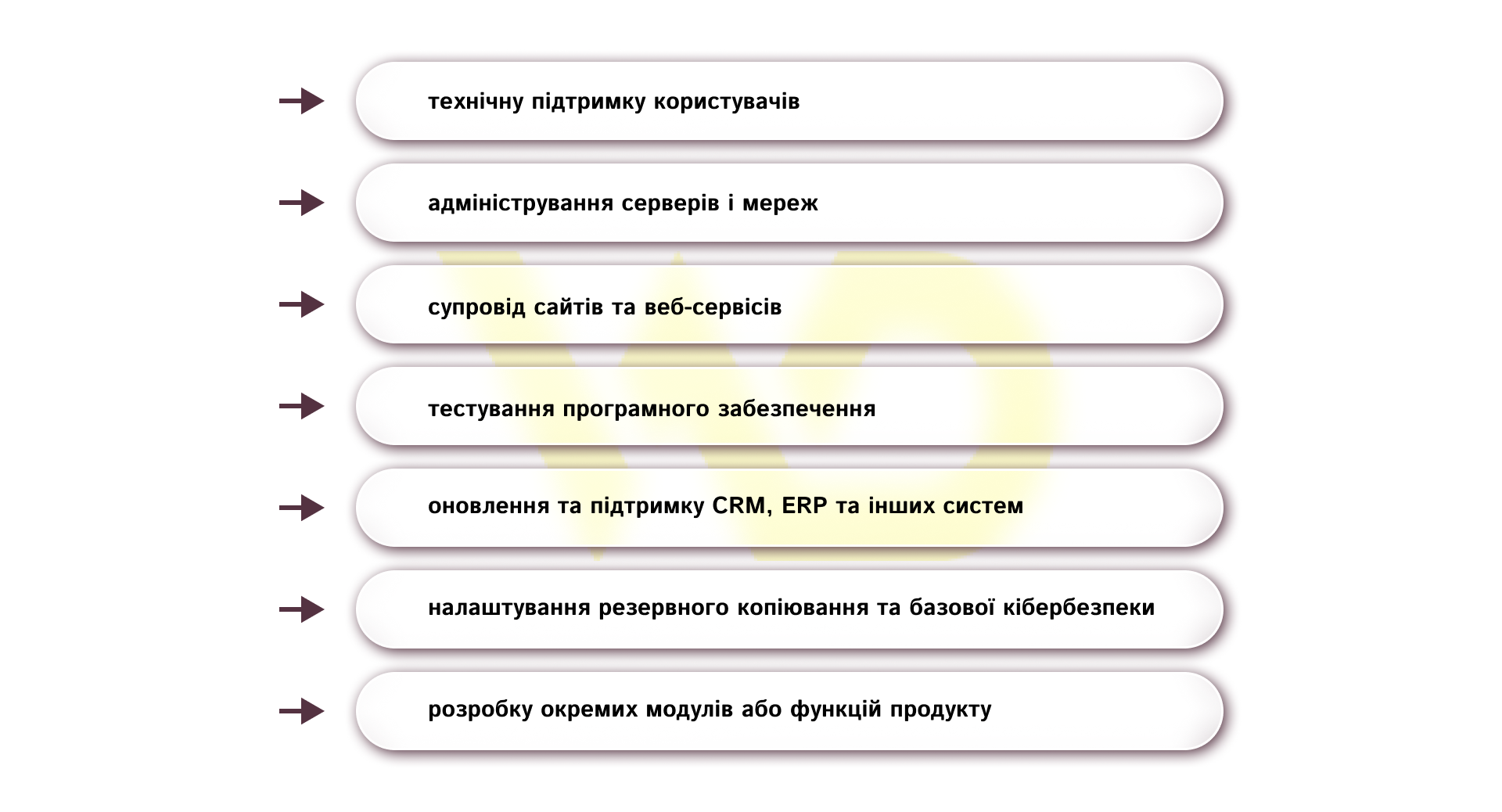
These are areas where stability and quality are important to the business, but where it is not necessary to maintain a full-fledged in-house department.
That’s why outsourcing is often chosen by companies that need not just one-time assistance, but regular technical support without unnecessarily expanding their internal structure.
Benefits of IT outsourcing for businesses
For businesses, IT outsourcing means less operational burden on the internal team and more opportunities to focus on priority tasks. Most often, these advantages are the deciding factors when choosing a collaboration model. But let’s take a closer look at all the benefits of this type of collaboration:
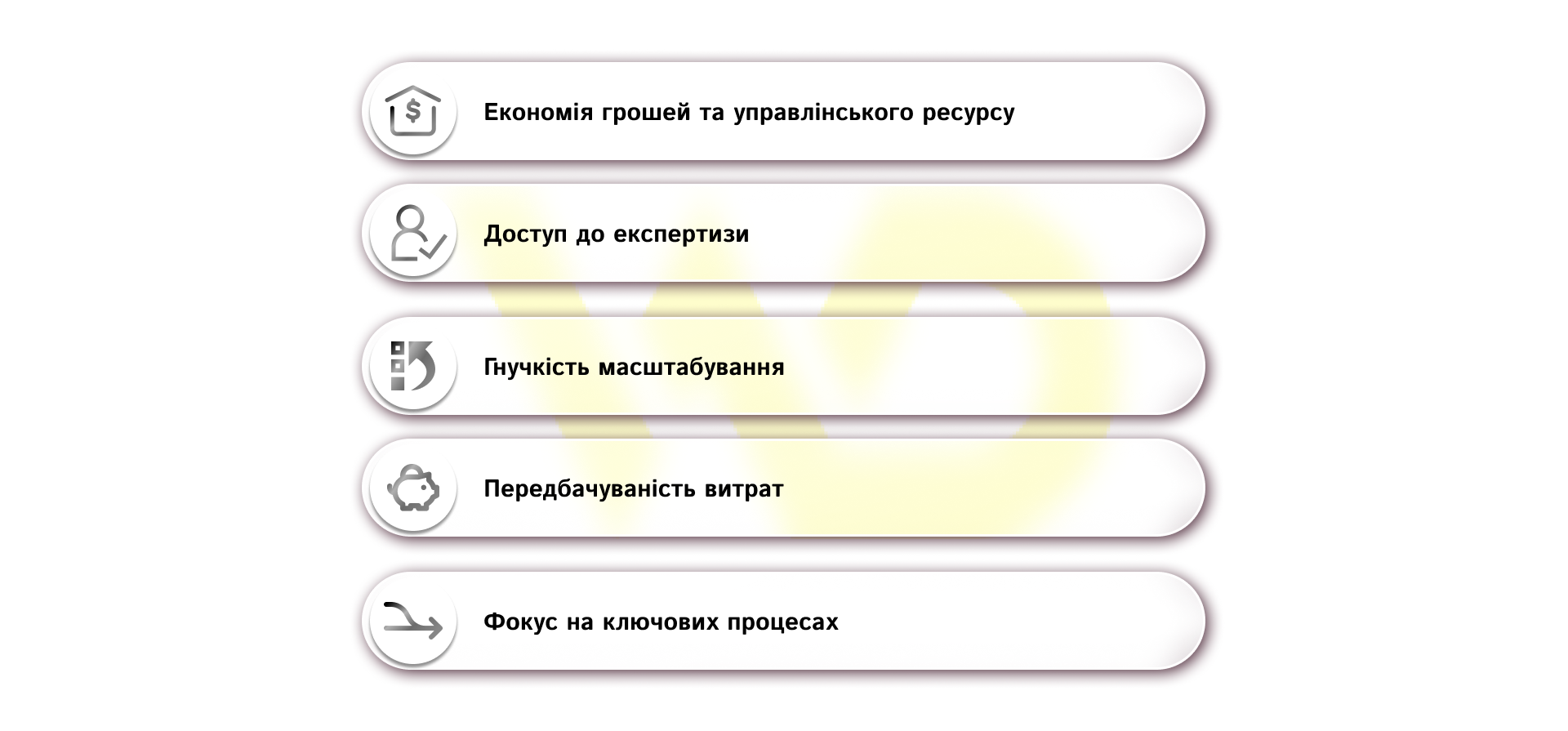
Savings on money and management resources
One of the main reasons companies turn to outsourcing is the ability to relieve some of the operational burden on their in-house team, as we mentioned earlier. Searching for, hiring, onboarding, and managing specialized IT professionals requires time, attention, and additional expenses. An external team allows you to shorten this process and move more quickly to task execution.
Access to expertise
Outsourcing makes it possible to bring in specialists who are difficult or expensive to keep on staff permanently. This is especially important when a business needs specialized expertise for a specific task: cybersecurity, DevOps, testing, support for complex infrastructure, or the development of a specialized solution.
Scalability
For businesses with fluctuating workloads, outsourcing is often more practical than maintaining an in-house team. When the volume of work increases, an external team can be scaled up more quickly, and when demand decreases, the collaboration can be scaled back without complex HR decisions. This is convenient for project-based companies, startups, and rapidly growing businesses.
Cost predictability
In most cases, outsourcing provides a clear cost model: there is an agreed-upon scope of work, deadlines, support terms, and payment structure. This helps with budget planning and avoids situations where an in-house team needs to hire additional staff, provide training, or replace employees at a critical moment.
Focus on key processes
When a contractor takes on the technical routine, the in-house team can focus on product development, sales, marketing, customer service, and other areas that truly impact business results. For many companies, this is the decisive factor in favor of outsourcing.
Therefore, the benefits of IT outsourcing are best realized when a business outsources not its strategic core, but well-defined and managed processes.
Disadvantages and risks of IT outsourcing
Despite its obvious advantages, outsourcing also has its weaknesses. These should not be ignored, as this is precisely where problems most often arise. Let’s take a look at them:
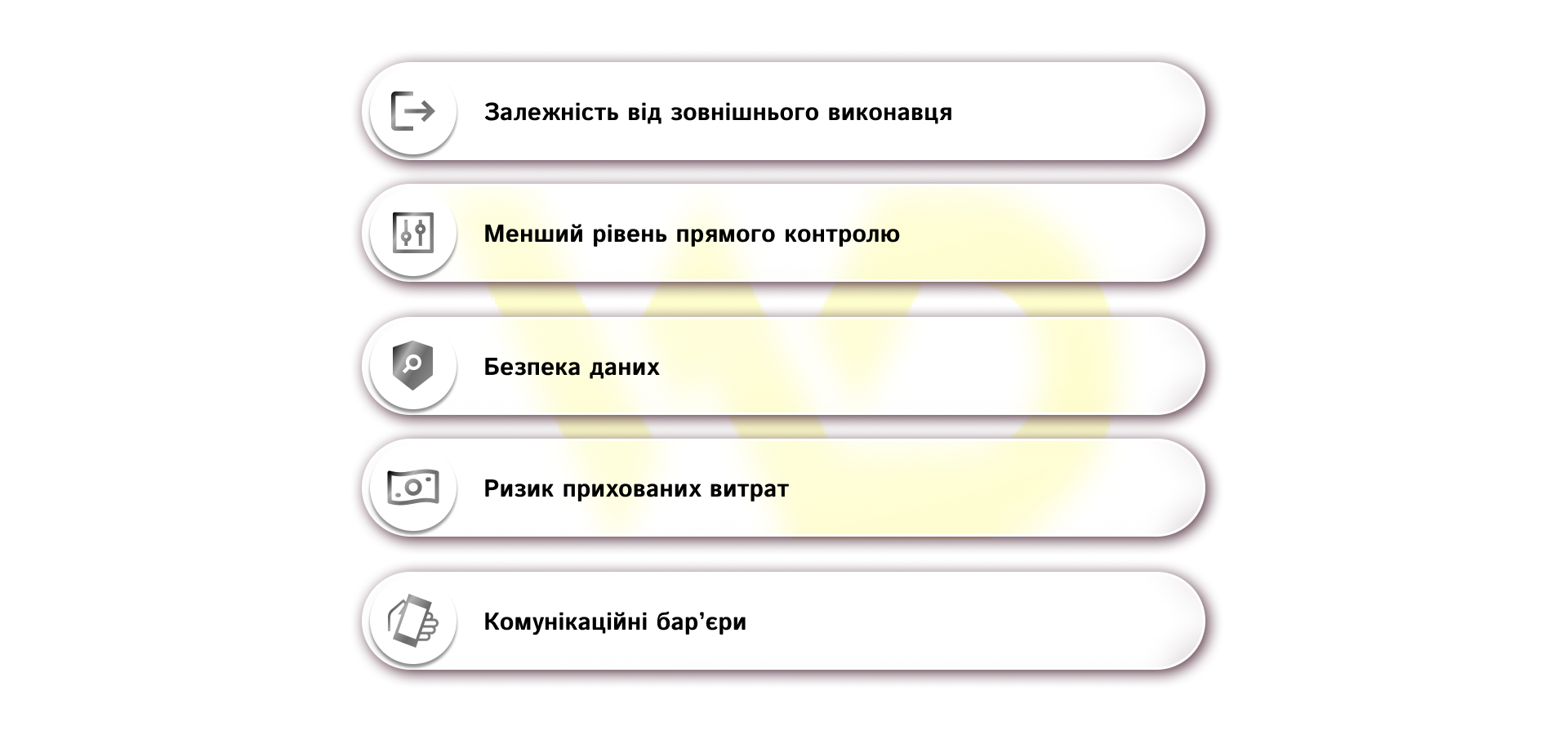
Dependence on an external contractor
If part of the processes is outsourced, the company becomes more dependent on the quality of the contractor’s work. In the event of poor communication, missed deadlines, or changes in the contractor’s team, this can affect the stability of business processes.
Less direct control
It’s easier to integrate an in-house team into a company’s day-to-day management processes. An external team operates differently: it focuses on the contract, the scope of work, and agreed-upon metrics. If expectations aren’t clearly defined, the risk of misunderstandings increases.
Data security
Granting access to systems, databases, and internal processes always creates additional requirements for information security. This does not mean that outsourcing is inherently dangerous, but companies need to pay very close attention to access policies, legal terms, and internal controls.
Risk of hidden costs
At first, outsourcing may seem cheaper than hiring in-house staff, but the overall cost-effectiveness depends on the quality of the task definition, the scope of support, and the frequency of changes. If the project is constantly being reworked, refined, or expanded, the final cost may increase.
Communication barriers
When the team is in a different time zone, follows its own processes, or lacks a full understanding of the business context, information exchange can slow down. In such cases, outsourcing requires at least as much — and sometimes even more — managerial discipline than an in-house team.
Despite all the risks, these drawbacks are not an argument against outsourcing as such — they merely show that the model requires clear rules, transparent communication, and the right choice of contractor.
When IT outsourcing is truly appropriate
Most often, this model is appropriate in several situations.
|
Indicator |
What this means in practice |
|
The task can be described in writing |
The contractor will understand the scope of work and the expected result |
|
There is a measurable result |
It is easier to monitor quality and deadlines |
|
The work does not require constant supervision |
There’s no point in maintaining a full-time staff |
|
Rare expertise is required |
An external team can fill the need faster |
|
Business changes quickly |
You can flexibly scale the scope of services |
In such conditions, outsourcing becomes not just a convenient solution, but a logical one. It allows you to avoid bloating your internal structure without sacrificing quality or speed.
When it’s better to keep tasks in-house
Not every IT function should be outsourced. There are tasks that directly impact the company’s strategic development, competitive advantage, or data security. These are precisely the areas that are best kept under internal control.
First and foremost, this applies to:
- product vision and architectural solutions;
- key data management;
- processes involving high levels of confidentiality;
- functions that require constant daily involvement;
- critical services where even a brief delay affects customers or revenue;
- tasks where the internal specifics of the business are too complex to be quickly transferred.
Outsourcing can help, but it shouldn’t take away a company’s control over what determines its future. In other words, if a task involves strategy, data, or high-level risks, it’s better to keep it within the team.
How to choose an IT contractor
Choosing an IT contractor is not just a matter of price or a list of technical services. It is far more important for a business to understand whether the team can operate in line with the company’s approach, maintain the pace, honor agreements, and avoid creating additional management risks. A reliable contractor should not just complete tasks but also be predictable in communication, quality, and accountability for results.
A reliable contractor for your business growth
The WEDEX team not only takes on tasks but also adopts a systematic approach to their implementation. Transparent processes, regular reporting, experienced specialists, and a focus on business goals help achieve predictable results.
Therefore, you should pay special attention to the following:
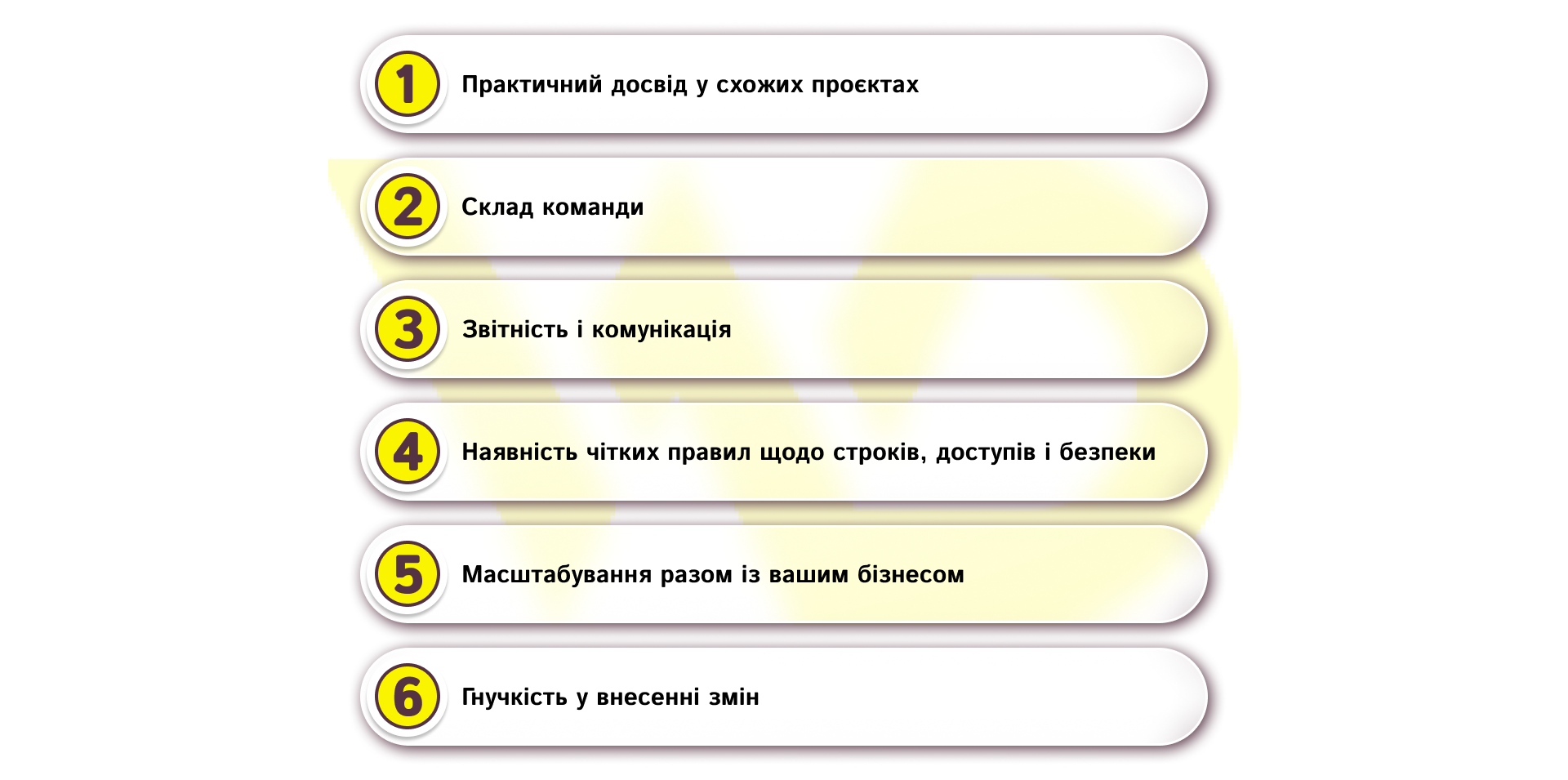
- Practical experience with similar projects.
A team that has already worked on tasks similar to yours has a better understanding of typical risks, pain points, and business expectations. This is especially important when it comes to complex digital products, infrastructure, systems with a large number of users, or projects where even a minor technical error can impact sales, service, or reputation.
- Team composition.
It’s important to understand exactly who will be involved in the work, what level of expertise the specialists have, how internal collaboration will be structured, and whether the team will change too frequently. This really matters for a business, as the stability of the contractor often affects the stability of the project itself. If a well-coordinated team is working on the task, it’s easier for the client to monitor the process and predict the outcome.
- Reporting and communication.
In a good collaboration model, the business shouldn’t just receive fragmented updates on the work completed; it should see a transparent process:
-
- what has already been done;
- what is in progress;
- where the risks lie;
- what the next steps will be.
This approach resolves many misunderstandings before they turn into problems.
- Clear rules regarding deadlines, access, and security.
If a contractor can’t immediately explain exactly how they protect data, who will have access to internal systems, and what the process for approving changes will be, that’s already a red flag warranting further scrutiny. In the IT sector, trust should be based not only on words but also on transparent processes.
- Can the team scale along with your business?
Sometimes a small group of specialists is enough at the start, but the scope of tasks grows over time. If the contractor can adapt to such changes without compromising quality, that’s a significant advantage. For the company, this means less risk of «outgrowing» the collaboration model and having to start from scratch.
- Flexibility in making changes.
In the real world of business, it’s rare for a task to remain unchanged from the very beginning. That’s why a contractor must be able to work both under an ideal scenario and in situations where priorities shift, new constraints arise, or resources need to be reallocated. This is precisely where it becomes clear whether a team is simply following instructions or truly understands the business context.
So, it turns out that a reliable IT contractor isn’t the one who promises the fastest and cheapest solution, but the one who demonstrates a mature approach to processes, manages risks transparently, and is capable of serving as a stable pillar for the business — not a source of additional burden.
A real-world example
Let’s imagine a company that is actively developing its own online service. Its in-house team works daily on the product, marketing, sales, and customer communication. Against this backdrop, technical support is beginning to take up more and more time, since it’s necessary to monitor server stability, update systems on time, check the functionality of individual modules, respond to minor glitches, and keep the website up and running. For a small or medium-sized team, this quickly becomes an additional burden that distracts from their core work.
In such a situation, a company can outsource technical support, infrastructure maintenance, some testing, and regular website maintenance to an external team. At the same time, in-house specialists do not lose control over the product; they simply free up time by offloading routine tasks. The external team takes on the consistent execution of the technical aspects, while the internal team focuses on what drives business growth: new features, customer experience, marketing campaigns, and growth strategy.
This approach is particularly useful when a company is scaling rapidly. For example, during the launch of a new business line or a period of seasonal growth, the company doesn’t need to urgently hire additional staff, spend time on onboarding, or take risks due to a lack of expertise at a critical moment. Instead, it can bolster the team with external specialists exactly as much as the situation requires.

commercial offer
Other articles by the author

15/07/2026
The Net Promoter Score (NPS) is a customer loyalty index that measures how likely people are to recommend a company, product, or service to their friends and family.

27/07/2026
The role of a brand manager is multifaceted and encompasses the entire product life cycle.

23/03/2026
GEO goal is to enable generative systems—such as chatbots, AI summarizers, or knowledge aggregators—to easily find, evaluate, and cite specific excerpts from your content.
Latest articles by #Useful tips

06/10/2026
From a business perspective, updating content is a sensible way to protect existing investments.

30/09/2026
Google's main focus in 2026 was the large-scale rollout and deep algorithmic integration of the AI Overviews (AIO) tool.

29/09/2026
A content pipeline transforms the creation of content from a spontaneous creative process into a managed production system. In such a system, AI serves as a powerful assistant.