

 14/08/2026
  1127
1127

Інтернет-маркетинг
простою мовою
Content of the article
- /01 Pinterest as a visual search engine: how it differs from social media
- /02 Setting up a business profile and technical optimization
- /03 Pinterest SEO: search algorithms and keywords
- /04 Content strategy and pin formats for attracting buyers
- /05 Targeted advertising and performance analytics
- /06 How to promote effectively on Pinterest
How to use pinterest effectively for business

Traditional traffic acquisition channels are becoming more expensive every year, forcing companies to seek new sources of conversion-driven reach. While most brands focus their budgets on Instagram or Google Ads, Pinterest remains an underrated platform with an audience that has high purchasing power.
In this article, we’ll explore practical strategies for turning Pinterest into a systematic sales channel from technical account setup and optimization algorithms to building a content funnel and launching targeted ads.
Pinterest as a visual search engine: how it differs from social media
The main strategic mistake businesses make is viewing Pinterest as a traditional social network.
Unlike platforms focused on social interaction and immediate content consumption, Pinterest operates on the logic of a visual search engine. Users come here not to socialize, but to find ideas for future purchases, which creates a unique search intent.
The lifespan of content on social media is measured in hours, whereas a high-quality pin attracts traffic for 4–6 months, and sometimes even several years after publication. This turns content creation into a long-term investment with a cumulative effect.
Pinterest co-founder Ben Silberman has repeatedly emphasized the fundamental difference between the platforms:
Social media is designed for communicating with other people. Pinterest, on the other hand, is primarily about planning and finding ideas for one’s own life.
From a marketing funnel perspective, consumers arrive on the platform at the stage of need formation, which makes them most receptive to product offers and visual solutions.
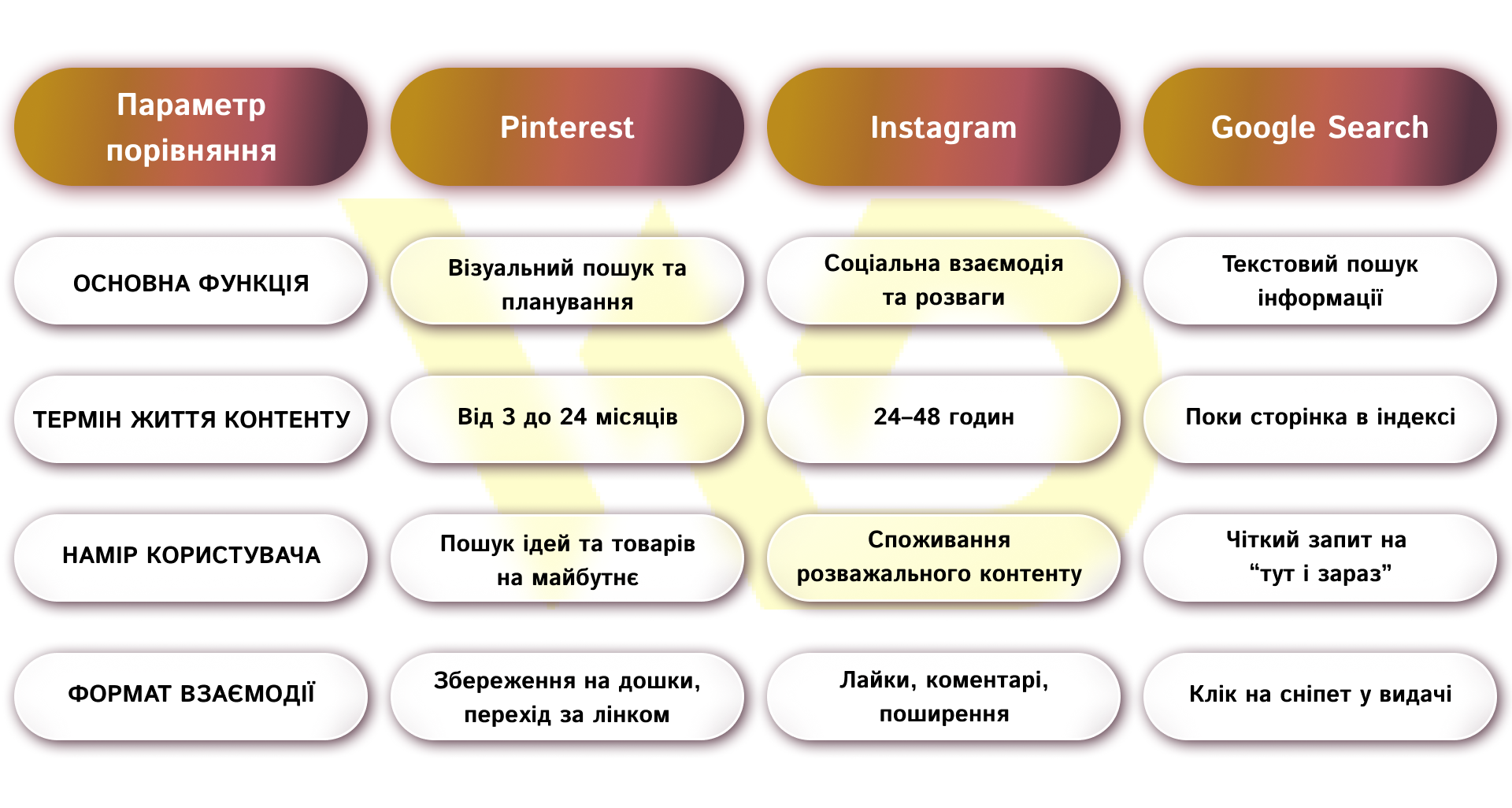
The specific behavior of the audience on the platform is determined by several key factors:
- high purchasing power: users create boards to plan home renovations, wardrobes, events, and major purchases;
- visual decision-making: the initial selection of products is based on aesthetic appeal and suitability for the intended use;
- seamless transition to the website: every standard pin contains a direct hyperlink to the landing page of an online store or blog.
Understanding this difference allows you to shift the focus from entertainment-oriented social media marketing to building a systematic, SEO-optimized database of visual cards that consistently generate leads.
Setting up a business profile and technical optimization
The transition from personal use to commercial scaling requires creating a business account. This unlocks access to advanced analytics, an advertising dashboard, and technical tools for integrating with your website.
The platform setup process involves following a series of mandatory steps.
- Register a business profile or convert an existing account by linking a corporate email address.
- Verify your own domain to confirm content ownership and display your brand logo under every pin from your website.
- Installing the Pinterest Tag a code snippet for tracking conversions, retargeting, and analyzing user behavior on the website.
- Implement microdata (Schema.org or Open Graph) to automatically generate Rich Pins, i.e., enhanced pins.
Rich Pins are critical for e-commerce and content projects because they automatically pull up-to-date data from a website directly into the platform’s interface.
|
Rich pin type |
Purpose |
Required microdata |
Automatic data in the pin |
|
Product Pins |
Online stores, retail businesses |
Schema.org/Product |
Current price, product availability, currency |
|
Article Pins |
Blogs, media, content projects |
Schema.org/Article |
Title, author, short description of the article |
|
Recipe Pins |
HoReCa, culinary brands |
Schema.org/Recipe |
Cooking time, ingredients, calorie count |
Technically sound profile optimization creates a solid foundation for algorithms to work effectively, as they begin to more accurately identify your business category and display content to the relevant audience.
Pinterest SEO: search algorithms and keywords
Since the platform functions as a search engine, content ranking is governed by clear textual and visual algorithms. The Pinterest algorithm takes four main factors into account:
- profile quality;
- pin quality;
- domain quality;
- keyword relevance.
According to Pinterest, users often can’t yet put into words exactly what they’re looking for, but they recognize the right product when they see it. That’s why the platform uses intent signals to recommend relevant content and products.
Compiling a semantic core for Pinterest has its own nuances. In addition to standard tools like Google Keyword Planner, you should use the platform’s internal resources: the search bar’s autocomplete feature and the Pinterest Trends section.
To achieve maximum visibility in the platform’s search results, follow these rules for keyword placement:
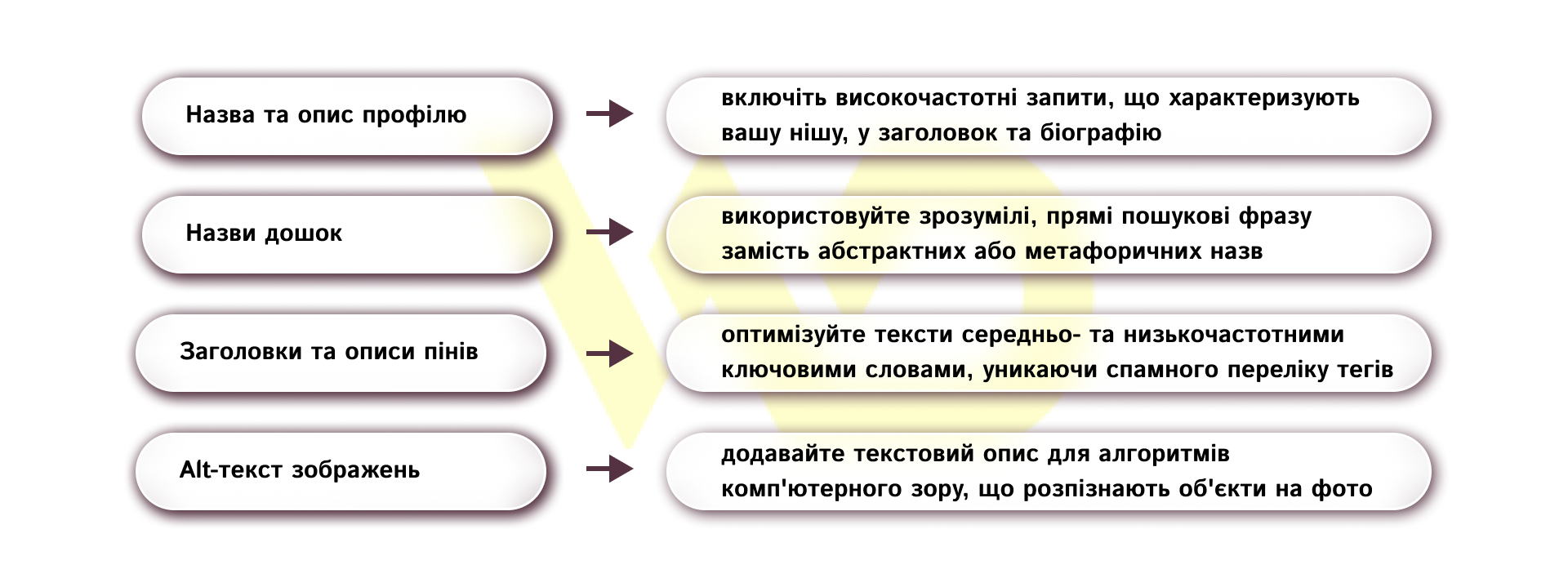
A harmonious combination of semantic optimization and attractive visuals allows content to appear not only in Pinterest’s internal search results but also in Google Images’ rich visual search results.
Content strategy and pin formats for attracting buyers
An effective content strategy on Pinterest is built on a balance of aesthetics and utility. Users are looking for solutions to their problems, so plain product photos on a white background perform significantly worse than lifestyle-style content that shows the product in a real-world context.
To build a comprehensive sales funnel, you need to combine different pin formats depending on the stage a potential customer is at.
Top of the Funnel (TOFU)
At the initial stage of brand discovery, the main goal is to capture the audience’s attention and generate initial interest, when users are simply looking for inspiration or ways to solve their problems. Dynamic and visually rich formats such as, Idea Pins, and Video Pins are best suited for this task. They allow you to vividly showcase your brand’s aesthetic and stand out in the feed. The key metrics for measuring success at this stage are reach, total views, and the number of pins saved to users’ boards, which indicate the high value of the content and its viral potential.
Middle of the Funnel (MOFU)
Once a potential customer is aware of their need, they move on to examining the details, comparing alternatives, and evaluating the practical benefits of the offer. At this stage, the business should focus on educating the audience and demonstrating the product’s advantages using carousel pins or detailed infographics. These formats allow you to reveal the features of a product or service step by step and build deep trust in the brand. The main metrics for measuring effectiveness are the number of clicks on a pin to expand it and the average time a user spends engaging with the content.
Bottom of the Funnel (BOFU)
The final stage of the funnel targets a highly engaged audience that is already ready to make a purchase and is looking for the most convenient way to complete it. Product Pins and Rich Pins play a decisive role here, as they automatically display the current price and product availability and provide a direct, seamless transition to the catalog. The main strategic goal is to simplify the customer’s path to the transaction as much as possible and encourage a quick purchase. The key metrics for analysis at this stage are the rate of direct visits to the website and the overall conversion rate into actual orders.
Creating high-quality visuals requires adherence to strict technical and aesthetic standards:
- vertical format: an aspect ratio of 2:3, for example, 1000×1500 pixels, since over 80% of users access the site from mobile devices;
- branding: unobtrusive placement of a logo or recognizable brand element at the top or bottom of the image;
- text overlay: a clear, easy-to-read headline directly on the image that explains the value of the offer;
- Call to action (CTA): a visual or text prompt such as «Download the guide», «Browse the catalog», or «Find out the price».
Consistently publishing content in various formats builds a strong visual brand presence and gradually guides the audience from initial interest to the final purchase.
Targeted advertising and performance analytics
Organic traffic on Pinterest delivers long-term results, but launching ad campaigns through Pinterest Ads allows you to significantly accelerate scaling and generate a predictable flow of leads. Ads appear as regular Pins labeled «Promoted», ensuring a high level of native integration.
The platform offers flexible targeting tools based on:
- keywords;
- interests;
- demographics;
- custom audiences (customer lists, website visitors, lookalike audiences).
A system of key performance indicators (KPI) is used to evaluate the effectiveness of both organic and paid promotion:
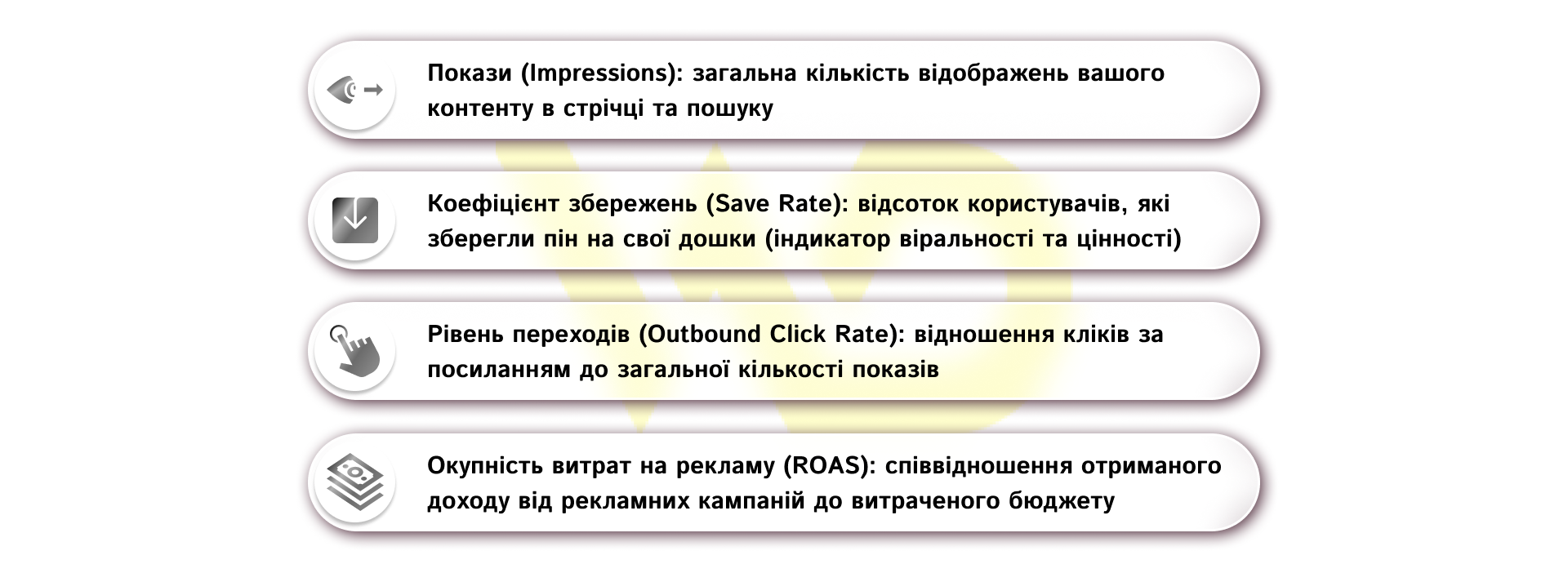
The Pinterest Analytics tool allows you to track the performance of each individual board and pin, adjust your media plan in a timely manner, and reallocate your budget toward the most conversion-driven content.
How to promote effectively on Pinterest
To achieve steady business growth on Pinterest, simply uploading photos isn’t enough you need a systematic approach that distinguishes professional management from amateur efforts.
In addition to the important rules discussed above regarding content, posting frequency, SEO, and analytics, to maximize your brand presence on the platform, it’s worth implementing additional practical techniques that are often overlooked.
- Creating themed groups. Collaborating with influencers and related brands to share audiences and get new accounts off to a quick start.
- Taking seasonality into account. Post seasonal and holiday content 30–45 days before the event, as users tend to plan ahead.
- Cross-posting and automation: Use certified auto-posting services to maintain a consistent posting schedule without spending time on it every day.
- Optimization for visual search. Creating unique, high-quality images with clear details for accurate recognition by the «Lens» algorithm.
Pinterest is a strategic tool with long-term ROI that works best when combined with a well-thought-out content marketing strategy for your website. Consistent work with the platform allows you to create a self-sustaining source of high-quality traffic that continues to generate sales even during breaks in advertising campaigns. And implementing the tools described here will help your business gain a competitive edge in its niche and convert users’ visual interest into real profit.

commercial offer
Other articles by the author

08/07/2026
ChatGPT can already search the web, provide quick answers, and display relevant sources, which means it’s important for businesses to be clear, cited, and verified in the digital space.

06/05/2026
DNS, or the domain name system, is a hierarchical system that helps a browser find the correct IP address for a domain.

26/03/2026
The benefits of integrating AI into PPC processes go beyond simply “faster text generation.” It’s about a fundamental shift in approach.
Latest articles by #Useful tips

24/09/2026
While feeds were previously viewed as a purely technical feature for running contextual ads in Google Ads, today their quality directly determines the share of impressions across all sales channels.

23/09/2026
Access to technology is no longer a competitive advantage what matters is a team of experts’ ability to integrate these solutions into real-world business processes.

18/08/2026
For businesses, the main challenge right now is not simply to “produce something,” but to speed up the time it takes for materials to reach the market, reduce the cost of content creation, and, at the same time, maintain the quality and human touch of communication.