

 25/11/2025
  2149
2149

Інтернет-маркетинг
простою мовою
Content of the article
- /01 What is feedback?
- /02 How to collect feedback: methods and tools
- /03 Frameworks and templates for quality feedback
- SBI (Situation → Behavior → Impact)
- «Sandwich (Positive → Correction → Positive)
- DESC (Description → Emotion/Evaluation → Specific action → Consequences)
- COIN (Context → Observation → Impact → Next steps)
- STAR (Situation → Task → Action → Result)
- 4Ls (What I liked / What I learned / What I lacked / What I would like)
- /04 Analyzing and processing feedback
- /05 Practical text templates and short examples of survey questions
- /06 Common mistakes when working with feedback and how to avoid them

Feedback: what it is and how to use it effectively

Competition is shifting from price and advertising to the quality of interaction. Customers expect not only a good product, but also a quick response to requests, clear communication, and the feeling that their voice affects the service. At the same time, internal feedback from the team determines whether the company can quickly adapt to changes and retain talent. For businesses, this is not an abstract «corporate culture» – it is a practical tool to reduce support and maintenance costs, improve product quality, and accelerate innovation.
In this article, we will consider how to turn individual feedback into a systemic resource. Namely, what types of feedback exist, how to collect and analyze them, and how to avoid the most common mistakes.
What is feedback?
Feedback is information about the result of a user’s or employee’s interaction with a product, service, or process, which allows you to evaluate performance, identify problems, and formulate specific steps for improvement. In the business context, feedback is an input for decision-making: from tactical corrections in service interaction to strategic changes in the product.
Types of feedback
The following key types of feedback are distinguished by source:
- Customer (customer and user feedback) – service ratings, NPS/NPS comments, complaints, suggestions. It provides direct information about market perception and willingness to recommend a product;
- internal (employee comments on processes, product, communications, tools – important for operational efficiency and staff retention;
- partner (feedback from suppliers, distributors, agencies) – often points to logistical or problematic areas in the business process;
- market or signal (competitive analysis data, open-source feedback, trends) – helps to identify new customer expectations and development directions.
Each of these types of feedback has its own sources and context. But it’s equally important to understand how a business can get this information.
How to collect feedback: methods and tools
To collect relevant feedback, start not with the tools but with the selection criteria: purpose (what you want to know), urgency, depth of insight, sample size, intrusiveness of the request, and resources (time and budget). So let’s look at the methods and their application.
- CSAT (customer satisfaction survey).
This is a short quantitative survey that provides an instant snapshot of customer satisfaction after a specific interaction (for example, a purchase or contact with customer support). Its advantage is the speed of collection and ease of interpretation of the results; at the same time, the disadvantage is that CSAT provides little information about the causes of dissatisfaction and rarely suggests what changes are needed. Therefore, CSAT should be used for operational monitoring of transactions and service processes, and, if necessary, combined with open-ended questions or qualitative research to find out the reasons.
- NPS (Net Promoter Score).
NPS is a tool for assessing a customer’s willingness to recommend your product. It is a single numerical question that is easy to track over time and is useful for identifying overall loyalty dynamics. Its strength is in its simplicity and the ability to segment the audience into promoters, neutrals, and detractors, but without textual explanations, NPS itself rarely tells you what exactly needs to be changed. It is advisable to use NPS periodically to monitor brand trends and in in combination with a short open-ended question «Why?» to get a direction for deeper research.
- CES (Customer Effort Score).
CES (Customer Effort Score) measures how easy it is for a customer to perform a specific action, such as placing an order or solving a problem through support. The advantage of CES is its focus on user journey barriers: a high effort score is a direct signal to optimize UX or processes. However, CES provides a localized answer and does not replace the overall picture of loyalty or emotional attitude towards the brand.
- In-depth interviews and focus groups.
Provide a qualitative context that is not available to quantitative methods. They reveal the motives, expectations and hidden pains of the audience, but require time, facilitation skills and careful selection of respondents. Such methods are used when you need to explain why certain trends are repeated, or before launching a new feature or product, so that you don’t rely on assumptions alone.
- Behavioral analysis (product or website analytics).
Behavioral analysis is a «silent» feedback: data about what users do in a product or on a website. Funnel metrics, heatmaps, and customer journeys often reveal problems before complaints: a user may not report an inconvenience but simply abandon the cart. Behavioral analysis is more objective, but requires a toolkit and the ability to interpret signals without emotional explanations.
- Social listening and feedback on external platforms.
They provide access to the emotional background and reputational risks. These sources are useful for early detection of crises, trends, and topics that are discussed outside your official channel. At the same time, they contain a lot of «noise» – you need to be able to filter and confirm important signals using other methods.
- Microfeedback.
Short, built-in queries (ratings, emoticons, one-click polls) allow you to collect a lot of point estimates with minimal user load. This is a convenient way to get a quick indicator after a specific action, but excessive use of such queries can cause fatigue and reduce the quality of responses.
The most effective system is a multi-level one: continuous automated data collection at the transaction and behavioral levels, regular review of NPS as a strategic indicator, and spot in-depth research (if necessary).
The practical implementation of such an architecture involves automating the collection (CRM surveys, widgets, analytics), centralizing responses in a single data warehouse, and linking each type of feedback to the person responsible for the process. This allows you not to collect chaotic data, but to get relevant insights with a clear understanding of what actions to take and when.
Frameworks and templates for quality feedback
Frameworks organize the thinking and structure of feedback, and templates provide ready-made phrases for quick application. Together, they turn vague comments into specific, actionable messages.
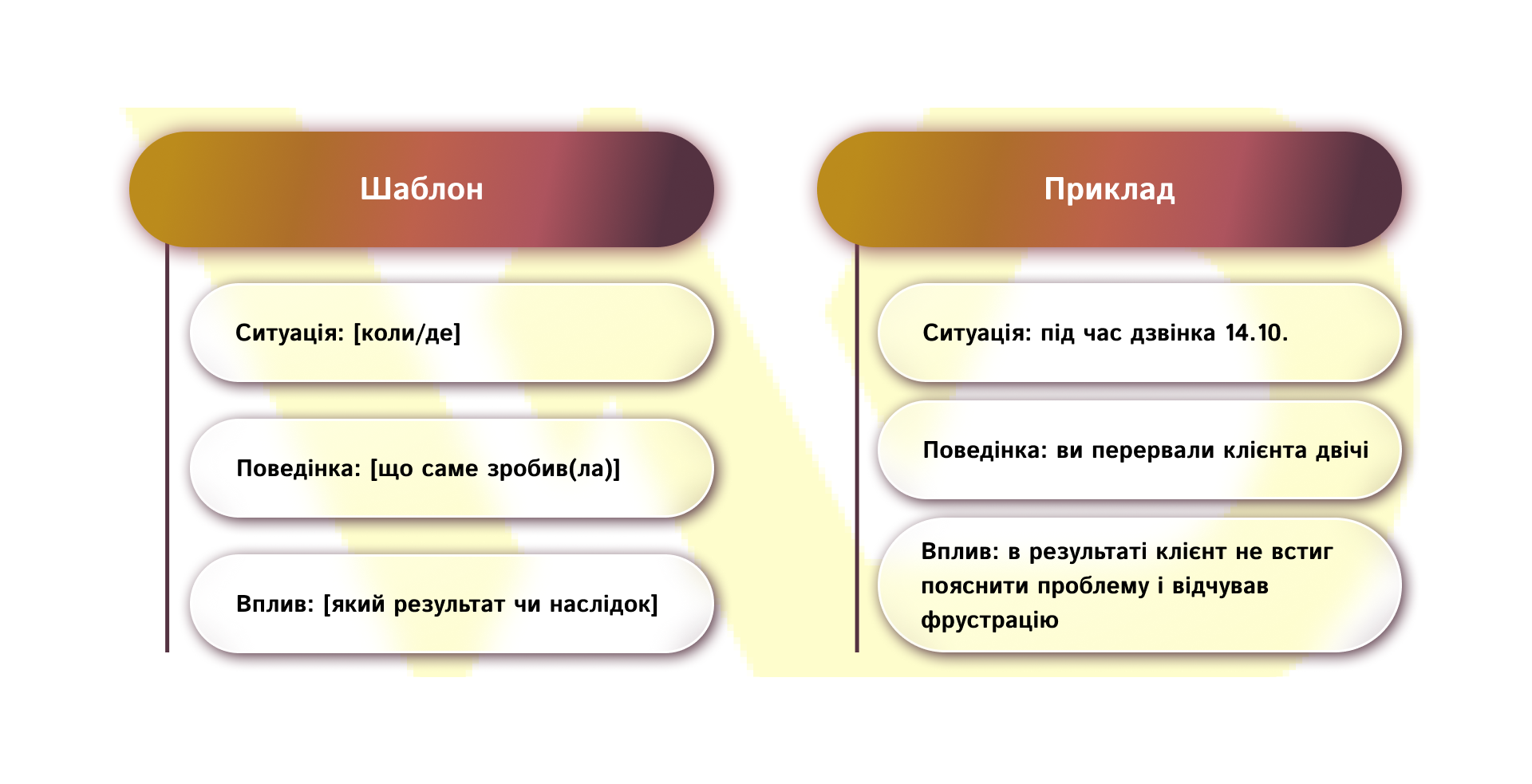
SBI (Situation → Behavior → Impact)
A short, fact-based approach to addressing specific incidents or customer cases. It helps to reduce the emotionality of the message and focus on the real impact of behavior on the process or result.
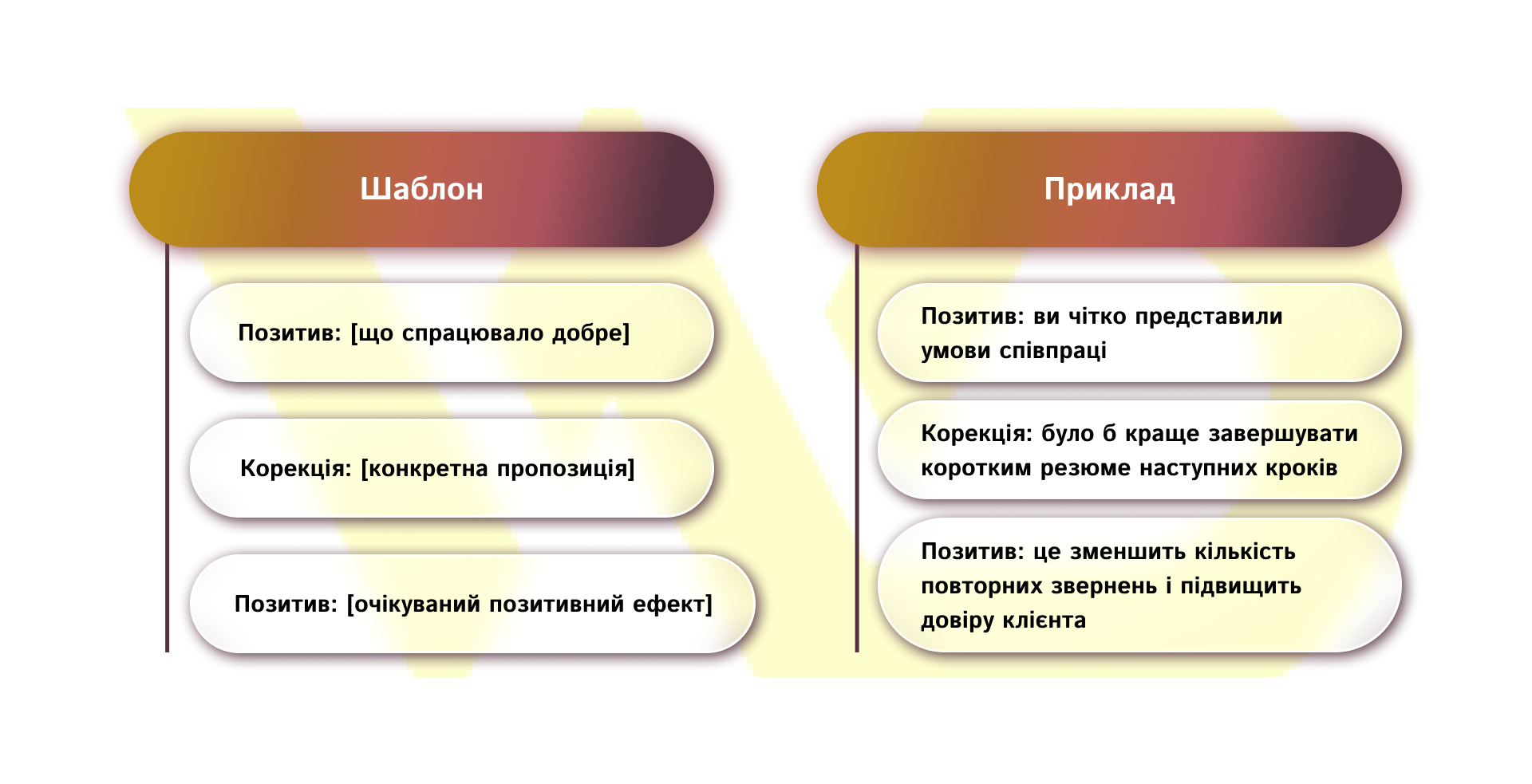
«Sandwich (Positive → Correction → Positive)
A format for soft corrective feedback. It is useful when you need to provide feedback, but keep the employee motivated or client contact.
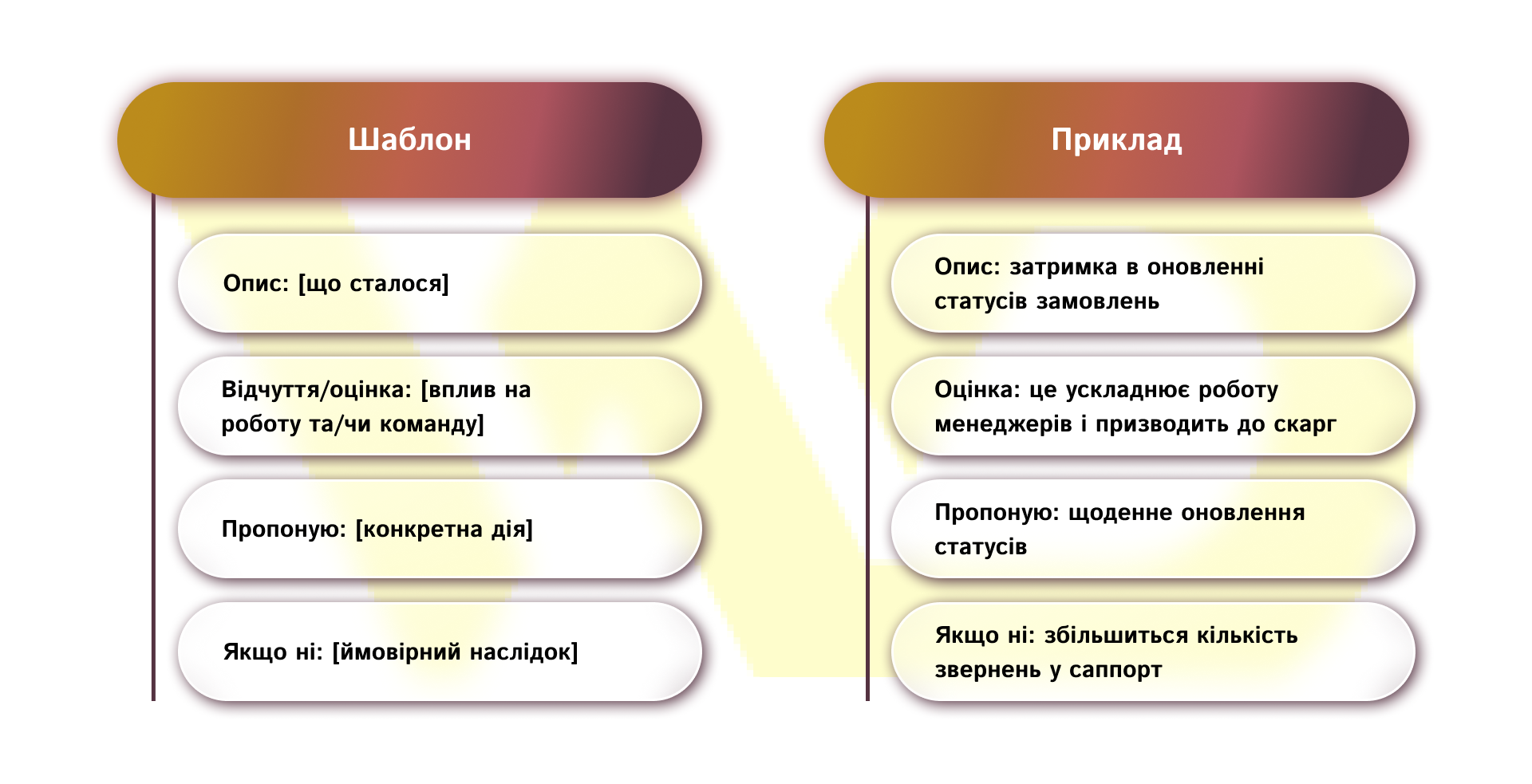
DESC (Description → Emotion/Evaluation → Specific action → Consequences)
An approach for constructive criticism with an emphasis on consequences and next steps. It is used when you need to not only point out the problem but also agree on the mandatory steps to fix it.
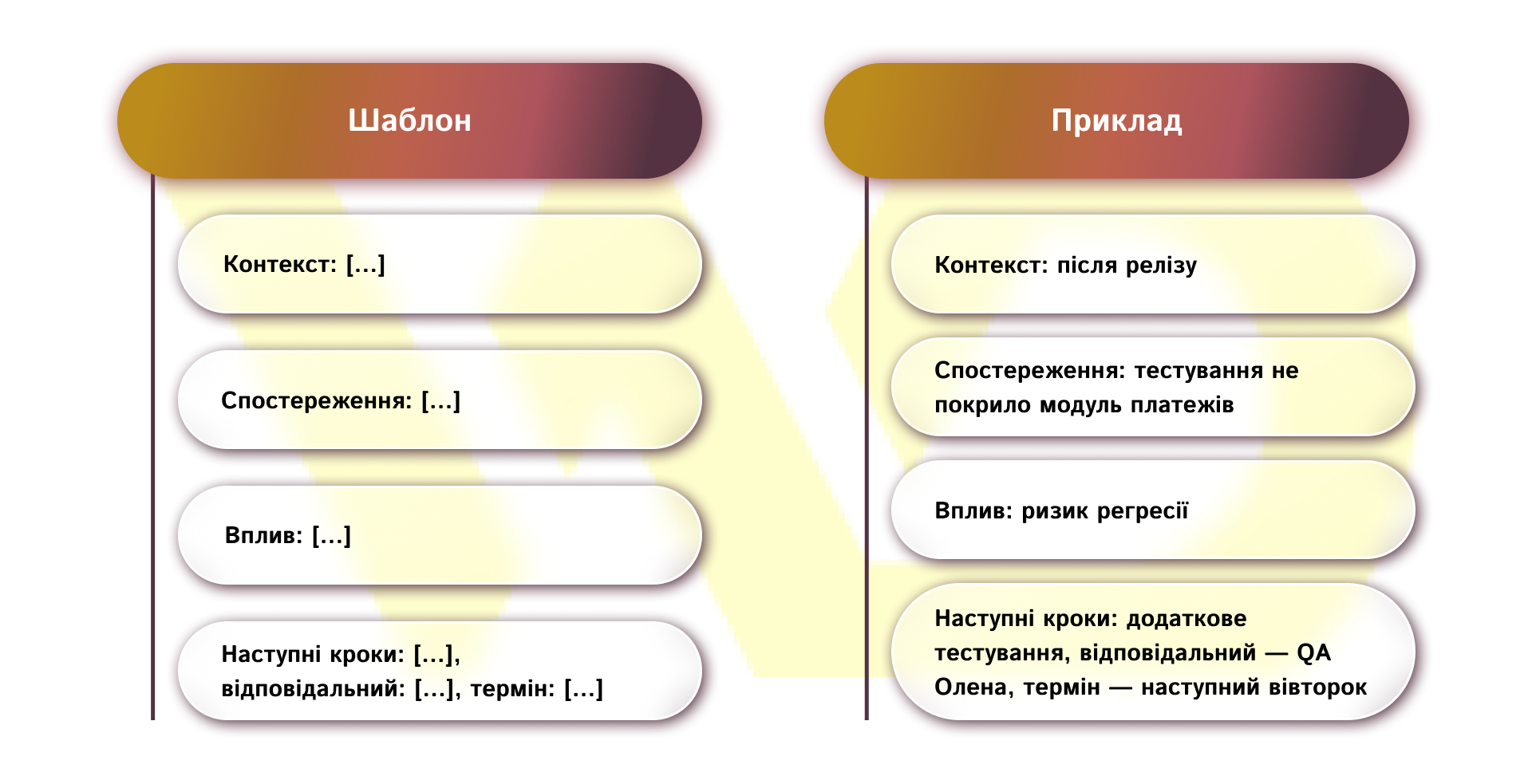
COIN (Context → Observation → Impact → Next steps)
A quick working format for operational reviews and meetings: it captures the situation, briefly explains its impact, and immediately assigns specific actions with responsibilities and deadlines.
STAR (Situation → Task → Action → Result)
A structure for case studies, post-mortems, and documenting lessons learned. Allows you to logically build a story from problem to solution and draw conclusions for further application.
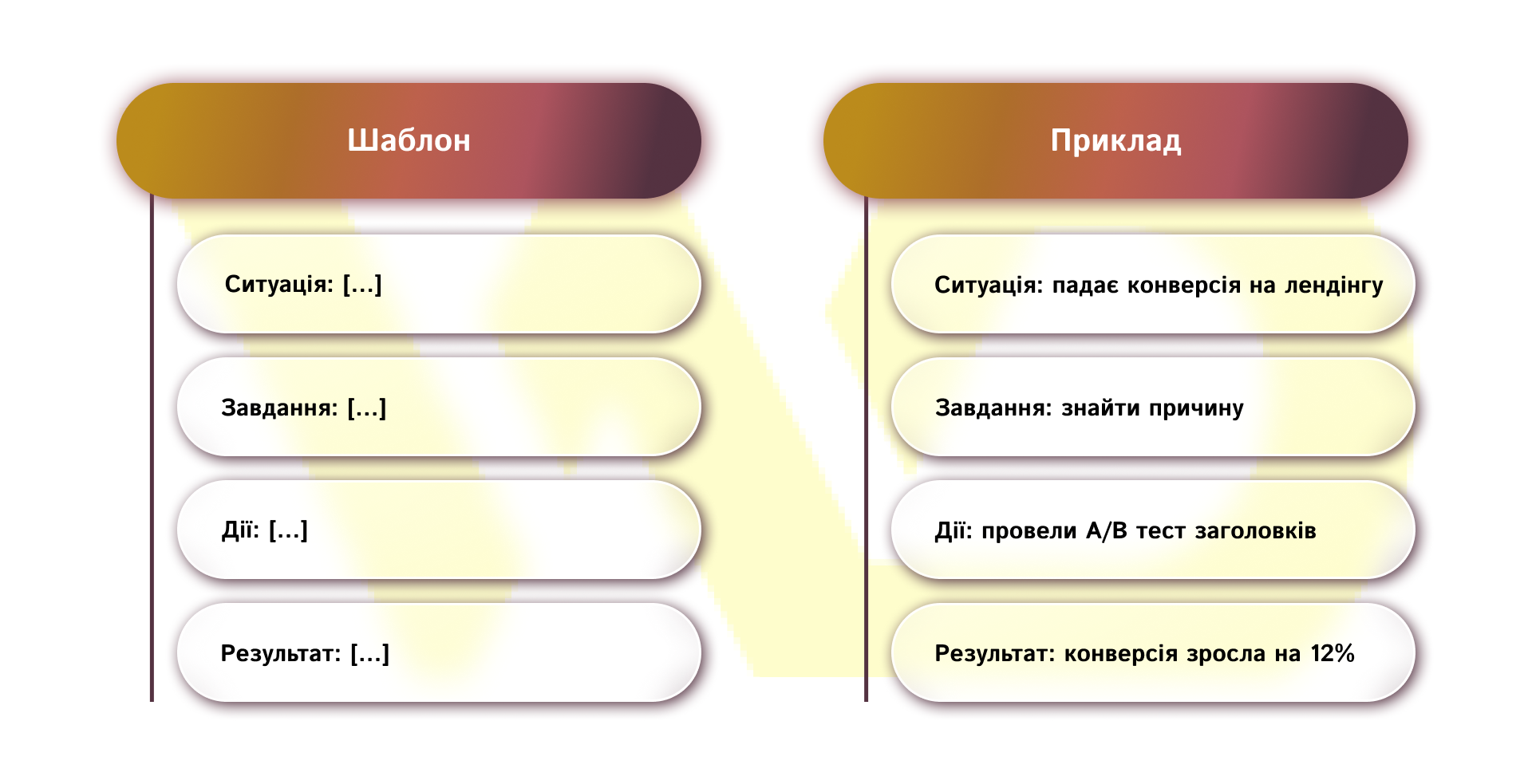
4Ls (What I liked / What I learned / What I lacked / What I would like)
A simple tool for retrospectives and team sessions that quickly identifies strengths, key lessons, gaps, and expectations for the next cycles.
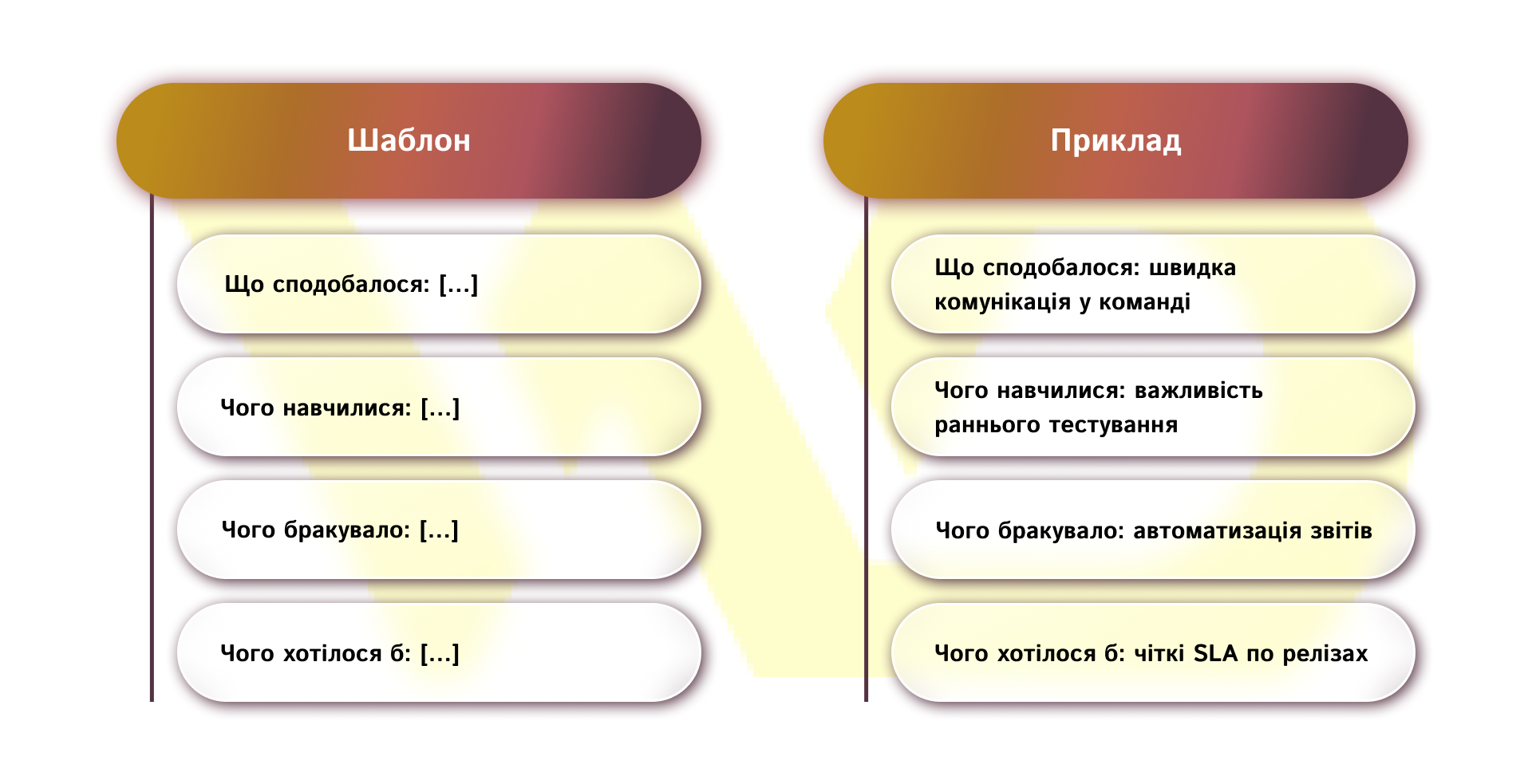
Always choose the framework that best suits the purpose: sometimes a quick COIN is enough, sometimes a full STAR analysis is required. Clear structures and ready-made templates reduce communication time and increase the likelihood that feedback will turn into real improvements.
Analyzing and processing feedback
Feedback analysis is the process of transforming disparate feedback into understandable insights and specific actions. For it to work sustainably and bring business results, it requires not only analytics but also operational discipline.
- Centralization and structure.
Collect all answers in one repository (CRM, VoC platform, or a single spreadsheet). Immediately apply unified tags and categories: product, UX, price, logistics, support, etc. This makes it easier to filter and count recurring topics.
- Pre-processing (triage).
Define the rules of primary processing:
- urgent incidents – instant escalation;
- repeated signals – priority for analysis;
- single praise or uncritical comments – accumulation for trends.
Assign responsibilities for each category and set response SLAs (for example, 24 hours for support, 7 days for the product team).
- Quantitative and qualitative analysis.
Analyze metrics (NPS, CSAT, CES, share of resolved requests) and open responses in parallel. Quantitative data reveals the scale of the problem, while qualitative data gives the reason. For open comments, use thematic classification with manual sample verification.
- Prioritize solutions.
Use an impact and cost matrix: rank topics by expected business impact and resources to address them. High impact and low costs are a priority. For product changes, formulate hypotheses: «If we do X, then Y will improve by Z%,» and plan an A/B test or pilot launch.
- Implementation and measurement of measurable results.
Each decision should have clear KPIs, a responsible person, and a deadline. After implementation, measure the effect using the same method that identified the problem (for example, a change in NPS or a decrease in support calls).
- Closing the cycle and communication.
Inform users or the team about the changes («we heard you and updated…»). Closing the loop increases trust and motivates them to provide feedback in the future.
- Risk management and privacy.
Anonymize sensitive data, follow storage and access policies. Automatic tools are useful but need to be controlled because they make mistakes in tone and categorization.
Remember: structured feedback analysis is not a one-time action, but a regular process to improve your business.
Practical text templates and short examples of survey questions
The right questions help you get useful answers. Here are some templates and examples for different tasks.
|
Type of question |
Example wording |
Why is it used |
|
Introductory request text |
«We would appreciate it if you could take a minute to rate our service. Your feedback will help us to become better!» |
A concise message with a polite tone encourages users to respond. |
|
Source of information |
«How did you find out about our product or website?» |
Allows you to understand which marketing channels attract customers most effectively. |
|
Net Promoter Score (NPS) |
«How likely are you to recommend our product to your friends or colleagues? (0 – «not at all», 10 – «definitely»).» |
Measures loyalty and allows you to segment customers into promoters, passives, and detractors. |
|
Open-ended «what/why» questions |
«What do you like most/least about our product/service?» |
Allows the client to describe the experience in their own words, identify strengths and growth points. |
|
Quantitative assessments (CSAT) |
«Please rate your satisfaction with our service on a scale from 1 (very poor) to 5 (excellent).» |
A classic tool for quickly measuring customer satisfaction. |
|
Questions about obstacles |
«Why did you decide not to complete the purchase?» |
Helps to understand the barriers – price, complexity of the process, distrust of payment, etc. |
|
Questions about features |
«What features of our product/website do you like the most?» «What important feature do you miss?» |
These questions reveal which elements create the greatest value for customers and which areas need to be developed. |
When creating a questionnaire, remember to ask short, clear questions, combine closed (scales, options) and open-ended formats, and avoid double questions and complex terminology. Use neutral wording, do not impose a yes/no option without the alternatives «I don’t remember» or «other». And don’t forget to motivate people to answer: for example, offer a small discount or participation in a drawing for filling out the questionnaire.
Common mistakes when working with feedback and how to avoid them
Even the best feedback collection system won’t work if you make common mistakes. Here are the main risks and ways to avoid them:
- Overloaded questionnaires. Surveys with a large number of questions are rarely filled out to the end. Formulate the minimum number of questions that will give the most benefit and explain the purpose of the survey right away.
- Poor question wording. Avoid leading or ambiguous phrases. Neutral, clear questions without emotional coloring provide more reliable results.
- Ignore criticism. Negative feedback is not a threat, but a source of data for improvement. Thank them for it, record it, and pass it on to the appropriate team. Even a short response shows customers that they are heard.
- Lack of follow-up. Collection without action is a loss of trust. Determine how the feedback results are integrated into your processes and communicate changes («We have updated…», «We have added a feature…»).
- Incorrect selection of respondents. Survey only those who have had relevant interaction with the product or service. This increases the accuracy and usefulness of the results.
- Single-channel approach. Don’t rely on just one collection channel – combine email, website, social media, chatbots, or phone, depending on where your audience is active.
- Lack of anonymity. If the topic is sensitive, offer anonymous responses. This reduces social desirability and helps to obtain honest data.
A properly organized feedback process is not a formality but a growth tool. A business that systematically listens to customers reacts to changes faster than competitors and builds trust not through advertising but through actions. Even a short but regular survey can become a source of strategic insights if it is really paid attention to.

commercial offer
Other articles by the author

21/06/2024
An SEO specialist is a person who is an expert in search engine optimization and bringing web resources to the top of search engines.
A competent SEO specialist understands not only website ranking algorithms, i.e. the principles of how search engines raise resources to high positions in search results, but also the basics of marketing, sales, copywriting, and advertising.

06/06/2024
An SEO website promotion strategy is a general action plan for a particular website that covers a certain period of time and helps to achieve the set goal. The development and implementation of an SEO strategy is the basis of website promotion, without which it is impossible to achieve a good result.

09/01/2026
Local visibility often determines whether a customer will find your company within a few kilometers or go to a competitor. Google Maps is one of the main channels for such contact.
Latest articles by #Useful tips

06/10/2026
From a business perspective, updating content is a sensible way to protect existing investments.

02/10/2026
For businesses, CPL is the primary metric for measuring how effectively ads and landing pages convert cold traffic into initial leads.

29/09/2026
A content pipeline transforms the creation of content from a spontaneous creative process into a managed production system. In such a system, AI serves as a powerful assistant.