

 30/10/2025
  2252
2252

Інтернет-маркетинг
простою мовою
Content of the article

Search engine crawlers: who they are and how they influence search results

Search engine results continue to be shaped not only by algorithms but also by human evaluation. That is why technical SEO optimization and link building should be combined with an understanding of how crawlers evaluate the quality of content. In this article, we will consider who the crawlers are, how and what they influence, how their assessments affect the algorithms, and what specific steps businesses need to take to steadily improve their rankings.
Who are search engine crawlers?
Search Quality Raters are ordinary people hired by search engines or contractors to check the quality of search results. They are not «manual admins» who raise or lower sites on demand. Their role is as follows:
- assessors evaluate the compliance of query results with quality criteria (for example, Google Search Quality Rater Guidelines);
- they check the relevance, completeness of the answer, credibility of the source, and user experience on the page;
- perform tasks on selected queries, in different language and regional sets;
- provide «human feedback» that becomes a training set for machine learning models.
A simple fact is important for business: assessors test and verify the behavior of algorithms in real-life scenarios. Their findings influence which approaches algorithms consider useful and relevant.
How assessors’ evaluations work and how they translate into algorithm changes
To put the knowledge about assessors into practice, it is useful to visualize the process as a chain:

Each stage of this chain is important – and the impact of your content on the SERPs goes through it. Let’s take a step-by-step look at what happens inside the system and what it means for business.
Collecting human ratings
Assessors receive tasks – specific search queries and sets of results (SERPs). Their job is to evaluate how well each result matches the query according to a number of criteria: relevance, completeness of the answer, authority of the source, risks for the user (especially in YMYL topics such as finance, medicine, etc.).
This is where the «human inspection» of your content takes place: the assessor checks not only the technical optimization for keywords, but also whether the page provides a clear, complete, and useful answer to the user’s request.
For example, if a user asks «which CRM is suitable for a small business», the crawler may come across your article: if it doesn’t have a comparison table, integration data, examples of successful use, or estimated prices, the score will be low – even if the headings and metadata are optimized. Therefore, business content should respond to the real needs of the audience, not just «check off» keywords.
Aggregation and validation
After the assessors have given their ratings, their results are aggregated into large sets and checked for consistency. Several people can evaluate the same SERP combination – the system cuts off anomalies (one sharply different voice), weighs repeated signals, and calculates representative metrics. Consistency tests are also performed: whether different evaluators give similar verdicts for the same cases.
A single bad rating is not decisive – repeated, cross-checked signals are important. If several crawlers independently emphasize a page’s weakness (e.g., lack of evidence or inconsistency of intent), this signal carries weight and is included in the training data set that will influence the algorithm. Therefore, it is not only worth correcting individual errors, but also identifying systemic problems that can give many «red flags.»
For example, if dozens of ratings show that your product description page does not contain information about compatibility with popular services, the aggregate signal will indicate a problem – and even without a direct «order» from the crawler, such pages will gradually lose visibility. Solution: update the product card template and add standardized blocks with technical information.
Training models based on human feedback
Aggregated and filtered ratings are used for machine learning: models learn to associate page features (structure, availability of sources, content format, engagement signals) with human ratings of usefulness. This is a process where the algorithm detects patterns and automatically starts favoring the types of pages that have received high ratings. In this way, a person forms rules that the machine applies automatically.
Anything you do to improve the obvious human signs of quality, such as structured content, links to authoritative sources, clear answers to a query, will become a feature in the ranking model. Investing in expertise and transparency has a double return because it improves the user experience and reinforces the «features» that the models look for in training.
For example, let’s imagine that you add a block with sources, author signatures, and a diagram of «how to apply the solution in practice» to articles. The model, trained on the assessors’ ratings, begins to recognize these features as positive and eventually increases the relevance of such pages in similar queries.
Testing and gradual release of changes
The trained model is not immediately turned on in all regions and queries – updates are tested in a controlled manner:
- A/B launches;
- canary testing on limited clusters of users;
- comparison of metrics (retention, CTR, satisfaction).
The assessors continue to monitor the results after the release, looking for unwanted side effects. Only after confirming that the changes are useful and do not cause harm are the changes rolled out.
The effects of algorithmic changes often appear in waves and at different times in different regions. Therefore, you need to track trends rather than reacting to a one-time decline. Moreover, the improvements you make may not be immediately apparent. It takes time for the model to «pick up» new patterns and start favoring them.
For example, after extensive model training, some sites temporarily lose traffic. But if you have conducted an audit and improved the quality of content in accordance with the new rules, a gradual rollout will show an increase in visibility in a few weeks. Therefore, it is better to document all changes and compare «before/after» in the period of 4-12 weeks.
This way, people evaluate, the system learns, and then the changes are rolled out in stages. This means that the business strategy should combine quick changes (UX, technical) with long-term investments in the authority and usefulness of the content.
Criteria for evaluating content by assessors
Assessors look at the page the way a real user would: whether they received a quick, clear, and useful answer to their query.
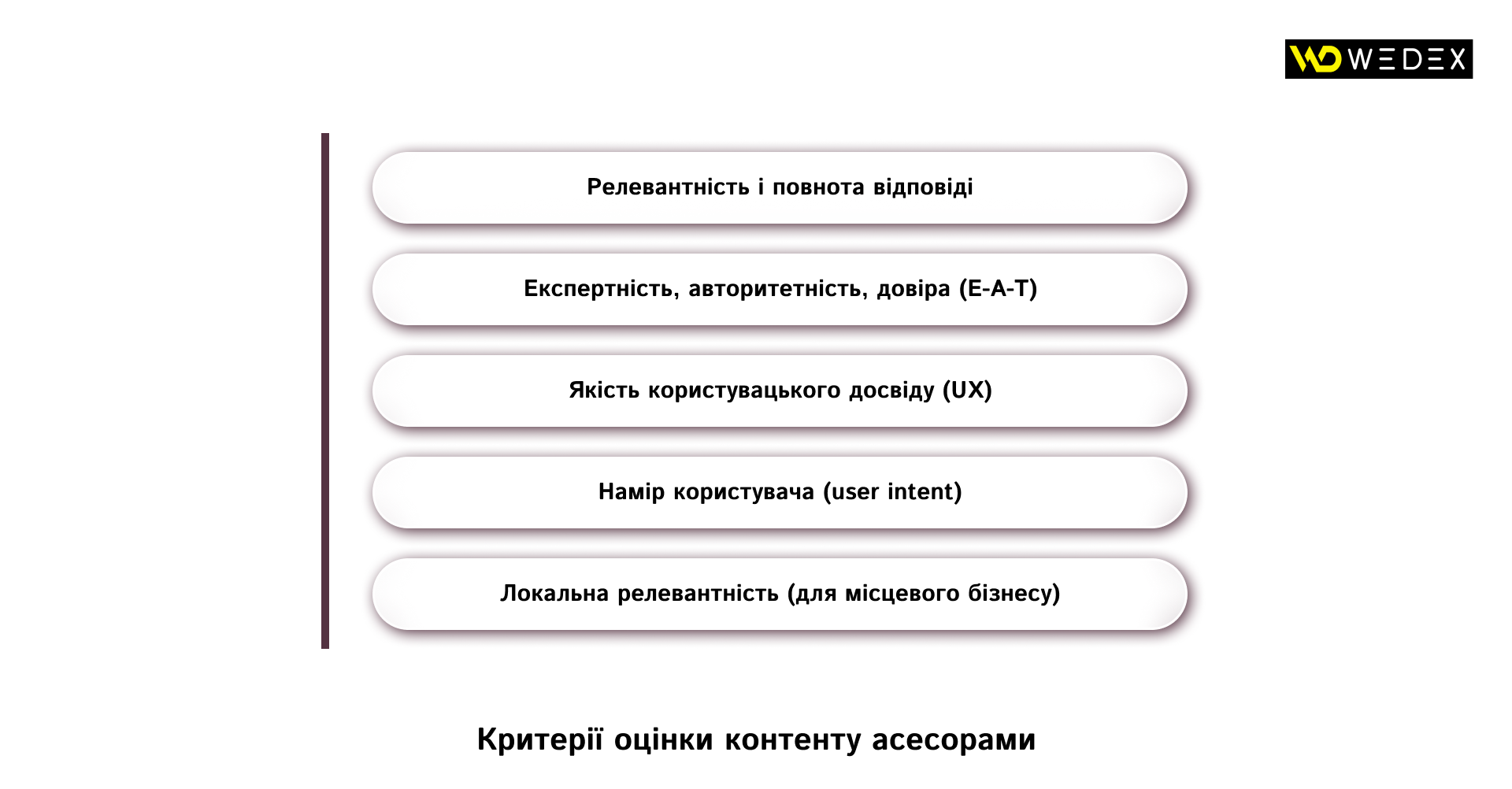
It is important for businesses not only to know these criteria, but also to be able to systematically meet them.
- Relevance and completeness of the answer.
Assessors evaluate how well the page clearly answers the query: there is the necessary information on the first screen and key facts, a logical structure, and closure of all sub-questions. The page should solve a specific user task without the need to search for additional sources.
Practical steps for business:
-
- start the article with a short summary (snippet-ready);
- add tables, checklists, FAQs for common questions;
- answer related questions within one page.
For example, for the query «how to treat seasonal allergies in adults», the assessor expects authoritative and safe content: links to medical sources, a doctor’s signature, and warnings against self-diagnosis. If this is not the case, the rating will be low.
- Expertise, authority, trust (E-A-T).
Assessors evaluate who is behind the content: whether the author has relevant experience and whether verified sources are provided, as well as the availability of reviews, cases, and confirmation of expertise. The page should demonstrate reliability and credibility, especially for YMYL topics (health, finance, law), so that the user can trust the information without additional verification.
Practical tips:
-
- add author signatures with a short biography and a link to the profile;
- indicate sources (studies, standards, norms);
- publish cases, testimonials, and certificates that confirm the expertise.
For example, when asked for a «small business loan», the assessor expects transparent information: loan terms, official sources, and the author or expert.
- Quality of user experience (UX).
Assessors take into account not only the text, but also how convenient and comfortable it is for the user to receive information: download speed, adaptation to mobile devices, and the level of intrusive advertising.
To improve it, you should
-
- optimize page speed (images, cache, critical CSS);
- remove aggressive interstitial ads;
- provide a logical structure with subheadings and short blocks.
For example, if the query is «online accounting for sole proprietorships», the assessor expects the page to load quickly without intrusive ads. If the page is slow and overloaded with banners, the score will be low.
- User intent.
The crawlers look at whether the page meets the type of query itself – informative, commercial, or navigational.
Practical steps:
-
- clearly segment content by intent (information, comparison, purchase page);
- use separate landing pages for different stages of the funnel;
- optimize headlines for real search queries.
For example, if a user searches for «buy office chairs», the assessor expects a commercial page with products, prices, and delivery terms. If the user gets to an informational article about materials, it will be a bad sign.
Optimize your website for real queries, not just keywords.
WEDEX specialists will help you adapt your content to user intent — from informational to commercial — so that search engines better understand your website and each query brings potential customers directly to you.
- Local relevance (for local businesses).
For requests with a local intent, crawlers check the accuracy of local data: name, address, business hours, phone number, reviews, and local content.
Tips for businesses:
-
- update your Google Business Profile and local directories;
- encourage customers to leave honest reviews;
- add local pages with unique content and structured data.
For example, if a cafe has incorrect opening hours, the crawler will record the discrepancy and the page will lose positions in the local block.
Optimization for algorithms should not be an end in itself. The main priority is to create content that is really useful and trustworthy. A practical approach combines quick technical fixes, such as improving UX and loading speeds, with long-term investments in expert, structured content and transparent company information. This way, your website will be valuable to both algorithms and real customers.
A practical action plan for business
Here are practical steps that allow you to combine technical and content optimization to achieve consistent results in search results today.
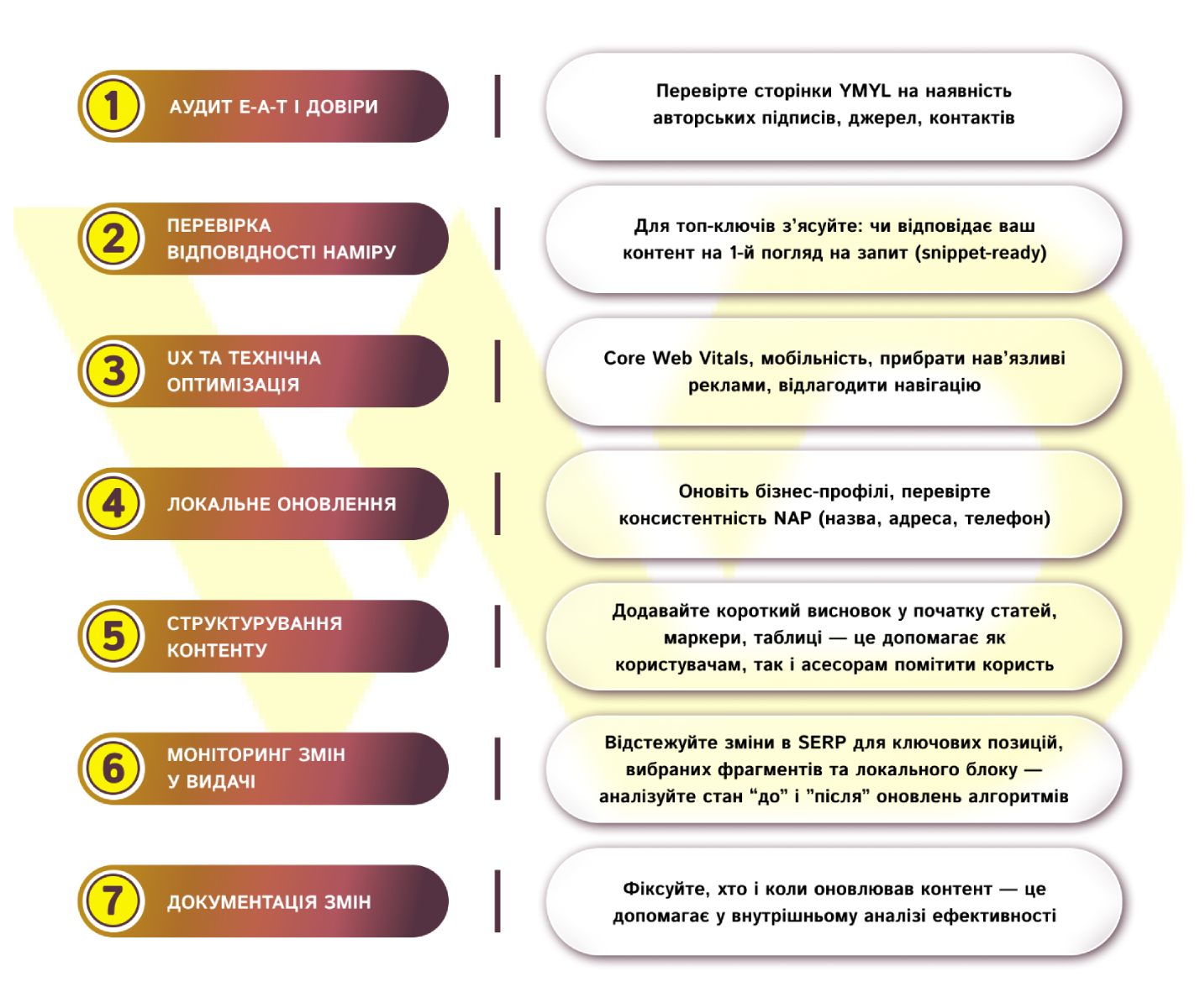
Following this plan helps to avoid chaotic edits and the cost of ineffective actions. A systematic approach ensures a balanced work on the technical aspects of the site and the quality of the content, increasing the chances of long-term success in search results. It also makes it easier to evaluate the effectiveness of the changes made and plan the next steps.
Impact of assessor ratings on voice search and AI assistants
Modern voice search engines and AI assistants (e.g., Google Assistant, Siri, Alexa) generate answers based on the same algorithms as traditional search, but with a special emphasis on the accuracy and speed of the answer. Assessor ratings directly affect these results: if the content demonstrates clarity, structure, expertise, and trust, the algorithms recognize it as reliable for short voice responses.
So, by optimizing your content for the criteria of the crawlers, you simultaneously increase your chances of getting into the blocks used by voice assistants. For example, FAQ blocks, clear tables, or specific action steps on the page help AI quickly identify key facts and formulate an accurate answer to the user.

commercial offer
Other articles by the author

11/09/2023
Google Search Console (GSC) is a free tool created by Google to help you get information about how your site ranks in search results, troubleshoot issues, and optimize your content. It's not just a useful addition to your work, but something you really need to stay at the top of the search results.

22/07/2024
A landing page is created with an emphasis on a specific offer and is aimed at a certain target audience. It's like a showcase that shows the most important and interesting things about the company.

03/10/2024
This category of responses is the most problematic and important to study. Status codes 400-499 indicate problems that have arisen on the initiative of the client. These problems can range from client-initiated requests to an incorrect node name, request timeout, uncontrolled request, malicious request, and others.
Latest articles by #SEO

12/08/2026
Broken links and non-existent pages aren't just technical flaws in a website they're a direct path to losing potential customers and dropping in search engine rankings.

23/07/2026
An RSS feed is a separate file containing a list of a website's latest posts. When a new article, news item, or other content appears on the site, information about it is automatically added to this feed.

08/07/2026
Donor analysis isn't about examining a single metric; it's about comparing several metrics against one another.