

 29/04/2026
  1464
1464

Інтернет-маркетинг
простою мовою
Content of the article

Coworking as an alternative to an office: a detailed analysis of advantages and hidden disadvantages

Coworking is a format not only for freelancers. Today, it is one of the flexible models of work organization that can replace a classic office in whole or in part, depending on the size of the team, working hours, and privacy requirements. That is why coworking is important today not only as a trend, but also as a practical management solution that affects business.
In this article, we will look at how coworking works in real life, analyze its strengths and hidden disadvantages for business.
What is coworking in the business sense?
At its most basic, coworking is a shared workspace where individuals, teams, and even entire organizations can work, using a common infrastructure and the opportunity for professional interaction. In today’s business context, coworking is perceived as an intermediate model between working from home and a classic office.
Types of coworking spaces
Coworking spaces can differ not only in the format of the space but also in the tasks they are designed for. The most common types are as follows:
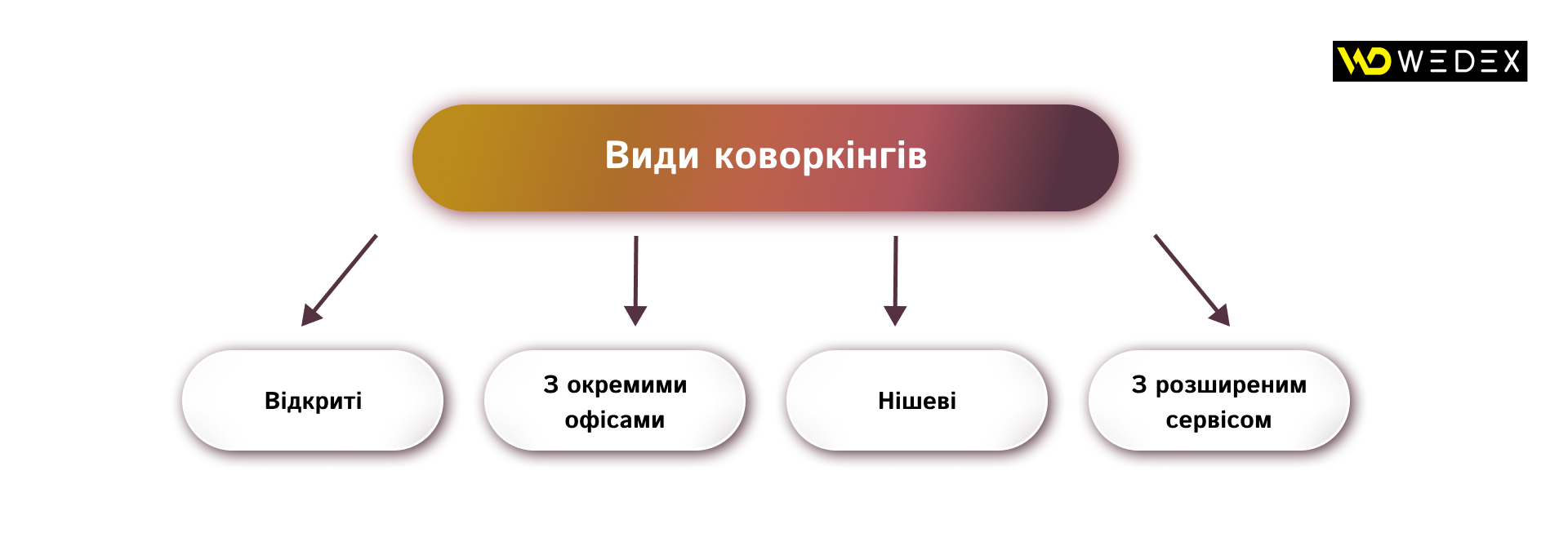
Open coworking spaces
These are spaces with common work areas without hard assignment of seats. They are suitable for professionals who value flexibility and a minimum of organizational restrictions. They are suitable for freelancers, small teams, remote workers, and start-up businesses that need mobility and minimal costs.
Coworking spaces with separate offices
In such spaces, you can rent both a workplace and a private room for your team. This is a convenient option for businesses that need shared infrastructure and privacy. It is relevant for small and medium-sized teams, agencies, companies with client processes or projects where it is important to maintain confidentiality.
Niche coworking spaces
They are focused on specific professions or industries, such as IT, creative industries, or startups. This format is often chosen by companies that value the environment of «their» specialists. They are ideal for specialized teams and companies that value networking, experience exchange, and working in an environment of like-minded people.
Coworking spaces with extended services
In addition to a workplace, there may be meeting rooms, events, a reception, a kitchen, a recreation area, and other services. It is convenient for teams that want to get a ready-made office without their own administration. It is best suited for businesses that do not want to deal with the operational administration of the office, teams with frequent meetings with clients, and companies that work in a hybrid format.
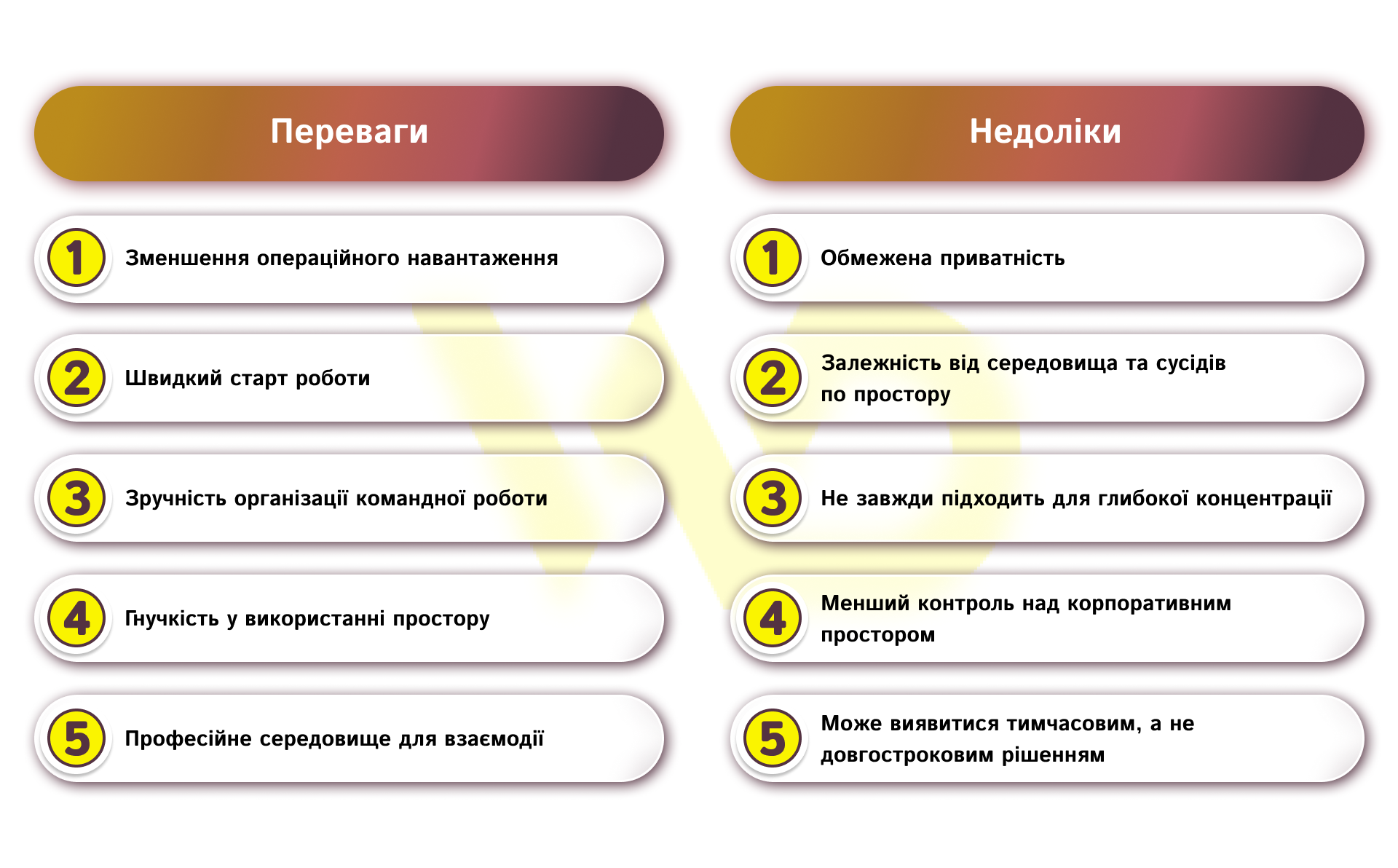
Benefits of coworking for business
Coworking as a work format provides businesses with a number of practical advantages that affect both costs and process organization.
- Reduced operational burden.
The company does not need to deal with the basic arrangement of the workspace, purchase of furniture, Internet connection, or other office issues on its own. This allows you to focus on your core business rather than on administrative details.
- Quick start of work.
Coworking allows you to start working quickly without a long office launch. This is especially convenient for businesses that are opening a new direction, forming a team, or testing a new location.
- Convenience of organizing teamwork.
Many coworking spaces already have meeting rooms, meeting areas, and space for collaboration. This makes the format practical for teams that need to periodically gather in one place without having to maintain a large office all the time.
- Flexibility in the use of space.
A company can choose a format that suits its needs: a separate workplace, a small block for a team, or a space for periodic meetings. This model is convenient for businesses with a dynamic staff or variable workload.
- Professional environment for interaction.
Coworking creates a neutral workspace suitable for meetings with clients, partners, or internal discussions. For many companies, this is a more comfortable alternative to working from home or an unfinished office.
Therefore, coworking should not be seen as a universal replacement for a classic office, but as a tool that works well for specific business tasks.
Hidden disadvantages of coworking for business
Coworking can be a convenient solution, but it is important for businesses to consider its disadvantages.
- Limited privacy.
In a shared space, it is more difficult to maintain confidentiality during negotiations, discussing financial issues, or working with sensitive information. For companies that value silence, separate space, and access control, this can be a significant disadvantage.
- Dependence on the environment and neighbors.
The efficiency of work in a coworking space largely depends on who else is using the space, how noisy it is, and how the common areas are organized. This means that the company cannot always fully control the working environment, and therefore the stability of the daily work rhythm.
- Not always suitable for deep concentration.
Although coworking is convenient for meetings and teamwork, it is not always comfortable for tasks that require prolonged focused work. It’s easier to get distracted in an open space, which can affect the productivity of individuals and teams as a whole.
- Less control over corporate space.
Unlike in your own office, in a coworking space, a company cannot fully customize the space to its culture, brand, work scenarios, or internal rules. For businesses that need a unified corporate atmosphere or specific requirements for organizing processes, this can be a significant limitation.
- It may turn out to be a temporary rather than a long-term solution.
The format is convenient to use as a flexible stage, but not always as a final model for all business processes.
Coworking should be viewed as a tool, not a one-size-fits-all answer to all office needs. Where speed, mobility and lower fixed costs are required, it can work very effectively. Where confidentiality, environmental stability, and full control over space are critical, a classic office or hybrid model will be stronger.
This is exactly the mature approach of business to choosing a working format: not to focus on the trend, but to compare the work model with real operational tasks.

commercial offer
Other articles by the author

12/08/2026
Understanding your audience forms the basis for every decision: from choosing the color scheme for your designs to setting up complex funnels in Meta Ads.

19/06/2026
Crowd marketing involves placing useful, organic mentions of a brand, product, or service on platforms where your audience is already engaging.

02/03/2026
A community manager is responsible for building, developing, and maintaining a community around a brand, product, or project.
Latest articles by #Useful tips

11/09/2026
Email remains the primary channel for business communication, but at the same time, it serves as the main “entry point” for various cyber threats.

10/09/2026
The leader's primary goal is to create conditions under which every employee works to the best of their ability, with a clear understanding of the overall direction.

09/09/2026
A well-chosen domain name strengthens the brand, shapes customers' first impressions, and facilitates search engine optimization, whereas a mistake at the outset can cost a company lost traffic and reputational risks.