

 29/09/2026
  1317
1317

Інтернет-маркетинг
простою мовою
Content of the article
- /01 What’s the difference between content generation and a content pipeline?
- /02 What makes up a content pipeline
- /03 The human-in-the-loop principle: quality control, fact-checking, and E-E-A-T
- /04 How to scale and cascade articles
- /05 How to evaluate the effectiveness of an AI pipeline and avoid mistakes during implementation

Content marketing automation: how to build an effective AI-powered content generation pipeline

Generative AI promised a revolution in marketing, but for most companies, it has turned into content spam. Attempts to replace an in-house copywriter with a chatbot create a stream of faceless articles that search engines penalize and readers ignore. But the problem isn’t with the algorithms it’s with the approach. AI doesn’t function as an independent author but as a component of a managed content pipeline.
In this article, we’ll explore how to build a system where artificial intelligence handles the routine tasks and analytics, while humans retain control over expertise, fact-checking, and the brand’s unique voice.
What’s the difference between content generation and a content pipeline?
In most marketing departments, working with AI looks like this: a specialist opens a chatbot window, enters a request such as «write a 5,000-character article about marketing trends» and within a few seconds receives a finished block of text. At first glance, the task is complete. However, upon closer inspection, it turns out that the material consists of generic phrases, lacks facts, fails to account for the company’s positioning, and contains dozens of clichés.
This approach is called chaotic generation. Its main drawbacks are:
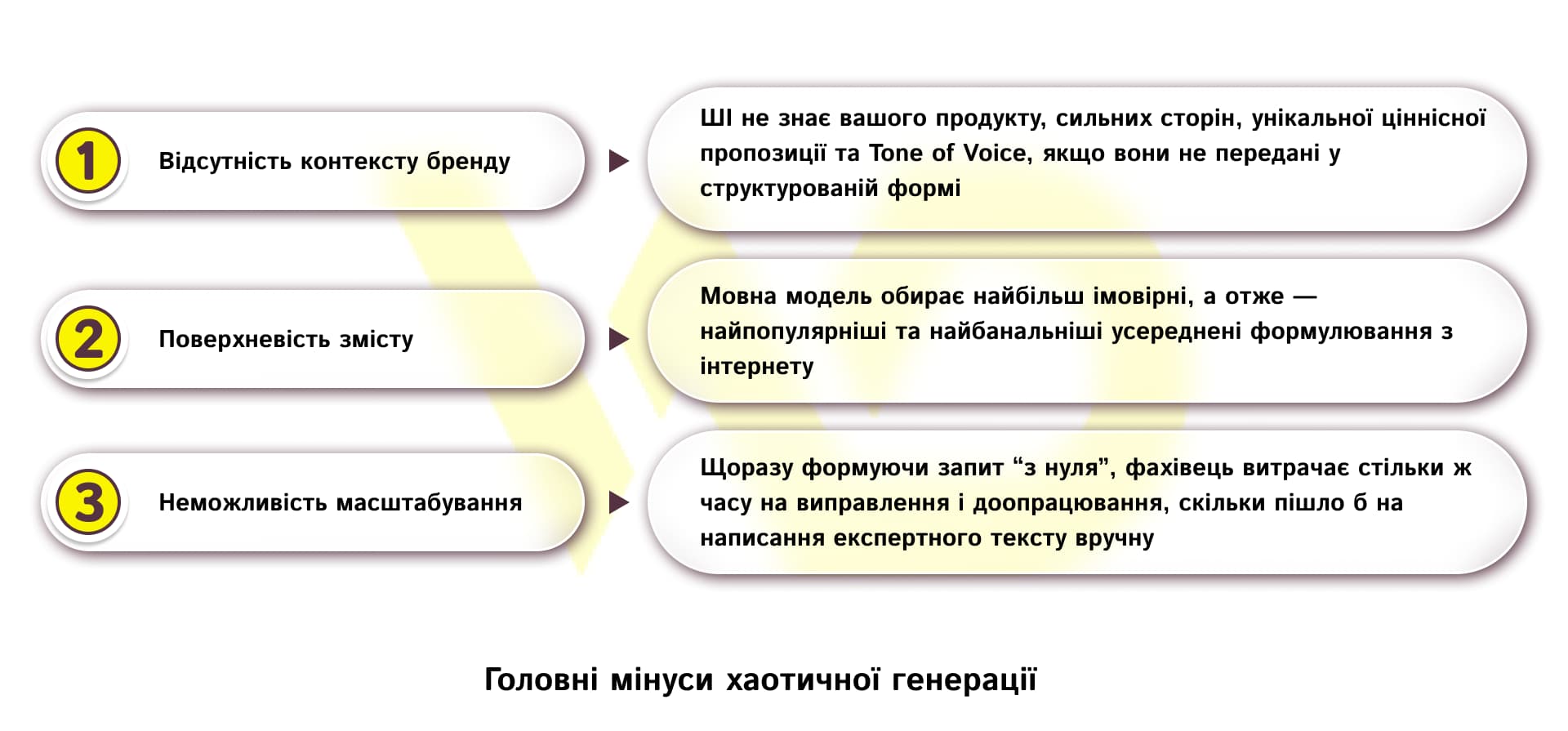
In contrast, content marketing automation involves building a systematic content pipeline. This is an end-to-end operational process divided into clear, sequential stages, where each task has input standards, an expected outcome, and established quality control points.
According to McKinsey’s estimates, generative AI has the potential to increase the productivity of marketing functions by 5–15% of total marketing expenses. This refers specifically to the potential economic benefit, not a guaranteed result for every company. However, this economic effect is achieved not by reducing the number of specialists—by speeding up initial data processing and draft preparation by 2–3 times—but by reallocating human resources toward deeper strategy and the creation of unique, expert-driven content.
The content pipeline transforms content creation from a spontaneous creative process into a managed production system. In such a system, AI acts as a powerful assistant: it quickly processes large amounts of information, identifies connections, forms structures, and creates initial drafts, leaving humans to focus on what matters most decision-making, fact-checking, and infusing the material with the author’s voice.
What makes up a content pipeline
An effective content pipeline consists of sequential modules. Skipping even one of them immediately reduces the quality of the final product. Let’s take a detailed look at how to organize the process, from finding an idea to producing a finished draft.
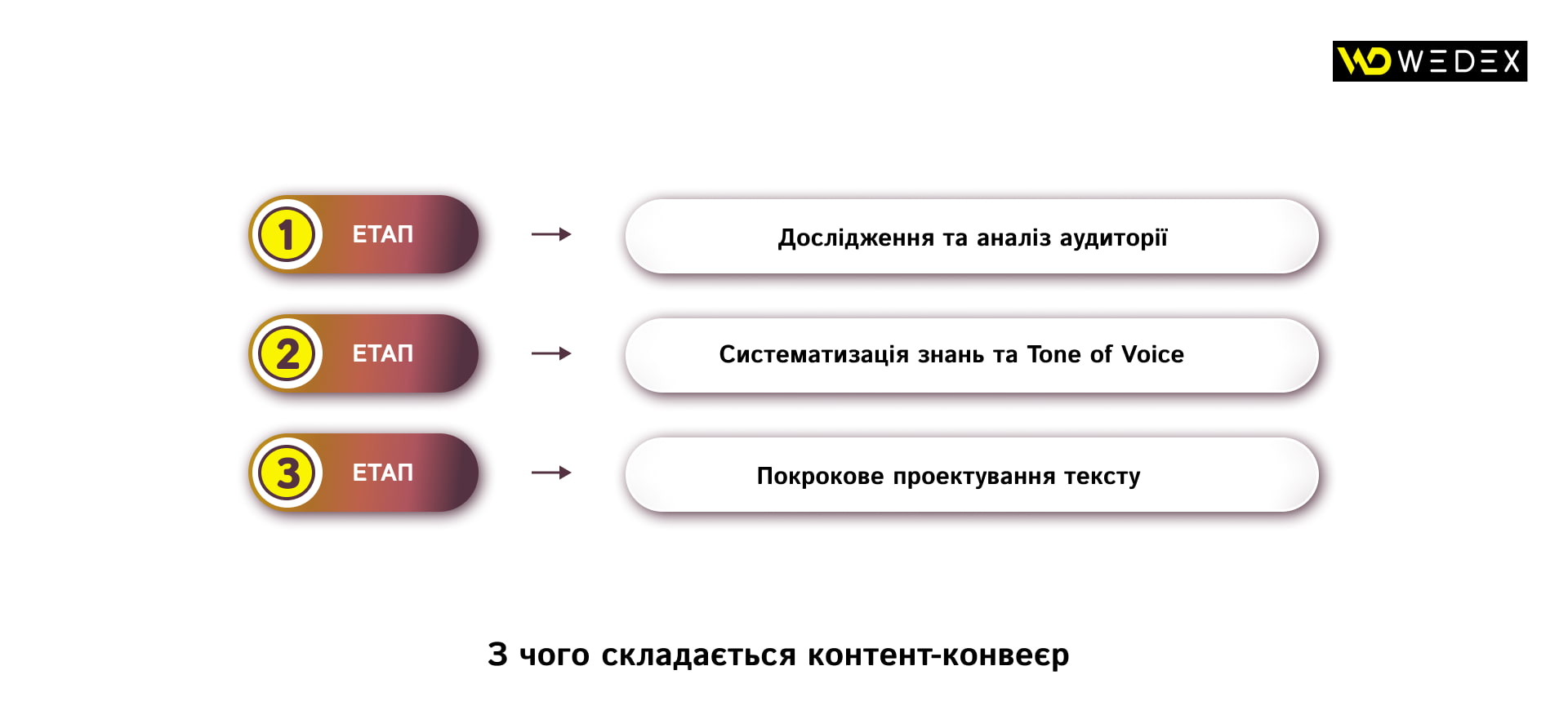
Stage 1. Audience research and analysis
Creating high-quality content begins not with subjective brainstorming, but with in-depth data analysis. At this stage, artificial intelligence takes on the role of an analyst: specialized tools like Perplexity AI or Claude process large volumes of competitors’ publications in just a few minutes, extract key user questions from topic-specific forums, and cluster the semantic core. The most valuable aspect at this stage is identifying information gaps that is, topics that the market has covered only superficially or overlooked entirely. Next, a content strategist steps in to evaluate the generated hypotheses through the lens of business goals. They filter out everything unnecessary, retaining only those topics that have commercial potential, align with the product, and are supported by the company’s internal expertise.
Stage 2. Knowledge systematization and Tone of Voice
The main reason why traditionally generated text is perceived as foreign is that the language model lacks access to the brand’s internal context. This problem is solved by developing specialized AI assistants in the form of Custom GPT or Claude Projects, trained on the corporate knowledge base. The model is given a clear operational framework: product descriptions, detailed target audience profiles, key value propositions, and pre-approved style guidelines (Tone of Voice). Another important component of this stage is the inclusion of stop words. The model is pre-programmed to ignore bureaucratic jargon, empty adjectives, and clichés such as «in today’s dynamic world» or «it is important to note», thereby immediately stripping the initial text of typical AI-style phrasing.
Stage 3. Step-by-step text design
Attempting to generate a 10,000-character article using a single prompt always results in a loss of logic, repetitions, and vague phrasing. That is why the third stage is based on cascading prompting technology, where text generation is broken down into a clear sequence of interconnected steps. First, the algorithm generates technical specifications and a basic outline based on semantics and a knowledge base. An editor then refines this framework, adding requirements to ensure specific business cases of the company are covered. Once the structure is approved, the AI generates the content in blocks — section by section — which helps maintain a high density of ideas and detail in each paragraph. Finally, the model performs an initial edit of the material, ensuring smooth transitions between ideas, and the specialist receives a finished draft that already meets 60–70% of editorial standards.
It is this structured draft that serves as a solid foundation for the next, most critical stage expert refinement, fact-checking, and giving the text the brand’s unique voice.
The human-in-the-loop principle: quality control, fact-checking, and E-E-A-T
No language model, not even the most advanced one, possesses real-world or business experience. AI operates based on the probability of words occurring, not on an understanding of the essence of phenomena. That is why the Human-in-the-Loop concept is a fundamental prerequisite for the functioning of a high-quality content pipeline.
According to HubSpot’s «State of AI in Marketing» report, over 80% of marketers use AI to generate content; however, they emphasize that content created by artificial intelligence must be edited and refined by a human before publication.
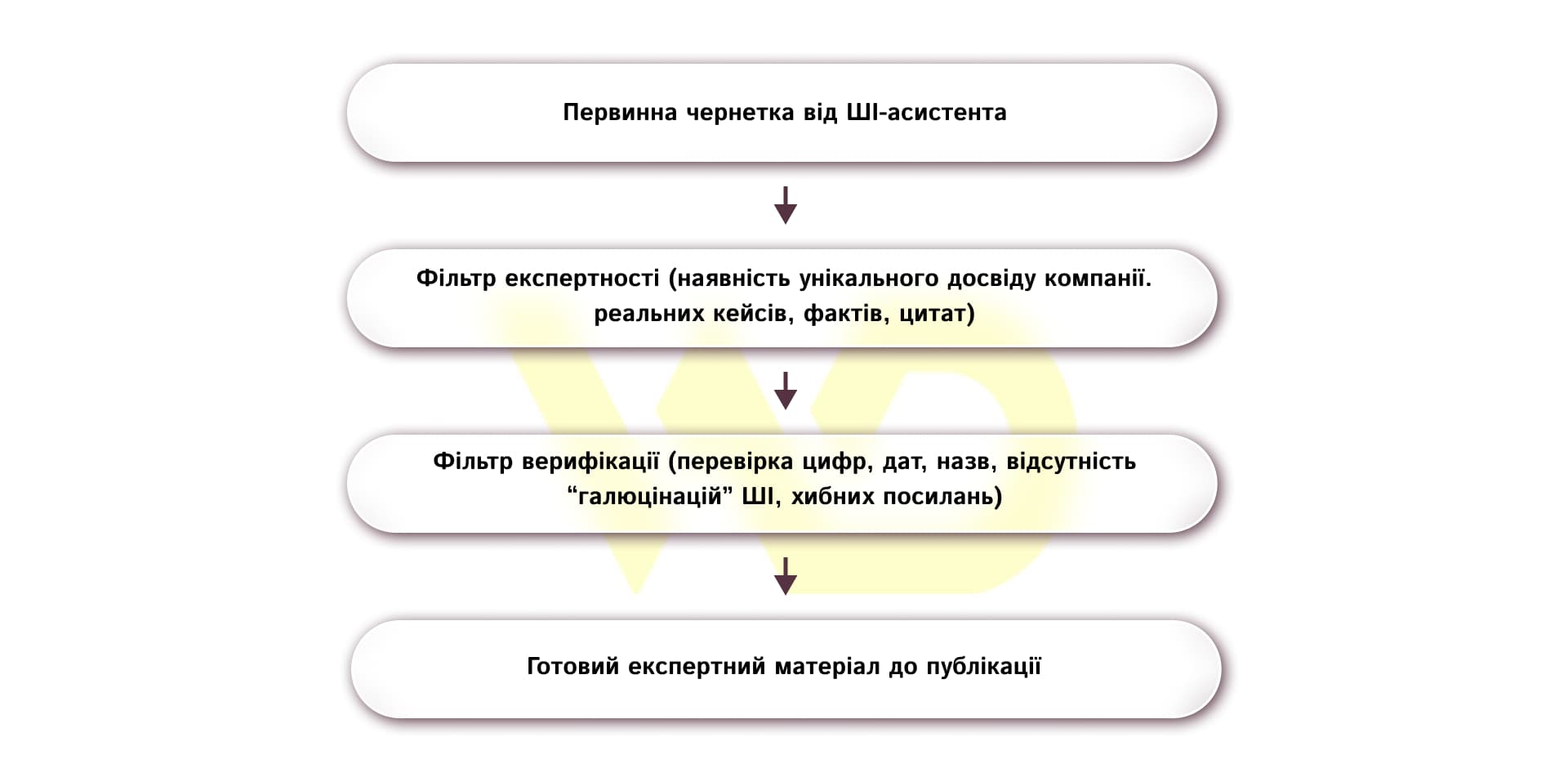
Protection against hallucinations and fact-checking
Language models are prone to «hallucinations» convincing fabrications of facts, statistics, scientific studies, and quotes. Publishing unreliable data deals a devastating blow to a business’s reputation.
The verification rule on the pipeline is as follows: no number, date, company name, or statistical claim generated by AI is published without direct confirmation from the original source.
The editor must verify every claim using official documentation, scientific publications, or primary reports from research companies. If a source cannot be found, the claim is removed from the text.
Compliance with Google E-E-A-T requirements and the concept of information gain
Search engines are becoming increasingly demanding when it comes to content quality. Official documentation from Google Search Central emphasizes that the system evaluates content based on E-E-A-T criteria (Experience, Expertise, Authoritativeness, Trustworthiness). At the same time, the algorithms do not care whether the text was created by a human or by AI. The main thing is whether it provides real value to the user.
The mass creation of websites with non-unique AI-generated text falls under Google anti-spam policies. To prevent a website from being penalized in search results, each piece of content must include unique information not found in other online sources (Information Gain).
A human refines the AI-generated draft on the production line by adding:
- practical experience: real screenshots, charts, and internal company figures;
- expert quotes: comments from the company’s subject matter experts, their perspectives on the issue, and counterexamples;
- real-world examples: abstract AI reasoning is replaced with specific business scenarios;
- editorial polishing: removing filler words, smoothing out sentence flow, and giving the text a lively, persuasive tone.
AI creates a high-quality framework and phrasing, but it is people who fill the content with meaning, which builds trust with the audience and search engines.
How to scale and cascade articles
Creating a foundational expert article requires significant resources, even when using AI. However, the greatest efficiency of a content pipeline is achieved during the cascading stage transforming a single piece of core content into an ecosystem of microcontent for various communication channels.
Artificial intelligence is ideal for adapting the format and style to the requirements of different platforms while preserving the key content.
The «content tree» model in practice
Once the main article has been approved by the editorial board, it is submitted to an AI assistant along with a series of specific prompts for transformation. The algorithm systematically adapts the verified information to meet the requirements and tone of various platforms.
Professional posts for LinkedIn
For the professional network, artificial intelligence extracts the key hypothesis, the main problem, and conclusions backed by data from the long-form article. The model adapts the material to a concise B2B style without introductory «fluff», focusing on specific metrics and business results. As a result, the team receives 2–3 ready-to-post articles for top managers’ personal profiles or the company’s official page, designed to stimulate professional discussions.
Quick posts for Telegram and social media
At this stage, the AI task is to extract practical instructions from a large body of material and package them into dynamic checklists or brief tips. The model transforms lengthy reflections into concise, easy-to-digest points tailored for quick scrolling through a feed. This allows us to publish a series of succinct posts that instantly convey the main takeaway to the reader.
Email newsletter for subscribers
AI transforms an article into a personalized message on behalf of a department head or subject matter expert. The algorithm identifies the audience’s key «pain point», offers a concise preview of the solution from the long-form article, and crafts a compelling call to action with a link to the full version of the content. In addition to the email text itself, the assistant immediately generates several options for compelling subject lines for A/B testing the newsletter.
Scripts for short videos (Shorts / Reels) and carousels
For visual formats, the AI selects the most compelling idea, a striking example, or a counterexample from the article and builds a dynamic script around it. The model clearly breaks down the structure into three elements: an attention-grabbing hook to hold the audience’s interest, the essence of the problem, and its quick solution in 30 seconds. As a result, the content creator receives a ready-made shot-by-shot script with text prompts, which just needs to be filmed or sent to a designer.
Important! With this workflow, the team spends time on in-depth research and fact-checking only once during the creation of the source material. Then, within a few minutes, the AI adapts this verified content to dozens of formats. At the same time, the risk of hallucinations during the cascading stage is virtually zero, since the AI works exclusively with the finished article text provided to it, rather than searching for information online.
How to evaluate the effectiveness of an AI pipeline and avoid mistakes during implementation
Building a content pipeline isn’t just about configuring prompts it’s about rethinking the team’s operational model. Even with the right architecture, companies often make mistakes during the launch phase.
Three major pitfalls when transitioning to an AI pipeline:
- Automating chaos instead of establishing a systematic approach.
Attempting to deploy ChatGPT to a team without a unified knowledge base and standards leads to each employee generating content at their own discretion. AI only accelerates the chaos rather than eliminating it.
- Ignoring the verification stage.
When the team sees that AI can produce complex and coherent text in seconds, there’s a temptation to skip human fact-checking. As a result, fake statistics, fabricated research, and clichéd phrases end up on the blog, which destroys SEO rankings and audience trust.
- Measuring effectiveness solely by volume.
Publishing 50 articles instead of 5 is not a victory if they don’t drive targeted traffic and generate leads. Content volume without measuring its quality and business metrics only clutters the website.
To ensure that your content pipeline performs as expected and delivers a return on investment, you need to implement an end-to-end analytics system.
Building a managed content pipeline transforms copywriting into content product management. Artificial intelligence takes on the role of a routine executor and analyst, but it is human expertise, editorial oversight, and strategic control that turn a collection of words into a practical tool for attracting customers.

commercial offer
Other articles by the author

22/04/2026
A portfolio is a collection of works, projects, case studies, and materials compiled in one place to demonstrate a professional’s expertise.

18/06/2026
A marketing director is, first and foremost, a top manager who is part of a company’s senior leadership and thinks in terms of the business as a whole, rather than individual advertising campaigns.

20/03/2026
An ambassador isn’t just a marketing channel—it’s a multifunctional resource: trust, content, traffic, reputation support, and product narrative.
Latest articles by #Useful tips
29/09/2026
A content pipeline transforms the creation of content from a spontaneous creative process into a managed production system. In such a system, AI serves as a powerful assistant.

10/09/2026
The 4P model serves as an architectural foundation that transforms disparate marketing activities into a single, manageable system.

08/09/2026
Today, an influencer is a distinct media platform with its own editorial policy, a keen understanding of its audience, and an established level of trust.