

 04/09/2026
  1120
1120

Інтернет-маркетинг
простою мовою
Content of the article

What is website ranking on the internet and what determines a site position in search results

When two different users search for the exact same word in a search engine, they may get completely different lists of web pages, and the websites themselves constantly change their positions in the search results. The reason lies in complex algorithms that seek out the most useful answers among billions of possible options.
In this article, we’ll explore what website ranking is, the principles by which algorithms evaluate content, and the specific factors that determine a website’s visibility in search engines.
What is website ranking
In everyday language, the terms «indexing», «ranking» and «position» are often treated as synonyms, but it’s important to distinguish them clearly. A search engine goes through several sequential stages before a user sees the final result on their screen.
The official Google Search Central documentation describes this process in three fundamental steps. The first stage is crawling, during which search bots follow links and discover new or updated web pages. The next step is indexing, when the system analyzes the content of the found page, stores its text and media elements, and adds the document to its vast database.
Ranking itself begins only when a user enters a specific search query. This is the process of sorting and organizing already indexed pages by their relevance and usefulness to a specific person. The position, in turn, is the final spot that a specific URL occupies on the search results page among all competitors.
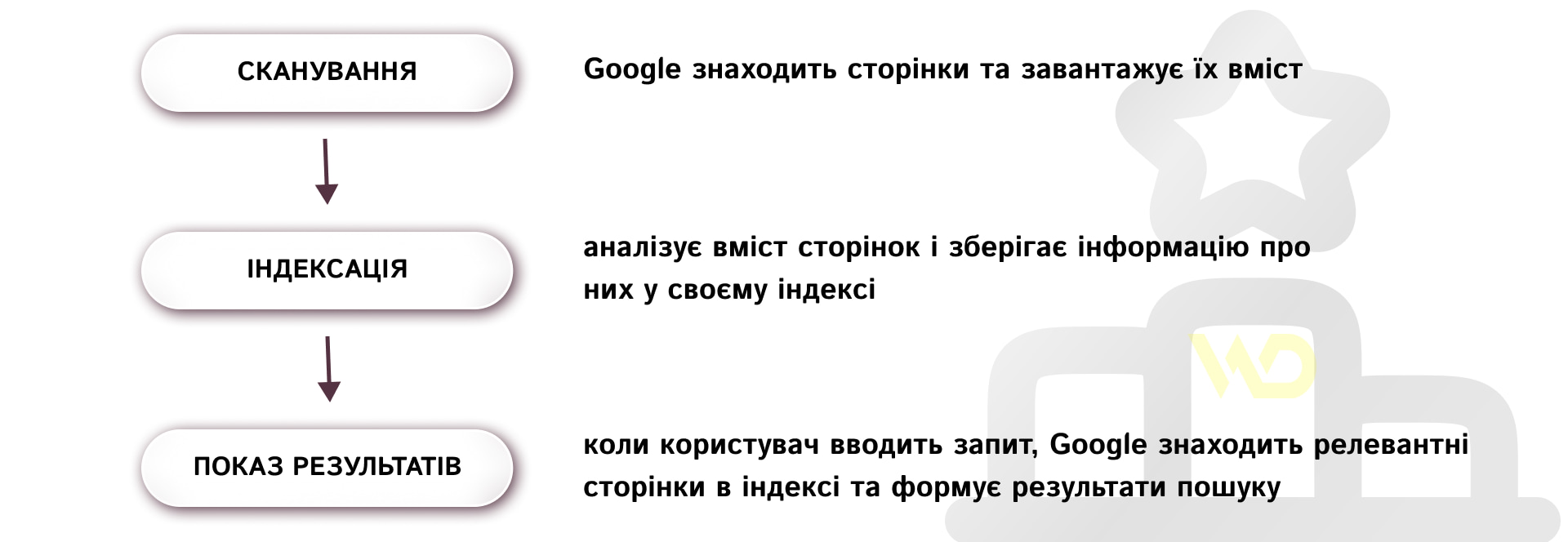
Thus, a page may be successfully indexed but still rank low or even appear outside the first few pages of results if the algorithm deems it less relevant to the query.
How a search engine determines a page position in search results
When a user clicks the search button, the system performs complex calculations in a fraction of a second. This process consists of several sequential steps.
- Analysis of the query and the user’s intent. The algorithm parses the entered text, corrects any typos, identifies the language, and determines the true intent of the search.
- Searching for matches in the index. The system queries its database and selects all documents containing the necessary terms and semantic relationships.
- Evaluation based on quality signals. Algorithms analyze each document found against hundreds of criteria, checking the resource’s authority, readability, and technical condition.
- Personalization of results. The search engine adjusts the order of the pages based on the user’s geographic location, device type, language settings, and time of day.
Search results are not a static list set in stone once and for all; therefore, the rankings of the same page are constantly changing.
For example, if someone searches for car repair services in Dnipro, the algorithm will generate a list of local service centers. The same search query in Kyiv will show completely different websites, since the search engine prioritizes local relevance for the user’s convenience.
What determines a website ranking
For a long time, there was a myth in professional circles about a closed list of 200 factors, each with a specific point value. Modern search engines operate in a much more complex way, relying on a combination of machine learning systems and signals whose weight varies depending on the topic and nature of the query. For convenience, these signals can be grouped into several key categories.

Content quality and usefulness
The foundation for high rankings is a focus on people, not algorithms. Google requires that the content provide a complete, comprehensive, and original answer to the question the visitor came with. The text must be easy to read, logically structured, and contain reliable facts.
Simply stuffing a page with keywords that have no real practical value no longer works. If the text is written exclusively for search bots and does not solve the user’s problem, the system will quickly lose trust in it.
Alignment with search intent
Even a thorough, high-quality article won’t rank highly if it doesn’t match the type of user need known in SEO as «search intent». Search intent determines exactly what a person expects to see in response to their query.
Let’s look at a practical example. When searching with the intent to buy a laptop, a user expects to find an online store catalog with filters, prices, and checkout buttons. If, instead of a catalog, they’re presented with a detailed long-form article about the history of laptops, the visitor will dismiss the page even if the content itself is perfectly written.
Experience, expertise, authority and trust
The E-E-A-T concept is an important guideline for evaluating the quality of content, especially in areas that affect human health, finances, or safety. However, it’s important to understand that this is not a single algorithmic score or numerical metric that can be measured in the Webmaster Tools dashboard.
The search engine analyzes indirect signals that confirm the author’s actual experience and the company’s reliability. These include a detailed «About Us» page listing the author’s credentials, links to authoritative sources of information, transparent business contact information, customer reviews, and brand mentions on independent websites.
Technical optimization
High-quality content is meaningless if search bots cannot access it or encounter technical obstacles while processing the page. The technical infrastructure ensures proper interaction between the server, the search engine, and the visitor. Important:
- configuring the robots.txt file and the sitemap to properly guide search engine crawlers;
- using canonical tags to prevent duplicate pages;
- fast content loading speeds and optimization for mobile devices;
- compliance with Core Web Vitals metrics, which measure the speed of core content rendering and layout stability.
Optimizing technical parameters creates a solid foundation that allows search engines to index and correctly interpret the content of your pages without any issues.
It’s time to check your website’s technical condition
We’ll conduct a comprehensive technical audit to identify issues that may affect indexing, speed, and SEO results. WEDEX specialists will pinpoint priority areas for optimization and advise you on where to start.
Internal structure and linking
A logical site architecture helps both visitors and search engine crawlers navigate between sections. Internal links connect thematically related content and distribute relative weight among pages.
Thanks to well-thought-out internal linking, algorithms can find new posts faster and understand which pages are the most important in your site’s hierarchy. If many other pages on the site link to an important category, this signals its high priority.
External links and authority
External links from other sites remain an important indicator of a site’s authority. Google still uses link analysis and the principles of the PageRank algorithm in its modern ranking systems, albeit in a much more complex form than in the early days of search.
Today, it is not the number of links that plays a key role, but their quality and naturalness. A link from a relevant, topic-specific, and authoritative resource is highly valuable, whereas mass link placement on questionable sites can harm a website’s visibility.
User experience
Search engines aim to recommend websites that are easy to use. Intuitive navigation, clear fonts, the absence of intrusive pop-ups, and responsiveness across all screen sizes all contribute to a positive user experience.
There is a simplified notion that algorithms directly measure the number of seconds a user spends on a page and use this to improve its ranking. In reality, search engines evaluate the audience’s overall behavior in search results and their general satisfaction with the results, rather than relying on a single abstract time metric.
Timeliness of information
For many types of queries, the freshness of data is a decisive factor. Google uses specialized systems to determine relevance, which give priority to newer content in areas where information quickly becomes outdated.
This is particularly critical for news, legislative changes, financial rates, reviews of new technologies, or seasonal services. If an article on tax reporting was written several years ago and has not been updated, it will be replaced by newer content reflecting current legal regulations.
Local factors
For companies tied to a specific physical location, regional optimization becomes a significant factor. Search engines aim to display the closest and most convenient options for solving local needs.
A completed Google Business Profile, the inclusion of an accurate address and local contact numbers on the website, as well as mentions of the company on regional portals, help secure top positions in local search results and on maps.
It’s important to understand that none of these areas works in isolation. Modern ranking is always a comprehensive assessment, where the technical soundness of the website allows the search engine to find content, expertise builds trust, and a user-friendly interface helps the user get the desired result. Ignoring even one group of factors can negate all efforts in the others, so optimization requires balanced and systematic work across the entire website.
Are all pages on a website ranked the same way?
A common misconception is that a website’s overall authority automatically guarantees high rankings for every newly created page. Official statements from Google confirm that most ranking systems operate at the level of individual URL, although site-wide quality factors also play a role in the process.
Let’s look at this using an online store as an example. A page selling iPhones on a popular website might rank first in search results thanks to its high level of detail, thousands of reviews, and a strong backlink profile. At the same time, a new blog post from the same store targeting a competitive search query might end up on the third page of search results if the text itself is superficial or loses out to content from specialized publications.
The domain’s overall authority provides a certain initial boost, but each individual page competes for its own position in the search results independently, demonstrating its own relevance to a specific query.
How to improve a website rankings in search results
Working to improve visibility requires a consistent and systematic approach. It’s impossible to achieve lasting results with a single, isolated adjustment, since search results are a dynamic environment.
- Conduct a thorough technical audit of the site to identify and fix indexing errors, duplicate content, and speed issues.
- Research search demand, compile a semantic core, and thoroughly analyze the intent of potential customers.
- Update and refine existing content, making it more comprehensive, structured, and up-to-date compared to competitors content.
- Optimize the internal structure, set up intuitive navigation, and establish a logical system of internal links between pages.
- Build brand authority through high-quality external mentions, publications on industry-specific resources, and work on local factors.
It’s important to remember that no reputable specialist or tool can guarantee a fixed spot in the top 1, as Google explicitly warns against such promises. Algorithms are regularly updated, and competitors are also improving their sites, so SEO is an ongoing process of website development.
Why a website might lose rankings
A decline in search engine visibility does not always indicate penalties or sanctions. In most cases, a drop in rankings is a natural consequence of changes in the environment or within the website itself.

Among the main reasons for losing rankings are increased activity from competitors who have created higher-quality and more detailed content, or the natural obsolescence of your content. Rankings can also change due to shifts in user intent, where people begin searching for a different format of information for a specific query.
Technical server issues, accidental exclusion of important sections from indexing, or scheduled updates to the search engine’s core algorithms (Core Updates) can also lead to fluctuations in traffic. Understanding these causes allows you to calmly analyze the situation and systematically restore your website’s performance.
In summary, it’s worth noting that rankings are the result of many interconnected systems working together to provide users with the most convenient and accurate answer to their query. A page’s ranking is determined holistically, taking into account content quality, the site’s technical health, its authority, and user-friendliness.
Successful SEO does not lie in attempts to circumvent algorithms or guess the weighting factors of individual elements, but in the continuous development of the website as a useful tool for your audience.

commercial offer
Other articles by the author

23/07/2026
Today, it’s not enough for businesses to simply adopt new tools; it’s important to understand how consumer psychology is changing.

16/04/2026
This is particularly important in business content, as the text must not only be grammatically correct but also serve a specific purpose.

05/03/2026
Customer focus is a systematic approach where all parts of the business work for the convenience and benefit of the customer: product, processes, communications, and internal culture.
Latest articles by #SEO

20/10/2026
Ben Hunt's model is a tool that helps break down a customer's path to purchase based on their level of awareness and select the right messages for each stage.

29/09/2026
A content pipeline transforms the creation of content from a spontaneous creative process into a managed production system. In such a system, AI serves as a powerful assistant.

10/09/2026
The 4P model serves as an architectural foundation that transforms disparate marketing activities into a single, manageable system.