

 16/04/2026
  1796
1796

Інтернет-маркетинг
простою мовою
Content of the article
- /01 What should a strong technical task contain?
- /02 How to prepare a brief for a neural network
- /03 Analyzing competitors’ articles with a neural network
- /04 How to work with keywords and topic coverage
- /05 Facts, examples, and sources: how to strengthen the expertise of your content
- /06 Formulating the final structure of the article
- /07 How to formulate instructions for a writer
- /08 How to adapt one ToR to different content formats

How to create the perfect content specification using neural networks

Content specifications have become one of the key tools in the work of marketing and content teams. For businesses, it’s a way to launch texts faster and get materials that meet the goal, speak the language of the audience, and have a clear structure. Neural networks are really useful in this regard: they help to research a topic, collect ideas, structure the material, and formulate a draft of the task. But the final quality still depends on a human who checks the facts, logic, and relevance to the business task.
In this article, we will analyze what to prepare for working with AI, how to analyze competitors, build a structure, collect semantics, write instructions for a writer, and adapt the resulting ToR to different content formats.
What should a strong technical task contain?
A strong statement of work is not just the topic of the article, but a clear instruction that helps the writer immediately understand what kind of material needs to be created and what result is expected from him or her. This is especially important in business content, because the text should not only be competent but also work for a specific purpose: to inform, explain, build trust, or support SEO tasks.
The structure of a high-quality ToR must include
- the topic of the article
- the purpose of the article
- target audience
- content format;
- search or communication intent;
- list of keywords;
- desired structure;
- requirements for tone and style;
- facts, examples or sources to be used;
- criteria by which the finished text will be evaluated.
It is this kind of detail that makes the ToR a working tool, not a formality. Moreover, this approach is in line with Google’s recommendations for people-first content: the material should be created primarily for people, be useful, accurate, and relevant, and not exist only as a set of SEO elements.
How to prepare a brief for a neural network
For AI to really help in the creation of the SoW, it needs to be given a meaningful starting brief. This is not the technical task itself, but a set of input data, based on which the neural network will be able to generate a useful draft of the structure, headings, or semantic blocks.

This allows the neural network to work more accurately and it does not invent the framework itself, but relies on the already set context. For example, for a B2B company, it is important to immediately determine whether the material should explain an expert topic, lead to an application, or work on brand credibility. Without such clarification, AI usually offers a universal structure that looks neat but does not always meet the real business goal.
Analyzing competitors’ articles with a neural network
One of the most effective ways to use AI in the preparation of SoW is to quickly analyze competitors’ content. A neural network allows you to collect a list of articles, structure their content, highlight recurring themes, and find gaps that can be used to create stronger material.
In practice, it looks like a sequential process.
- You set a topic and get a list of relevant articles.
- You pass the texts or links to the neural network.
- Ask it to analyze the structure, meanings, and approach of the authors.
- You get a summarized picture: what has already been disclosed and what has not.
For example, let’s imagine that you are preparing an article for a pet store or a veterinary clinic on the topic of raising a puppy. You can use the following prompt, which can be adapted to any topic:
«Analyze the following articles on the topic of “raising a puppy ” (I will provide texts or links).
Task:
- Briefly describe the content of each article (2-3 sentences).
- Identify the main themes and subthemes that are repeated in most of the materials.
- Identify which issues are covered superficially or without practice.
- Find what is missing in these articles.
- Identify content opportunities: how you can make the material deeper, more useful, and more structured.
- Suggest an ideal article structure that will be better than the competition.
Give your answer in a structured way, with subheadings and specific conclusions without general phrases.»
After analyzing 5-10 competitors’ articles, the neural network can give a generalized picture that most often competitors have information about basic commands, toilet training, feeding regimen, and general advice without specifics. As well as other recurring weaknesses. Further, based on such an analysis, specific opportunities for strengthening the future material are opened up. Instead of general advice, it is advisable to build a step-by-step puppy training program with a weekly schedule that gives the reader a clear understanding of the sequence of actions. Practical scenarios explaining how to act in typical situations and explaining not only the animal’s actions but also the logic of its learning add additional value.
In this approach, the text ceases to be a formal list of tips and turns into a systematic, in-depth material that truly surpasses most competitive publications.
How to work with keywords and topic coverage
Neural networks can greatly simplify the work with semantics. However, AI does not replace professional SEO tools such as Ahrefs, Serpstat, or Google Keyword Planner, as it does not provide accurate data on the frequency or competition of queries. At the same time, it works effectively at the stage of generating ideas, helping to expand the semantic field and see the topic from a broader perspective.
It is advisable to use a neural network as a tool for preliminary collection of keywords, variations, and synonyms. It can suggest wording that is not always obvious, but corresponds to the real ways users formulate their queries. This is especially useful in niches where a variety of wording is important or where there are several variants of the same service name. This allows you to balance SEO requirements with readability. The text doesn’t look overloaded with keys, but at the same time covers enough queries to remain relevant to search engines.
For example, if you need to prepare an article on «how to write a technical task for a copywriter» a neural network can help you find additional wording and related queries.
The prompt will look like this:
«Imagine that you are an SEO specialist and you are preparing semantics for an article on “terms of reference for a copywriter “. Main keywords: terms of reference for a copywriter, terms of reference for a text, how to write a TоR. Suggest additional keywords, synonyms, and related queries that users can use. Divide by frequency.»
The neural network’s response is as follows:

Some of them will be mid- and low-frequency, but such wording often helps to expand coverage and make the material more relevant to different types of queries.
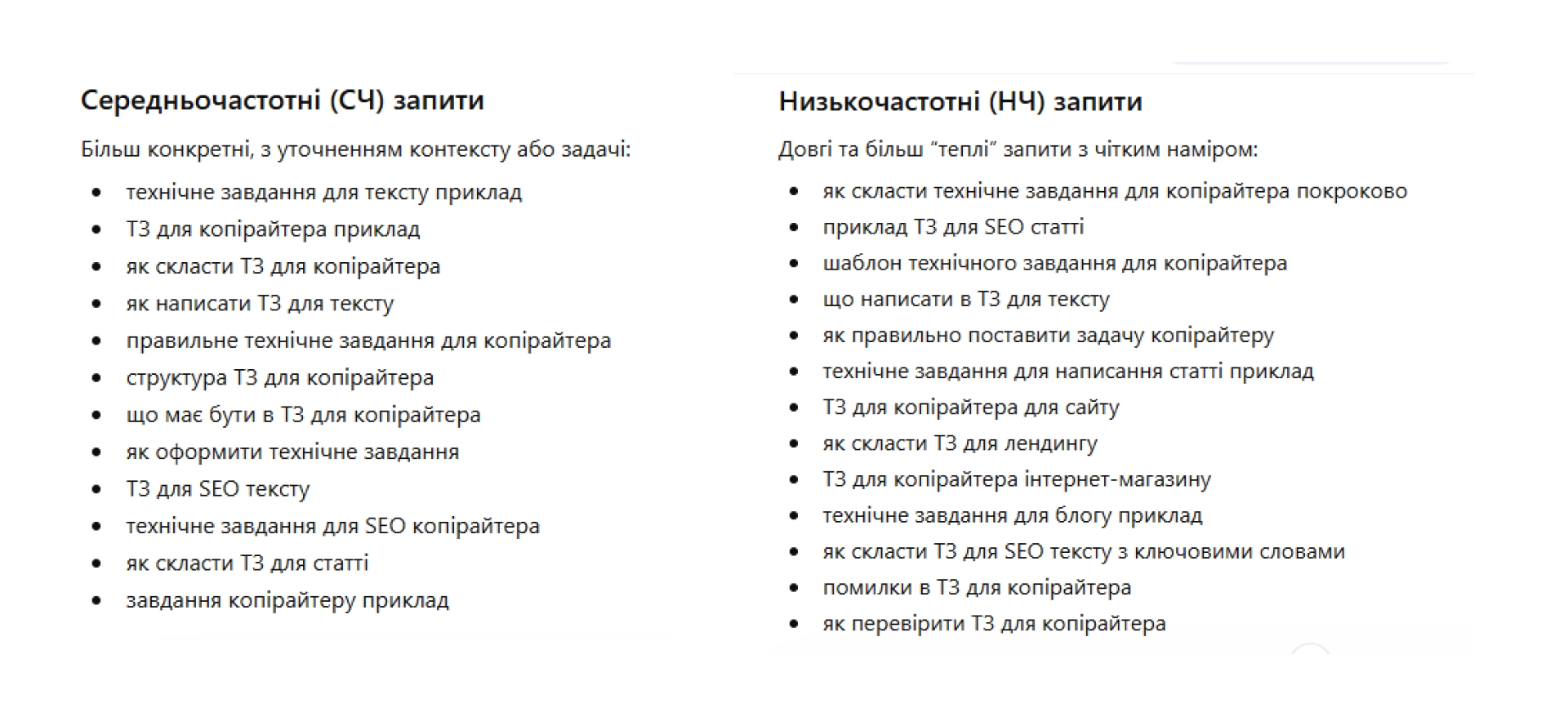
The neural network also produces:
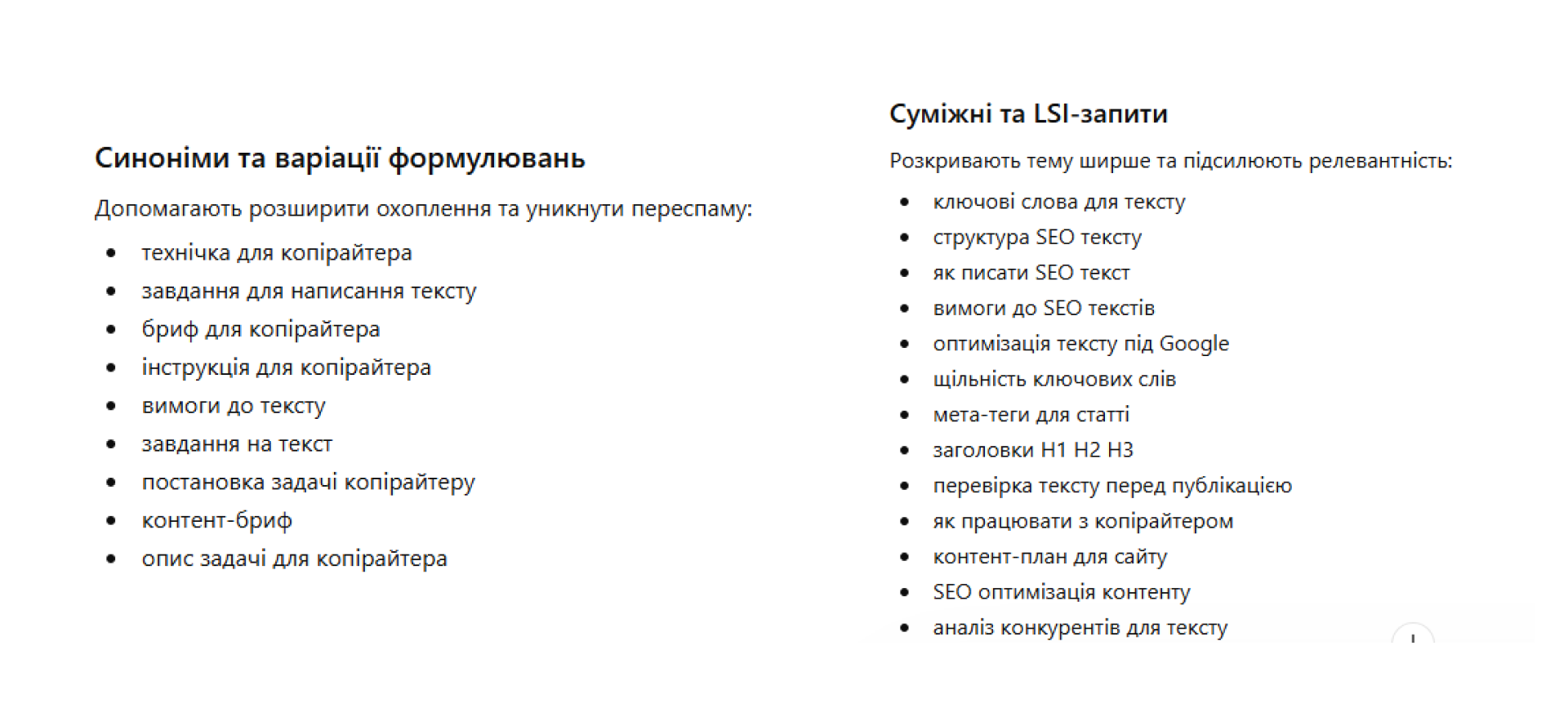
It is also interesting that AI can additionally offer intent queries on its own initiative, which will help with the formation of the article structure.

After this stage, the collected keywords should be checked using SEO tools to evaluate their effectiveness and appropriateness. In its recommendations, Google emphasizes that it is important to use words that people really search for and place them in prominent places on the page, in particular in the headings.
Facts, examples, and sources: how to strengthen the expertise of your content
It is at this stage that the difference between superficial text and trustworthy material is formed. The neural network can not only suggest where to add statistics or examples, but also help you quickly find relevant data to strengthen your expertise. This is especially important given Google’s approach to evaluating content through the EEAT principles (experience, expertise, authority, and trustworthiness).
AI is used as a tool for primary search. It can offer statistics, market dynamics, research results, or industry facts that should be integrated into the text. For example, for a story about the real estate market, this could be average prices by region, changes in demand, or the number of transactions over a certain period.
At the same time, it is important to understand the limitations. The neural network does not guarantee the reliability of sources. Therefore, every fact, figure, or link must be additionally verified through official resources, analytical platforms, or of the original source. This stage ensures the quality of content and reduces the risk of publishing inaccurate information.
To get more relevant results, you should immediately formulate a request with clear data requirements: period, geography, format, and the mandatory availability of sources. This approach allows you to collect the text for the article faster and make it not only informative but also convincing from the point of view of the business audience.
Formulating the final structure of the article
The last key step in getting the perfect ToR using a neural network is to build the structure of the future material. It is at this stage that the logic of the text is formed: how the sections will be arranged, in what sequence the topic will be covered, and how holistically the material will be perceived.
AI helps to quickly assemble the basic structure: offer several options, combine blocks of similar content, and build a sequence of sections. This allows you to immediately see the material from the outside and evaluate its logic before writing the text.
A structure is not just a list of subheadings. It determines how the reader will interact with the material. A well-structured text leads the reader from a general understanding of the topic to specific solutions, gradually delving into the details. In business content, this directly affects the perception of expertise and trust in the company.
For the structure to work, it is important to follow the basic principles:
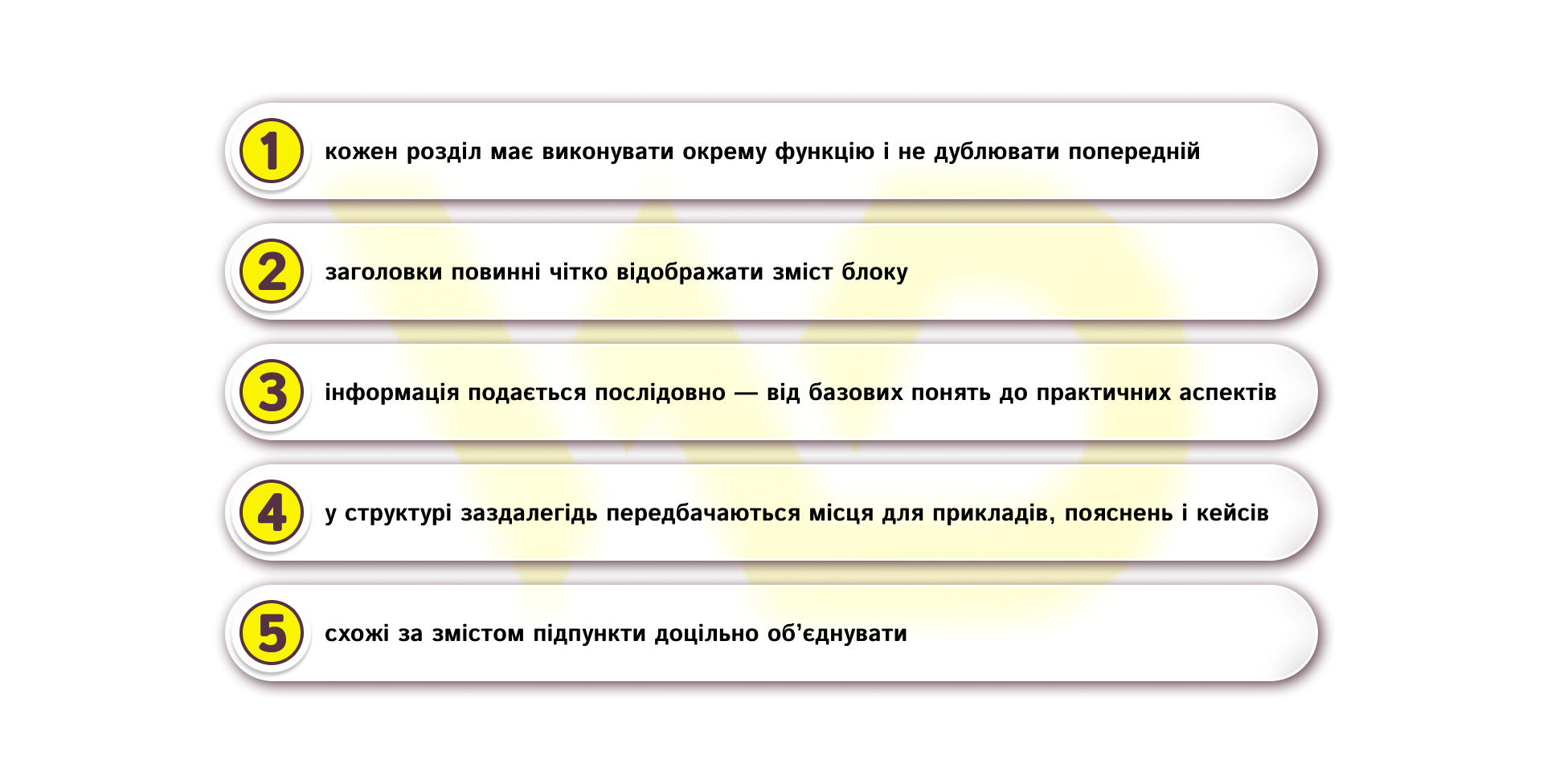
After that, the final structure is formed – as a proven and logically built framework of the article. At this stage, it is important to assess whether there are any overlaps between sections, whether the meanings are evenly distributed, and whether the order of the blocks corresponds to the user’s intentions.
Let’s look at the example of the car rental topic. To get a relevant result, it is important to clearly formulate the query.
Example prompt:
«Suggest a logical structure for an SEO article on the topic of car rental. Indicate in what order to cover the topic so that the text is understandable for the user, takes into account different intentions (informational and commercial), and meets the requirements of search engines.»
In response, the neural network usually forms a structure that includes an explanation of the service, rental benefits, terms and conditions, car selection criteria, price factors, and practical recommendations for customers.
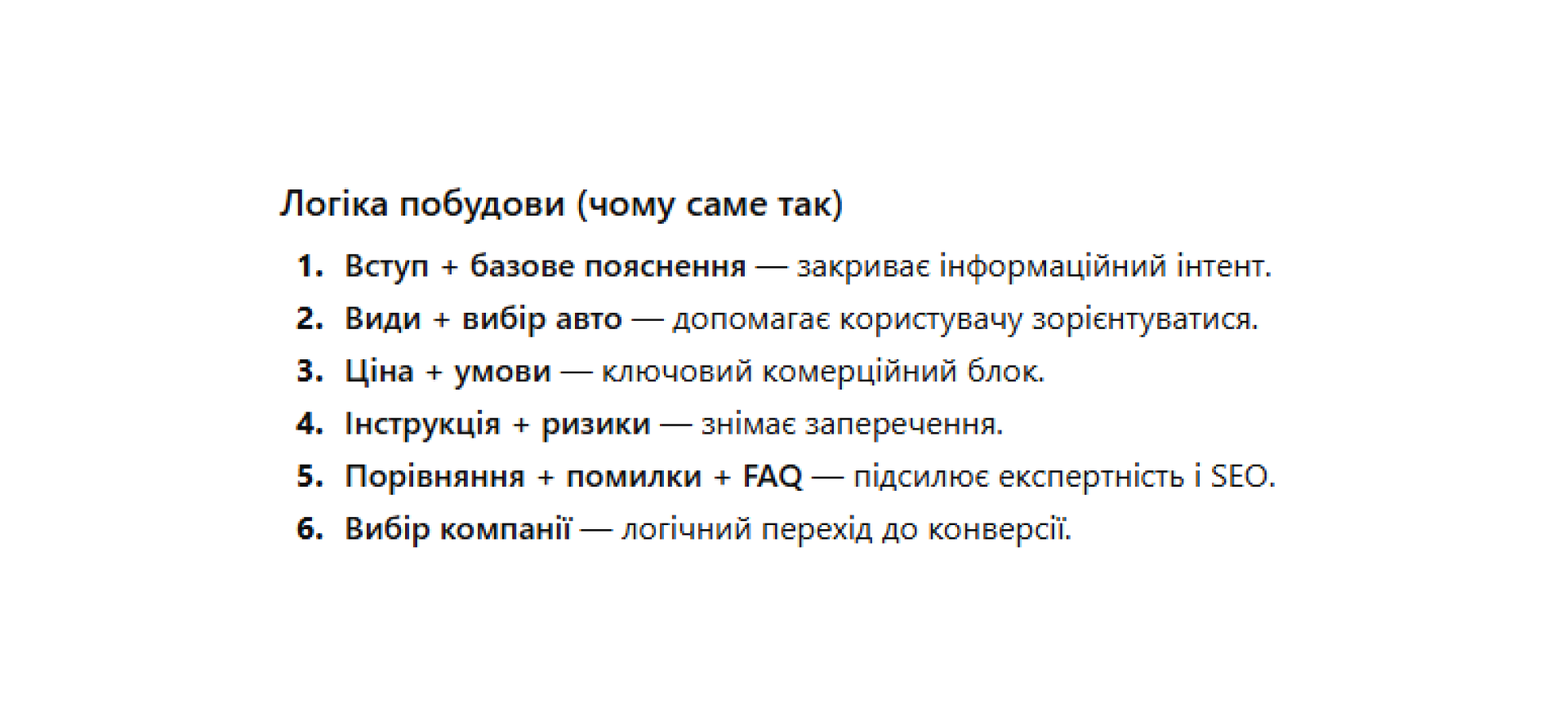
It is important that this approach allows you to immediately see whether there are any duplications between blocks and whether the meanings are logically distributed.
How to formulate instructions for a writer
Even a well-thought-out structure does not guarantee a high-quality result if the terms of reference do not contain clear explanations for each section. In practice, this is the reason for most edits: the writer sees the title but interprets it in his or her own way, which is why the text does not meet the business’s expectations.
To avoid this, it’s important to not just list subheadings in the ToR, but to set the exact direction for each block to be covered. For example, instead of saying «Describe the benefits of the product», it’s more appropriate to immediately clarify what benefits are meant, in what context they should be presented, and whether examples are needed. If it is a complex topic, it is worth specifying where an explanation in «simple terms» is necessary and where a brief summary without excessive detail is sufficient.
Special attention should be paid to the consistency of the material. If a certain aspect has already been covered in the previous section, it is better to fix it in the ToR to avoid repetition and overloading the text. It is also important to immediately indicate the requirements for facts and data: whether references to sources are needed, how critical the accuracy of figures is, and whether generalizations are permissible. As a result, this approach saves time for both the writer and the editor.
How to adapt one ToR to different content formats
The basic logic of the ToR is the same, but it needs to be adapted to a specific format. For an SEO article, semantics, structure, and search intent are important. For expert material, examples, arguments, and depth of disclosure come to the fore. For a commercial text, a clear logic of benefits, objections, and a call to action is essential. This is where a neural network can help to quickly reformulate the same framework for different tasks without losing logic.
This is especially useful for teams that work with more than one type of content and manage several areas at once. In this case, AI helps to speed up the preparation and make the process more standardized.

commercial offer
Other articles by the author

04/03/2026
A loyalty program is not just a discount tool, but a multidimensional business strategy.

27/05/2026
Web analytics has become one of the key components of digital marketing, as it helps businesses understand what happens on their website once they’ve attracted traffic.

20/03/2026
Detailed feedback allows you to take targeted action, conserve resources, and increase revenue.
Latest articles by #Useful tips

29/09/2026
A content pipeline transforms the creation of content from a spontaneous creative process into a managed production system. In such a system, AI serves as a powerful assistant.

10/09/2026
The 4P model serves as an architectural foundation that transforms disparate marketing activities into a single, manageable system.

08/09/2026
Today, an influencer is a distinct media platform with its own editorial policy, a keen understanding of its audience, and an established level of trust.