

 10/09/2026
  1094
1094

Інтернет-маркетинг
простою мовою
Content of the article
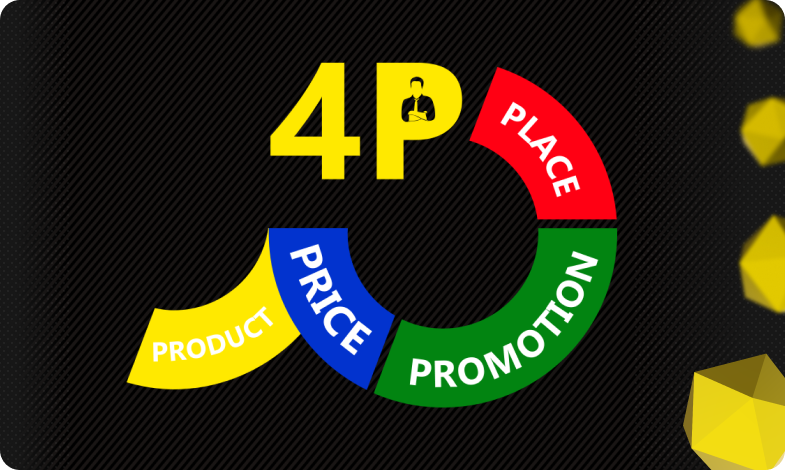
The 4P of marketing: model elements, modern alternatives and examples of application
Launching advertising campaigns haphazardly without a clearly defined pricing policy or sales channels is the main reason for budget wastage in modern business. The 4P model serves as the architectural foundation that transforms disparate marketing activities into a single, manageable system.
In this article, we’ll examine the systematic logic of the 4P, a business audit methodology based on it, as well as the expanded 7P and 4C alternatives, adapted for the services market and the digital environment.
Origins and concept of the 4P model
The history of the 4P model dates back to before the term itself was coined. In 1948, James W. Calliton, in his study «The management of marketing costs», described a business executive as a «mixer of ingredients» a sort of «mixer» who combines various marketing approaches depending on the situation. This idea influenced Neil Borden, who developed the concept of the marketing mix and, in 1964, published a systematic description of it comprising 12 key «ingredients». In 1960, E. Jerome McCarthy, in his book «Basic marketing: a managerial approach», grouped a broad set of marketing tools into four categories: Product, Price, Place, and Promotion the 4P model known today. The model subsequently became widely adopted in marketing literature, in part thanks to the works of Philip Kotler.
«Marketing remains an art, and the marketing manager, like a chef, must creatively combine all marketing activities.» — Neil H. Borden, *The Concept of the Marketing Mix*
This metaphor effectively conveys the key feature of the marketing mix: the result depends not on any single tool, but on how coherently a company integrates its marketing decisions.
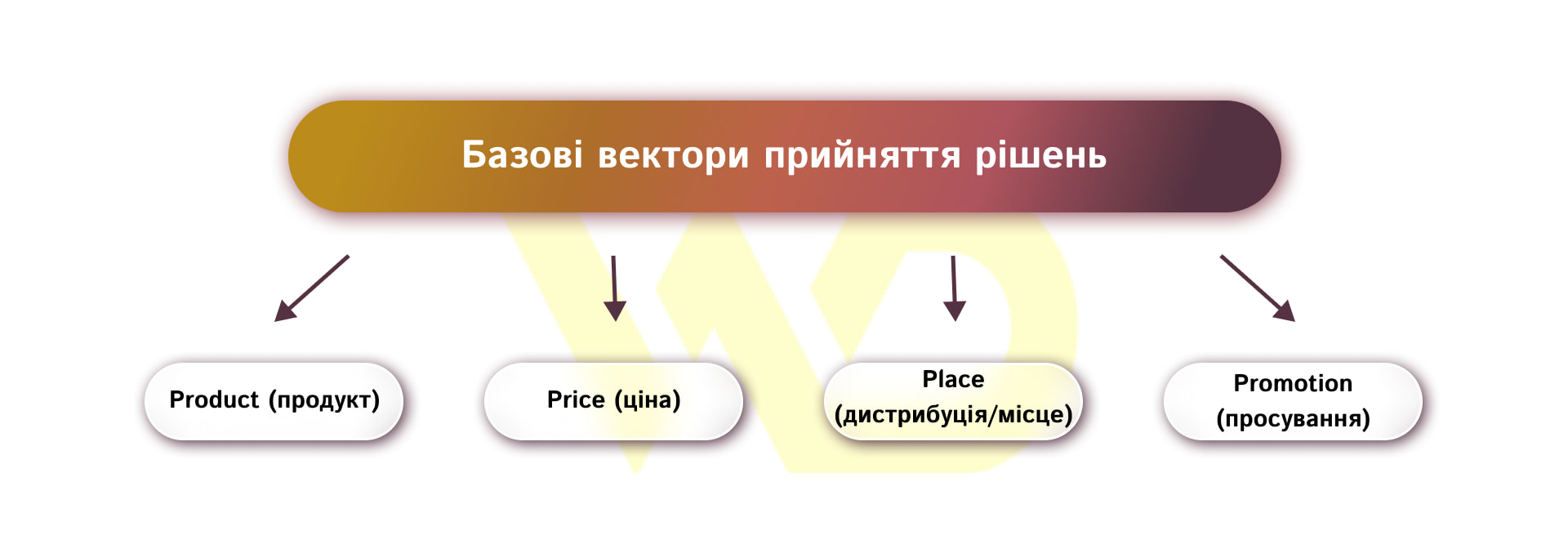
Thus, the anatomy of the 4P encompasses four basic decision-making vectors.
Product
The product is the fundamental source of value that drives consumers to buy from a business. It is not just a physical good or service, but the entire set of tangible and intangible characteristics that the customer receives. If the product does not solve a real problem for the target audience or falls short in functionality compared to alternatives, the other three elements will only accelerate its market failure.
The management framework for the Product block covers several critical areas:
- functional core: core benefits, technical specifications, reliability, performance, and build quality;
- product range policy: the breadth and depth of the product line, the development of new variants, and the timely discontinuation of obsolete items;
- visual and physical identity: industrial design, ergonomics, packaging, environmental friendliness of materials, and brand positioning;
- after-sales service: warranty period, speed and quality of technical support, availability of replacement parts, and after-sales service procedures.
When formulating a product strategy, a manager must clearly understand exactly which consumer problem the product solves and what creates its unique value proposition. It is important to assess at which stage of the life cycle the product line is and how exactly the updated product differs — both physically and emotionally — from all substitutes available on the market.
Price
Price is the only element of the marketing mix that generates revenue and profit for the company. The other three elements constitute investment and operating expenses. Pricing not only determines the financial stability and profitability of the business but also serves as a powerful psychological signal to the buyer regarding the quality and status of the product.
Strategic price management consists of the following elements:
- pricing approach: choosing the main model setting a high price at the outset for a unique product, entering the market with a low price to quickly capture market share, focusing on value in the eyes of the buyer, or matching competitors’ prices;
- cost calculation and markup: accurately calculating the cost of goods sold, determining the desired profit (margin), and setting separate prices for wholesale, dealers, and end consumers;
- discounts and bonuses: tools that encourage purchases special prices for large orders, seasonal sales, discounts for immediate payment, and incentives for partners;
- convenient payment options: lowering the financial barrier for customers through installment plans, credit, recurring subscriptions, deferred payments, or trade-in programs.
The main task at this stage is to accurately assess the target audience’s price sensitivity and determine the break-even point. The pricing model must reflect the product’s true value in the eyes of the buyer while ensuring the necessary profitability for business growth.
Place (Distribution / Location)
The «Place» element ensures the physical or digital availability of the product to the buyer. Even an ideal product at a fair price will remain unsold if the process of finding and purchasing it requires excessive time, physical, or cognitive effort from the consumer. Distribution forms the value delivery chain from the manufacturer to the end consumer.
Organizing distribution involves addressing four key areas:
- sales channels: choosing between direct sales, indirect channels through distributors or retail chains, and a hybrid omnichannel model;
- geography and points of presence: coverage of regional markets, placement of company-owned showrooms, entry into international marketplaces, and expansion of the company’s retail network;
- logistics and supply chain: managing warehouse inventory, selecting delivery providers, order processing speed, and optimizing transportation;
- product presentation and merchandising: standards for product display in brick-and-mortar stores, window displays, as well as the user-friendliness of digital product pages and website navigation.
When building a distribution system, a business should focus on minimizing the customer’s path to purchase. Assessing the number of intermediaries, analyzing their margins, and eliminating logistical delays help maintain consistent service quality and prevent customer loss at the final stage of the sales funnel.
Promotion
Promotion is responsible for all forms of communication between the company and the market. The main goal here is to build product awareness, convey its benefits to consumers, build trust in the brand, and encourage customers to take the desired action at every stage of the marketing funnel.
Promote your business holistically
We’ll combine SEO, Google Ads, and social media advertising to attract an audience from various channels and drive steady growth. WEDEX experts will develop the optimal strategy tailored to your business goals.
The promotion mix includes the following tools:
- marketing communications: a combination of media and performance advertising, PR activities, content marketing, and participation in industry events;
- digital channels: SEO optimization, contextual and targeted advertising on social media, email marketing, SMM, and collaborations with influencers;
- sales promotion: running limited-time promotions, providing free samples, giveaways, referral programs, and special offers;
- direct sales: developing sales scripts, training managers, implementing CRM systems, and creating personalized B2B presentations.
The effectiveness of marketing is determined not by the volume of reach, but by the profitability of customer acquisition. The communication strategy should be built around channels where the target audience is actually present, and advertising messages must fully correspond to the actual experience of using the product.
The synergy of the 4P: how changing one element affects all others
In practice, the 4P model is a single, dynamic mechanism. Shifting one lever inevitably triggers a chain reaction throughout the entire business system: if you change the price, you’ll have to adapt your customer service, review your sales channels, and completely overhaul your advertising messaging.
A successful marketing mix operates on the principle of resonance. When all four elements are balanced, the company’s overall value grows exponentially.
Scenarios of interdependence within the marketing mix
To understand how synergy works in practice, let’s consider two typical scenarios of strategic maneuvering and their implications for the entire system.
Scenario A. Product premiumization (Price ↑)
Let’s imagine that a company decides to improve the composition of its materials, add premium packaging, and introduce round-the-clock personalized service. The result is:
- Impact on price: production costs rise, and with them, the buyer’s expectations regarding quality. A low price in this case would work against the brand, causing mistrust. The price point must be raised;
- Impact on distribution: Selling such a product on mass-market discount marketplaces or in regular supermarkets becomes impractical it damages the brand’s image. The company is forced to switch to selective distribution: opening its own flagship showrooms or selling through concept boutiques;
- Impact on marketing: Instead of aggressive performance-based ads with calls to action like «Buy with a 50% discount!», emotional storytelling, native advertising through influencers, private events, and PR in niche media are taking center stage.
Ultimately, premiumization isn’t just about wanting to earn more per unit. It’s a complete overhaul of the business model, where every interaction with the brand must reinforce its high value and meet the expectations of a discerning customer.
Scenario B. Aggressive entry into the mass market (Price ↓)
Suppose a business decides to drastically lower its price to capture a new market share. The following occurs:
- Impact on the product. Lowering the margin requires optimizing production costs. The company must simplify the product’s design, switch to basic packaging, and reduce extended warranty obligations;
- Impact on distribution. The low margin per unit can only be offset by volume. Distribution must become as intensive as possible: the product must be available at every touchpoint from large retail chains to small online stores;
- Impact on marketing. The focus of communications shifts from uniqueness to rational benefits. The main emphasis is placed on widespread advertising, encouraging impulse purchases, and promotional special offers.
A low-price strategy requires the company to have flawless operational efficiency and maximum reach. Any disruption in logistics or a shortage of products on the shelves during a price war instantly wipes out expected profits.
Common mistakes in balancing the 4P in real business
If you try to solve a systemic problem using only one tool, mistakes are inevitable. Let’s look at what those mistakes might be.
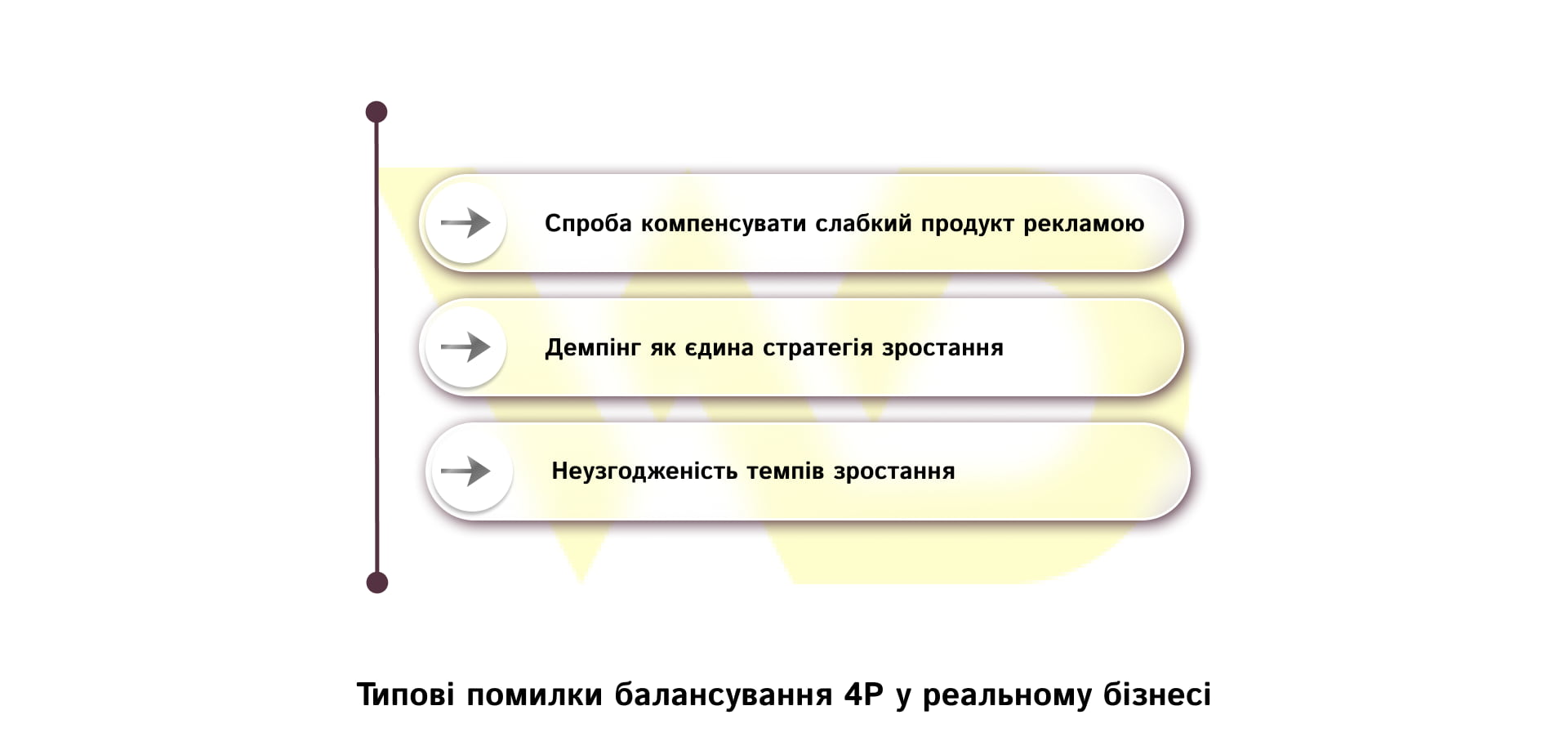
- Attempting to compensate for a weak product with advertising.
If a product does not meet consumer needs or falls short of competitors in terms of basic characteristics, increasing the marketing budget will only accelerate the spread of negative reviews. Advertising does not create value; it merely amplifies awareness of the product.
- Dumping as the sole growth strategy.
Lowering prices without reviewing the cost structure and distribution channels leads to the depletion of working capital. Customers attracted solely by low prices have the lowest level of loyalty and will immediately switch to a competitor at the slightest price fluctuation.
- Mismatched growth rates.
When launching large-scale media campaigns, businesses often forget to check whether the sales department and logistics partners are ready. If a customer sees an ad but can’t conveniently place an order or has to wait weeks for delivery, the marketers’ efforts turn into losses.
All these mistakes share a common root cause the attempt to solve a complex problem through isolated actions. Effective marketing begins when a team recognizes the interconnections between decisions and adjusts the system as a whole, rather than just the element that’s easiest to change at the moment.
An expansion of the classics: 7P for services and 4C for digital
The classic 4P model was developed during an era of rapid growth in mass industrial production. With the transition to a post-industrial economy and the rapid growth of the service sector and digital business, there arose a need to adapt the marketing mix to these new realities.
The 7P Model: an extension for the service sector
In 1981, Bernard Booms and Mary Bitner expanded the 4P model with three new elements, developing the 7P concept, which takes into account the specific characteristics of services their intangibility, inseparability from the source, and variability in quality. These additions are explained in more detail as follows:
- people: all company employees who directly interact with the customer or influence the quality-of-service delivery. In the service sector, the staff’s qualifications, empathy, and communication skills become part of the product itself;
- process: the step-by-step procedure and mechanics of how the customer receives the service. The more transparent, faster, and more predictable the process is for the customer (from the initial appointment to the delivery of the result), the higher their level of satisfaction;
- physical evidence: the physical environment in which the service is provided and indirect evidence of its quality. For offline businesses, this includes the interior, cleanliness, and equipment; for online services, it includes a professional website, official certifications, a portfolio, and case studies.
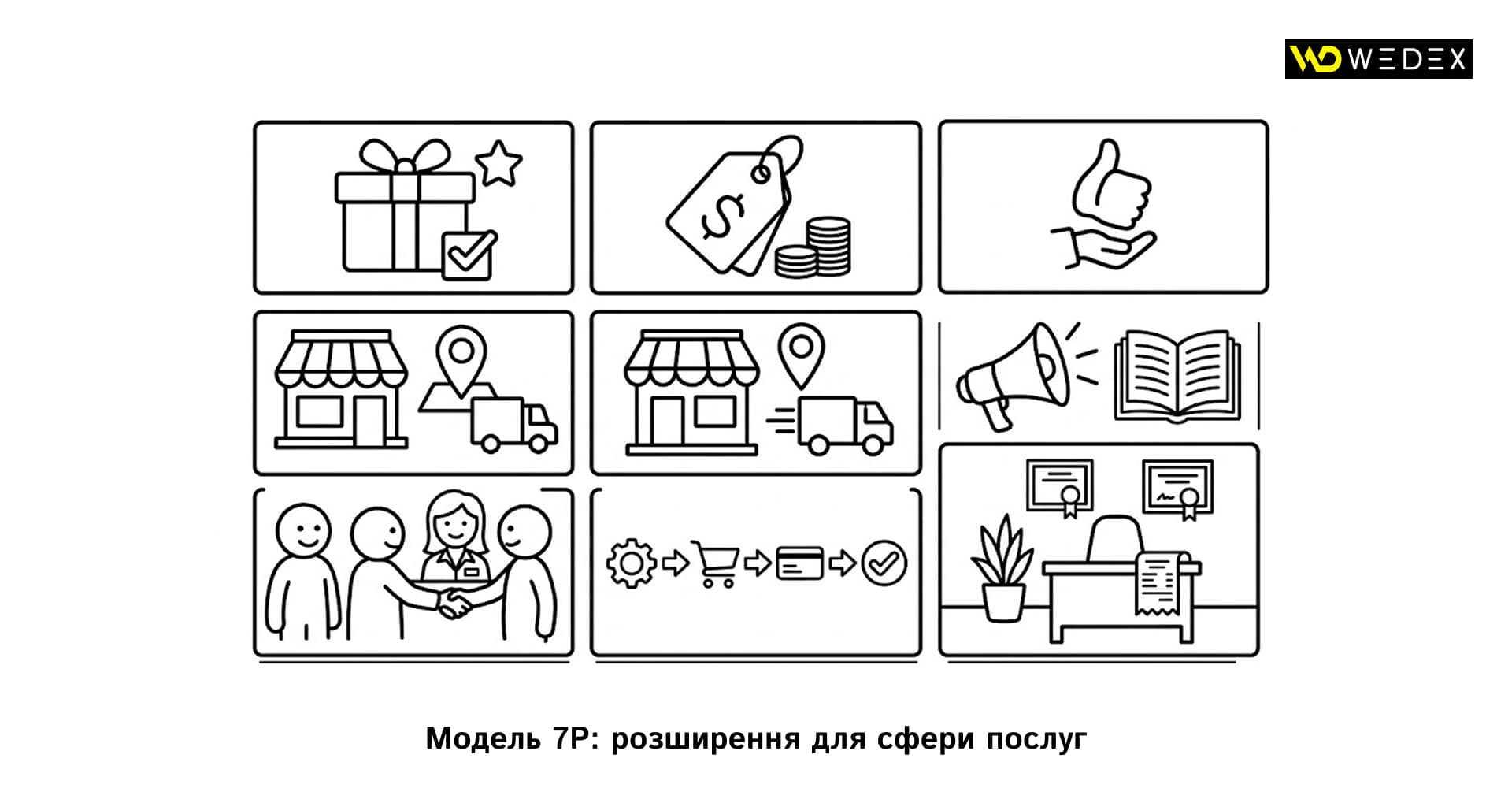
The 7P extension allows service and B2B companies to systematize the customer’s subjective experience. Implementing service standards, automating processes, and ensuring physical evidence of quality transform an intangible service into a clear and predictable product.
The 4C model: consumer focus in the digital environment
In 1990, Bob Loteborn proposed the 4C concept, which shifted the focus from a company’s internal processes to consumer needs and experiences. In a digital environment where customers have instant access to information and can compare offers, this model has become the foundation for building customer-centric strategies.
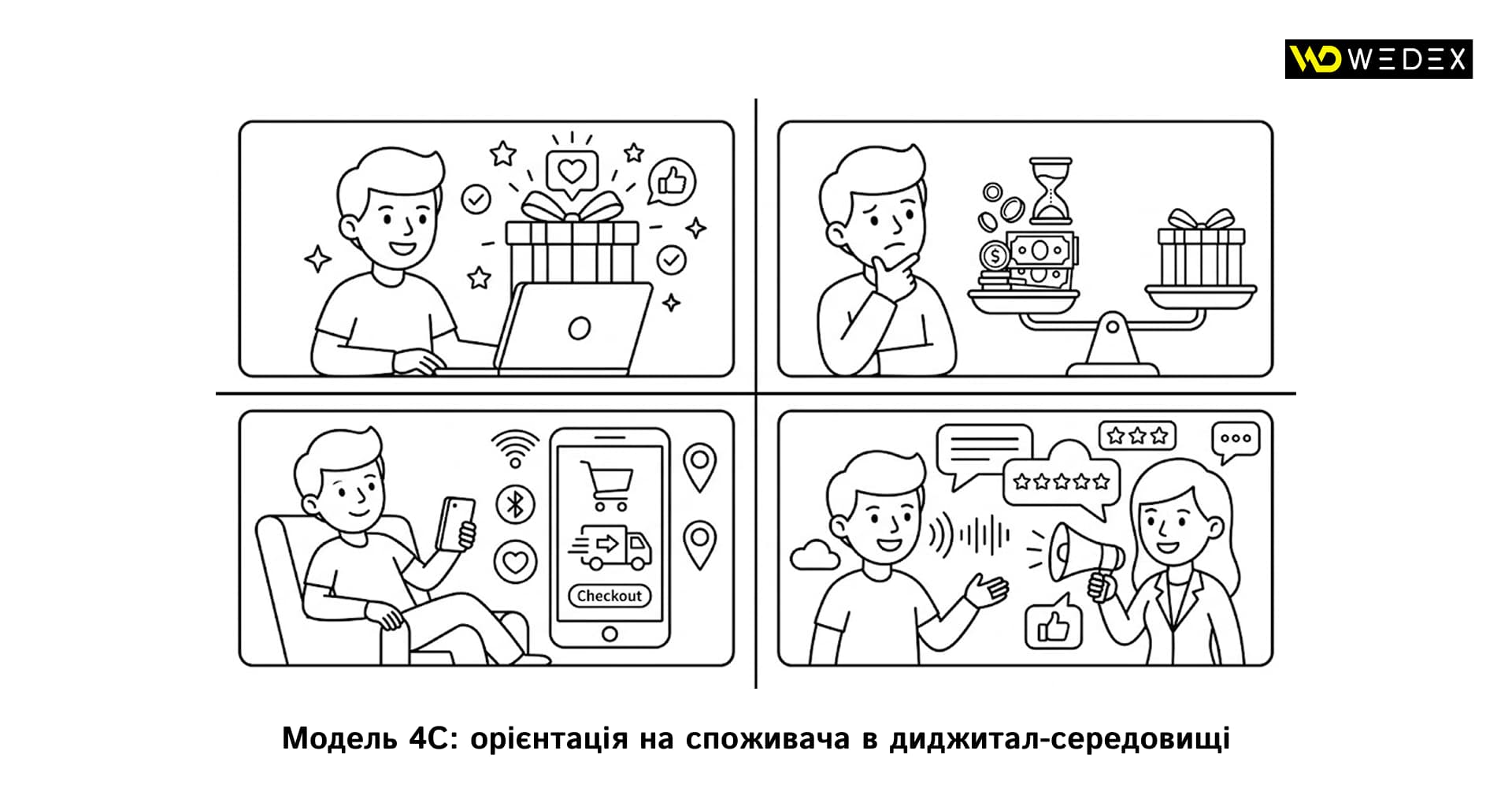
- Product → Value for the Customer
A shift from describing a product’s features to understanding what specific task (the job to be done) or consumer pain point this offering solves.
- Price → Customer Costs
It’s not just the price on the label that matters, but the customer’s total costs money, time, effort spent on searching and learning, as well as the emotional risks involved in switching providers.
- Location → Convenience
Ensuring maximum convenience for making a purchase right here and now through a mobile app, chatbot, one-click payment, or free express delivery.
- Promotion → Communication
Replacing aggressive, one-sided advertising pressure with two-way dialogue, content marketing, community building, and providing personalized value.
The 4C concept does not contradict the 4P framework but complements it, serving as its mirror image. While the 4P framework describes marketing from a manager’s perspective («what we do»), the 4C framework evaluates the results of these actions from the consumer’s perspective («what I get and how much effort I expend»).
The choice of a specific model depends on the specifics of your business model and the maturity of the market. Most often, the operational framework of the 4P/7P is combined with the people-centered 4C approach to create comprehensive digital strategies.
How to apply the 4P for business growth
The 4P concept remains a fundamental tool for marketing analysis, as it protects businesses from one-sided perspectives and chaotic actions. Success in the market is rarely the result of a random breakthrough in a single area most often, it is the result of the harmonious functioning of the entire system.
A high-quality product, transparent and well-justified pricing, seamless logistics, and precise, unobtrusive communication create a holistic customer experience that transforms casual visitors into loyal brand advocates.
It’s worth conducting a regular audit of your marketing mix whenever the market environment changes, new competitors enter the market, or you’re preparing to launch new products. Evaluating each marketing decision through the lens of its impact on related elements allows you to identify hidden imbalances in a timely manner, protect your marketing investments, and build a predictable growth model for your company.

commercial offer
Other articles by the author

15/06/2026
The algorithms of digital platforms are evolving faster than user habits, and by 2026, social media had undergone radical changes.

27/05/2026
Web analytics has become one of the key components of digital marketing, as it helps businesses understand what happens on their website once they’ve attracted traffic.
20/10/2026
Ben Hunt's model is a tool that helps break down a customer's path to purchase based on their level of awareness and select the right messages for each stage.
Latest articles by #Marketing
20/10/2026
Ben Hunt's model is a tool that helps break down a customer's path to purchase based on their level of awareness and select the right messages for each stage.

29/09/2026
A content pipeline transforms the creation of content from a spontaneous creative process into a managed production system. In such a system, AI serves as a powerful assistant.
10/09/2026
The 4P model serves as an architectural foundation that transforms disparate marketing activities into a single, manageable system.