

 10/09/2026
  1302
1302

Інтернет-маркетинг
простою мовою
Content of the article

The complete guide to the Team Lead role: what they do, what you need to know and how to advance to Team Lead

The expansion of the digital and IT markets is complicating business processes and making the role of a team lead one of the most in-demand and at the same time, one of the scarcest positions in modern companies. For mid-level and senior specialists, the transition to management is a logical path for career growth; however, this is precisely where most encounter the toughest barrier: expertise in performing tasks hands-on no longer guarantees success in managing others. Mistakes made by new leaders cost businesses lost time, employee burnout, and a decline in product quality. That is why a deep understanding of this role is critical for both companies and professionals seeking a deliberate career leap.
In this article, we’ll take a detailed look at what a Team Lead actually does, which set of hard and soft skills is essential for successful management, the step-by-step path from specialist to team lead, the typical psychological pitfalls for beginners, and the metrics businesses use to evaluate a Team Lead’s effectiveness.
Who Is a Team Lead
A Team Lead serves as the link between a company’s business strategy and the team’s day-to-day operations. The leader’s primary goal is to create an environment where every team member works to their full potential while understanding the overall direction of the team. Research by the Gallup Analytics Institute shows that direct managers account for about 70% of the variation in employee engagement levels. When a team lacks a strong leader, processes quickly lose focus, and deadlines are missed due to communication gaps.
It is a mistake to assume that a Team Lead must combine the roles of all related managers. There is often confusion in the market between the roles of Team Lead, Tech Lead, and Project Manager. To avoid false expectations and choose the right path for development, it’s helpful to compare them based on their key areas of responsibility.
|
Role |
Main focus |
Key question |
Key success metric |
|
Team Lead |
People and the Environment Within the Team |
Who carries out the tasks and under what conditions |
Increased team productivity, high eNPS, and low employee turnover |
|
Tech Lead |
Architecture, engineering standards, and tech stack |
How to implement this technically flawlessly |
No technical debt, system reliability, and scalability |
|
Project Manager |
Scope of work, budget, deadlines, and stakeholders |
What exactly needs to be delivered to the client and when |
Adherence to deadlines, budget constraints, and client requirements |
The distinction between these roles is based on focus. While the Project Manager works with the external parameters of the project and the Tech Lead ensures the quality of technical or engineering solutions, the Team Lead is responsible for internal human resources and coordinating activities.
How to balance people, processes and expertise
The Team Lead work is built on three interconnected areas: people management, process optimization, and expert oversight.
The first area involves regular one-on-one work with each team member. This goes beyond periodic discussions about current tasks; it includes a systematic analysis of motivation, assistance in overcoming professional barriers, and a systematic review of results. Leaders foster a supportive environment through regular one-on-one meetings, where they identify signs of emotional burnout or dissatisfaction before an employee decides to leave the company.
The second area covers process routines: breaking down strategic business tasks into clear steps, setting priorities, and facilitating team rituals. A team lead ensures that sprint planning or daily stand-ups do not become a mere formality but help identify roadblocks early on.
Finally, the third area concerns expert oversight. A manager doesn’t need to personally review every line of code or design mockup, but they must establish a system of cross-checks and reviews that ensures consistent quality of the final product without their direct intervention in every task.
Team lead skill set
The transformation from specialist to manager requires a fundamental shift in focus between hard skills and soft skills.
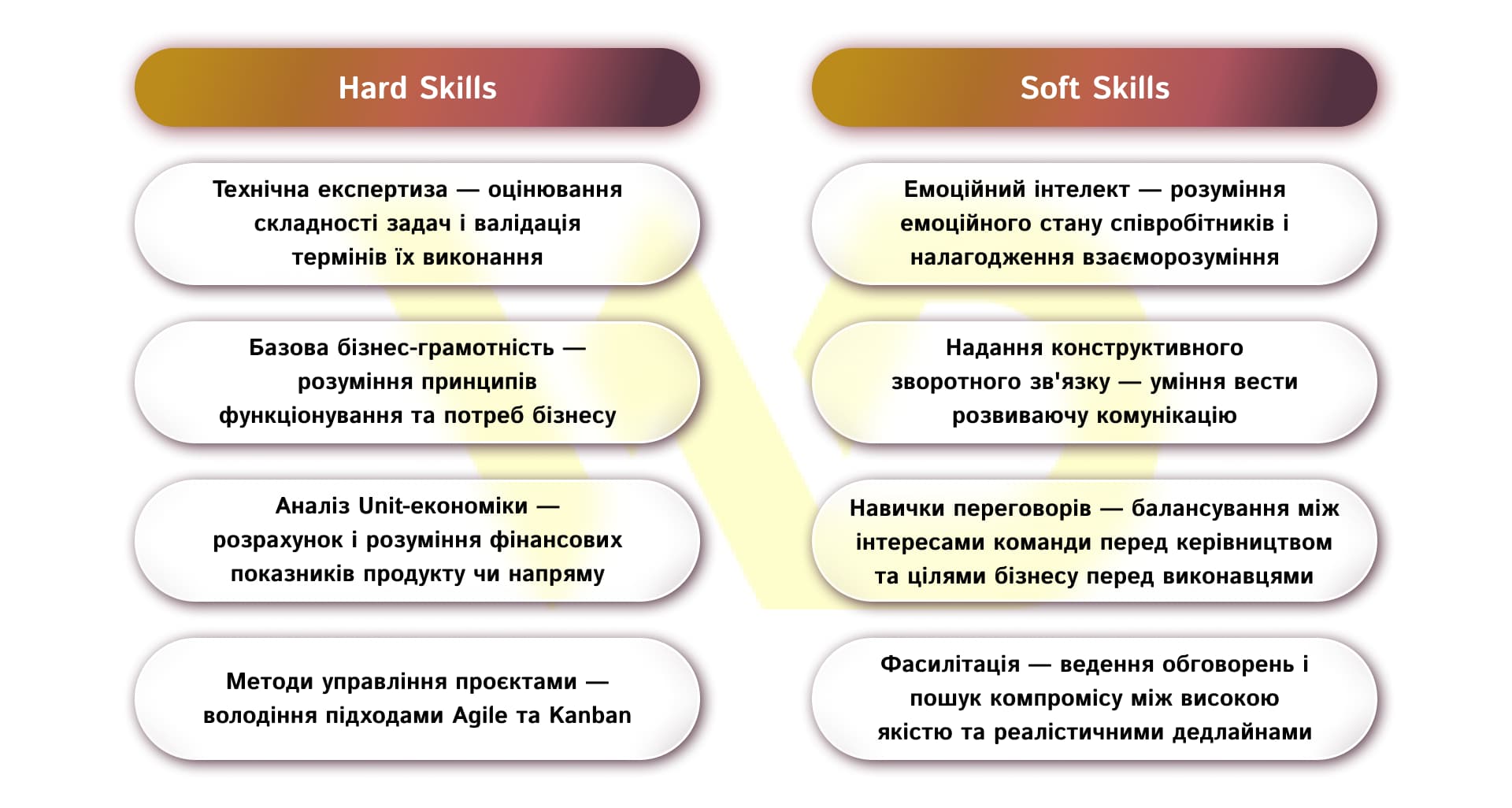
While a Middle or Senior specialist relies on in-depth knowledge of tools, a Team lead must master basic business literacy, unit economics analysis, and Agile or Kanban management methods. However, while technical expertise allows one to assess the complexity of tasks and validate timelines, a leader’s success is 80% determined by their soft skills.
Among the key soft skills, emotional intelligence and the ability to provide constructive feedback take top priority. For example, instead of emotional criticism such as «You made a mistake again», a professional team leader applies the SBI (Situation Behavior Impact) methodology. In this framework, the leader first identifies a specific situation («During yesterday’s project presentation to the client…»), then describes the actual behavior («…you interrupted the analyst and didn’t let him finish his argument…»), and finally explains the business consequences («…which caused the client to doubt the coordination of our team’s actions»). This approach disarms the employee’s defensiveness and steers the conversation toward a constructive resolution of the problem.
In addition, negotiation and facilitation skills become critically important. A team lead must simultaneously advocate for the team’s interests with senior management and defend the company’s business objectives with the team members, striking a balance between realistic deadlines and high quality.
How to advance from a Middle/Senior specialist to a Team Lead
Advancing to the position of Team Lead is a planned career path, not a sudden appointment. To ensure the transition is smooth for both the specialist and the company, it’s important to systematically go through five key stages.
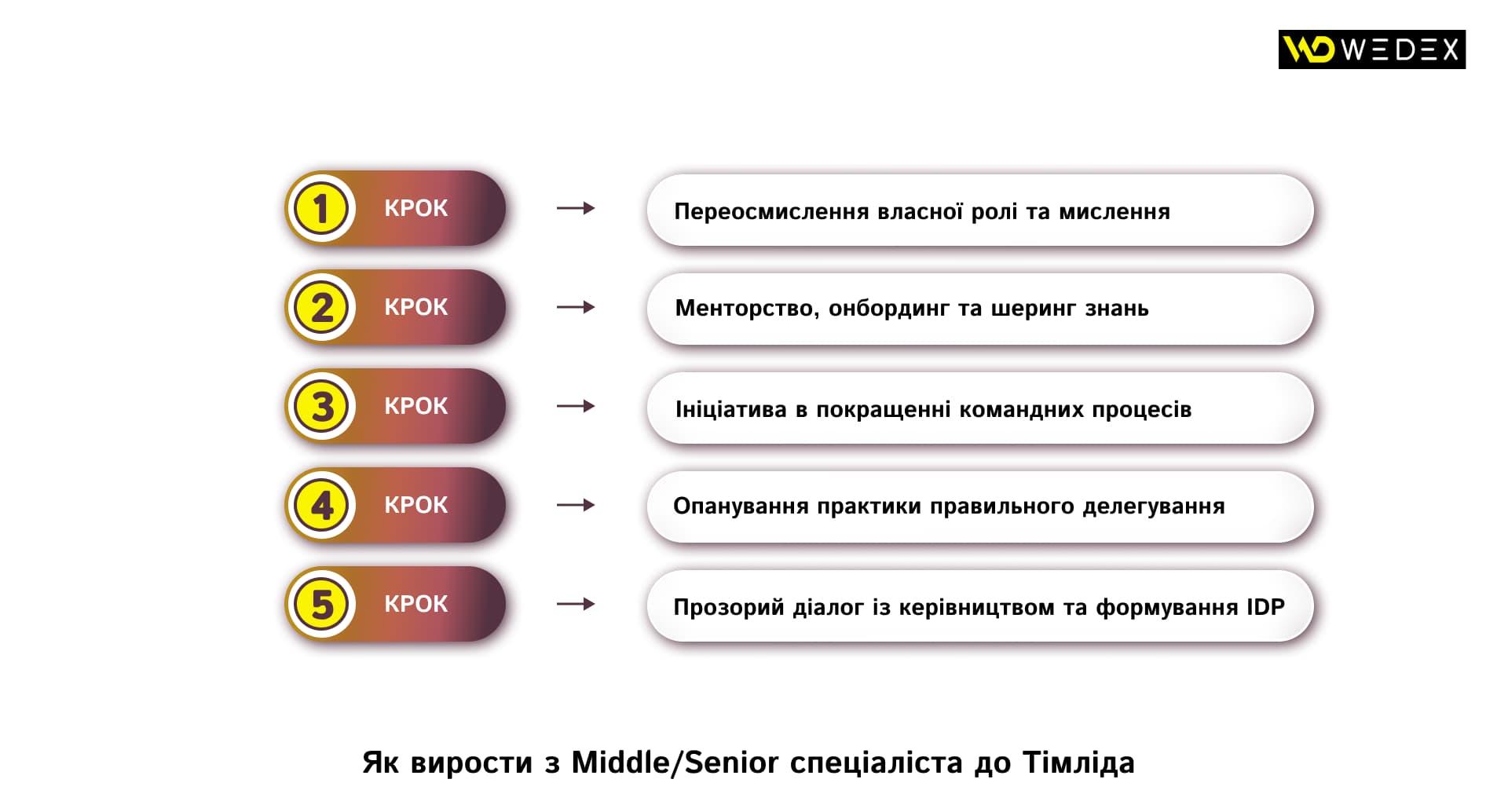
The first step begins with changing your mindset. You need to move away from a narrow view of success based solely on the volume of work you’ve personally completed and start identifying systemic bottlenecks within the team.
The second step is to take on mentoring responsibilities. Mentoring less experienced colleagues, helping new hires settle in, and conducting internal training sessions allow you to put your management skills to the test in practice without an official change in title.
The third step involves actively participating in optimizing team processes. If you notice confusion in task descriptions in Jira or outdated documentation, initiate the creation of new guidelines or quality control checklists.
In the fourth stage, you need to master the art of delegation. Start delegating some of your own tasks to colleagues, retaining only an advisory role and the responsibility for final review. This builds trust within the team and frees up your time for larger-scale initiatives.
The final, fifth step is an open conversation with management. At a dedicated meeting, articulate your career aspirations and work with the HR department to create an Individual Development Plan (IDP) with clear evaluation criteria, the fulfillment of which will precede your official appointment.
Psychological pitfalls and management mistakes early on
The first 6–12 months in the role are the most critical period of adaptation, when a management style takes shape and the foundations of relationships with the team are laid. Most mistakes made by novice managers stem not from a lack of competence, but from attempting to apply familiar patterns from their time as an employee to new managerial tasks.
- Micromanagement and total control.
Attempting to monitor every step an employee takes, demanding constant progress reports, and controlling every detail indicate a lack of trust. This demotivates employees, stifles initiative, and turns the team lead into a «problem» in all processes, causing decision-making to grind to a halt.
- The «I’ll do it myself» syndrome.
When a complex task arises or a tight deadline approach, a new leader may feel it’s easier and faster to do the work personally than to explain it to colleagues. The result of this approach is that the manager works 14 hours a day and finds themselves on the verge of burnout, while the team’s level of autonomy and competence remains at the initial level.
- Friendship Instead of Leadership.
The desire to maintain the status of «one of the guys» among former colleagues creates a dangerous blurring of boundaries. In such a situation, it becomes psychologically difficult for the team leader to enforce discipline, provide critical feedback, or make unpopular decisions. Effective leadership is built on mutual respect, professional authority, and transparent expectations not on trying to please everyone without exception.
- Fear of difficult conversations and delaying feedback.
Attempts to postpone an unpleasant conversation about consistently missed deadlines or subpar work only build up tension within the team. A lack of timely feedback creates a sense that low-quality work is the norm, which ultimately harms the entire project.
- Ignoring business goals.
Becoming immersed solely in internal process routines or becoming overly preoccupied with technical perfection without considering the company’s strategic objectives. A strong team lead always understands how each task or release brings the business closer to achieving its key financial and product metrics.
Being aware of these pitfalls is already half the battle in overcoming them.
It’s perfectly natural to make mistakes early in a leadership journey, but a new leader’s main task is to recognize in time any drift toward micromanagement or isolation from the business. The ability to adjust one’s behavior in a timely manner allows you to turn your first leadership challenges into valuable experience and build a mature, autonomous team.
Team Lead performance metrics
Assessing a team leader’s effectiveness cannot rely solely on the number of completed tasks or personal output. A Team lead success is determined holistically: through the stability of team processes, the quality of the final product, and the psychological well-being of the team.
|
Metric |
Category |
What it measures |
Practical benefits for businesses |
|
Speed of Execution |
Processes and Productivity |
Amount of work completed in a single sprint or iteration |
Ensures predictability in development and accuracy in release planning |
|
Cycle time and execution time |
Processes and Productivity |
The speed at which a task progresses from start to final release |
Identifies delays and bottlenecks in the operational chain |
|
Return rate and defect density |
Product quality |
Percentage of tasks returned for revision due to errors |
Indicates the effectiveness of the team’s self-monitoring and verification processes |
|
Employee loyalty index |
Team atmosphere and morale |
Level of employee loyalty, motivation, and satisfaction |
Allows for the early detection of risks of burnout and dissatisfaction |
|
Staff turnover rate |
Team atmosphere and morale |
Percentage of employees who leave the team during the period |
Reduces the company’s financial costs associated with recruiting and onboarding new employees |
|
Interchangeability Index |
Stability and Security |
Level of interchangeability and concentration of knowledge among specialists |
Protects the project from downtime in the event of vacations or sudden resignations |
When evaluating process metrics, it is important for management to focus not on one-time peak values for execution speed or cycle time, but on their stability over several consecutive iterations. Sharp fluctuations in speed indicate problems with breaking tasks down into smaller parts or an unsystematic distribution of the workload. Reducing task completion times is achieved not through overtime or overwork, but by promptly removing obstacles and streamlining approval procedures.
For their part, team health metrics reflect the unit’s long-term viability. A high employee loyalty index and low staff turnover directly indicate the creation of a healthy work environment where specialists see opportunities for their own development. At the same time, analyzing the interchangeability metric allows team lead to identify knowledge silos in a timely manner: if only one specialist understands a key system, the manager must organize a systematic exchange of knowledge among colleagues and update internal documentation.
A balanced combination of these two sets of metrics allows team lead to be assessed as a mature leader who does not simply «meet deadlines at any cost», but rather builds a predictable, resilient, and self-sufficient team.

commercial offer
Other articles by the author

12/08/2026
More and more professionals in traditional fields are choosing hands-on online courses to quickly acquire in-demand skills and break into the IT and marketing industries.

05/03/2026
Customer focus is a systematic approach where all parts of the business work for the convenience and benefit of the customer: product, processes, communications, and internal culture.

31/08/2026
A strategic session is not a facilitated brainstorming session, not team coaching, and not motivational training. It is a strictly regulated management technique for making coordinated decisions under conditions of limited resources and uncertainty.
Latest articles by #Useful tips

22/10/2026
To properly link Instagram to Facebook, you need to distinguish between the different types of accounts within the Meta ecosystem, since confusion between a personal profile and a business page is the most common cause of errors during setup.

20/10/2026
Ben Hunt's model is a tool that helps break down a customer's path to purchase based on their level of awareness and select the right messages for each stage.

06/10/2026
From a business perspective, updating content is a sensible way to protect existing investments.