

 20/10/2026
 996

Інтернет-маркетинг
простою мовою
Content of the article
- /01 What is Ben Hunt’s ladder and why is it important in marketing
- /02 Ben Hunt’s 5 steps: how customer behavior changes
- Stage 0: The customer is not yet aware of the problem
- Step one: The problem is recognized, but there’s no solution yet
- Step two: The customer is looking for solutions
- Step three: The customer chooses a specific solution
- Step four: The benefits are clear, but a decision hasn’t been made yet
- Step five: The customer is ready to buy
- /03 How to use Ben Hunt’s ladder in a marketing strategy
- /04 Common mistakes when using Ben Hunt’s ladder
- /05 How to turn Ben Hunt’s ladder into a practical tool

Ben Hunt’s marketing ladder: how to guide a customer from objection to purchase
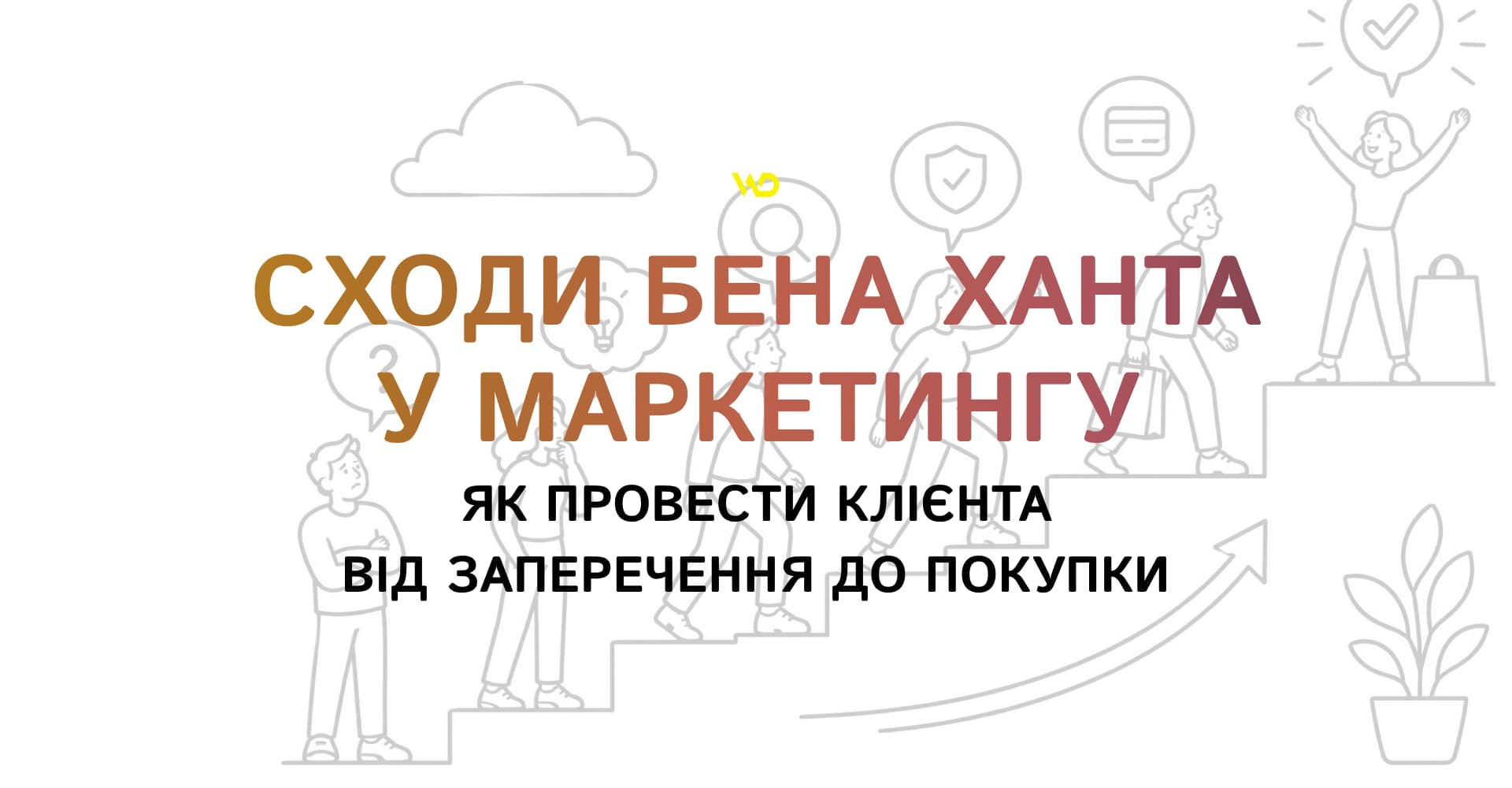
In marketing practice, a paradoxical situation often arises: a company creates an objectively high-quality product, invests significant budgets in promotion, and develops creative advertising campaigns, but the final conversion rate remains critically low. Most often, the problem lies in the wrong choice of timing and context for communication. The message simply does not match the audience’s level of readiness to receive it.
For marketing communication to work effectively, the messaging must be tailored to the consumer’s current state of mind. This is precisely where Ben Hunt’s model comes in a tool that helps break down the customer’s journey to purchase by stages of awareness and select precise messages for each stage.
In this article, we’ll explore what happens to the consumer at each of the five stages of awareness, how to select relevant content to address doubts and objections, and how to turn this model into a practical tool for building a marketing strategy.
What is Ben Hunt’s ladder and why is it important in marketing
Ben Hunt’s model, or Ben Hunt’s Awareness Ladder, is a marketing concept that describes the sequential growth of a potential customer’s awareness: from a stage of complete ignorance about the existence of a problem to a clear understanding of a specific solution and a willingness to purchase it.
Historically, this concept is based on the levels of awareness first described by Eugene Schwartz; however, it was Ben Hunt who developed this logic into his own «Awareness Ladder» model, which he applied to website optimization, marketing, and conversion.
It’s important to understand the fundamental difference between Hunt’s ladder and the classic marketing funnel. The traditional funnel, such as AIDA, primarily tracks the stages of a user’s interaction with a company: saw an ad, clicked, submitted a request, paid. In contrast, Hunt’s ladder in marketing focuses on a person’s internal cognitive state:
- what they know;
- what they believe;
- what they fear;
- what arguments they need right now.
The practical value of this model lies in its ability to align content with the audience’s real needs. It provides insight into what format of content, what level of expertise, and what calls to action will be appropriate.
At the same time, Ben Hunt’s ladder should be viewed not as a rigid algorithm where every person must consistently go through all the steps day by day, but as a flexible framework for segmentation. Some consumers may «skip ahead» after reading an in-depth analytical article, while others may remain at the stage of comparing alternatives for months.
Ben Hunt’s 5 steps: how customer behavior changes
The customer’s journey to purchase is a process of gradually gathering information and overcoming internal barriers. The general framework for the transformation of awareness looks like this:
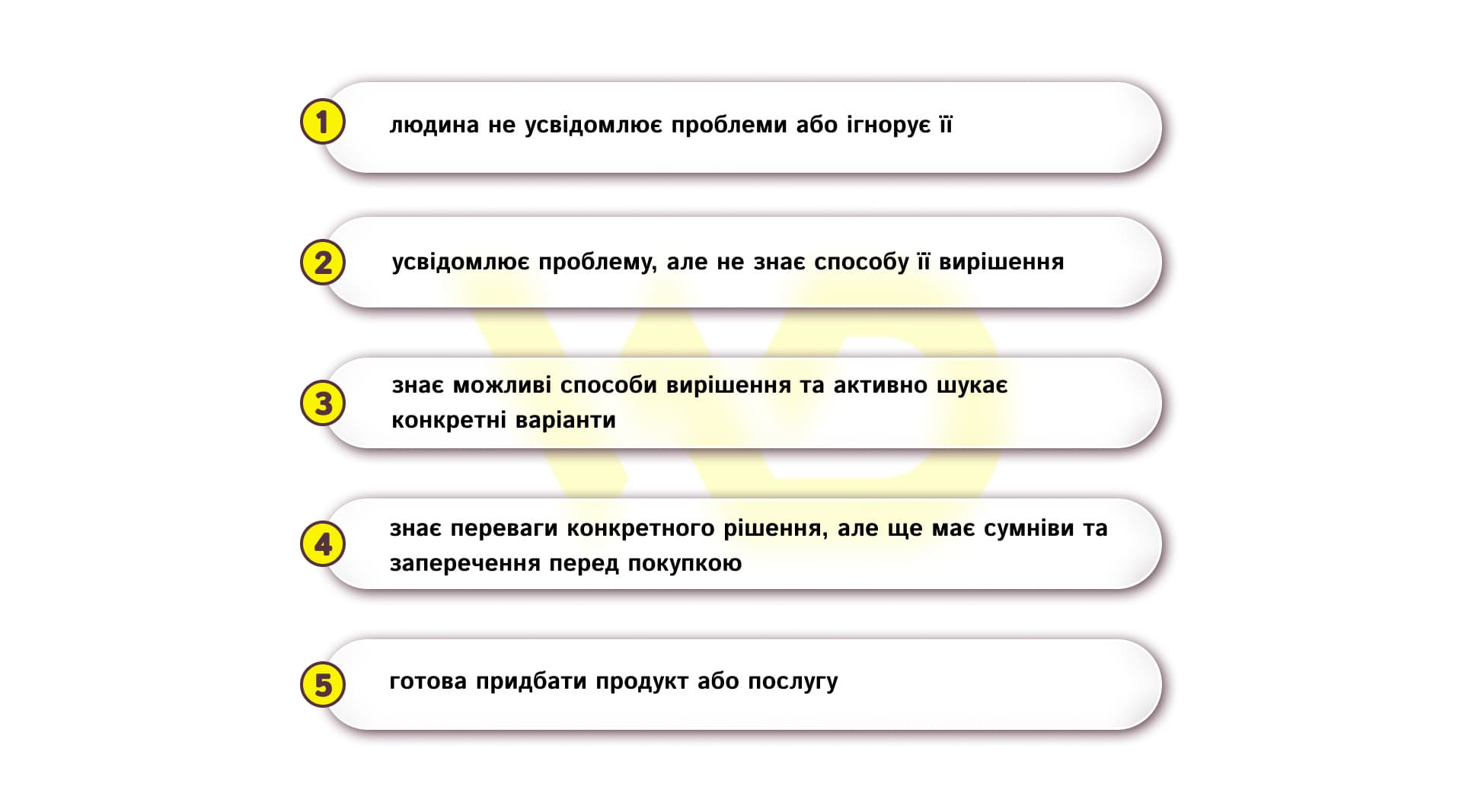
To ensure effective communication, let’s take a detailed look at each of these customer stages.
Stage 0: The customer is not yet aware of the problem
At this stage, the potential buyer is in a state of calm. The situation may objectively be less than ideal the business may be losing money, and the person may be losing health or time but the problem itself has not yet been identified. Compensatory mechanisms or the habit of acting according to old patterns kick in.
The main task of marketing at Stage Zero is not to try to sell a product. Any direct offer will be rejected because there is no internal demand for it.
The goal is to help the audience recognize the problem, understand its consequences, or see the lost benefits.
At this stage, broad, comprehensive formats that grab attention and spark interest work best:
- educational and entertaining content;
- native articles and guest posts in the media;
- market research, trends, and analytics;
- videos showing the contrast between «the current state» and «how it could be»;
- social media posts designed to go viral.
For example, let’s imagine a company that develops a SaaS solution for automating management accounting. At the very beginning, a small business owner is used to keeping records in scattered Excel spreadsheets. He isn’t looking for a new program. The marketing message here shouldn’t be «Buy our software at a discount», but rather an article in a specialized business publication: «Why a profitable business suddenly faces a cash flow shortfall: 3 subtle accounting mistakes». This prompts reflection and encourages the reader to move to the next level.
Step one: The problem is recognized, but there’s no solution yet
The customer feels discomfort. They understand that cash flow gaps are hindering growth, or that their current level of English is blocking career advancement. The problem is acknowledged, the emotional pain is present, but there’s no understanding of exactly how to proceed.
Therefore, it’s necessary to bring order to the chaos in the consumer’s mind, show that a solution exists, and outline possible categories of solutions. At this stage, the brand begins to build trust.
The first step requires:
- expert articles on the corporate blog (in a «how-to» format);
- webinars and free educational materials;
- infographics and checklists;
- SEO-optimized content for informational queries (for example, «how to avoid a cash flow gap»);
- video tutorials.
The focus is on education. You should promote your own product as naturally as possible, positioning it only as one of several possible tools for achieving a goal.
Step two: The customer is looking for solutions
The active research stage. The person already knows that their problem can be solved in various ways. Returning to the example of management accounting: the business owner has discovered that they can hire an outsourced CFO, commission the development of their own system, or implement a ready-made cloud solution (SaaS).
The marketer’s task at this stage is to help define selection criteria and convincingly demonstrate that the category your product belongs to is the best fit for a specific audience segment.
Particularly relevant for the second stage:
- detailed guides and expert reviews;
- comparative content (for example, «Cloud system or dedicated server: which to choose for a small business»);
- case studies illustrating the successful application of a particular approach;
- frequently asked questions (FAQs) integrated into the content;
- targeted ads offering a useful guide for download.
Communication must be objective. It’s important for a brand not just to promote itself, but to teach customers how to make the right choice by highlighting the criteria where the brand itself is objectively strongest.
Step three: The customer chooses a specific solution
The potential buyer has narrowed down their search. They’ve decided that a cloud service is exactly what they need. Now they’re comparing specific companies, brands, and products. The customer’s level of awareness has reached the stage where general informational content no longer works. They’re looking for specifics: numbers, features, terms, and evidence.
Now, instead of explaining the nature of the problem, you need to clearly articulate your unique value proposition (UVP). You need to answer the question: «Why should they choose you among dozens of alternatives?».
At this stage, the following are used:
- product cards or service pages with the most detailed descriptions possible;
- product demos and trial periods;
- in-depth case studies with real numbers (ROI, time saved, increase in leads);
- direct comparisons with competitors, if permitted by law and market ethics;
- cost or effectiveness calculators;
- contextual advertising targeting brand and transactional search queries.
All benefits must be backed by facts. Instead of the cliché «high quality», write «99.9% server uptime»; instead of «quick integration», add «implementation within 48 hours by our team».
Show your customers why they should choose you
We’ll set up contextual ads that highlight your product’s advantages, competitive offerings, and the needs of potential buyers. The WEDEX team will help you attract an audience that’s already looking for a specific solution.
Step four: The benefits are clear, but a decision hasn’t been made yet
This is a critical stage that is often given the least attention. The client knows the brand, understands the product, and recognizes its benefits. But the deal isn’t closed. The reason lies in the client’s objections and internal fears. People are afraid of making a mistake, losing money, encountering hidden fees, or facing implementation challenges. In the B2B segment, this is compounded by the fear of being held accountable to management for choosing the wrong contractor.
The task of marketing is to identify all possible barriers and methodically, with sound reasoning, remove them. Communication must convey safety, reliability, and predictability. This is precisely where the transition from objection to purchase takes place.
The following are used:
- testimonials from real customers, which work best in video format or with real profiles;
- a detailed description of the service delivery or onboarding process to alleviate the fear of the unknown;
- transparent guarantees, such as refunds, SLAs, and free support;
- social proof (awards, certificates, client logos);
- public answers to difficult questions;
- direct communication with the customer support team or sales managers who work in synergy with the marketing team.
If the customer is put off by the price, marketing needs to demonstrate value that outweighs it for example, through a return-on-investment calculation. If the customer is put off by the risk, offer a trial period without requiring a credit card.
Step five: The customer is ready to buy
All doubts have been dispelled. The stages of the customer’s readiness to purchase have been completed; all that remains is to take the final step.
The worst thing a business can do at this stage is to complicate the process or start talking again about the company’s mission and the product’s core benefits.
Right now, the main goal of marketing is to make the target action intuitive, fast, and seamless. Any friction at this stage such as a lengthy registration form, a confusing payment interface, or the lack of a desired shipping method will result in the loss of a «hot» lead.
At the final stage, the following are important:
- retargeting with a direct call to action (for example, a reminder about an abandoned cart);
- personalized emails;
- a transparent and streamlined checkout process;
- special, personalized offers that serve as the final trigger, such as free shipping or a bonus on the first order.
It’s important to stay authentic: avoid creating a false sense of urgency, such as using fake countdown timers. In the long run, manipulative FOMO (fear of missing out) erodes the trust that was built in the earlier stages.
How to use Ben Hunt’s ladder in a marketing strategy
Understanding the theory doesn’t generate revenue until it’s integrated into the company’s actual processes. For the model to work, it must be applied to the existing marketing ecosystem. Let’s look at the step-by-step process.
- Audit and segmentation. You need to analyze your current audience and traffic sources. Who are these people? What level of knowledge do they bring with them from search engines, and what level from targeted ads?
- Journey Mapping. For each segment, you should determine: what they already know about the problem, what they know about the solution, and whether they are familiar with the brand.
- Identifying barriers. It is necessary to gather data from the sales department and customer support.
-
- What are the most common questions customers ask?
- Why do deals fall through?
This will help create a list of objections to address in the fourth step.
- Developing a content matrix. Create appropriate content for each awareness level. For example, publish educational articles for cold traffic, and for those who visited the pricing page but didn’t buy, use retargeting with case studies and guarantees.
- Selecting distribution channels. Different platforms work at different stages. PR and creative campaigns are great for the zero and first stages. SEO promotion of a blog works for the second stage. Contextual search ads are ideal for capturing those in the third stage. Email marketing effectively nurtures leads in the fourth and fifth stages.
- Analytics and adjustments. You need to constantly test hypotheses: Does the complexity of the message match the audience’s level? If an ad has a high CTR but zero conversions on the website, the offer is likely ahead of the user’s readiness.
It’s important to remember that sophisticated marketing communication involves working with all stages simultaneously. A business shouldn’t wait for a single customer to complete the entire journey. The system should be configured to continuously attract a cold audience, nurture those who are on the fence, and seamlessly handle hot leads from those who are already ready to pay.
Common mistakes when using Ben Hunt’s ladder
Even when aware of the different levels of awareness, marketers often make strategic mistakes. The main ones are:
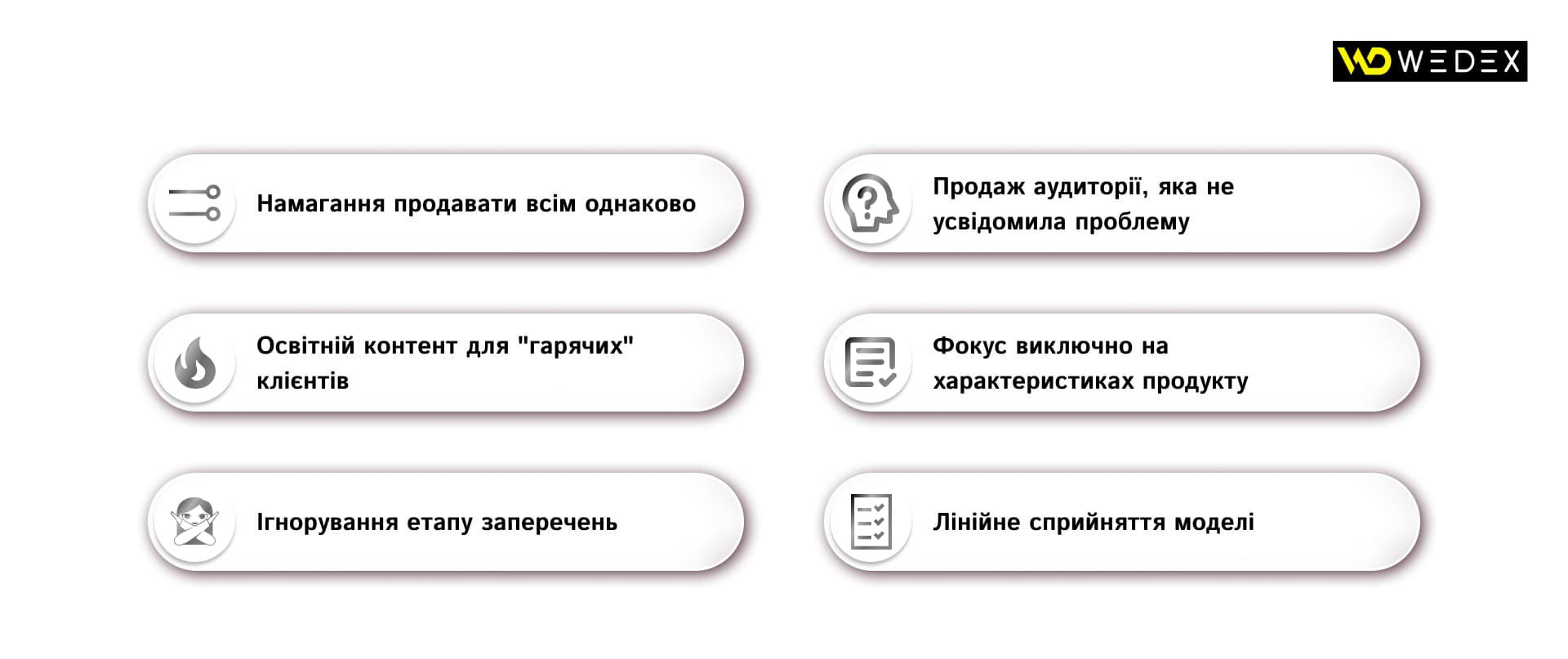
The common thread among all these mistakes is the attempt to artificially accelerate the natural decision-making process through irrelevant communication.
Eliminating these strategic gaps allows you to transform disparate advertising activities into a unified, predictable marketing system, where every piece of content and every scaled campaign fulfills a clearly defined task at its respective level of customer awareness.
How to turn Ben Hunt’s ladder into a practical tool
The true value of any theoretical framework is measured by its ability to solve practical problems. Ben Hunt’s model isn’t just a description of consumer psychology it’s a checklist you should consult before launching any advertising campaign, writing an article, or designing a landing page.
To make this tool effective, simply ask yourself a key question before creating any marketing message:
«What exactly does a potential customer already know at this touchpoint, and what information, evidence, or emotions are they missing to move to the next level?».
The answer to this question automatically dictates the structure of the text, the choice of arguments, and the tone of the communication.
Effective marketing never tries to force a person to make a purchase against their will or readiness. Professional communication, on the other hand, «takes the customer by the hand» and provides them with exactly the information, expertise, and level of support they need right here and now. Only with this approach does a brand become not an intrusive salesperson, but a reliable partner, with whom the journey from initial doubt to the final purchase becomes logical, comfortable, and inevitable.

commercial offer
Other articles by the author

08/07/2026
ChatGPT can already search the web, provide quick answers, and display relevant sources, which means it’s important for businesses to be clear, cited, and verified in the digital space.

16/04/2026
This is particularly important in business content, as the text must not only be grammatically correct but also serve a specific purpose.
10/09/2026
The 4P model serves as an architectural foundation that transforms disparate marketing activities into a single, manageable system.
Latest articles by #Useful tips
20/10/2026
Ben Hunt's model is a tool that helps break down a customer's path to purchase based on their level of awareness and select the right messages for each stage.

29/09/2026
A content pipeline transforms the creation of content from a spontaneous creative process into a managed production system. In such a system, AI serves as a powerful assistant.
10/09/2026
The 4P model serves as an architectural foundation that transforms disparate marketing activities into a single, manageable system.