

 08/07/2026
  1449
1449

Інтернет-маркетинг
простою мовою
Content of the article
- /01 Why mentions in ChatGPT have become a new channel for visibility
- /02 What exactly does ChatGPT see?
- /03 How to make your brand understandable to AI on your website
- /04 What content most often appears in AI responses
- /05 External mentions: why your own website is no longer enough
- /06 Technical readiness: robots.txt, crawl access, and schema
- /07 How to check if ChatGPT already mentions your brand
- /08 How to build a content ecosystem around a brand

How to get ChatGPT to mention and recommend your brand

Today, brands compete not only for positions in traditional search results but also for whether they’ll appear in generative search responses. ChatGPT can already search the web, provide quick answers, and display relevant sources which means it’s crucial for businesses to be clear, cited, and verified in the digital space.
In this article, we’ll take a detailed look at how to optimize your website, content, and brand’s external presence so that ChatGPT mentions you more often in its responses.
Why mentions in ChatGPT have become a new channel for visibility
In generative systems, the logic is slightly different from that of traditional search. They don’t simply provide a list of links; instead, they compile an answer from multiple sources and reformat it into a coherent text. A GEO study describes this as a new search paradigm, where content creators must optimize their materials for visibility in generative system responses, rather than just for traditional search rankings.
If ChatGPT perceives your brand as a reliable, structured, and verified source, the chances of it being mentioned increase. However, if your website uses generic phrases, the information on different pages is inconsistent, and there’s no external verification online, the system will most likely choose a competitor or a generalized description that doesn’t mention your brand by name.
What exactly does ChatGPT see?
ChatGPT isn’t looking for «flashy presentation» in an advertising sense, but rather data that can be quickly interpreted, compared, and used in a response. That’s why the website’s structure, consistency of wording, and the presence of external corroboration are just as important as the content itself. Google also emphasizes that structured data helps better explain the content of pages and the entities on them — companies, products, articles, questions, and answers.
To understand this in practical terms, let’s take a closer look at how the system «paints a picture» of a brand. It doesn’t look at a single page, but rather at the sum of various signals.
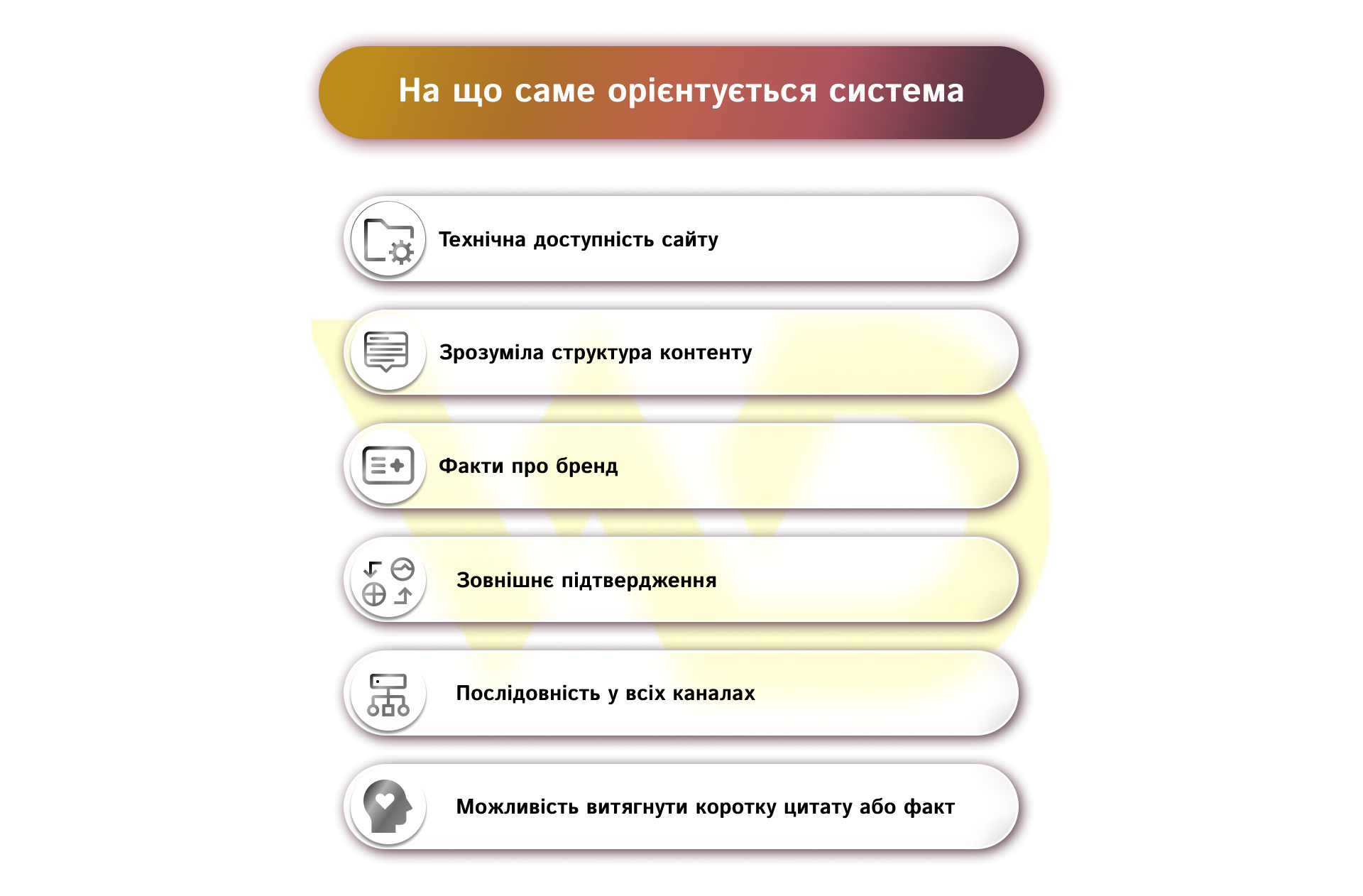
- Technical accessibility of the site.
If pages are closed to indexing or access to them is restricted, the system simply won’t receive enough data for analysis. OpenAI explains that to be included in, it’s important not to block the OAI-SearchBot, and Google reminds us that bots need proper access to page content. For businesses, this is a fundamental requirement: before working on visibility, you need to make sure that the website can be read properly in the first place.
- Clear content structure.
ChatGPT works more easily with content that has clear headings, logical paragraphs, distinct blocks of meaning, and direct answers to questions. If the text is vague, overloaded with general phrases, or lacks structure, the system receives a weak signal. That’s why «About Us», «Services», «FAQ», «Case Studies», and «Comparisons» pages often perform better than abstract promotional texts.
- Facts about the brand.
The system reads pages better when they contain specific details: company name, industry, list of services, geographic coverage, contact information, examples of solutions, price range, team, clients, and reviews. For AI, these aren’t trivial details but key reference points that help it understand who you are and in what context you’re relevant. The fewer ambiguities there are, the easier it is for a brand to appear in a relevant search result.
- External validation.
Having your own website is important, but it’s not enough. Generative systems place greater trust in brands that are mentioned in independent sources, such as industry media, rankings, reviews, testimonials, industry roundups, and expert commentary. This strengthens trust in the brand and gives the system additional reasons to mention it in its response. GEO’s research also shows that sources that are easy to verify and cite are particularly valuable for generative search.
- Consistency across all channels.
If a brand is described one way on its website, another way in directories, and yet another way in external publications, the system receives conflicting signals. For ChatGPT, it’s important to have the same name, similar service descriptions, consistent themes, and a clear message. This increases the likelihood that the brand will be recognized as the same entity across different sources.
- The ability to extract a short quote or fact.
If a page is structured in a way that makes it easy to extract a short and precise statement, it becomes much more useful for AI. That’s why sections with short definitions, answers to frequently asked questions, key benefits, step-by-step explanations, and clear, concise wording work well.
In short, optimizing mentions in AI starts with the quality of the brand’s entire digital presence.
How to make your brand understandable to AI on your website
For ChatGPT and other AI systems to correctly understand your brand, it’s important to present information about your company in a way that’s structured, consistent, and easily interpreted by both people and algorithms. This is where an AI-visible brand begins.
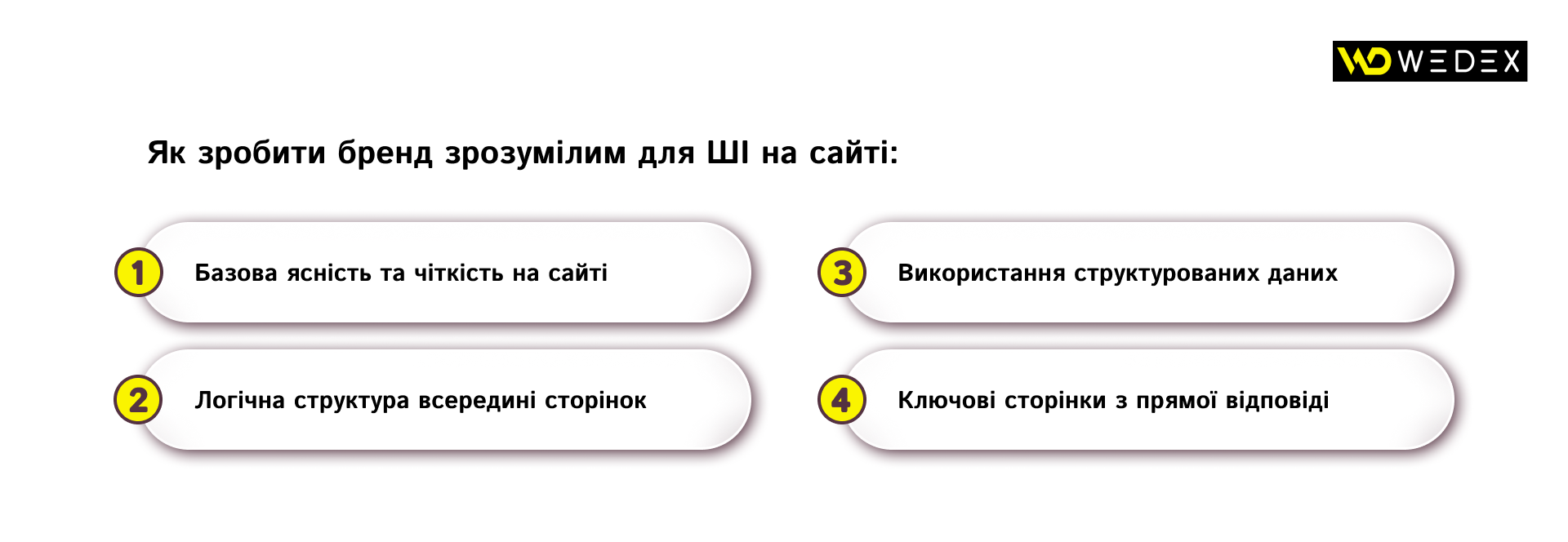
Start with basic clarity
Don’t complicate the presentation with «tricky» SEO tactics if your website lacks basic clarity. The brand name, business description, list of services, geographic coverage, contact information, prices or price range, case studies, reviews, and FAQ should be presented in a way that leaves no room for guesswork. If the company refers to itself differently on various pages, it’s harder for the system to piece together a complete picture of the brand.
Give the brand a logical structure
The most effective pages are those where information is presented concisely, factually, and without unnecessary rhetoric. For a company, this could be a separate «About Us» page; for a service, a dedicated landing page; for a product, a product card with clear specifications; and for questions, a separate Q&A section. This structure helps search engines and generative systems better understand who you are and exactly what you offer.
Use structured data
Schema markup is one of the most practical ways to explain a page’s content to systems. The Organization, Product, Article, Review, and QAPage types are particularly useful for brands, as they help machines identify the nature of the page more quickly and accurately.
Start key pages with a direct answer
Direct and concise opening paragraphs often work better than long introductions filled with stories and general musings. That’s why it’s best to structure key pages according to the principle we’ll discuss below. This format is convenient for both readers and the systems that extract snippets for answers.
Prepare your website for AI search
WEDEX experts will help you structure your pages, boost your SEO, and optimize your website so that search engines and AI services can better understand your brand, services, and content.
What content most often appears in AI responses
According to an article by erlin.ai, pages where information is organized into logical blocks are particularly useful for ChatGPT:
- a brief introduction;
- the main point;
- clarifications;
- an example;
- a practical conclusion.
The following are well-suited for this section:
- comparative materials;
- guides;
- answers to frequently asked questions;
- lists of common mistakes;
- usage scenarios;
- solution reviews;
- «how-to» guides.
These formats are easy to break down into smaller pieces, making them simpler to use as a source for AI-generated responses.
In practice, this means that articles like «How we can help», «How to choose a contractor», «What’s included in the service», «What are the options», and «How the process works» have greater practical value than abstract texts about trends. For example, if you sell CRM solutions, an article titled «How to choose a CRM for a small sales department» will work better than «Why digital transformation is important». In the first case, there’s a specific task that AI can recognize, match to the brand, and reference.
External mentions: why your own website is no longer enough
The most important conclusion from current research on AI search and GEO is that generative systems rely heavily on earned media — external mentions, reviews, ratings, industry publications, and community discussions. A 2025 study by Cornell University explicitly shows that AI search has a systemic bias toward third-party authoritative sources compared to branded and social content. For businesses, this means that a brand’s reputation must extend beyond its own domain.
Particularly useful here are articles in industry-specific media, «best companies» lists, market reviews, interviews, case studies, and reviews on independent platforms and in communities where users discuss solutions without an advertising tone.
AI tends to trust content that has already been verified by several independent sources. That’s why mentions in press releases that aren’t picked up elsewhere, «dead» partner publications, or artificially uniform texts have a significantly weaker impact.
For example, for a brand offering a B2B service, a single review on an authoritative industry resource, one expert comment in a specialized media outlet, and several organic reviews within a community can do more for AI visibility than five articles on the company’s own blog. A generative system seeks confirmation from various sources, not just the company’s self-promotion.
Technical readiness: robots.txt, crawl access, and schema
If a website is closed to useful bots, the rest of the work becomes pointless. OpenAI explains that to be included in summaries and snippets, you shouldn’t block the OAI-SearchBot, and its crawler logic is controlled via robots.txt. Google, for its part, reminds us that robots.txt is a tool for managing crawler access, but not a universal way to «hide» a page from indexing; to completely exclude a page, you need to use noindex or other mechanisms. This is important because businesses often mistakenly block the very pages that should be displayed.
Schema markup is another foundational layer that helps search engines correctly understand your content. For brands, the most useful types are typically Organization, Product, QAPage, Article, Review, and Profile page — where applicable to the actual page type.
It’s also worth mentioning llms.txt. In its June documentation update, Google clarified that such files are not required for Google Search and do not affect visibility or ranking in its systems, although they can be maintained for other services. This means that businesses shouldn’t place excessive expectations on llms.txt; it’s better to first get your website structure, schema, indexing, and content in order.
How to check if ChatGPT already mentions your brand
Setting up your website once isn’t enough. Visibility in ChatGPT needs to be monitored and maintained just as systematically as traditional SEO. Let’s take a look at exactly how to do this.
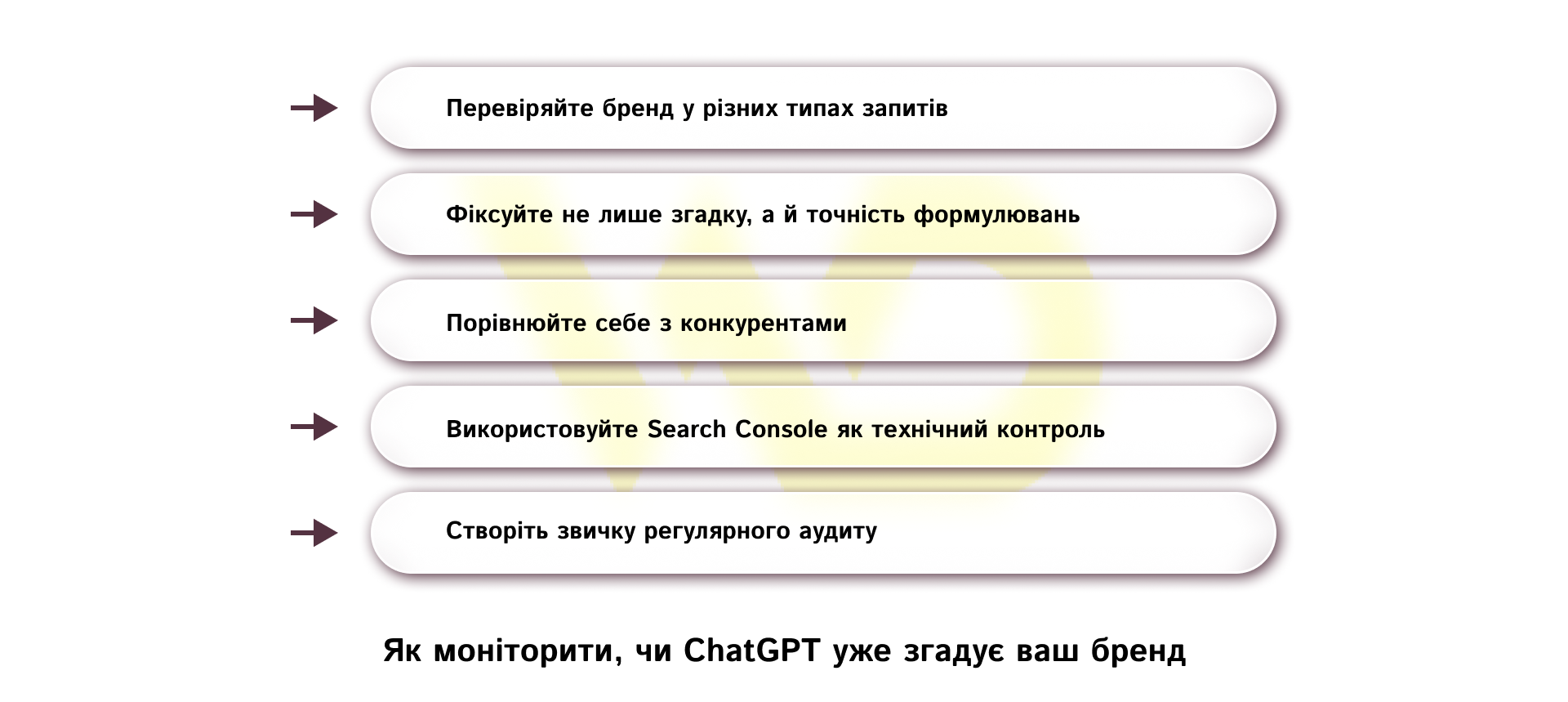
Check for your brand in different types of queries
Start by identifying scenarios in which a potential customer might search for your category. It’s important to see if your brand appears in commercial, informational, and comparative queries, as well as whether ChatGPT specifically names your company — not just the service category. This check reveals not only whether your brand is mentioned but also the context in which it’s associated with the topic.
Record not only the mention but also the accuracy of the wording
It’s helpful to see exactly what characteristics ChatGPT attributes to the brand. Does it correctly describe the business’s focus, does it confuse services, or does it shift the focus to competitors? This is where the difference between a simple online presence and a high-quality digital reputation becomes apparent. If the system consistently produces inaccuracies, this is a sign that the brand lacks consistent facts and external corroboration.
Compare yourself to your competitors
Monitoring only makes sense when done in comparison. If ChatGPT mentions competitors more frequently in a particular category, it’s worth examining the specific sources behind those mentions: do they have a media presence, structured pages, reviews, roundups, or other independent confirmations? This approach helps you understand where the brand’s digital presence — not the product itself — is falling short. Research on generative search also shows that authoritative third-party sources often carry more weight than a company’s self-promotion.
Use search console for technical monitoring
If a website has pages that should appear in AI search, they also need to be monitored at the indexing level. Google Search Console allows you to check the current status of a URL, view its indexing status, and, if necessary, request a recrawl via URL Inspection. This helps quickly identify technical reasons why a brand isn’t appearing in search results or is showing up with a delay. However, repeated recrawl requests do not speed up the process indefinitely, so checks should be targeted and justified.
Make it a habit to conduct regular audits
A regular cycle works best, rather than a one-time check:
- test requests;
- recording changes;
- comparison with the previous period;
- updating content where the system identifies errors or an incomplete picture.
This is especially important for businesses because mentions in AI can change following new publications, website updates, or the emergence of a stronger competitor in the sources the model relies on. That’s why monitoring should be treated as a separate workflow, rather than an «afterthought» to SEO.
Thus, the brand’s task is to consistently remain a clear and verifiable source for ChatGPT. When monitoring becomes systematic, the brand gains not random mentions, but a controlled presence in AI responses.
How to build a content ecosystem around a brand
To increase the frequency of mentions in ChatGPT responses, a content ecosystem is more effective — one in which a cohesive body of materials is built around the brand, consistently presenting the company’s name, its specialization, value to the customer, and key topics. It is precisely this structure that helps AI better understand the brand.
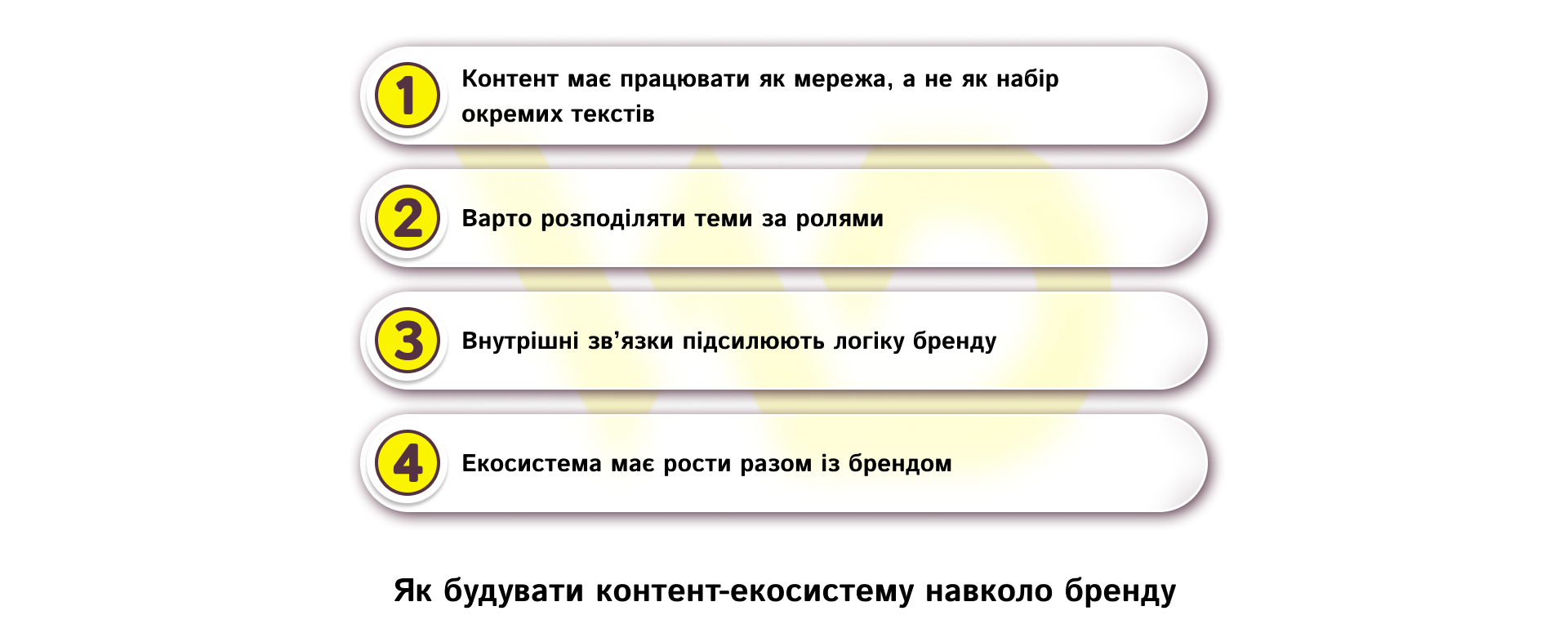
Content should function as a network, not as a collection of separate texts
One of the most common mistakes businesses make is creating content piecemeal: an article about a service today, a case study a month later, and an FAQ sometime after that. But for generative systems, it’s not the random presence of texts that matters, but the connections between them. If pages reinforce one another, refer to shared concepts, explore a single topic from different angles, and do not contradict each other, the brand appears more cohesive and trustworthy. In this framework, each new piece of content doesn’t just «drive traffic» — it strengthens the overall narrative surrounding the company.
It’s worth organizing topics by role
In a content ecosystem, each type of content serves a specific function. Some pages explain what the brand does and the problems it solves. Others help users choose between options or understand how the brand operates. Still others demonstrate expertise through case studies, examples, and results. Still others answer frequently asked questions that potential customers have even before contacting the team. This is exactly how a brand begins to be perceived not as an advertisement, but as a comprehensive source of knowledge in its niche.
Internal links reinforce the brand’s logic
It’s equally important for content to be interconnected not only thematically but also technically. Internal links help establish a logical flow: from a general overview to a detailed explanation, from a problem to a solution, from a service to a case study or recommendations. For the reader, this makes the journey clear and convenient. For search engines, it demonstrates that the site has a structure where individual pieces of content do not exist in isolation but form a unified content map of the brand.
The ecosystem must grow alongside the brand
Another important point is that content shouldn’t become «stagnant». If a company launches new services, addresses new customer needs, or shifts its focus, this should be reflected in the content. Updating old content, adding case studies, creating new explanatory pages, and expanding on topics help the brand stay relevant not only to people but also to AI systems that track the freshness and relevance of information.
A content ecosystem is a way to make a brand stand out through a collection of interconnected materials that consistently explain who you are, what value you provide, and why you can be trusted. It is precisely this depth and logical structure of your online presence that sends a much stronger signal to ChatGPT than any single post.

commercial offer
Other articles by the author

02/03/2026
A community manager is responsible for building, developing, and maintaining a community around a brand, product, or project.

12/08/2026
Broken links and non-existent pages aren't just technical flaws in a website they're a direct path to losing potential customers and dropping in search engine rankings.

02/04/2026
For Stories to deliver business results, you need regular analytics—that is, a focus not just on basic metrics, but on understanding the entire funnel, from viewing Stories to clicks and conversions.
Latest articles by #Useful tips
09/09/2026
The Facebook lead form helps businesses collect contact information from potential customers directly from an ad, without requiring them to visit the website.
08/09/2026
Today, an influencer is a distinct media platform with its own editorial policy, a keen understanding of its audience, and an established level of trust.

04/09/2026
Instagram Shopping is a set of Meta features that allows businesses to integrate their product catalog with their social media profile.