

 29/06/2026
  1263
1263

Інтернет-маркетинг
простою мовою
Content of the article

What is a search query: definition, types, and importance for SEO

Search queries reveal exactly how the audience articulates its needs when searching for a solution, product, or service. For businesses, this is one of the most accurate indicators of demand, since it is through search that people often move from interest to selection, comparison, and action. If you work with search queries correctly, you can better understand your audience, build a more precise website structure, create relevant content, and boost SEO results without unnecessary expenses.
In this article, we’ll take a detailed look at what a search query is, the different types of search queries, how they impact website promotion, and how to use them in your content to achieve your business goals.
What is a search query?
A search query is a word, phrase, or entire sentence that a user enters into a search engine when they want to find an answer, a product, a service, a brand, or a specific page. From an SEO perspective, it reflects demand; from a marketing perspective, it articulates a need as it arises. A search engine doesn’t simply match the words in the query with the text on the page; it tries to understand exactly what the user wants to find. Google describes this as a mechanism where the relevance of the query is taken into account when displaying results, and the search engine itself goes through the stages of crawling, indexing, and displaying results.
In SEO practice, it’s important to distinguish between the query itself and the keyword:
- a keyword is an element of the strategy we use to optimize pages;
- whereas a query reflects the user’s actual behavior.
Therefore, working with semantics should begin with an analysis of the tasks behind these phrases. This approach aligns with Google recommendations to create content for people, not for search engines.
How a search engine understands user intent
The same topic can be phrased in different ways. A user might be looking for a general explanation, a comparison of options, a specific brand, or a page to make a purchase. That’s why Google uses various signals to determine which result will be the best for that particular query.
Important! A page must match not only the topic but also the user’s expectations.
If a user searches for «what is CRM», they need an explanation. If they type «CRM for small businesses price», they’re already looking to compare solutions and assess cost-effectiveness. If they’re searching for the name of a specific service, the content should quickly lead them to the relevant page. In modern SEO, this is especially important because Google is getting better and better at handling longer and more specific queries, as well as follow-up refinements during the search process.
Main types of search queries
This classification by type is most often used in content creation because it helps determine which page format will be most appropriate.
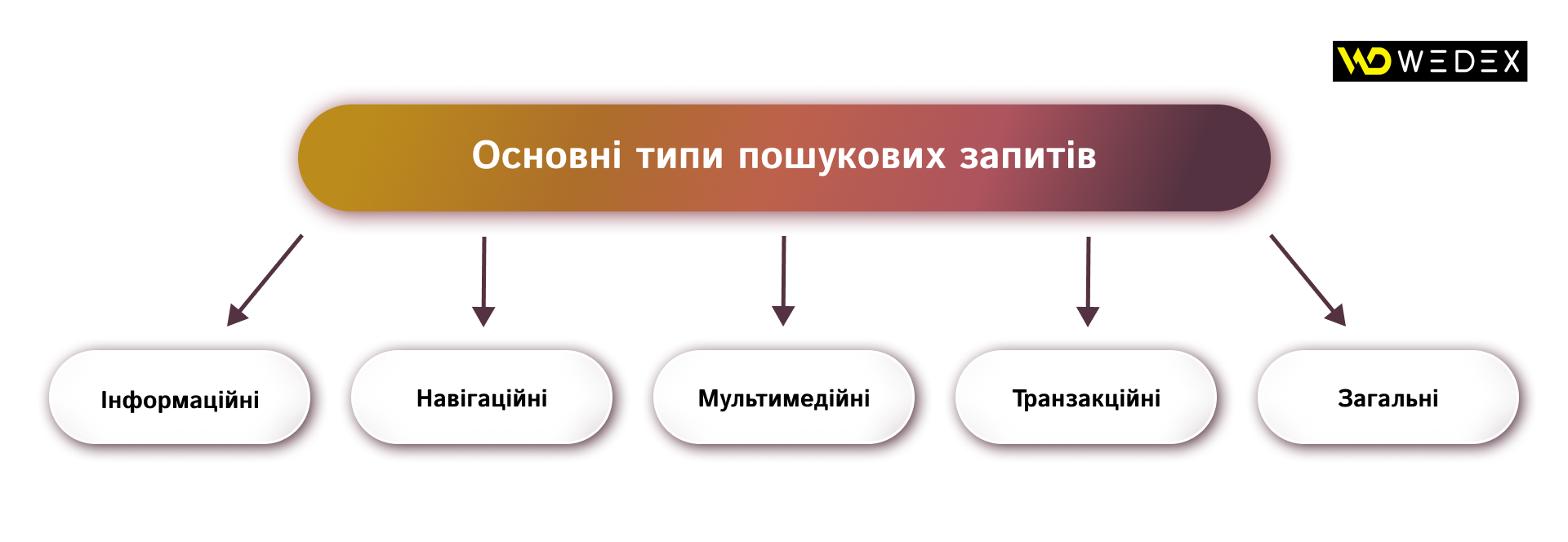
Informational queries
People enter these queries when they want to understand a topic, get an explanation, or find an answer to a specific question. They usually begin with the words «what», «how», «why», «for what», or take the form of a brief problem statement. These are queries at the discovery stage, when the user isn’t yet ready to make a purchase but is already looking for clear and useful information.
For businesses, informational queries hold strategic value. It is through these queries that a brand can capture the audience’s attention, demonstrate its expertise, and gradually build trust. Such queries work well in articles, guides, analytical pieces, FAQ, and explanatory texts. If an informational query is answered correctly, the user will remember the site as a source of clear and useful explanations and that’s already a good step toward further engagement with the brand.
Navigational queries
Users enter navigational queries when they already know exactly where they want to go. This could be a company’s website, a specific section, a service page, a blog, a user account, or another resource. In this case, the user isn’t searching for a general topic but is trying to quickly get to the right place.
In terms of business value, this type of query indicates that the brand already has a certain level of recognition. If a user searches for a company directly, it means they are either already familiar with it or have heard of it before. In SEO, such queries are particularly valuable for strengthening the brand, ensuring proper indexing of key pages, and monitoring how the company appears in search results.
Multimedia queries
Multimedia queries involve searching for images, videos, music, or other visual and audio content. A person might be looking for a photo, an instructional video, a presentation, a diagram, or an illustration in other words, not just an answer, but a format that will show them what they need more quickly. Such queries are especially useful when it’s important to see the result visually rather than read a long text.
For websites, multimedia queries open up additional opportunities for traffic. They are useful for blogs, online stores, media projects, educational platforms, and any resources where visual content enhances the message. If a page contains high-quality images, videos, or other media elements, it can better meet user expectations and hold their attention longer. In a business context, this is especially important because multimedia content often helps explain a complex product or service more effectively.
Transactional queries
Transactional queries indicate a person’s readiness to take action. This could be a purchase, an order, registration, a subscription, a download, or another specific action. Such queries often include words like «buy», «order», «price», «delivery», «download», or «sign up». These are the clearest indicators of commercial interest and a user’s proximity to making a decision.
For businesses, transactional queries have the greatest direct value, as they most often lead to inquiries and sales. But here, it’s important not just to insert a popular keyword into the text, but to create a page that truly drives action: with a clear offer, understandable benefits, answers to objections, and a seamless path to placing an order. If such a page addresses the user’s query without unnecessary distractions, it converts traffic into results much more effectively.
General queries
General queries are broad phrases without a clearly defined goal. People enter them when they haven’t yet decided on a specific search direction or simply want to get a general overview. Such queries often consist of one or two words and yield a very wide range of results in the search results.
For SEO, this is one of the most challenging types of queries because competition for them is usually high, and the user’s intent may be unclear. On the one hand, they offer great reach potential. On the other hand, they don’t always attract the specific audience that’s ready to engage with the business. Therefore, it’s best to use general queries as part of a broader strategy: they can help attract attention, but shouldn’t be the sole basis for content. They work best when they guide the user further through the site’s structure — to more precise, practical, and commercially valuable content.
When working with semantics, you shouldn’t limit yourself to just one type of query. An effective SEO strategy typically combines different types of queries to reach users at every stage of the decision-making process from searching for information to completing a target action. This helps attract not only more traffic but also a more engaged audience.
Why search queries are critical for SEO
Search queries form the foundation of the semantic core and serve as one of the main guiding principles for SEO specialists. If a website fails to account for actual user demand, it risks losing potential traffic even if it has high-quality design, a strong brand, and a good product.
Search queries are crucial for SEO for several reasons, which we’ll explore below:
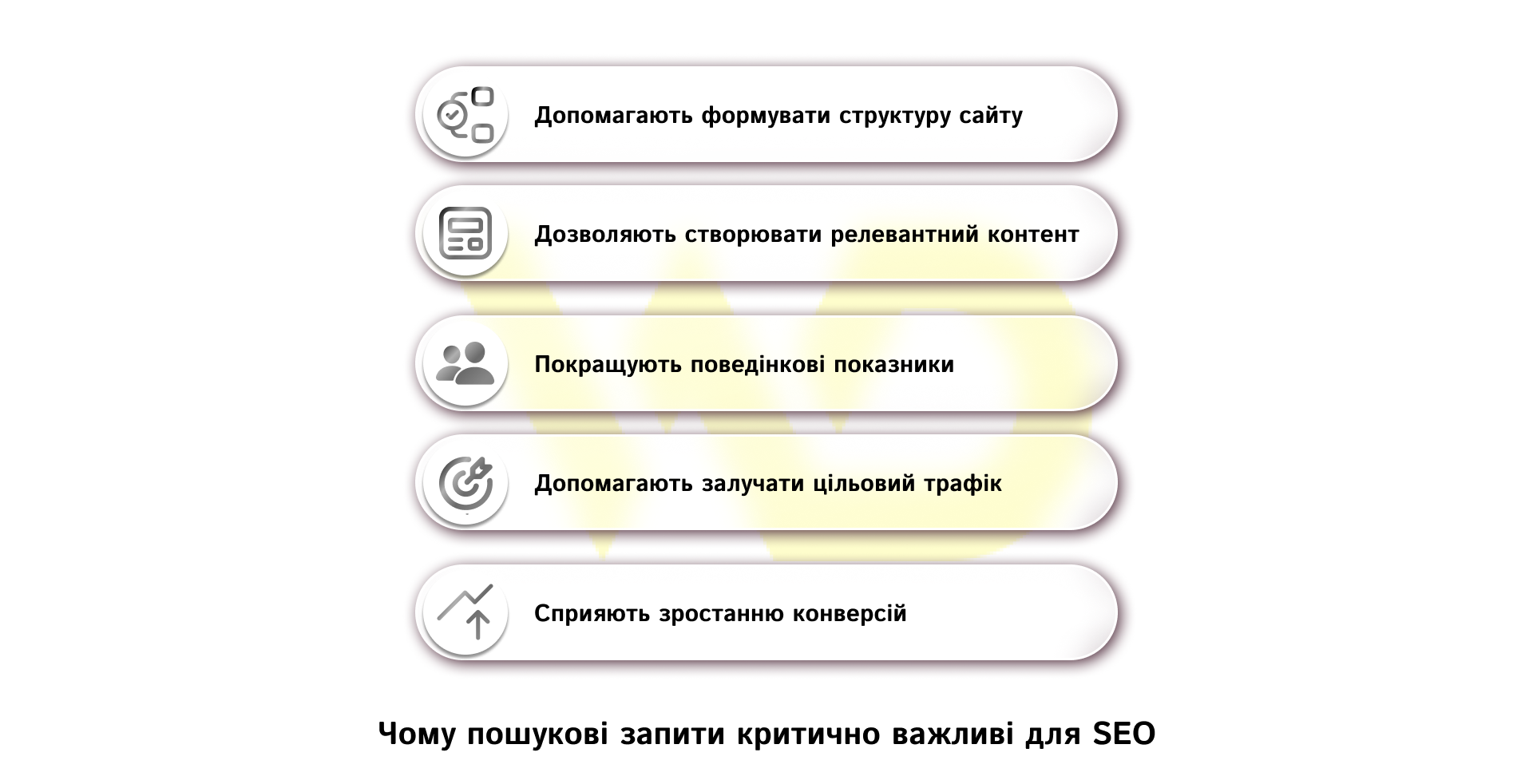
- They help shape the website’s structure. It is precisely based on search queries that the main sections, categories, service pages, and articles are determined. For example, if users regularly search for specific company services, it makes sense to create separate landing pages for them rather than grouping everything into a single section.
- They allow you to create relevant content. Understanding search queries helps you answer your audience’s actual questions. The more precisely a page matches the user’s intent, the greater the chance of achieving high rankings in search results.
- They improve behavioral metrics. When a user finds the information they need right away, they stay on the site longer, browse other pages, and are more likely to take the desired actions. For search engines, this is an additional signal of content quality.
- They help attract targeted traffic. A large number of visitors alone does not guarantee results. It is much more important to attract people who are genuinely interested in the product, service, or topic of the site.
- They help increase conversions. If a page is designed to address a specific user intent, the likelihood of a lead, purchase, or inquiry increases significantly.
In practice, this is quite straightforward. For example, a person might first search for «which luxury watch to choose as an investment», then move on to «review of Swiss luxury watches», and finally, «buy a Rolex Submariner from a trusted seller». At each stage, they need a different type of information: from a general understanding of the category to comparing models and, ultimately, making a purchase decision and it is these search queries that shape this sequential journey.
In addition, analyzing search queries helps identify new directions for the website’s development. If a company notice growing interest in a particular topic, it can prepare content in advance and secure its position before competition intensifies.
Working with search queries is not just a part of SEO, but one of the main tools for the strategic development of organic traffic.
How to collect and verify search queries before publication
It’s especially important for businesses not to rely solely on intuition when choosing topics for their website. Even if a particular topic seems obviously important to customers, actual search activity may paint a completely different picture. That’s why, before creating content, it’s worth analyzing search queries using specialized tools and verifying whether they’re actually in demand among the target audience.
The practical process of working with search queries can be broken down into several steps:

- Analyze current search queries.
Start by reviewing the data in Google Search Console. This will allow you to see which search queries are already driving impressions and clicks to your site, which pages attract the most traffic, and which topics have potential for further development.
- Find new ideas for content.
To do this, you can use Google Keyword Planner and other keyword analysis tools. They help you assess a topic’s popularity, find related search queries, and understand exactly how users phrase their needs.
- Check for seasonality and demand trends.
Even a popular search query may only be relevant during a specific time of year. Google Trends lets you assess how interest in a topic change over time and whether it’s worth preparing content in advance.
- Group search queries by user intent.
Informational, commercial, and transactional search queries should lead to different types of pages. This approach helps you create content that more accurately meets your audience’s expectations.
- Distribute queries across the site’s pages.
For each page, it’s best to identify the main query and several additional thematically related phrases. This will help avoid competition between your own pages and make the site’s structure clearer to search engines.
- Create content tailored to the user’s specific intent.
It’s important not just to add keywords to the text, but to provide the answer the user expects to receive. The more precisely the content addresses the user’s needs, the greater its value will be for both the audience and search engines.
For example, an online sports shoe store might discover in Search Console that users frequently visit the site via the search query «running shoes for beginners». In this case, it’s worth creating a separate article with tips on choosing models or a product category that best matches this query.
Another example is a company that provides accounting services. If Google Trends analysis shows a steady increase in interest in tax reporting ahead of the filing period, it makes sense to prepare a series of articles, guides, or advisory materials in advance. This will help drive organic traffic precisely when demand is at its peak.
For the B2B sector, analyzing search queries can also suggest new directions for content development. For example, if users are increasingly searching for «CRM for manufacturing companies», a business can create a dedicated landing page, case studies, or expert content for this market segment instead of promoting only general pages about CRM systems.
It’s best to approach semantics systematically: first, analyze actual queries in Search Console; then, assess their potential using Keyword Planner; and finally, check for seasonality and trends with Google Trends. This approach helps you not just collect keywords, but make decisions based on real data about demand.
It’s important to remember that effective SEO doesn’t start with a large number of keyword phrases, but with an understanding of your audience’s needs.
The same search query can imply different expectations depending on the stage of the decision-making process, so when planning content, it’s important to consider both search volume and user intent. The more precisely a page addresses the audience’s actual search query, the higher its chances of attracting not just visitors, but potential customers.

commercial offer
Other articles by the author

27/07/2026
Effective management of a backlink profile requires a systematic approach, the foundation of which is designing the correct structure of text links.

04/09/2026
Instagram Shopping is a set of Meta features that allows businesses to integrate their product catalog with their social media profile.

05/02/2026
Geotargeting is an algorithm that allows content or advertising messages to be shown to users based on their geographical location.
Latest articles by #SEO

02/10/2026
For businesses, CPL is the primary metric for measuring how effectively ads and landing pages convert cold traffic into initial leads.

29/09/2026
A content pipeline transforms the creation of content from a spontaneous creative process into a managed production system. In such a system, AI serves as a powerful assistant.

24/09/2026
While feeds were previously viewed as a purely technical feature for running contextual ads in Google Ads, today their quality directly determines the share of impressions across all sales channels.