

 24/04/2026
  1547
1547

Інтернет-маркетинг
простою мовою
Content of the article

Hierarchy of needs and motivation: applying Maslow’s psychology in modern business

Modern business is competing less and less on the basis of product and more and more on the basis of understanding people. To sell effectively, it is not enough to know what you offer. It’s important to understand what need your offer fills, why the customer chooses you, and what influences their decision. That is why Abraham Maslow’s theory is still useful for marketing, sales, HR, and branding. It helps to look at motivation systematically — from basic needs to the desire for development and self-realization.
In this article, we’ll look at how the hierarchy of needs works in marketing, sales, HR, and product solutions, as well as how to apply it without simplifications and mistakes.
What is Maslow’s hierarchy of needs?
In his original concept, Maslow proposed not just a list of needs, but the logic of their interconnection: a person tends to focus on more basic needs, and only then move on to higher ones. Classically, there are five key levels:
- Physiological needs — food, rest, basic comfort.
- Security — stability, protection, predictability.
- Social needs — belonging to a group, interaction.
- Respect — status, recognition, self-esteem.
- Self-realization — development, achievement, realization of potential.
It is important to note that even Maslow himself emphasized that this hierarchy is not rigid. In real life, people can be guided by several needs at the same time.
The same offer can satisfy different needs depending on how it is presented. For example, food delivery can be perceived as:
- a way to satisfy a basic need for comfort and time saving;
- a guarantee of predictability if the service is stable;
- part of a lifestyle if the brand builds emotionally strong communication.
Or another example: A CRM system for business. It is sold not only as a set of functions. For a manager, it can mean control, process transparency, and risk mitigation. For the team, it means convenience of work. For the company as a whole, it is a growth point.
That’s why it’s important in marketing not just to describe product characteristics but to translate them into the language of needs.
How to apply Maslow’s pyramid in marketing
In marketing, this model helps to formulate more accurate messages and better segment the audience. If a company understands what level of needs its product addresses, it can speak to customers more appropriately and convincingly.
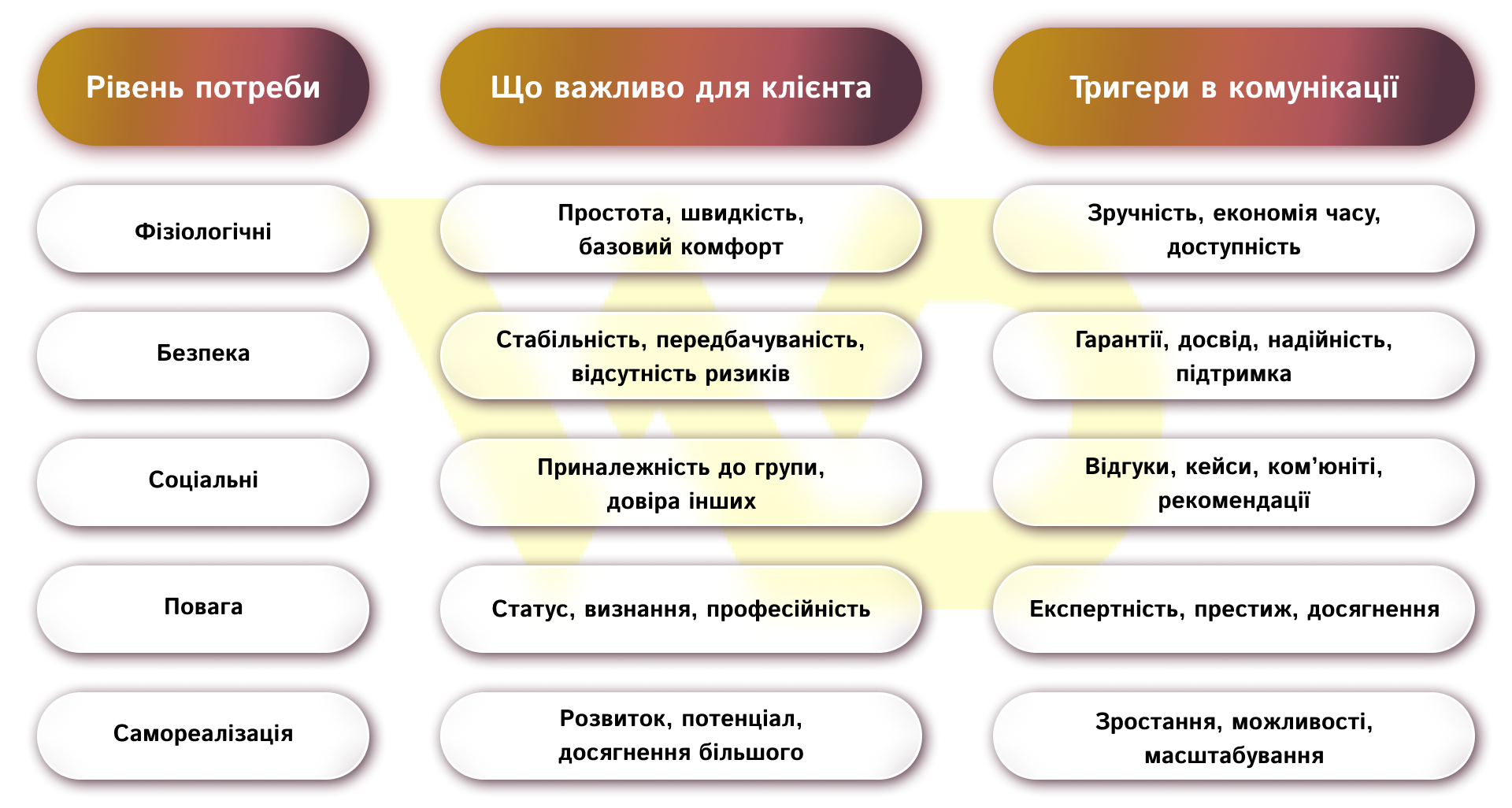
At the level of basic needs
This is where messages about convenience, accessibility, time savings, stability, and simplicity work. This approach is suitable for mass goods and services where it is important to quickly close a practical request.
As it sounds in the brand’s message:
- «Place orders quickly without unnecessary steps»
- «Get a service that saves you time every day»
- «A simple solution for everyday tasks without unnecessary complexity»
On the security level
When predictability is important to the audience, the brand should emphasize guarantees, experience, reliability, support, and control. This is especially true for financial services, healthcare, education, B2B solutions, and technical services.
For example:
- «Work with a team trusted by hundreds of customers»
- «Receive transparent terms and clear results»
- «A service that works stably and without risks for your business»
On the level of social needs
People want to be part of a community. This is where reviews, case studies, communities, customer stories, publicity, and a sense of belonging to a particular group work.
How it sounds:
- «Join the community of companies that are already growing with us»
- «Choose a solution recommended by customers in your niche»
- «Become part of a brand that professionals trust»
On the level of respect
If a product is associated with status, professionalism, or recognition, communication should emphasize expertise, premium, achievement, results, and prestige.
For example:
- «The solution for companies seeking a higher level of results»
- «Emphasize the professional level of your brand»
- «Choose a service that meets high market standards»
At the level of self-realization
Here, the brand no longer just sells a product, but shows how it helps a person grow, unleash their potential, and achieve more. This works especially well in the field of training, consulting, creative services, and development products.
The brand’s message is as follows:
- «Tools that help you grow your business and see new opportunities»
- «Unleash your team’s potential with a solution that supports growth»
- «Create more, achieve more, move on»
Application in sales and B2B
In B2B communication, motivation is often less emotional at first glance, but the principle is the same. A business client wants not just to buy a solution, but to reduce risks, improve processes, save resources, and get a predictable result.
A sales manager can build arguments in different ways depending on the role of the interlocutor:
- The owner of the company cares about money, risks, and payback;
- Marketing Director — efficiency, scaling, and impact on the result;
- an operational manager needs convenience, control, and stability of processes.
One product in B2B can cover several needs simultaneously. That’s why strong sales are rarely built on a functional description alone. They work by understanding the customer’s priorities.
How to use the model in HR
Maslow’s pyramid is useful not only for external communication but also for internal team management. A person will not work effectively where at least the basic needs are not met: stability, clear rules, normal salary, and respect from management.
Then there are other factors:
- a sense of belonging to a team;
- recognition of results;
- opportunities for development;
- the prospect of realizing one’s own potential.
That’s why a strong employer sells not just a vacancy, but the experience of working in the company. If this is not done, even good specialists will quickly lose motivation.
Why Maslow’s pyramid is not a hard and fast rule
Despite its popularity, modern research does not confirm that human needs are always met strictly in turn. A large empirical study using data from Mexico tested four key assumptions of Maslow’s theory, and all of them were rejected. The authors concluded that need satisfaction strategies do not have to be sequential. This means that in real life, people can simultaneously seek security, belonging, and recognition.
That is why it is dangerous to build communication in business only according to the «first we will close the lower level, then move on to the higher level» template. This approach oversimplifies the behavior of the audience.
A more effective strategy is to combine several motives in one positioning: for example, a product can simultaneously promise time savings, predictability, professional growth, and a sense of control.
How to work with the model correctly
Maslow’s theory provides a convenient framework for understanding motivation, but in business, it does not work as a universal «default» solution. Its value lies in the ability to form reasonable hypotheses about audience behavior, which then need to be tested using data.
The key mistake is to try to immediately «assign» a level of need to a client. In reality, motivation is much more complex: it varies depending on the situation, product, previous experience, and even the point of contact with the brand. The same customer may be driven by different needs at different stages of the funnel, from rational to emotional.
Therefore, the first step is to make an assumption: which need is currently dominating a particular segment. For example:
- In B2C, it can be security (guarantees, quality, reliability);
- In B2B, it is efficiency and results (process optimization, resource savings);
- in the premium segment – status and self-realization.
But these assumptions are only valuable if they are confirmed by user behavior.
In practice, this means working with several data sources simultaneously. Search query analytics allows you to understand how customers formulate their needs. Behavior on the site shows what arguments keep them or, on the contrary, push them away. Advertising campaigns provide quick feedback on which messages are «catching on» and which are being ignored.
Qualitative data is especially valuable. Interviews with customers allow you to see the motivation deeper: not just «what they bought» but «why they chose this particular solution». It is often in such conversations that real triggers are discovered.
Another important step is analyzing post-purchase feedback. It helps to understand what value of the product turned out to be decisive after the interaction. Here, businesses often receive insights that differ from their initial hypotheses.
As a result, this approach changes the very principle of working with motivation: instead of intuitive decisions, businesses move to systematic verification. This allows you to more accurately formulate positioning, create relevant messages, and build communication that really resonates with the audience, rather than being based on assumptions.

commercial offer
Other articles by the author
10/09/2026
The 4P model serves as an architectural foundation that transforms disparate marketing activities into a single, manageable system.

12/06/2026
In professional circles, UX refers to the entire ecosystem of human interaction with a brand, digital product, or service.

21/04/2026
For businesses, this means a new reality in which interactions with a brand may begin not through a search engine or an ad, but directly within AI services.
Latest articles by #Useful tips

18/08/2026
For businesses, the main challenge right now is not simply to “produce something,” but to speed up the time it takes for materials to reach the market, reduce the cost of content creation, and, at the same time, maintain the quality and human touch of communication.

16/07/2026
The official launch of OpenAI ad testing on February 9, 2026, was a historic moment that marked the emergence of an entirely new media channel for promoting businesses.

08/07/2026
ChatGPT can already search the web, provide quick answers, and display relevant sources, which means it’s important for businesses to be clear, cited, and verified in the digital space.