

 21/04/2026
  1832
1832

Інтернет-маркетинг
простою мовою
Content of the article
- /01 How Google AI changes search logic
- /02 How AI Mode changes user behavior
- /03 What content works best for Google AI
- /04 How to rebuild your content strategy for Google AI
- /05 How to measure performance in AI search
- /06 How to adapt content to different business models
- /07 How to prepare a website for Google AI from the technical side
- /08 What are the limitations of AI Mode?
Basics of working with Google AI: how to get the maximum result

Google search is changing, and users increasingly receive not just a list of links, but a ready-made AI answer with additional sources for clarification. In this regard, the competition is shifting from SEO traffic and contextual advertising to visibility in the search results. Therefore, it is important for businesses to understand how Google’s AI functions work and how to adapt their website and content to get the most out of them.
In this article, we will analyze what Google AI is in search, how it changes user behavior, and what approaches help businesses stay visible in the new search results format.
How Google AI changes search logic
Previously, a user would enter a query, browse the results, and collect the answer from several websites. Now, Google is increasingly showing a ready-made explanation right in the search results, and only then — sources for more details. This changes the very logic of search: the quality of the content that can be used in the answer comes to the fore, rather than the page position.
But despite the emergence of AI functions, the basic principles of SEO remain important. Indexing, Googlebot accessibility, matching structured data to visible content, and content quality are still crucial. In other words, AI does not replace SEO, but strengthens the requirements for it.
Get your website ready for AI search today
The WEDEX team will tailor your website’s SEO strategy to Google’s latest AI algorithms.
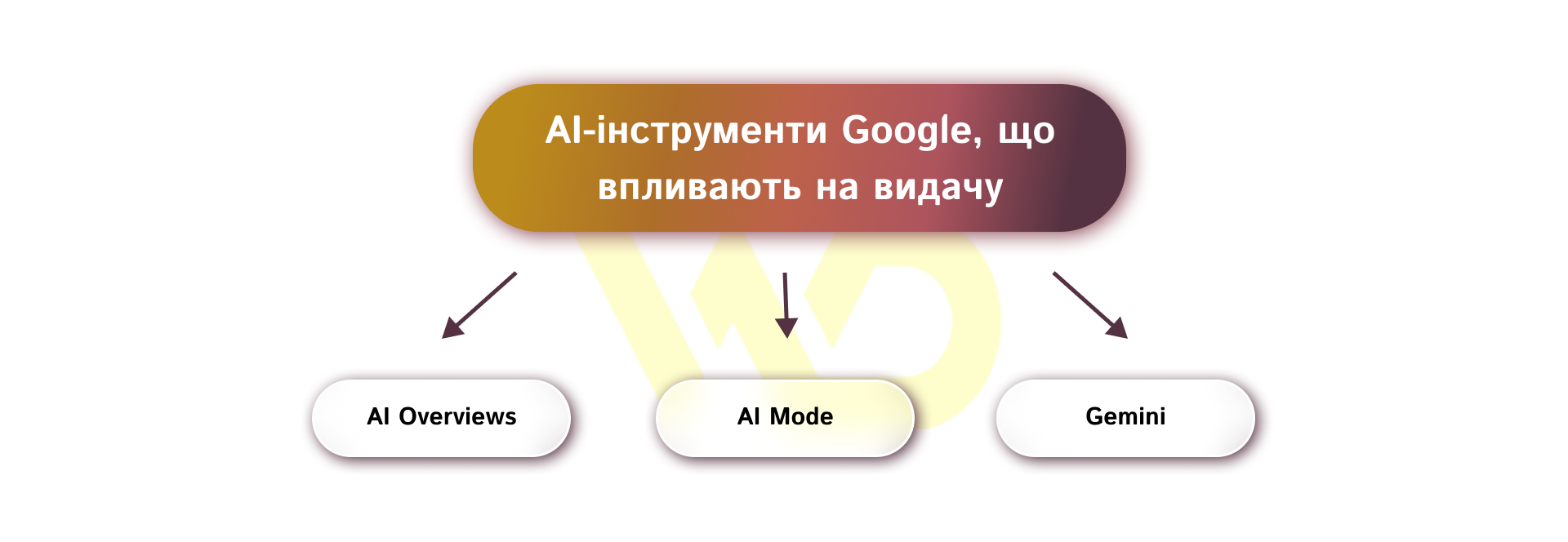
To understand exactly how this works in practice, it is important to understand Google’s main AI tools that already influence the look of search results and user behavior.
What are AI Overviews?
AI Overviews is a short AI answer in Google search results. It appears above or next to regular search results and gives the user a brief summary of the topic along with links to sources.
Well-structured content can be ranked and get into the area where the user first sees the essence of the answer and then goes to the site. Materials that quickly explain a complex topic, contain clear wording, and answer common clarifying questions work especially well for this purpose.
What is AI Mode?
AI Mode is a deeper dialog mode where users can clarify their query, change the wording, and get a more detailed answer. Unlike the short AI summary in search results, the interaction here is built like a conversation: a person asks a question, and the system helps narrow down the topic, compare options, and explore the query in more depth.
This is especially important for businesses in niches where decisions are not made immediately. That is, for those who promote services, complex products, B2B solutions, technically intensive topics, and expensive purchases. In such cases, the user is not looking for one short answer — they compare, clarify, and check. That is why content should be structured to provide sufficient depth, not just a basic explanation.
What is Gemini?
Gemini is a separate Google AI tool that works alongside search but is not the same as AI Mode. While AI Mode is a format of interaction within search, Gemini is a broader AI service for generating, analyzing, working with text, and performing various tasks.
It is important not to confuse these tools. Gemini can help with content, analysis, or working with information, but it is not synonymous with AI search. In the context of SEO and website visibility, AI Overviews and AI Mode are of primary importance, as they affect how users see and consume search results.
Let’s take a look at the comparison table for clarity.
|
Tool |
How it works |
What the user sees |
What it means for business |
|
Normal search |
Shows a list of pages by relevance |
The user chooses the site and collects the answer himself |
Classic SEO, CTR, positions, snippets are important |
|
AI Overviews |
Provides a short AI answer in the search results with links to sources |
The user immediately sees a brief summary of the topic |
Clear, structured, and accurate content is required |
|
AI Mode |
Works as a dialog search with refinements |
Users can ask additional questions and study the topic in depth |
Expert materials, comparisons, explanations, and FAQs are preferred |
|
Gemini |
A separate AI tool for working with information and generating content |
Users interact with AI beyond the classic search results |
Useful for internal business work, but not a substitute for SEO presence |
How AI Mode changes user behavior
AI Mode changes not only the look of search, but also the user behavior itself. Now search is increasingly turning into a dialog. The user clarifies the topic, narrows down the criteria, compares options, and gradually moves towards a solution. For business, this means that both the page for the exact query and the content that helps to go all the way from interest to choose are valuable.
Let’s analyze what exactly changes.
- The query is split into several sub-queries.
AI Mode doesn’t work like a regular search with one short phrase. If the topic is complex, the system can break it down into separate components and process them in parallel. For example, a query about CRM for small businesses can turn into a set of refinements: price, integrations, reporting, ease of implementation, support. For a website, this means that in addition to the main commercial pages, reviews, comparisons, FAQs, and explanatory materials become important.
- The user receives an answer before they go to the site.
Google takes care of some of the information work even before the click. A person first sees a short or detailed explanation, and only then decides whether to go to the source. Because of this, the website is no longer always the first place of contact with the brand, but can become a source that the system trusts when forming a response.
- The quality of the source, not just the traffic, becomes the center of attention.
In the new model, it is important not just to appear in search, but to become a resource that Google can use as a reliable source. That’s why weak, superficial, and template materials lose their chances of being noticed.
- The role of funnel content is changing.
In AI Mode, it’s not just one single page that benefits, but the entire content ecosystem around a topic. The user can move from a general query to clarifications, and therefore, the content should support them at different stages of this path. You need commercial pages and materials that explain, compare, and remove objections. It is this structure that helps a brand stay visible in the new search format.
And to understand which materials have the highest chances of being used by Google in this scenario, it is worth looking at what content Google AI uses more often.
What content works best for Google AI
Google is not pushing businesses to develop a «magic» formula for AI search results. On the contrary, the Search Central documentation emphasizes that the same basic SEO approaches work for AI functions as for regular search.
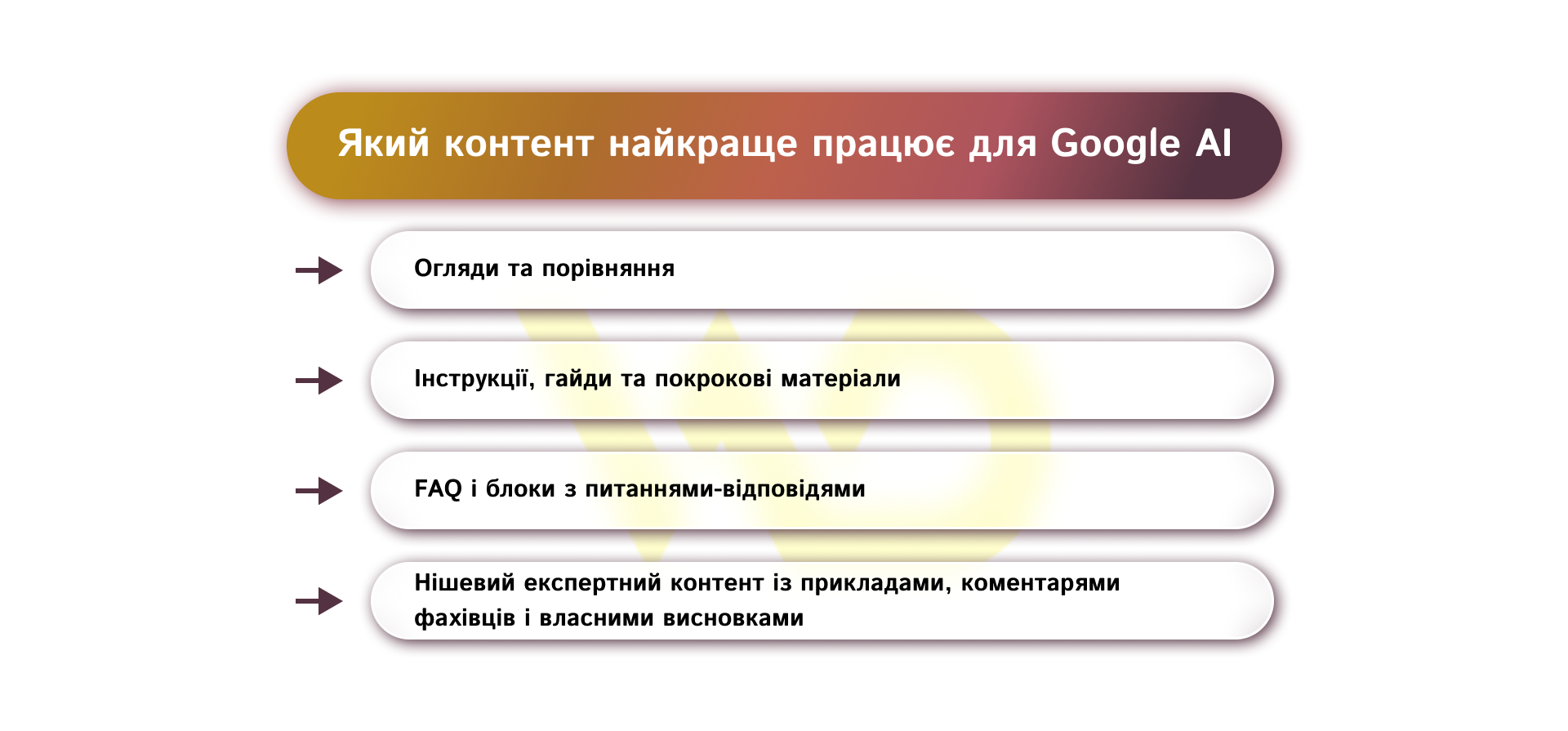
- Reviews and comparisons. For Google AI, materials that do not just name a product or service but help the user to choose between several options are especially valuable. The systems strive to display useful and reliable information, and the content should contain original analysis, a full description of the topic, and added value compared to other pages in the SERP. That’s why review articles, comparative collections, and analytical materials have a strong potential for AI responses. For example, a B2B service will be better served by an article like «How to choose a CRM for your sales team: 5 comparison criteria» rather than just a «Our product» page.
- Instructions, guides, and step-by-step materials. Google works well with content that helps people go from problem to solution. Search Central’s guidelines emphasize that «useful material should provide a sufficient, complete, and meaningful answer, as well as demonstrate the author’s depth of knowledge and experience». That’s why step-by-step guides, instructions, checklists, and «how-to» materials are of high practical value for AI search. For example, the article «How to prepare a website for launching Google Ads» will be more useful for AI results than a general text without a clear structure and conclusions.
- FAQ and question and answer blocks. The format of questions and answers helps to better structure the page and close typical user queries. FAQ blocks are appropriate for pages of services, product categories, and complex expert materials. For example, for a marketing agency website, you can add blocks with answers to questions about deadlines, budget, stages of work, reporting, and expected results.
- Niche expert content with examples, expert comments, and your own conclusions. Google evaluates content that demonstrates real expertise, sources, experience, and credibility the best. This is especially important for AI because the system is looking for not just a topic, but a reliable source for an answer. For example, an agency’s blog will be better served by a post with examples from SEO, e-commerce, or B2B than a general article without reference to real-world practice.
In the end, the decisive factor is not the type of material, but its ability to be useful and understandable to the user.
How to rebuild your content strategy for Google AI
Updates to search results affect the structure of content, the logic of its creation, and the interaction between different types of pages. To keep your website up-to-date and in the top rankings, you need to consider the following points:
- Change the role of the blog: from traffic to a source of answers.
A blog ceases to be just a channel of engagement and becomes part of the overall expert presence of the brand. The more useful, structured, and in-depth materials it contains, the higher the chances that this particular site will be used as a source.
- Build content clusters instead of creating individual articles.
Separate texts for specific queries are gradually losing their effectiveness. nowadays, the approach when content is combined around a topic works better.
For example:
-
- main article that covers the topic as a whole;
- additional materials: comparisons, instructions, FAQs;
- commercial pages related to the topic.
This structure helps Google to better understand the site’s expertise and use different pages for different types of queries within AI Mode.
- Ensure coverage of the entire user journey.
AI search «guides» the user from a general question to a specific solution. Therefore, it is important that the content corresponds to different stages of this process:
-
- familiarization (what it is, how it works)
- comparison (what options are available);
- choice (how to choose, what to look for);
- decision (where to order, how to start).
If a website covers only one of these stages, it loses some of its visibility. If it covers the entire path, it gets more entry points through AI.
- Combine SEO, AI, and commercial pages.
AI is changing the interaction between SEO and commercial pages. An effective strategy looks like this:
-
- informational content answers queries and gets into AI results;
- the user goes to the website for more details;
- commercial pages close a purchase or contact request.
In other words, content works as a bridge between search and business results. And the better this connection is built, the higher the efficiency in the new search model will be.
How to measure performance in AI search
Google AI results should be evaluated not only by traffic volume. Transitions from AI Overviews and AI Mode are included in the total search traffic in the Search Console, and data on them is displayed in the Performance report within the Web search type. To analyze performance, Google also recommends combining Search Console with Google Analytics to see not only the fact of conversion but also the user’s further behavior on the site.
The basic metrics in Search Console are clicks, impressions, CTR, and position. They show how the page behaves in search in general and whether its visibility in the responses generated by Google based on AI functions is increasing. If you see more impressions but fewer clicks, it may mean that the page appears more often in the user’s field of vision, but it needs to be strengthened with content or presentation.
It is useful for businesses to evaluate not only clicks but also what happens after the transition. Google separately recommends tracking conversions and time spent on the site in Google Analytics, as well as combining this data with the Search Console to see a more complete picture. In its documentation, Google also notes that clicks from AI Overviews results are of higher quality: users are more likely to spend more time on the site.
The most convenient way to look at performance is in three dimensions:
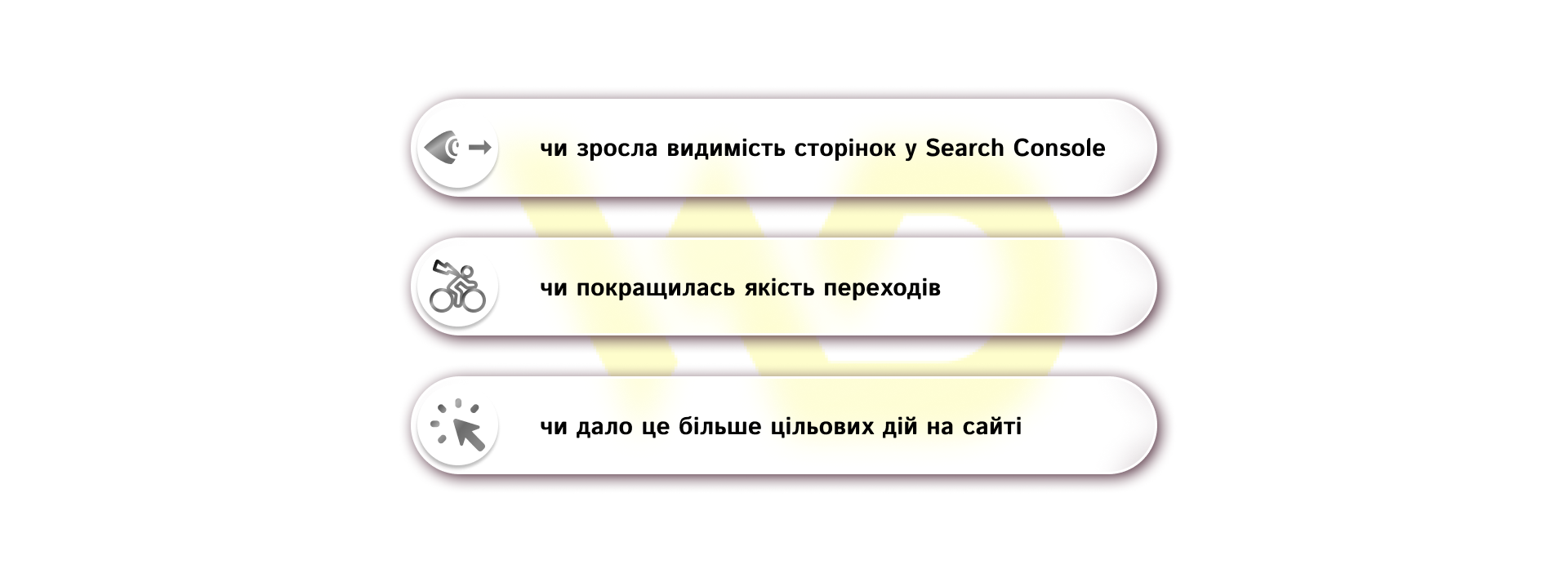
To do this, you should regularly analyze pages and queries in the Performance report, and then compare them with Analytics data on conversions and time on the site. This approach shows the real effect of AI search better than a simple comparison of traffic before and after.
How to adapt content to different business models
The effectiveness of Google AI depends on the quality of the content and how it fits the type of business. Different models have different entry points to search and different roles in user decision-making, so the approach to content should also be different.
E-commerce: focus on data and comparison
For online stores, the key role is played by the accuracy and structured information. Google AI actively uses product data, so it is important to:
- correctly design product cards;
- maintain up-to-date prices and availability
- add reviews and ratings;
- describe delivery and return conditions.
In this segment, not only the text is crucial, but also the quality of the data that the system can use to generate a response.
Services: explaining the process and removing objections
For service businesses, the main task is to help the user understand how the service works and what they will receive.
The best ways to do this are:
- pages describing the work process;
- case studies with real-life examples;
- FAQ with frequently asked questions;
- expert materials with explanations.
It is important not only to describe the service, but also to remove uncertainty and reduce the barrier to contact.
B2B: analytics and decision justification
In the B2B segment, decisions take longer to make, so content should support the process of analysis and comparison.
The best content is:
- analytical market reviews;
- comparison of approaches and solutions;
- explanation of complex processes;
- content with business arguments.
Here, you should demonstrate not the product but the logic of choice and the value of the solution for the business.
How to prepare a website for Google AI from the technical side
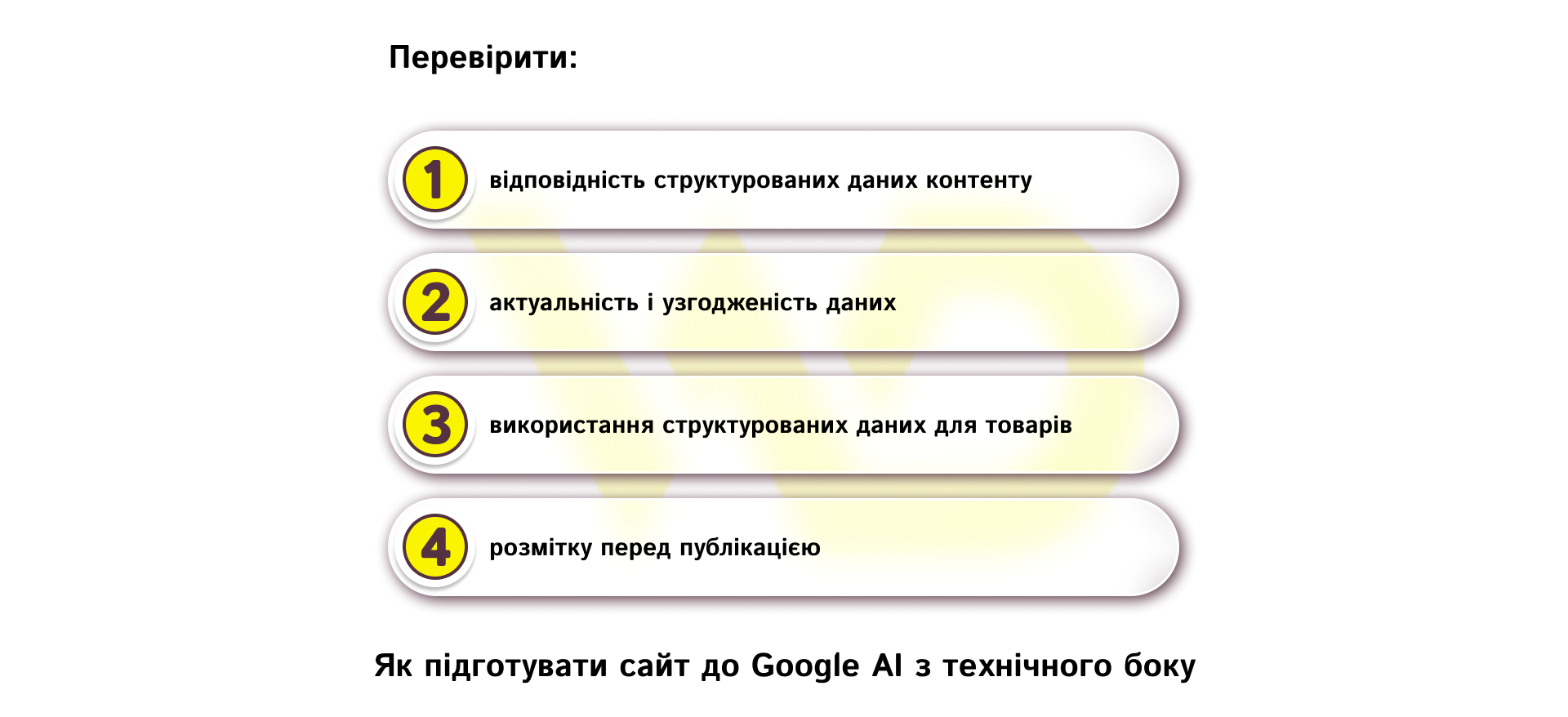
Even the best content will not work if the website is technically incomprehensible to the search engine. AI functions do not require separate optimization, but basic technical requirements remain critical.
Matching structured data with content
Structured data only works if it reflects the actual content of the page. If the markup contains data that is not in the visible content or is different, it reduces the credibility of the page.
For example, if the price of a product is one in the text and another in the markup, or if the characteristics do not match, this creates risks for correct display in search results. For businesses, structured data is not a formality, but a tool that helps Google accurately understand the content of a page.
Data relevance and consistency
Google focuses on relevant information, especially for commercial and local queries. Therefore, it is important that the data on your website, profiles, and services are consistent with each other.
For online stores, this means
- the same price in the product card, markup, and Merchant Center;
- correct product availability;
- up-to-date delivery terms.
For local businesses:
- exact working hours;
- up-to-date address;
- correct contact information in the Business Profile.
Any discrepancies reduce the quality of the page as a source of information, and thus the chances of being used in AI responses.
Using structured data for products
For product pages, it is especially important to use structured data of the Product type. It helps Google to get the key attributes: price, availability, rating, reviews, delivery terms.
This does not guarantee getting into the AI results, but it significantly increases the chances that the page will be correctly understood and used in search results.
Check markup before publishing
Any page should be checked before publication not only in terms of text but also technical correctness. Google recommends using structured data validation tools to detect errors and make sure that the page meets the requirements.
What are the limitations of AI Mode?
Despite its advantages, AI Mode is not a perfectly accurate tool and has a number of limitations that businesses should take into account.

- Errors in summarizing information. The system can simplify complex topics or lose some context when forming an answer. This is especially noticeable in niches with technical or multifactorial solutions.
- Inaccurate interpretation of sources. AI can incorrectly interpret or abbreviate information from pages, which can result in simplified or out-of-context wording.
- Changes in click-through rate (CTR). Since part of the answer is provided directly in the search results, users may be less likely to click through to the site, even if the brand was used as a source.
- Limited brand visibility. It is important for businesses to control how they are presented in the answers, as AI forms a generalized picture that does not always fully coincide with the company’s positioning.
Thus, the new environment is favorable for those websites that work with content systematically: combine expertise, structured data, logical page architecture, and in-depth topic disclosure. It is this combination that allows you to remain visible in AI-oriented search results and turn search into a real channel of influence on user decisions.

commercial offer
Other articles by the author

16/06/2026
Performance marketing is an approach to promotion in which the primary goal is not abstract reach, but a specific and measurable result.

15/06/2026
The algorithms of digital platforms are evolving faster than user habits, and by 2026, social media had undergone radical changes.

09/09/2026
The Facebook lead form helps businesses collect contact information from potential customers directly from an ad, without requiring them to visit the website.
Latest articles by #SEO

22/10/2026
To properly link Instagram to Facebook, you need to distinguish between the different types of accounts within the Meta ecosystem, since confusion between a personal profile and a business page is the most common cause of errors during setup.
09/09/2026
The Facebook lead form helps businesses collect contact information from potential customers directly from an ad, without requiring them to visit the website.

08/09/2026
Today, an influencer is a distinct media platform with its own editorial policy, a keen understanding of its audience, and an established level of trust.