

 23/07/2026
  1212
1212

Інтернет-маркетинг
простою мовою
Content of the article
What is retail and how does it work
Retail today is a dynamic ecosystem that requires businesses to adapt instantly to changing market conditions. To remain competitive and attract customers, it’s not enough for companies to simply stock shelves with merchandise. Today, it’s essential to create a flawless customer experience at every stage of interaction.
In this article, we’ll explore how modern retail works, how it fundamentally differs from traditional retail, which formats dominate the market, and which marketing tools and metrics businesses can use to scale their sales.
The difference between retail and traditional retail
The word «retail» comes from the English term «retail», which translates to «retail sales» or «small-scale trade». At its most basic level, it is the process of selling goods or services to end consumers for their personal use. However, equating modern retail with the traditional retail trade of years past would be a serious strategic mistake for an entrepreneur.
By 2026, shoppers had become more discerning, more mobile, and better informed. They no longer buy a product simply because it’s in stock. In response, retail has transformed into a model of a qualitatively new, systematic approach to interacting with consumers. Here, every step — from the first click on a website to packing a product in a brick-and-mortar store — is guided by a unified marketing strategy and data analysis.
Traditional retail — such as street markets or kiosks — operates on a transactional model: «buy in bulk — add a markup — sell — lock in a profit». Here, the principle of a one-time interaction applies. Modern retail, on the other hand, is a deeply integrated ecosystem focused not on the transaction itself, but on creating a unique customer experience and building long-term relationships.
To better understand business processes, let’s compare these two models based on key criteria:
|
Comparison criteria |
Traditional retail |
Modern retail |
|
Location and channels |
A purely physical presence in a specific location with no alternatives for the customer |
Multichannel or omnichannel system (offline + online) |
|
Pricing |
Flexible, often chaotic, with room for negotiation and no fixed prices |
Strictly fixed, managed through a system of dynamic discounts and personalized bonuses |
|
Level of service |
Minimal service, limited to the moment of handing over the goods |
High service standards, professional consulting, after-sales support |
|
Data management |
Off-the-cuff record-keeping or a complete lack thereof, no information about the customer |
In-depth behavioral analytics, use of CRM systems, and personalized marketing |
|
Competitive advantage |
Primarily low price or the random uniqueness of the location |
Brand strength, service quality, delivery speed, shopping convenience, and emotional connection |
Thus, the transition from traditional retail to modern retail is not merely a change in terminology, but a full-fledged evolution of business thinking.
Main retail formats
Modern retail is classified into three main categories, each of which requires a distinct marketing and logistics approach.
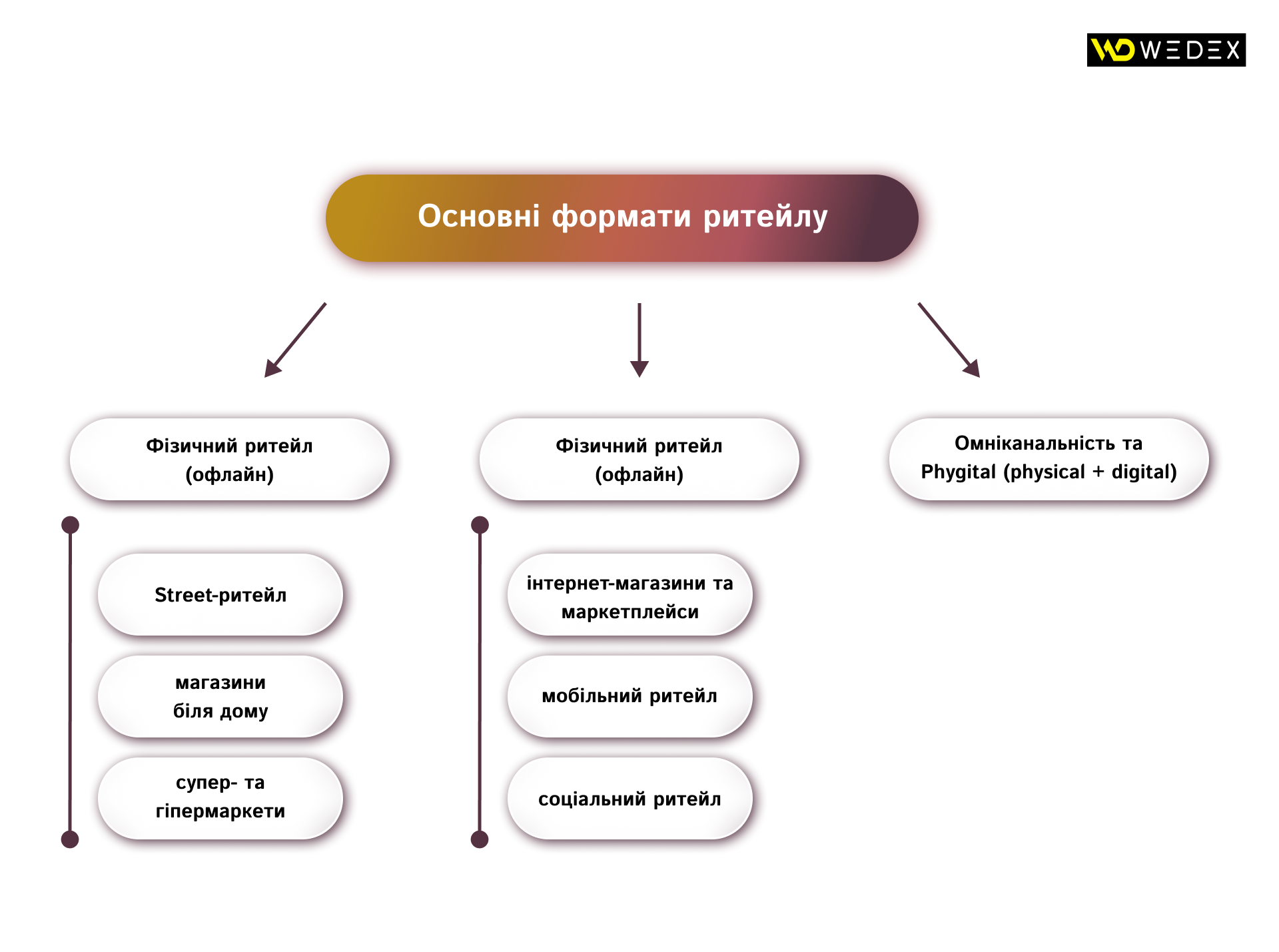
- Physical retail (offline).
Despite the market digitalization, physical locations remain a key channel for delivering a direct customer experience. They are divided into the following main formats:
-
- Street retail: stores on the ground floors of buildings along busy streets, targeting spontaneous foot traffic;
- Convenience stores: small markets focused on quick purchases of daily essentials;
- supermarkets and hypermarkets: large retail spaces with the widest possible assortment for comprehensive family shopping.
The development of these offline formats demonstrates that physical space is no longer merely a place for dispensing goods it has become a platform for building an emotional connection with the brand.
- E-commerce.
The digital retail format has eliminated geographical limitations and enabled companies to interact with customers 24/7 through three main channels:
-
- online stores and marketplaces: websites that make it easy to compare prices and product specifications and place orders quickly;
- mobile retail: sales through brand apps with personalized push notifications and fast checkout;
- social retail: direct sales on Instagram, Facebook, or TikTok based on interactive visual content.
Thanks to this variety of digital tools, businesses can not only expand their sales reach but also collect accurate data on each customer’s behavior.
- Omnichannel and phygital.
This represents the pinnacle of retail development, seamlessly integrating all online and offline channels into a single system. A shopper can start browsing products on social media, complete the purchase in an app, and pick it up at a brick-and-mortar store. At the same time, the «Phygital» concept — a blend of «physical» and «digital» — integrates digital tools, such as QR codes on price tags or touchscreens, directly into the physical store environment.
Today consumers no longer distinguish between online and offline shopping; instead, they choose the quickest path to a purchase. The brands that succeed in this evolution are those that create a flexible and seamless phygital system for customers at every stage of their interaction.
How to manage buyer behavior
Working in the retail business is always a complex task that requires mapping out a clear customer journey. The main goal of retail marketing is to guide the consumer from the stage of «I’m hearing about this brand for the first time» to the stage of «I shop here regularly and recommend it to others».
To achieve this, tools are used that fall into two key categories.
Trade marketing (activities directly at points of sale):
- professional store layout planning, zoning, eye-level product placement («golden shelf»), and managing customer flow within the brick-and-mortar store;
- POS materials: signs, wobblers, shelf talkers, and banners that draw attention to promotional offers and encourage impulse purchases at the checkout;
- the use of specially selected music, scents, and lighting to create a pleasant atmosphere and encourage shoppers to spend more time in the store.
Digital marketing (online engagement tools):
- targeted and contextual advertising;
- retargeting and remarketing;
- content marketing and SEO.
Data is at the heart of this entire matrix. Modern CRM systems and analytics platforms allow you to collect information about every purchase, analyze average transaction value, visit frequency, and customer preferences. This enables you to make hyper-personalized offers that hit the mark.
Effective retail marketing works discreetly but systematically. It transforms chaotic consumer behavior into a predictable and manageable process with high conversion rates, which significantly optimizes advertising costs.
Metrics for retail business success
Let’s take a look at key metrics in modern retail:
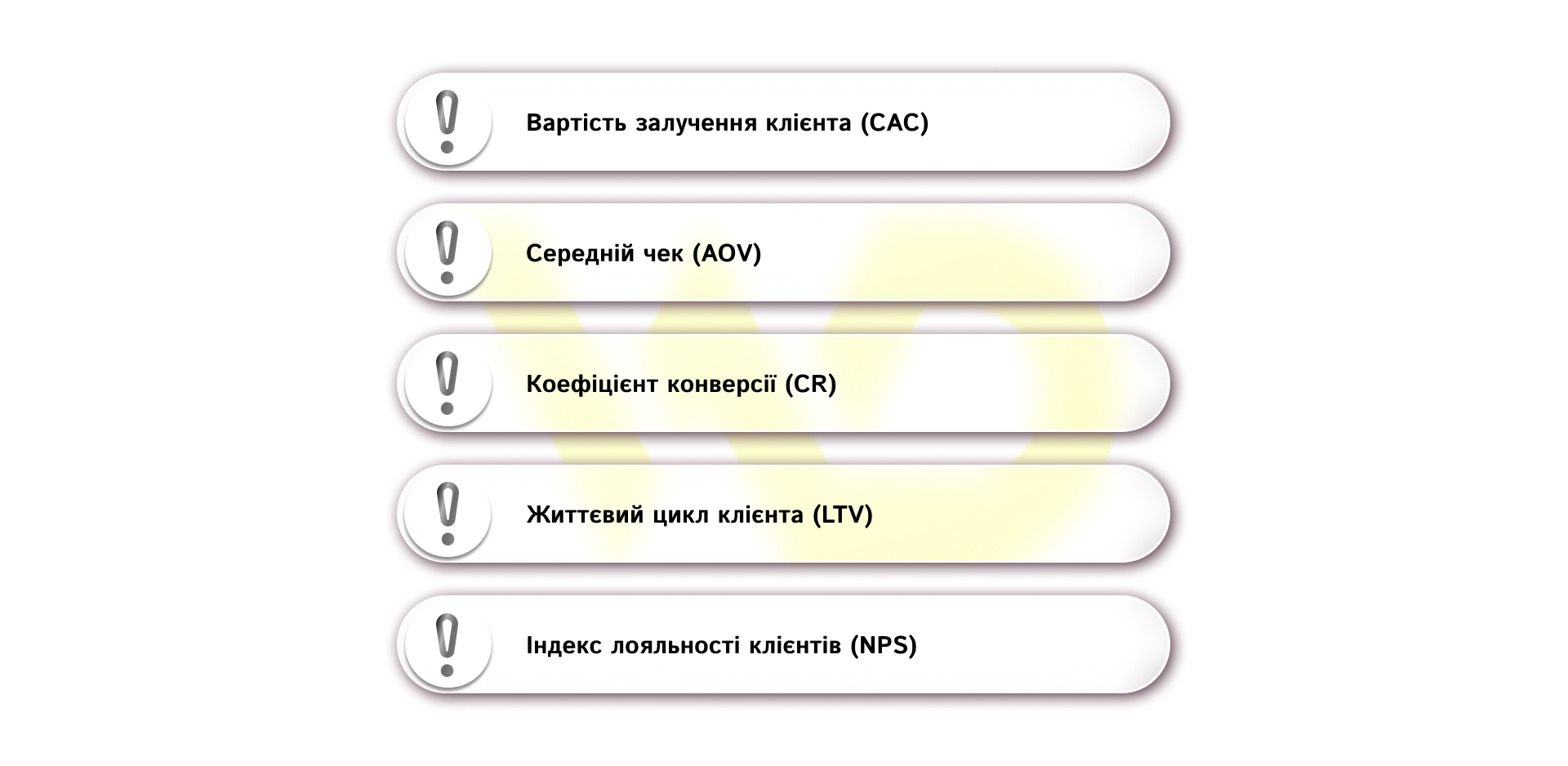
- Customer Acquisition Cost (CAC). This metric determines how much money a company spends on advertising and marketing to acquire one new customer. It is calculated as the ratio of total marketing expenses to the number of customers acquired over a specific period.
- Average Order Value (AOV). This metric shows the average amount a customer spends per transaction. Efforts to increase the average order value are typically carried out through cross-selling and upselling tools.
- Conversion Rate (CR). In online retail, this is the percentage of website visitors who made a purchase. In brick-and-mortar retail, conversion is measured using foot traffic sensors and the ratio of the number of receipts to the total number of people who entered the store.
- Customer Lifetime Value (LTV). The projected amount of net profit a business will earn from a single customer over the entire duration of their relationship. The ideal ratio for a stable business is when LTV is at least three times higher than CAC.
- Net Promoter Score (NPS). A metric that shows how willing customers are to recommend your brand to their friends and acquaintances. It is measured through short post-purchase surveys.
Regular monitoring of these metrics allows business owners to adjust their marketing strategy in a timely manner, identify weaknesses in the sales funnel, and uncover hidden growth opportunities to scale their business.
Trends, innovations, and growth opportunities
If you aim to build a leading company, you should pay attention to the three major trends shaping the modern market.
The first trend is the adoption of artificial intelligence (AI) and machine learning. Today, AI is used for more than just basic support chatbots. Leading retail chains use algorithms for demand forecasting, inventory optimization, and dynamic pricing. Artificial intelligence analyzes thousands of factors and suggests how many items to purchase to avoid shortages or overstocking.
The second trend is barrier-free shopping. Shoppers don’t want to waste time waiting in lines. Self-checkout lanes, in-store mobile scanning technology (Scan & Go), and fully contactless payments are becoming the bare minimum for retail outlets of any size.
The third trend is hyperlocalization. Large chains are moving away from a standardized product assortment across all their locations. Using big data analytics, retailers tailor the product assortment of a specific store to the micro-needs of residents in the specific neighborhood where that store is located.
In light of this, here are the key growth opportunities for your business:
- Collect your own data from day one. Customer loyalty is built on personalization, and personalization is impossible without a high-quality CRM system and purchase analytics;
- Invest in the mobile experience. The smartphone has become the primary communication tool. Even if you operate exclusively offline, your customers should be able to easily find you online and quickly get answers to their questions;
- Compete on convenience, not price. There will always be someone offering a lower price. But customers are willing to pay a premium for impeccable service, fast delivery, friendly staff, and a hassle-free shopping experience.
The success of modern retail lies not in the mere act of selling a product, but in selling convenience, time savings, and positive emotions. The future belongs to those brands that learn to listen to their audience needs, analyze their own data, and turn every customer interaction into a flawless experience.

commercial offer
Other articles by the author

02/09/2026
Guest blogging remains one of the most effective tools for promoting a business, yet there are still many misconceptions surrounding it.

11/09/2026
Email remains the primary channel for business communication, but at the same time, it serves as the main “entry point” for various cyber threats.
04/03/2026
A loyalty program is not just a discount tool, but a multidimensional business strategy.
Latest articles by #Useful tips
20/10/2026
Ben Hunt's model is a tool that helps break down a customer's path to purchase based on their level of awareness and select the right messages for each stage.
29/09/2026
A content pipeline transforms the creation of content from a spontaneous creative process into a managed production system. In such a system, AI serves as a powerful assistant.
10/09/2026
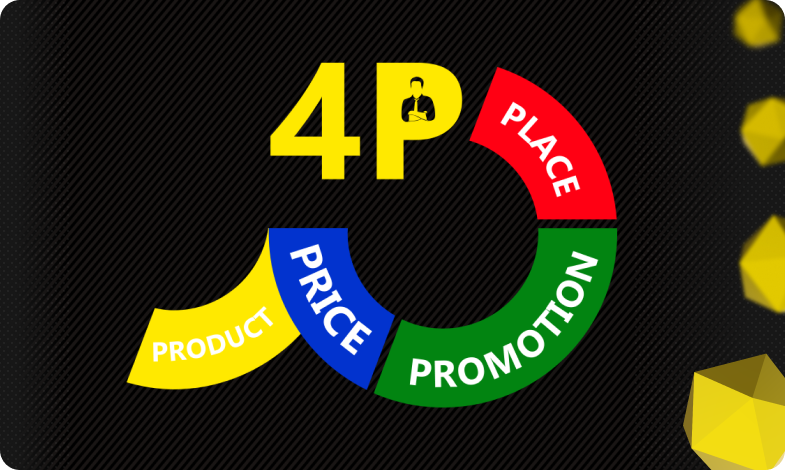
The 4P model serves as an architectural foundation that transforms disparate marketing activities into a single, manageable system.