

 16/06/2026
  1317
1317

Інтернет-маркетинг
простою мовою
Content of the article
- /01 What is naming and why is it important
- /02 Where to start when creating a name
- /03 What approaches are used in naming
- /04 Legal review: a crucial stage of naming
- /05 How to test a name before launch
- /06 Common mistakes that undermine naming
- /07 When it’s better to entrust naming to a team rather than doing it yourself

The art of naming: principles for creating a name that customers will remember

A brand name for a business has long ceased to be merely a product of creative inspiration. Today, naming is a strategic tool that directly impacts customer acquisition cost (CAC), ad conversion rates, legal security, and, ultimately, a company’s market value.
In this article, we’ll explore how to develop a viable name for a company, assess risks, test options on a real audience, and avoid costly mistakes.
What is naming and why is it important
According to the World Intellectual Property Organization (WIPO), a strong brand is an intangible asset that can account for up to 40–50% of a company’s total market capitalization in the B2C segment and up to 20–30% in B2B. A name is the first point of contact with the market. It acts as an initial filter: either attracting the target audience or forcing the company to spend additional budgets on explaining exactly what it does.
Effective naming solves three main business challenges:
- Reducing marketing pressure. A short, memorable name requires fewer repetitions in advertising to achieve brand awareness.
- Legal protection. A unique name minimizes the risk of lawsuits from competitors and patent trolls, protecting marketing investments.
- A platform for scaling. The right name allows a company to enter adjacent niches or international markets without the need for costly repositioning.
So, let’s take a closer look at how to approach naming effectively.
Where to start when creating a name
The search for a successful name doesn’t start with a generator or a random brainstorming session, but with an understanding of the company itself. At this stage, it’s helpful to establish a few basic guidelines that will shape the subsequent search for a name:
- brand positioning — premium, mass-market, expert, innovative, or friendly;
- target audience — their age, needs, perception style, and language habits;
- the product’s key value — what exactly the company wants to emphasize through the name;
- competitive environment — what names are already in use in the niche and how to differentiate from them;
- business development plan — will the name remain relevant if the company expands its product range or enters new markets.
This kind of preparation helps avoid wasting time on random ideas and instead focus immediately on options that have the potential to become a long-term part of the brand.
What approaches are used in naming
There is no universal formula for creating a strong name. What works for a tech startup won’t always be appropriate for a law firm, a local service, or an e-commerce project. That’s why different approaches are used in naming.
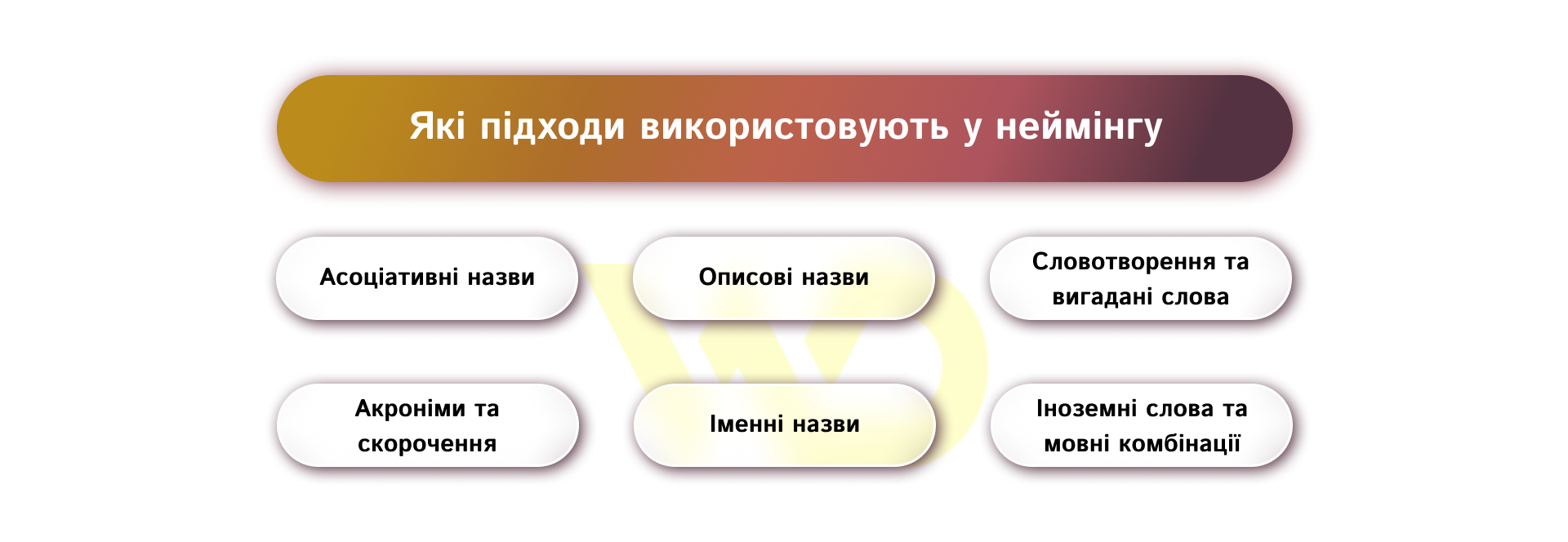
Among the most common approaches to creating names, several categories can be identified.
- Associative names.
These are based on images, characteristics, or feelings that the brand wants to evoke. For example, a name might hint at speed, reliability, comfort, technological sophistication, or care. Well-known examples:
- Jaguar (associated with speed and grace);
- Apple (freshness, simplicity, and accessibility — in contrast to the complex names of computers from the 1970s).
Associative names help build a deep emotional connection with the customer, but require a clear marketing strategy to ensure the association is interpreted correctly.
- Descriptive names.
They directly or partially explain the company’s or product’s field of activity. They are easier to grasp, especially when starting a business, as they help people quickly understand what the brand does. At the same time, an overly literal name can sometimes limit growth if the company plans to scale up.
Well-known examples include Nova Post, Svit Matrasiv, and Kyivstar. When entering the international market and expanding its services, Nova Poshta had to rebrand as Nova Post and develop the Nova ecosystem.
- Word formation and coined words.
Creating entirely new words by combining existing ones or inventing them from scratch. This approach offers a better chance of securing a unique name, an available domain, and legal clarity. However, it requires additional work to explain the brand at the outset, as customers don’t always grasp the meaning immediately. Examples: Monobank, Rozetka, Google, Lego.
- Acronyms and abbreviations.
In other words, this involves forming a name from the first letters of words or abbreviated forms. This format is common in the B2B segment, as well as in the technology and financial sectors. The name sounds concise and professional, but abbreviations are harder for the audience to remember in the early stages. For example, DTEK, IBM (International Business Machines), BMW (Bayerische Motoren Werke).
- Personal names.
This involves using the founder’s last name, a personal name, or a historical reference. Personal names emphasize personal responsibility and expertise. They work great in the service, consulting, or craft manufacturing sectors. A potential downside is that such a business is much harder to sell as an independent entity, since it is strongly tied to the founder’s personality. For example: Porro Make-up, Ferrari, McDonald’s.
- Foreign words and linguistic combinations.
These are often used by companies targeting the international market or seeking to project a modern, tech-forward, or premium image. However, in such cases, it is especially important to verify the meaning of the word across different languages and cultural contexts. Examples: Prestigio, Vivant.
In practice, businesses rarely use just one method in its pure form. For example, a name may combine an association with a neologism or have a descriptive basis, yet still sound unique enough to qualify for trademark registration.
Legal review: a crucial stage of naming
The biggest mistake is to approve a name simply because the board of directors liked it and immediately launch the development of a website and branded products. Legal review is a mandatory step that protects the business from catastrophic losses.
Important for your business! If it turns out that the name you’ve chosen is already registered by another company in your class of goods/services (according to the International Classification of Goods and Services), you could face a lawsuit. The consequences include a ban on using the name, removal of products from circulation, fines, and forced urgent rebranding, which will cost 10–20 times more than professional naming at the start.
WIPO recommends checking the name not only in the Global Brand Database but also in national and regional registries, and, if necessary, consulting with a trademark specialist.
It is particularly important for businesses not to limit themselves to checking for exact matches. In practice, problems often arise not because of an identical name, but because of similarities in sound, spelling, or overall visual impression. A comprehensive search and assessment of the likelihood of confusion is necessary that is, situations where a consumer might confuse one brand with another. This means you should check not just one option, but a whole range of similar forms, alternative spellings, and phonetic variations.
It is also helpful to think not only from the perspective of today’s launch but also from the perspective of the company’s future development. A name that appears to be available in one country or for one class of goods and services may be restricted in another jurisdiction or in a related category. If the brand plans to scale up, enter a new market, or launch additional products, the review must cover a broader context than simply «is this word available».
How to test a name before launch
Once the list of options has been narrowed down, you shouldn’t approve a name based solely on the team’s gut feeling. In the final stage, it’s important to test how it performs not just in the office, but in real-world perception, because for trademarks, the key risk is a situation where the name could cause brand confusion in the consumer’s mind.
It’s best to test not just one name, but 3–5 finalists. This allows you to compare them and see which one performs better in terms of clarity and consistency in perception. For a business, the key here is not to pick the team’s «favorite», but to find an option that will work well in long-term communication: in ads, on the website, in email addresses, in a manager’s signature, in verbal presentations, and in search results. If a name looks good on a slide but is hard to pronounce or requires constant explanation, that’s a sign it might fall short in real-world use.
A small but well-chosen sample is sufficient for a quality test. It’s worth involving people who truly resemble the brand’s target audience: potential customers, partners, and sometimes sales or support staff who deal with audience questions and initial reactions on a daily basis. In this format, it’s important not to impose a pre-determined answer on them, but to allow room for spontaneous reactions.
During such testing, it’s worth asking a few practical questions that will give the business not an emotional, but a practical understanding of the name:
- the first impression the name evokes;
- how easy it is to remember after hearing it once;
- clarity regarding the industry the brand belongs to;
- the risk of similarity to already well-known brands;
- the level of trust or neutrality it conveys;
- suitability for future business expansion;
- ease of pronunciation in face-to-face and telephone communication.
It is also helpful to divide the test into two formats: written and oral. The written format shows how the name looks visually, whether there are any spelling difficulties, and whether it raises unnecessary questions. The oral format provides different insights: how the name sounds out of context, whether it’s easy to remember by ear, and whether it evokes associations with another brand or product. This is particularly important for trademarks, as similarities can create a risk of confusion even when the spelling isn’t exactly the same.
After the survey, it’s worth evaluating which name strikes the best balance between clarity, memorability, and the absence of unnecessary risks. If one option is appealing but people confuse it with a competitor, while another is less emotionally resonant but is quickly memorable and raises no questions, the latter is often the better choice for the business.
Pre-launch testing is an essential part of naming that reduces risks and increases the chances that the brand will sound confident and appropriate from day one.
Common mistakes that undermine naming
Let’s look at the mistakes that most often weaken a name even before the brand launches.
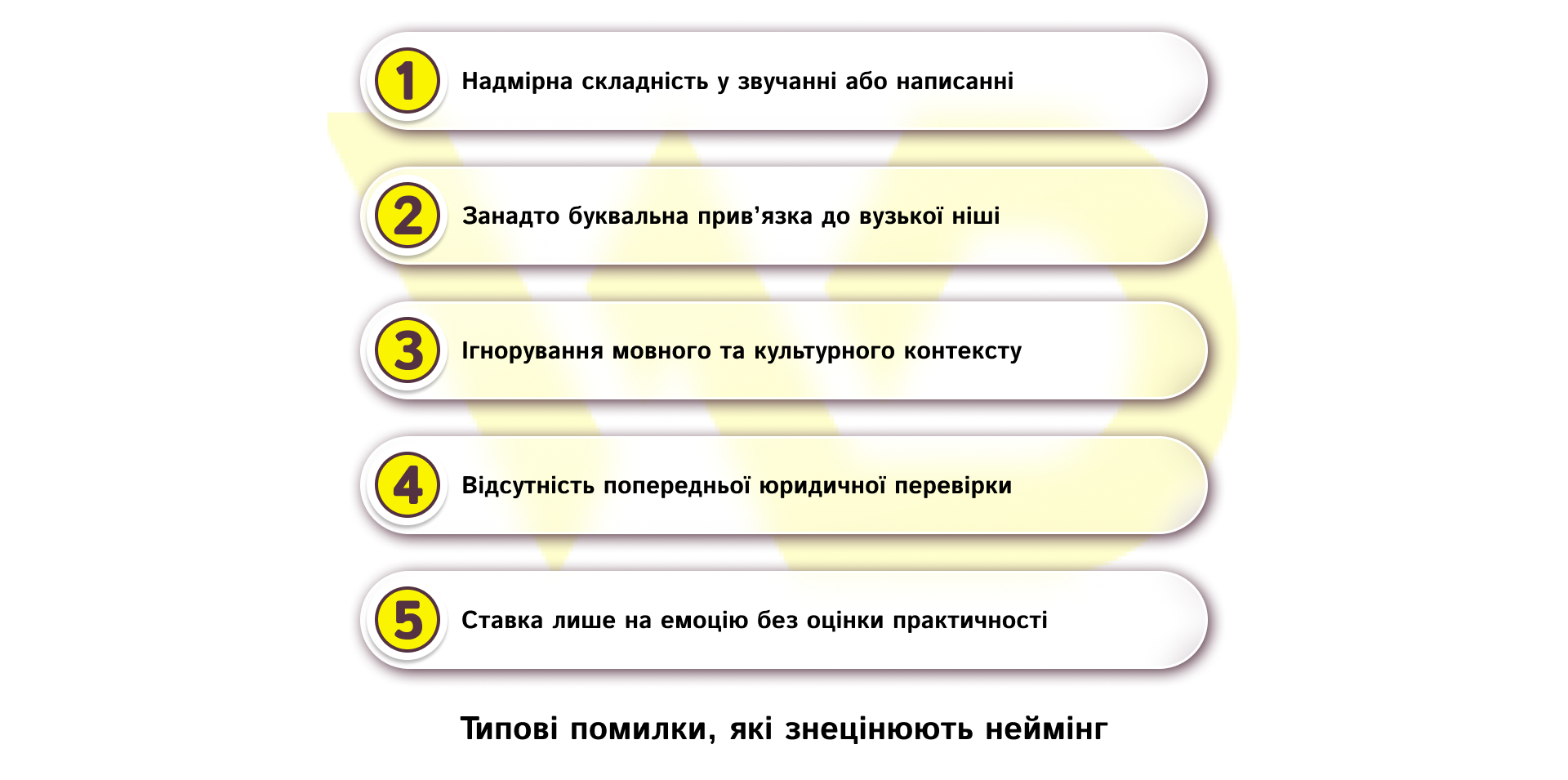
Excessive complexity in sound or spelling
A name should be easy to read, pronounce, and remember from the very first encounter. If it is overloaded with complex letter combinations, unusual structures, or is too long, the customer begins to perceive it as cumbersome. Names like «Ukrprompostachkomplektatsiya» or «TechDigitalGlobalSolution» are doomed to oblivion. The business audience values conciseness. If a client can’t pronounce the name on the first try, they won’t recommend it to colleagues, meaning the «word-of-mouth» effect is lost. As a result, the brand loses some of its appeal right at the introduction stage.
Too literal a tie to a narrow niche
When a name describes only one product or service too directly, it limits the brand’s future growth. In other words, if a company is named as if it deals with only one type of product, it will be harder for it to launch new categories without the risk of a mismatch between the name and the actual scale of the business.
Ignoring linguistic and cultural context
A name that works well in a local market may sound awkward, ambiguous, or even evoke unwanted associations in another country. This is especially important for brands planning an online presence, international sales, or expansion beyond a single market. For example, the name «Lviv Furniture» works perfectly well as long as you stay within the region. But when trying to open a branch in Warsaw or Munich, such a geographical detail can cause either logistical skepticism or a cultural barrier.
Lack of prior legal due diligence
This has already been discussed in detail above, but it is a very important point. If it turns out that a similar or identical name is already registered, the business may lose time and budget and may even be forced to change its name after launch.
Relying solely on emotion without assessing practicality
A beautiful, profound word from Latin or mythology may look great in an agency’s presentation, but if all the domains are taken, and Google search results for that word show thousands of unrelated images you’ll waste your marketing budget trying to get the site into the top 10.
Strong naming requires not only creativity but also attention to detail. The name must work for the brand in real-world conditions, and that is what distinguishes a successful company name from a mere pretty word.
When it’s better to entrust naming to a team rather than doing it yourself
Developing a name on your own is a viable option for a small local business with a limited budget. However, there are three clear indicators when internal brainstorming becomes risky and the task should be handed over to an external specialized team.
- High cost of failure. You are launching large-scale production, purchasing equipment, planning a franchise network, or attracting venture capital. Investors and major partners do not work with brands that lack a clean legal history and a registered trademark.
- An oversaturated market. In your niche (such as IT, real estate development, retail, or pharmaceuticals), thousands of players have already claimed all the obvious keywords and associations. A deep analytical approach at the intersection of semiotics and marketing is needed to find an untapped niche to build upon.
- Expanding into the international arena. Expertise in international patent law is required, as well as the involvement of native speakers to assess how the name is perceived in different cultural circles.
And remember: a strong name doesn’t try to please absolutely everyone during its first presentation. Its main quality is stable and uninterrupted performance in real market conditions. It’s easy to spell, quickly memorable, legally protected, and grows alongside your company’s market capitalization.

commercial offer
Other articles by the author

02/04/2026
For Stories to deliver business results, you need regular analytics—that is, a focus not just on basic metrics, but on understanding the entire funnel, from viewing Stories to clicks and conversions.

15/06/2026
The algorithms of digital platforms are evolving faster than user habits, and by 2026, social media had undergone radical changes.

08/05/2026
For businesses, Instagram has long been not just a platform for posting content, but also the place where customers form their first impression of a brand.
Latest articles by #Useful tips
09/09/2026
The Facebook lead form helps businesses collect contact information from potential customers directly from an ad, without requiring them to visit the website.

08/09/2026
Today, an influencer is a distinct media platform with its own editorial policy, a keen understanding of its audience, and an established level of trust.

04/09/2026
Instagram Shopping is a set of Meta features that allows businesses to integrate their product catalog with their social media profile.