

 27/07/2026
  1121
1121

Інтернет-маркетинг
простою мовою
Content of the article

Who is a brand manager and what do they do: responsibilities, functions, and tasks

Today market is oversaturated with offerings. Consumers no longer simply buy «high-quality shoes», «delicious coffee», or «reliable software». In an era when the technical specifications of competing products are nearly identical, businesses face a challenge: how to avoid drowning in a sea of sameness and prevent the entire competition from devolving into a grueling price war. The solution lies in creating a special connection with your company in the customer’s mind. You need to ensure that they choose you with their heart and mind, not just their wallet.
In this article, we’ll take a detailed look at who a brand manager is, what their key functions and responsibilities are within a company, and how they differ from a traditional marketer and related specialists.
Who is a brand manager?
A brand manager isn’t just a creative or designer responsible for a good logo. They’re a strategist who combines analytics, finance, consumer psychology, and marketing to transform an abstract product into a strong brand that generates additional profit margins.
According to the Edelman Trust Barometer Special Report: «In Brands We Trust?», 81% of consumers say that trust in a brand is a decisive or critically important factor when making a purchase decision. It is the brand manager who builds, maintains, and protects this trust.
The primary goal of this specialist for a business is to ensure that customers choose your product not because it’s the cheapest, but because it best aligns with their values and lifestyle or fulfills a specific emotional need.
For example, have you ever wondered why people are willing to pay extra for coffee at Starbucks or buy Apple products, ignoring cheaper alternatives with similar features? This is the result of the systematic work of the brand team, which sells not coffee beans or microchips, but status, comfort, a sense of belonging to a community, and a unique customer experience.
4 key functions of a brand manager
A brand manager work is multifaceted and spans the entire product lifecycle. To organize their responsibilities, a brand manager’s activities are divided into four strategic areas.
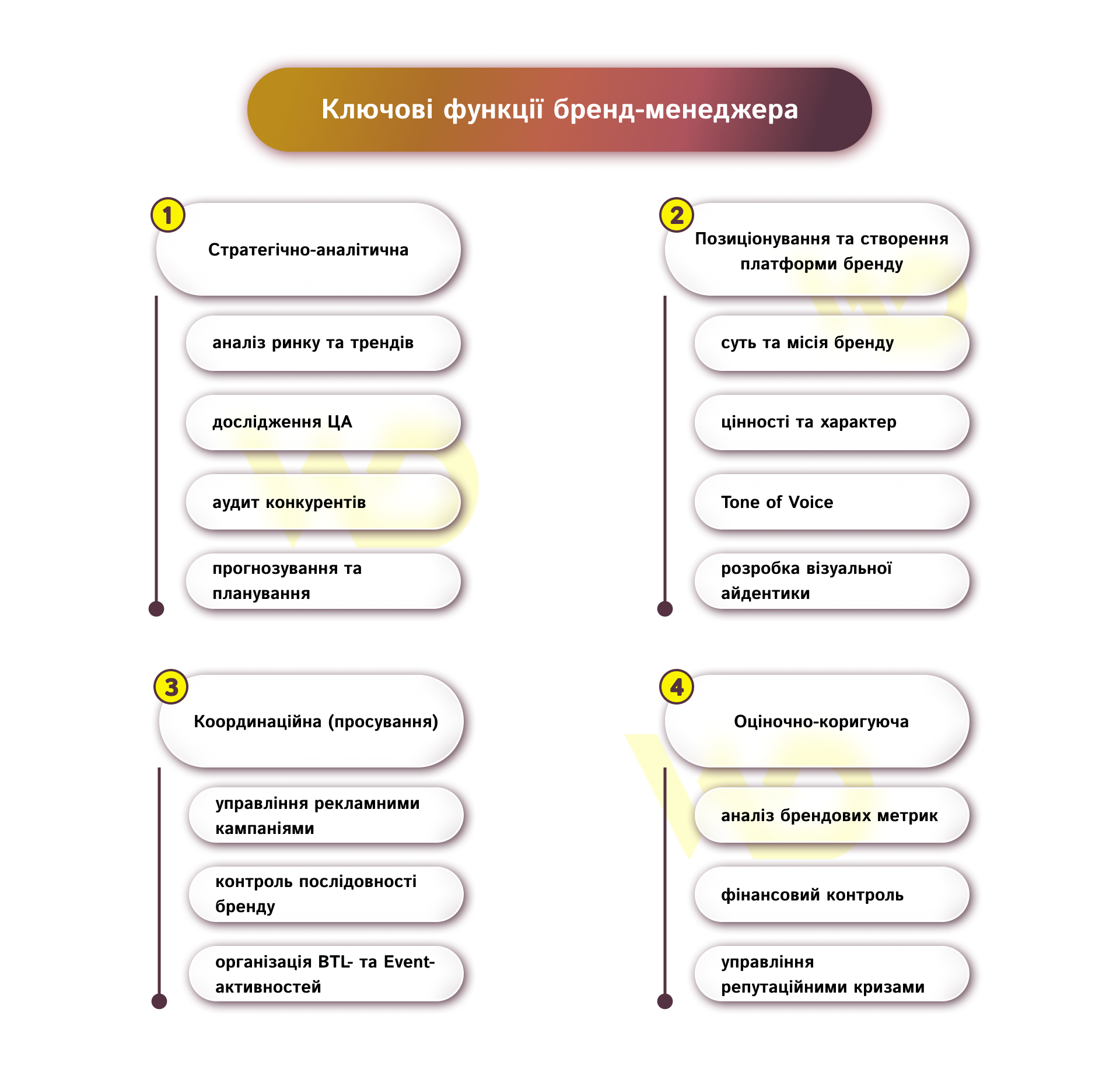
Strategic and analytical function
Every decision in brand management is based on data and research, not intuition. Before launching large-scale campaigns, the specialist conducts in-depth preparatory work.
- Market and trend analysis: tracking global and local changes in consumer behavior.
- Target audience research: identifying hidden motivations, barriers, and customer insights (using the CJM (Customer Journey Map) method).
- Competitor audit: analyzing the positioning, strengths, and weaknesses of other market players.
- Forecasting and planning: participating in the development of media plans; assessing the potential market capacity for a new product.
Brand positioning and platform development
This is the stage of creating a unique «brand profile» that defines how the audience perceives the brand. The brand manager defines the following:
- Brand essence and mission: why the company exists in the market.
- Brand values and character: the emotional and functional benefits communicated to the consumer.
- Tone of Voice: the unique voice and tone of communication, such as friendly, expert, provocative, etc.
- Development of visual identity: the specialist does not design the logo themselves, but creates a detailed technical brief for designers or brand agencies and ensures the final result aligns with the intended meanings.
Coordination function (promotion)
The brand manager synchronizes the work of various company departments and external contractors to ensure a unified brand positioning.
- Advertising campaign management: coordinating the work of PPC specialists, SMM, PR, and influencer marketers.
- Ensuring brand consistency: making sure that a billboard message, a social media post, and a sales manager’s script do not contradict one another.
- Organizing BTL and event activities: presentations, exhibitions, and collaborations with other brands.
Evaluation and adjustment function
A brand must be profitable. Therefore, the specialist regularly evaluates the effectiveness of implemented strategies.
- Analysis of brand metrics: trends in brand awareness, loyalty (NPS), and brand health (Brand Health Index).
- Financial control: monitoring sales plan execution, return on marketing investment (ROMI), and the overall impact of brand equity on company revenue.
- Reputation crisis management: promptly responding to negative sentiment and adjusting the communication strategy in force majeure situations.
Given the multifaceted nature of the role, many business owners are tempted to turn the brand manager into a «jack-of-all-trades» who single-handedly fills any gaps in marketing. However, to ensure the specialist’s work is as effective as possible and the company does not waste resources, it is crucial to clearly define the boundaries: where strategic management ends and the operational work of other specialists begins.
The brand manager scope of responsibility
To clearly understand the division of duties within a company, let’s examine a clear delineation of areas of responsibility.
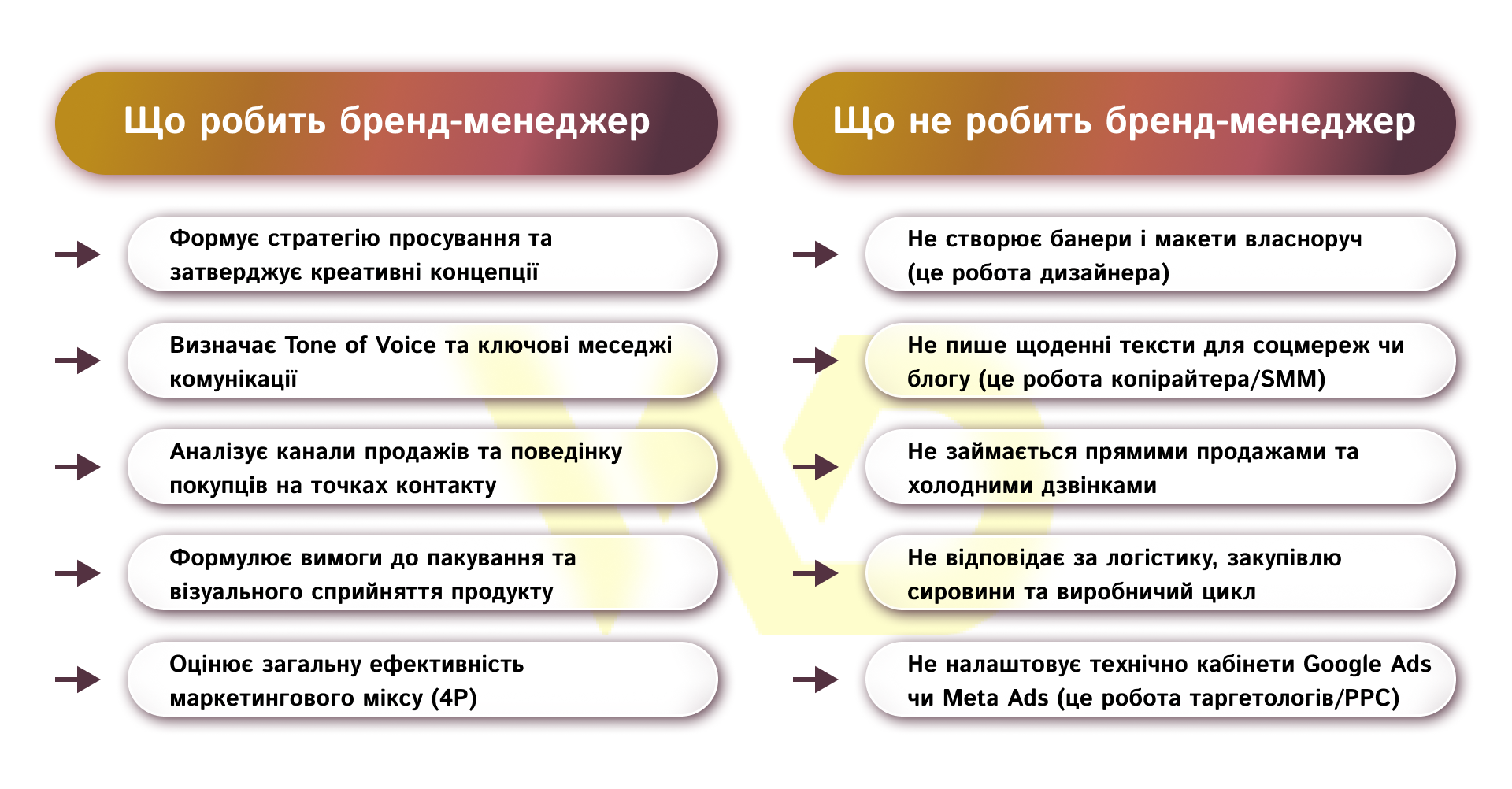
The brand manager oversees the value creation process by coordinating the work of specialized professionals, but does not replace them.
Brand manager specializations
Depending on the niche in which the company operates, a brand manager’s focus and tools will vary significantly. In modern practice, several key specializations are identified.
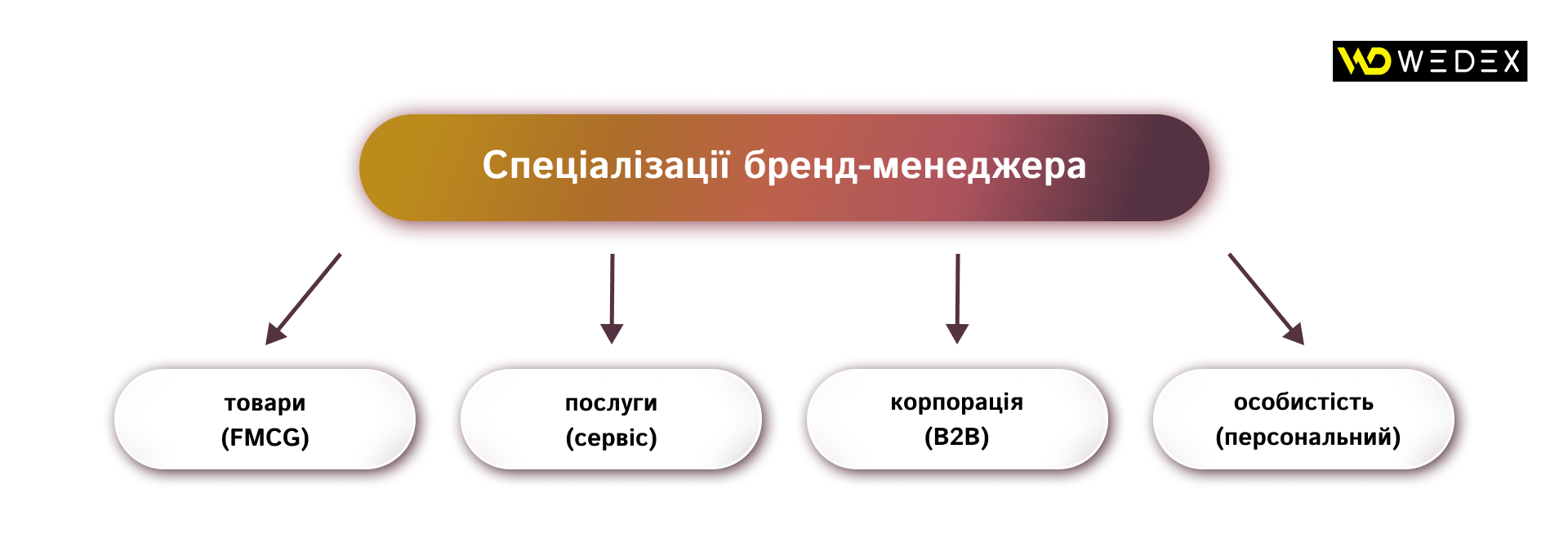
- Product brand management (primarily FMCG — fast-moving consumer goods).
Focus on packaging design, ergonomics, product visibility on supermarket shelves, and encouraging repeat purchases. For example, managing a line of dairy products or juices, where it’s critical to stand out among dozens of competitors at the point of sale.
- Brand management in the services sector.
The focus is on the customer experience, quality of service, atmosphere, and the emotional impact following interaction with the company. Here, the brand represents a promise of a certain standard of service. For example, a restaurant chain, a private medical clinic, or a fintech platform, where loyalty is built on trust in the staff and the convenience of the user interface.
- Corporate branding (B2B and large holding companies).
The focus is on the company’s reputation in the business environment and its relationships with partners, investors, and government agencies. This also includes developing the HR brand — enhancing the company’s appeal as an employer to attract top talent. For example, an IT consulting firm or a logistics giant, for which a reliable and stable image is crucial.
- Personal branding and regional branding.
The focus is on promoting a specific individual (an expert, politician, or top manager) or enhancing the tourism and investment appeal of cities or regions. For example, working on the personal brand of a business founder, which helps the company scale up through a high level of personal trust.
Each of these specializations shapes the specialist’s daily routine. However, regardless of the chosen direction and the specifics of the niche, the success of brand capitalization always hinges on one and the same factor the specialist own human qualities. No matter how deep one’s knowledge of classical marketing may be, without a certain set of psychological traits and the flexibility to manage the emotions of thousands of consumers, success is simply out of reach. Therefore, we will now examine in detail the mental and emotional profile of the ideal candidate for this position.
Soft skills of a brand manager
Since the position involves constant communication between different parts of the business, a brand manager professional success depends on their soft skills by more than 60%. A candidate for this role must possess a unique set of the following qualities:
- well-developed emotional intelligence: the ability to empathize with consumers’ pain points and hidden desires. Without this, it is impossible to create an advertising campaign that evokes genuine emotions;
- cross-functional leadership and facilitation skills: a brand manager must defend their ideas before the board of directors while simultaneously motivating the sales team or product designers. They must speak the language of numbers with finance professionals and the language of emotions with creative contractors;
- public speaking and presentation skills: presenting a new product to partners or speaking at major industry events is an integral part of brand promotion;
- Stress resilience and flexibility: the ability to respond quickly to criticism, negative feedback, or changes in market conditions without losing focus on strategic goals.
It is precisely this set of adaptable skills that transforms an ordinary marketing analyst into a true architect of meaning, capable of uniting a team around a single idea.
Challenges of the profession
It is crucial for a business owner to understand the internal dynamics and operational challenges that a brand manager inevitably faces.

The biggest trap that company leadership often falls into is expecting immediate financial results from the brand manager work. Unlike traditional performance marketing, where launching contextual or targeted ads yields measurable leads and sales as early as the next day, brand equity is built over months and sometimes even years. Changing how the audience perceives a company is an extremely slow process, so investors and CEO need to be prepared for the long haul and view this role as a strategic investment rather than a quick fix to save the current monthly plan.
In addition to the need for managerial patience, the specialist daily routine carries a heavy informational and psychological burden. A brand manager is constantly at the epicenter of vast and often contradictory data sets. They must simultaneously analyze dry financial reports, fluctuating metrics from digital advertising platforms, results from in-depth focus group interviews, and unexpected tactical moves by competitors. This environment demands a high level of self-organization and the ability to filter out information noise, as the need to keep track of the development trajectories of all departments without clear templates very often leads to rapid emotional burnout.
The situation is further complicated by the fact that this specialist is forced to operate in an environment of constant high uncertainty. During periods of economic volatility or large-scale market crises, it is the brand manager who is the first to take the brunt of the impact. They bear the responsibility for urgently revising the global positioning strategy, quickly adjusting the tone of the company’s communications in the media landscape, or even completely optimizing the product portfolio to align with new and often harsh financial realities and consumer anxiety.
Understanding these internal risks and challenges helps management set realistic KPI for the new hire and create conditions in which they can work effectively for the long term.
4 signs that your business needs a brand manager
To avoid premature spending on expanding the workforce, a business owner should carefully assess the current stage of the business’s development. Let’s look at four indicators that will help you determine whether your organization truly needs this specialist.
- The price-cutting traps. You’re forced to constantly lower prices to keep up with competitors, causing your profit margins to shrink. A brand manager will create value for which customers will pay more, regardless of price.
- Entering new markets. You’re planning an expansion or the launch of a sub-brand. A specialist will adapt your positioning to a new audience, preventing losses from a «trial-and-error» launch.
- Communication chaos. Social media, the website, and the sales department are sending mixed messages. A specialist will bring order by establishing uniform standards and a consistent tone of voice across all touchpoints.
- Marketing operational routine. The team sets up ads and writes posts, but there’s no strategic vision for the years ahead. A brand manager will take on the role of architect for the company’s future.
If your business has moved beyond the survival stage and is striving for systematic leadership, such a specialist should become your key partner.
Don’t just look for an executor — find a strategist with a high level of empathy. After all, a strong brand is the most enduring intangible asset, one that cannot be copied. Even in times of turbulence, it is the brand that will protect your margins, turning ordinary customers into loyal advocates of the company for years to come.

commercial offer
Other articles by the author

17/02/2026
Sitelinks are a set of internal links that Google sometimes displays below the main result in the search results.

02/03/2026
Your website is no longer just a showcase, but one of the main channels for sales, communication, and brand positioning.

17/04/2026
AI can be useful during the content creation process, but it does not replace an editor, an SEO specialist, or a product expert.
Latest articles by #Useful tips

18/08/2026
For businesses, the main challenge right now is not simply to “produce something,” but to speed up the time it takes for materials to reach the market, reduce the cost of content creation, and, at the same time, maintain the quality and human touch of communication.

16/07/2026
The official launch of OpenAI ad testing on February 9, 2026, was a historic moment that marked the emergence of an entirely new media channel for promoting businesses.

08/07/2026
ChatGPT can already search the web, provide quick answers, and display relevant sources, which means it’s important for businesses to be clear, cited, and verified in the digital space.