

 18/08/2026
  1264
1264

Інтернет-маркетинг
простою мовою
Content of the article

AI tools for content creation

Just a few years ago, there was a heated debate about whether artificial intelligence could replace copywriters. Today, this question is no longer relevant, as AI has become a standard work tool, just like a task manager or spreadsheets. For businesses, the main challenge now is not simply to «generate something», but to speed up the release of materials to the market, reduce the cost of content creation, and at the same time maintain the quality and humanity of communication.
In this article, we’ll take a detailed look at 16 popular AI tools for working with text and how to effectively integrate them into your team’s workflow without risking your reputation.
General-purpose language models
General-purpose large language models (LLM) serve as the foundational platform for content creation. They aren’t constrained by rigid templates and are capable of analyzing large datasets, developing content strategies, and generating in-depth, expert-level texts tailored to various business needs.
Let’s take a look at three key market players offering different features for the B2B segment.
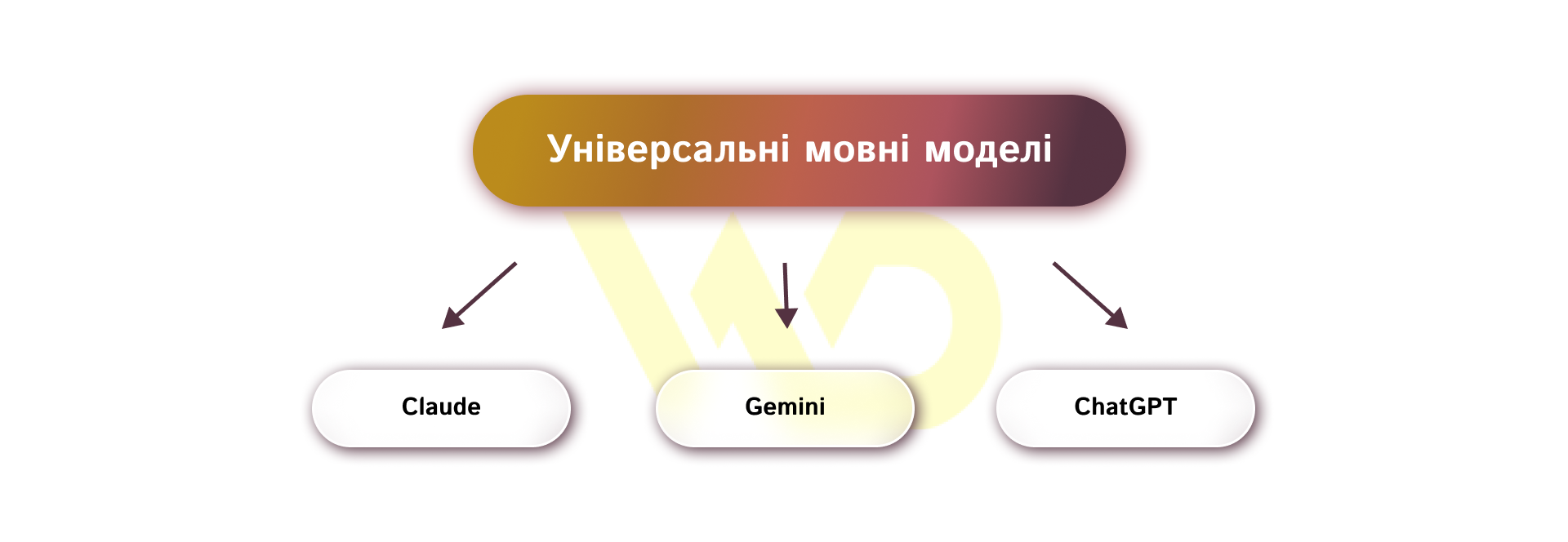
Claude (Anthropic)
This service handles long-term context better than any other LLM and demonstrates the highest stylistic accuracy when working with the Ukrainian language. By default, the tool avoids clichés that are often characteristic of other models. Thanks to the Artifacts feature, users get a separate editing window next to the chat where they can structure articles, rearrange paragraphs, and track document versions in real time.
Gemini (Google)
The tool’s main advantage is its deep, built-in integration with the Google Workspace ecosystem and a massive context window. The model can process a 100-page PDF report or a transcript of a one-and-a-half-hour Google Meet call in a matter of seconds. The service also allows you to create Gem-bots highly specialized micro-assistants for specific tasks, such as checking compliance with editorial policies.
ChatGPT (OpenAI)
The most versatile system with a well-developed Custom GPT marketplace. It’s ideal for quickly implementing marketing frameworks such as AIDA, PAS, and BAB, brainstorming positioning strategies, and writing scripts. The model excels at handling highly complex prompts that include numerous constraints and role-based scenarios.
OpenAI co-founder Sam Altman emphasizes the fundamental shift in the role of the specialist in light of AI’s development:
AI won’t replace people. But people who use AI will replace those who don’t. — Sam Altman, CEO of OpenAI.
To get the most out of general-purpose models, it’s important to move away from single-sentence queries in favor of structured prompts. For example, instead of an abstract request like «write an article about SEO», it’s better to use a role-based prompt with detailed context.
Let’s break down an example of a working prompt structure for analyzing an interview with an expert.
- Role: «Act as an experienced B2B editor with 10 years of experience in the SaaS industry».
- Input: [Insert a transcript of an audio recording of a conversation with a developer or marketer].
- Task: «Identify the five main points regarding customer challenges mentioned by the expert, and use them to outline the structure of a long-form blog post».
- Restrictions: «Do not use the words innovative, revolutionary, or undoubtedly. The tone should be businesslike, restrained, and geared toward top management».
Using general-purpose LLM allows the content department to reduce the time needed to prepare the first draft of a text. For example, an MIT study published in the journal Science showed that using ChatGPT for professional writing tasks reduced completion time by approximately 40%, while improving the quality of the result by 18%.
Many content teams use AI to build a solid intellectual framework for their material, and then turn to specialized software for narrow, niche tasks.
Tools for e-commerce and commercial copy
Working with commercial copy in the e-commerce sector requires high accuracy, scalability, and strict adherence to the brand’s tone of voice. When a business needs to prepare descriptions for 5,000–10,000 new product listings ahead of the sales season, traditional copywriting becomes a bottleneck for the entire project. Specialized e-commerce solutions are designed specifically to automate such routine tasks.
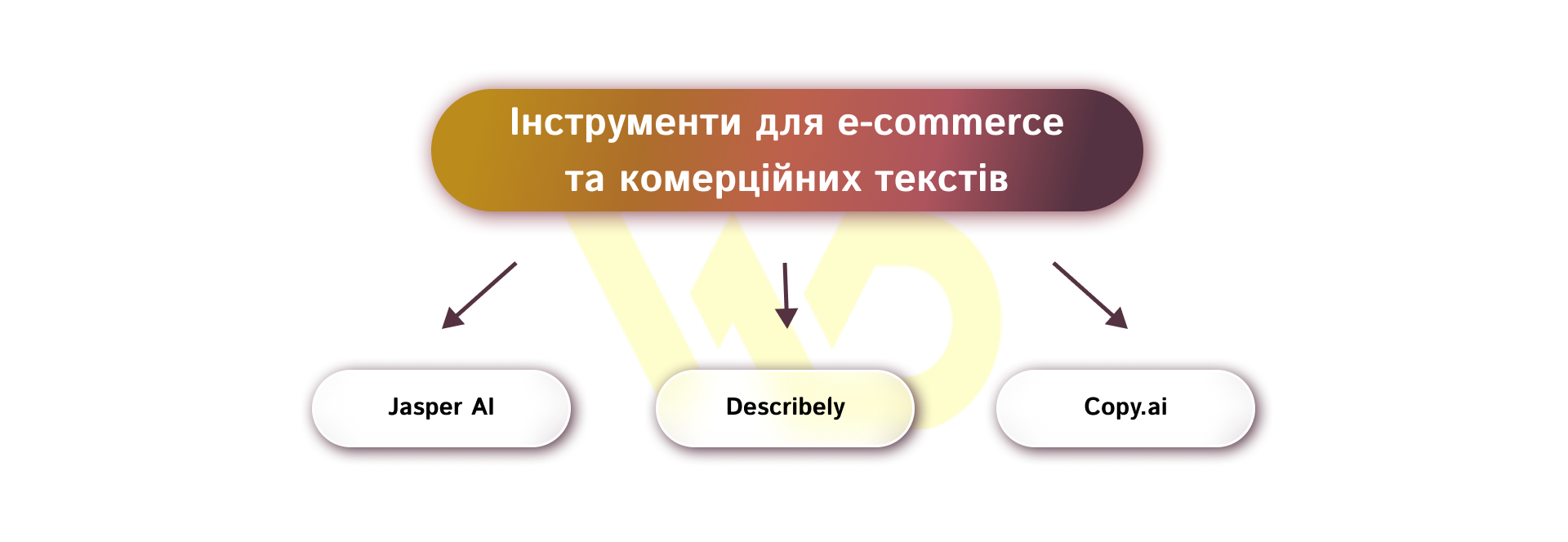
Jasper AI
The platform is geared toward marketing teams at major brands and agencies. Its key feature is the Brand Voice & Knowledge Assets function. You upload your brand book, corporate guidelines, product descriptions, or examples of your best advertising campaigns to the system. Based on this data, Jasper generates copy that accurately reflects your brand’s style and stays within the approved positioning guidelines.
Describely
A tool designed specifically for the needs of online stores and marketplaces. The service integrates via API with popular platforms such as Shopify, WooCommerce, or PIM systems. Instead of entering prompts one by one, you upload a CSV file containing dry technical product specifications such as dimensions, materials, and SKU and Describely automatically generates unique descriptions, bullet-point lists of benefits, SEO titles, and meta descriptions.
Copy.ai
This service is designed for building automated content workflows and generating performance-driven copy. The Workflows module allows you to link several actions into a single chain: for example, generate a product description, immediately create five variations of ad copy for Meta Ads based on it, and prepare copy for an email newsletter for A/B testing.
To understand the actual economic impact of implementing such software, let’s consider a projected benchmark for resource savings for an online store when adding a catalog of 1,000 new products.
Comparison of resource usage between manual and AI-assisted catalog processing:
|
Criterion |
Manual work by a copywriter |
AI-assisted processing (via Describely) |
|
Processing speed (1,000 product cards) |
160–200 man-hours (10–12 minutes per card with meta tags) |
3–5 hours of specialist work (template configuration and selective verification) |
|
Consistency and standardization |
Errors in 15–20% of cases (deviations from editorial standards due to human error) |
100% compliance with the standard (guaranteed adherence to the specified format) |
|
Publication of meta tags and indexing |
Delay in page indexing (due to the time-consuming, manual, phased process of populating websites) |
Instant coverage with SEO tags (generated immediately upon uploading the file to the CMS) |
Thanks to the automation of commercial content, marketers are freed from the tedious task of rewriting product instructions and specifications. They gain the opportunity to shift their focus to developing in-depth offers, testing value propositions, and working on conversion points on the website.
Services for SEO and in-depth research
For informational articles and corporate blogs, it’s not enough to simply create coherent text. The content must align with user intent on Google, be based on verified facts, and outperform competitors in terms of structure and the comprehensiveness of the topic coverage.
A specific set of tools is also used in the field of search engine optimization and analytics.
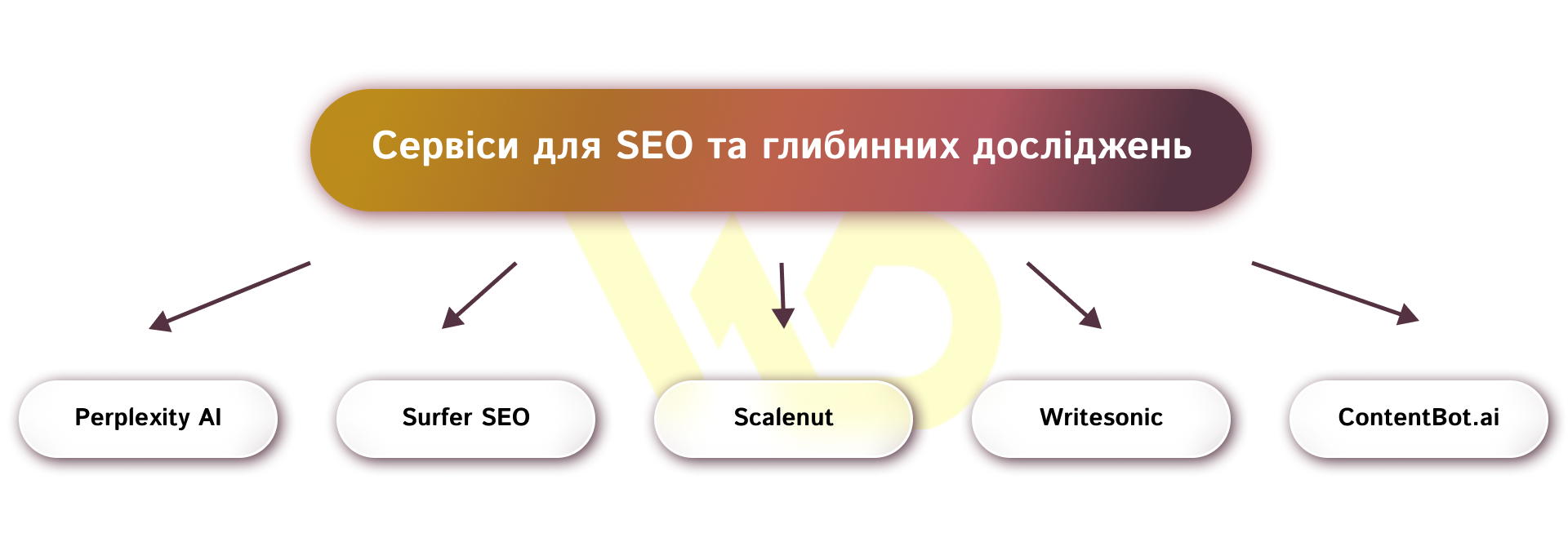
Perplexity AI
A next-generation search engine powered by artificial intelligence. Unlike conventional chatbots, Perplexity scans the live web in real time and provides answers with direct links to sources. Thanks to its Pro Search mode, the service can analyze uploaded PDF reports and spreadsheets, and allows you to select a base language model (Claude 3.5 Sonnet, GPT-4o). It’s the perfect tool for quickly gathering statistics, searching for scientific research, and conducting initial fact-checking, with the ability to conveniently export sources into client reports.
Surfer SEO
A professional tool for correlation analysis of search engine results pages (SERP). The service compares competitors pages in Google’s top 10 for a selected keyword and generates clear technical specifications: optimal text length, number of headings and images, and the required LSI keyword density. Key benefits: the built-in Surfer AI module for quickly generating drafts, a tool for auditing already published articles, and the intuitive Content Score metric, which allows you to assess a piece’s readiness for publication even before it’s indexed.
Scalenut
A platform that covers the full cycle of SEO content marketing. It includes modules for clustering the semantic core, creating content plans, and step-by-step article writing. The proprietary Cruise Mode allows you to create an SEO-optimized long-form article in 5 simple steps, while advanced NLP prompts help you naturally weave key phrases into the text without the risk of over-optimization, making the service a cost-effective solution for scaling projects.
Writesonic
Allows you to create in-depth articles in just a few steps, based on real-time analysis of competitors’ content. The service automatically generates options for structures, introductions, and conclusions, and can also generate relevant illustrations directly within the text using the built-in Photosonic module. Thanks to integration with Ahrefs and Semrush, copywriters receive accurate data on keyword frequency directly in the editor window.
ContentBot.ai
Designed to create automated content pipelines and system triggers. The tool can generate article drafts on a schedule, adapt them for different channels, and automatically send them to the WordPress admin panel via a special plugin. For agencies with varying workloads, the service offers a flexible pay-as-you-go pricing model, meaning you pay for the actual number of words generated rather than a fixed monthly subscription fee.
Despite all these benefits of working with AI, Paul Roetzer, founder of the Marketing AI Institute, emphasizes that AI tools are merely assistants that require mandatory human oversight:
«These tools produce very reliable first drafts. However, you still need a person in the process who will take what the machine has created and polish the material until it’s ready for publication.» — Paul Roetzer, founder and CEO of the Marketing AI Institute.
Creating high-quality SEO content involves a clear sequence of steps using various services. And combining analytical data with in-depth editing allows you to produce content that consistently ranks highly in search results and builds trust in the brand.
Services for SMM and microcontent
The nature of social media requires marketing teams to post frequently, work with various visual formats, and quickly adapt a single narrative to the standards of different platforms.
Let’s take a look at specialized solutions that use SMM to address these challenges.
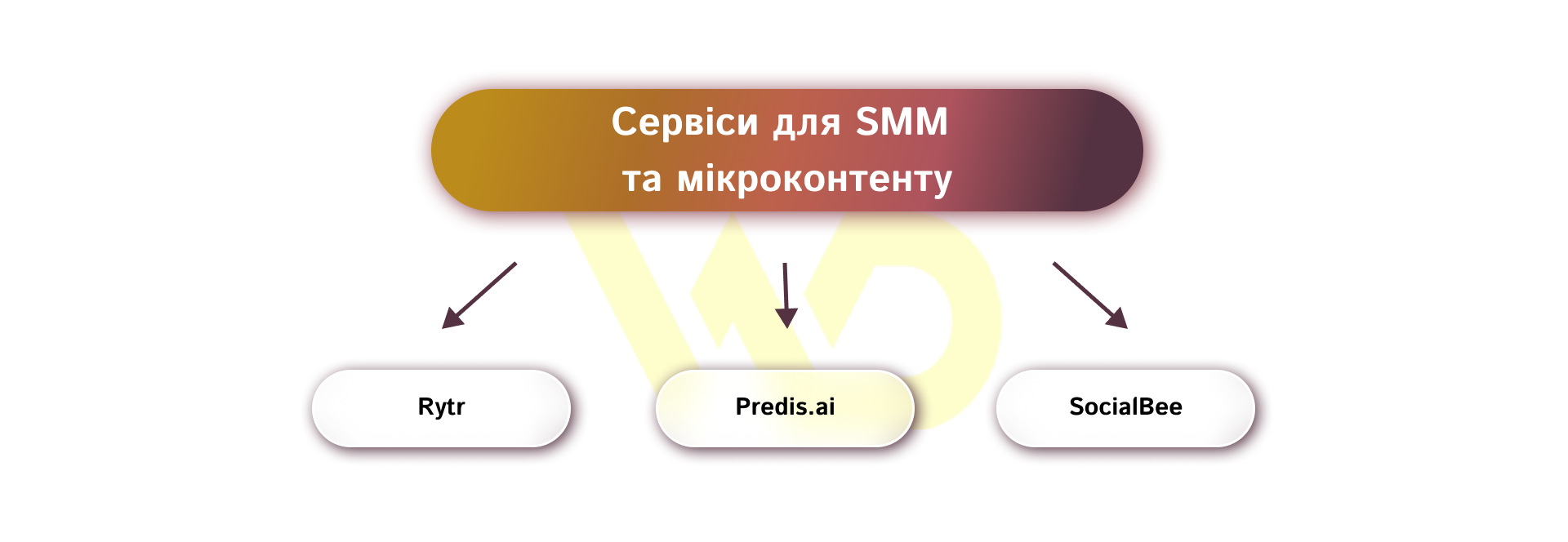
Rytr
A simple and fast generator for creating microcontent and short text formats. The service is ideal for crafting ad headlines, calls to action (CTA), email subject lines, and post captions. Its key advantages include over 20 presets for tone of voice, a built-in plagiarism checker, and a convenient Chrome browser extension. This allows to generate and refine text directly within the Gmail, WordPress, or Meta Ads dashboard without constantly switching between tabs.
Predis.ai
A full-featured all-in-one platform for SMM automation that generates a «turnkey» post based on a short text prompt. The service not only writes text and selects relevant hashtags but also automatically creates visual content from graphic carousels to animated templates and videos with AI voiceovers for Reels, TikTok, and Shorts. The tool allows you to upload corporate brand books, integrates with e-commerce platforms to instantly showcase products in posts, and includes a comprehensive analytics module for monitoring posting frequency and competitors content funnels.
SocialBee
A professional platform for managing SMM activities with a powerful generative AI assistant. The service’s main advantage is the ability to take a single long-form post from a blog or a website’s RSS feed and automatically adapt it into a series of unique posts for LinkedIn, Facebook, Instagram, Threads, and X, taking into account each platform’s character limits and style guidelines. The tool supports category-based planning that is, the automatic rotation and reuse of «evergreen» content includes a built-in library of SMM prompts, and offers convenient multi-workspaces for agencies managing dozens of client accounts simultaneously.
Typical microcontent formats that are best fed to algorithms to speed up publishing:
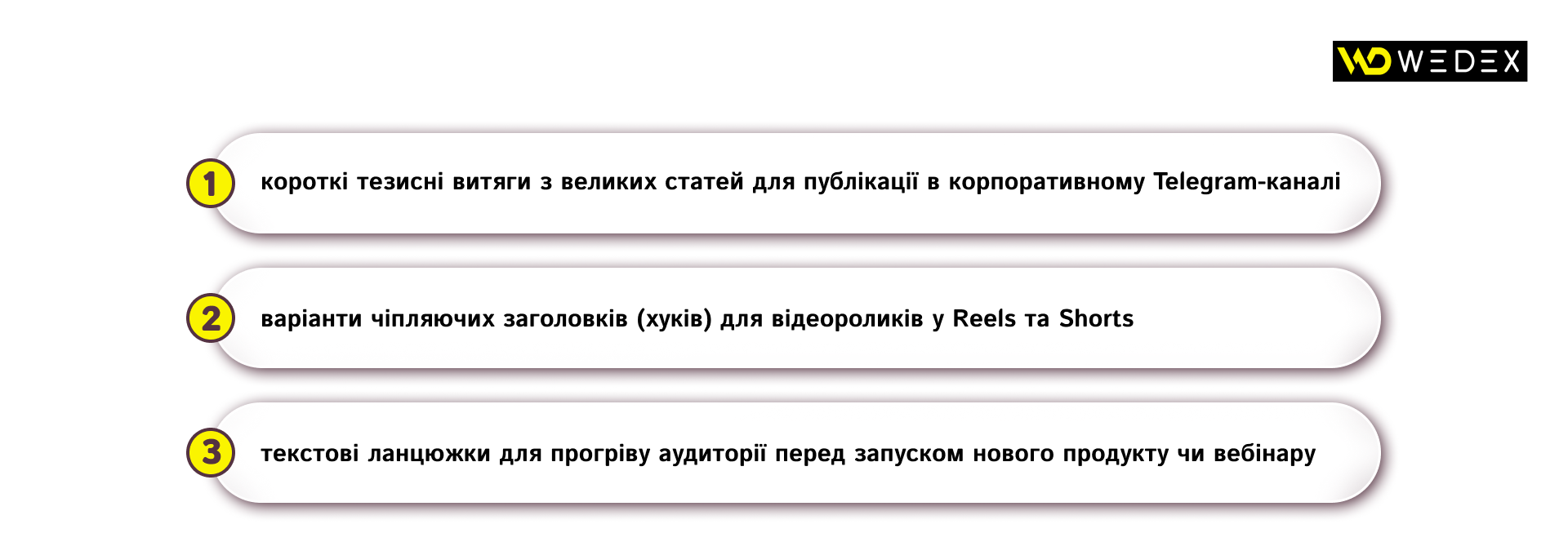
By outsourcing the creation of initial microcontent to specialized services, SMM specialists free up time to engage with their audience in the comments, monitor trends, and build a vibrant community around the brand.
How to improve and localize the final text
Even after successful generation, a draft text often comes across as dry, containing bureaucratic language or templates typical of language models. Additionally, when a company enters international markets, the challenge arises of accurately translating commercial materials while preserving industry-specific terminology.
That’s why there are effective tools for stylistic polishing and localization.

QuillBot
A specialized, comprehensive service for rephrasing, editing, and improving writing style. The tool offers over 10 processing modes, as well as a synonym slider for precise control over the degree of modification to the source text. The platform’s main advantage is its integrated ecosystem, which combines a content summarizer (Summarizer), grammar checker, citation generator, and plagiarism checker all within a single workspace. Thanks to extensions for Chrome, Google Docs, and Microsoft Word, editors can «bring to life» and adapt generated drafts directly within their Gmail, Slack, or Notion windows, quickly transforming complex technical text into easy-to-understand content.
DeepL
The gold standard in neural translation and the localization of corporate materials. Unlike standard machine translators, DeepL deeply analyzes the overall context of a document, accurately reproducing idioms, business slang, and highly specialized business terminology. For the B2B segment, key features include the ability to create corporate glossaries to standardize the translation of proprietary terms, the dedicated DeepL Write module for improving style and grammar, and the translation of documents (.docx, .pdf, .pptx) while fully preserving the original layout.
Renowned content marketing expert Ann Handley notes that in a world of mass-produced AI content, the human factor is becoming the key competitive advantage:
The more proficient AI becomes at generating content, the more valuable genuine human expression becomes. AI can generate content at scale, but it cannot generate meaning. — Ann Handley, Chief Content Officer at MarketingProfs.
And to transform a raw, generated draft into high-quality corporate content, it’s worth implementing clear guidelines for final editing.
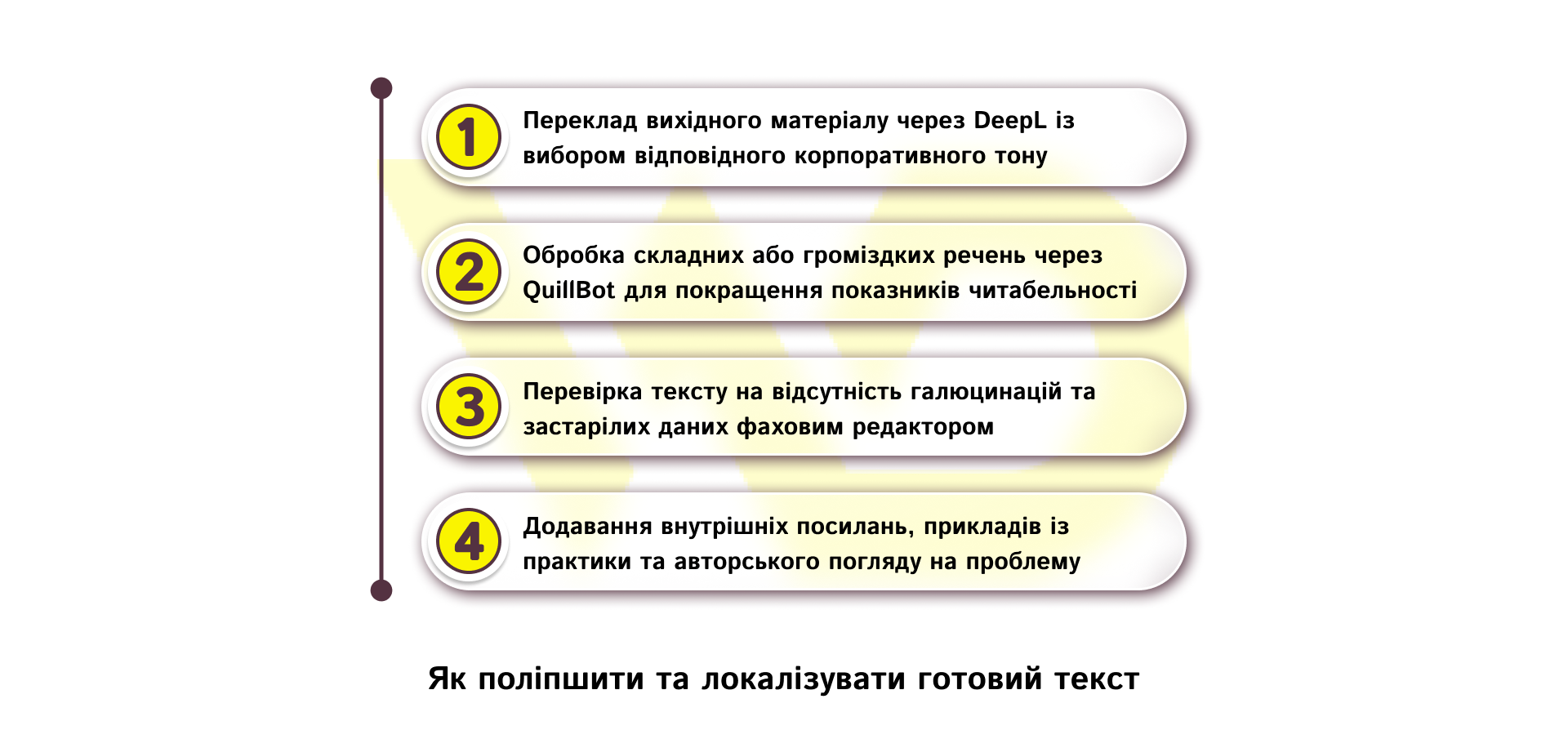
This multi-stage editing process ensures that the brand’s materials will sound natural in any language and inspire trust among potential customers.
Data security and corporate risks related to AI
The active integration of artificial intelligence into marketing processes brings not only benefits but also significant risks to businesses. Uncontrolled use of public services by employees can lead to leaks of confidential information or a loss of search traffic.
There are key risk areas that require special attention.
- Leakage of trade secrets (NDA).
When using the basic free plans of ChatGPT, Claude, or other platforms, the default input data may be used by developers for further model training. If an employee enters an internal financial report, a customer database, or a description of an unannounced product into the chat, this information could theoretically end up in responses to other users.
- Search engine demotion (Google E-E-A-T).
Google’s search algorithms can identify low-quality, mass-generated content created solely to manipulate search results. Content lacking real-world experience, expertise, authoritativeness, and trustworthiness risks being penalized.
- Legal uncertainty regarding copyright.
Under the laws of many countries, content created by artificial intelligence without significant human creative input is not protected by copyright. This means that competitors can legally copy such materials.
To minimize these risks, companies must develop and implement internal security policies:
- implementing a mandatory corporate document an AI Policy that clearly specifies the list of data prohibited from being entered into AI services;
- switch to enterprise versions of tools (ChatGPT Enterprise, Claude for Work), which guarantee that input data is not used to train models;
- adhering to the «human-in-the-loop» principle: no text is published on external resources without human review and editing.
A systematic approach to security allows businesses to harness the potential of generative models without legal or reputational risks.
How to implement AI in business
Attempting to purchase subscriptions to all available services without a clear understanding of their role in the overall process leads only to unwarranted budget expenditures. Effective implementation involves building a unified content pipeline where each tool addresses a specific task.
An example of a balanced set of tools for a content department:
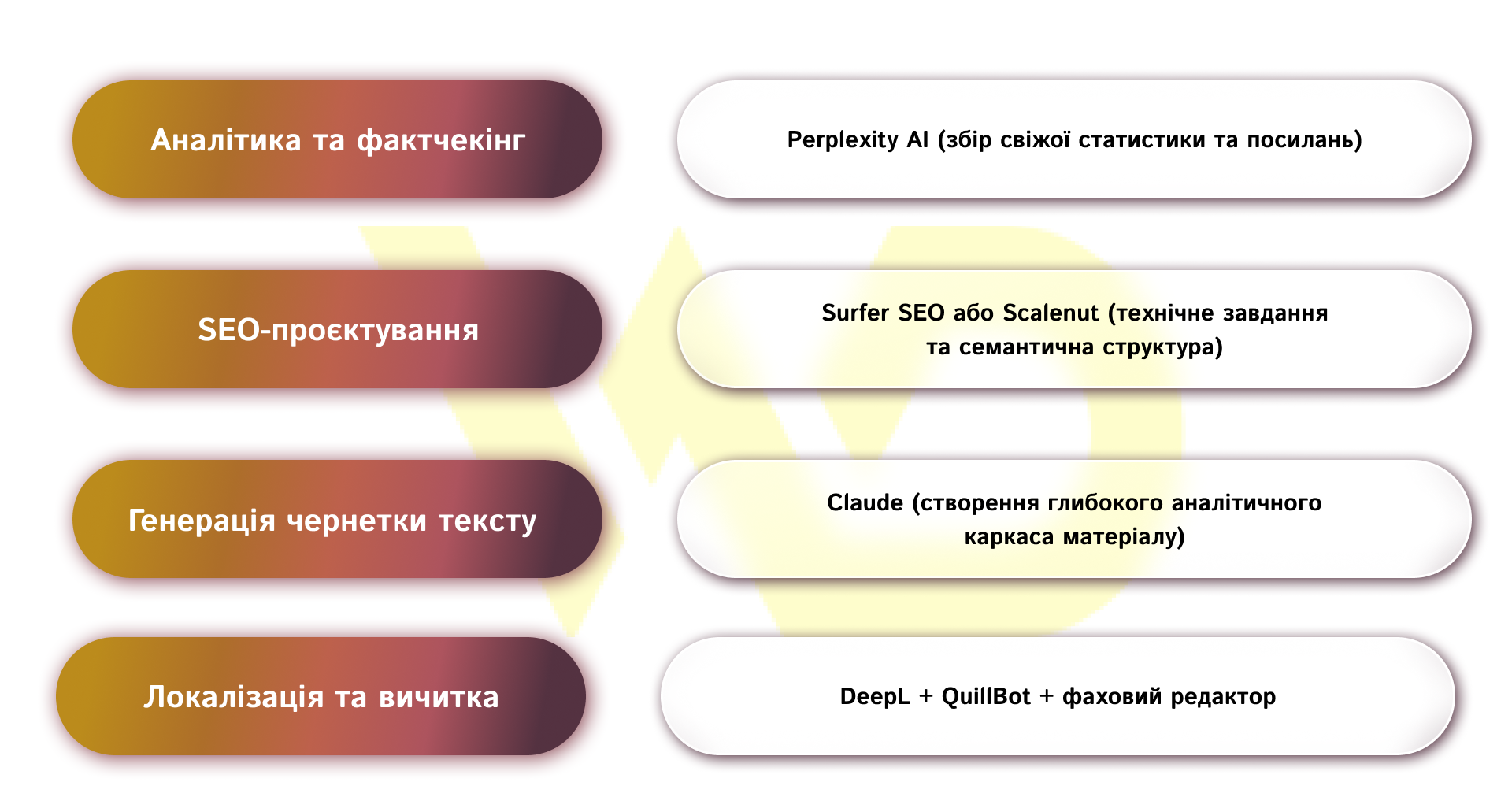
To successfully launch such a process, companies should proceed in stages:
- conduct an audit of routine operations;
- build an internal database of effective prompts;
- train employees in critical editing;
- track changes in key metrics the cost of creating a unit of content and the speed of publication.
Artificial intelligence in copywriting isn’t a replacement for human intelligence, but a powerful amplifier. The brands that succeed will be those that can harmoniously combine the speed of algorithms with the depth, empathy, and real-world practical experience of their specialists.

commercial offer
Other articles by the author

29/05/2026
A virtual SMS number is ideal for businesses that handle a high volume of inquiries, operate across multiple markets, and require in-depth analytics and reporting.

02/10/2026
For businesses, CPL is the primary metric for measuring how effectively ads and landing pages convert cold traffic into initial leads.

17/08/2026
Mass copying of text, photos, or videos not only reduces a website’s uniqueness but also creates legal and SEO-related risks.
Latest articles by #Useful tips

06/10/2026
From a business perspective, updating content is a sensible way to protect existing investments.
02/10/2026
For businesses, CPL is the primary metric for measuring how effectively ads and landing pages convert cold traffic into initial leads.

29/09/2026
A content pipeline transforms the creation of content from a spontaneous creative process into a managed production system. In such a system, AI serves as a powerful assistant.