

 02/10/2026
  998
998

Інтернет-маркетинг
простою мовою
Content of the article
- /01 What is CPL and its role for business
- /02 How to calculate the Cost Per Lead
- /03 CPL, CPA, CAC, and CPC metrics in the sales funnel
- /04 What factors determine CPL
- /05 Why CPL is rising: 8 main reasons
- /06 How to lower CPL without sacrificing lead quality: 7 practical steps
- /07 Why a CPL of 150 UAH might turn out to be more expensive than a CPL of 400 UAH

Cost Per Lead: how to calculate CPL and effectively reduce advertising costs

A company’s marketing budget may grow every month, but if these expenses don’t translate into actual profit, the business is at risk. To understand why ads, generate expensive leads and how to reduce their cost, it’s important not just to look at the final numbers in reports, but to understand the economic essence of the CPL metric and its role in the overall sales system.
In this article, we’ll break down what’s really behind the cost of acquiring a lead, how to correctly calculate CPL, the differences between key marketing metrics, the main reasons why leads become more expensive, and effective tools for optimizing advertising campaigns.
What is CPL and its role for business
CPL (Cost per Lead) is the cost of acquiring a single potential customer who has expressed interest in a product or service and provided their contact information. In marketing analytics, it is a key metric for evaluating the effectiveness of advertising channels in the upper and middle stages of the sales funnel.
For businesses, CPL is the first metric for gauging how effectively ads and landing pages convert cold traffic into initial contacts. However, the main mistake is to consider every inquiry an equally valuable lead. Depending on the business model and the specifics of the sale, the term «lead» can encompass radically different actions:
- E-commerce and retail: adding an item to the cart while providing contact information, signing up for a discount, or submitting a brief request for a callback;
- B2B and complex services: filling out a detailed form for a cost estimate, requesting a product demonstration, or booking a consultation;
- Real estate and automotive: scheduling a property viewing or test drive, or making a direct phone call to the sales department.
If a company equates a random click to subscribe to a newsletter with a targeted request for a quote, the resulting CPL will be skewed. That is why, before analyzing costs, it is important to distinguish between initial inquiries classified as MQLs that is, leads that meet the formal criteria of the target audience and SQLs potential customers who are ready to engage with the sales department.
Clearly defining exactly what action your company considers to be a lead helps you avoid self-deception when evaluating advertising costs and build future analytics based on real business data.
How to calculate the Cost Per Lead
The classic formula is used for a basic calculation of the cost per lead:
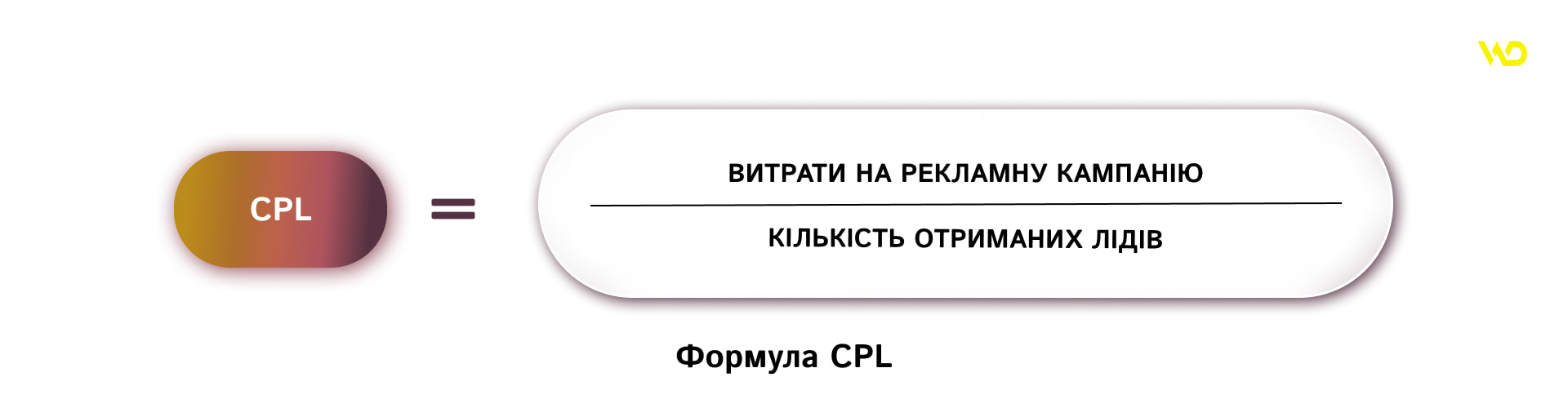
For example, if a company invested 80,000 UAH in a Google Ads campaign and received 400 leads, the media CPL would be:
CPL = 80,000 / 400 = 200 UAH
However, this calculation shows only the net media CPL, which is suitable for a quick assessment of the work of a targeting specialist or a contextual advertising specialist. It does not reflect the business’s actual costs of acquiring a lead.
To determine the full cost of acquiring a lead, you must add related operating expenses to the numerator of the formula. Specifically:
- payment for specialist services: the cost of an agency, freelancers, or the salaries of the in-house marketing team;
- content production: expenses for designers, copywriters, video production, and creative development;
- technical infrastructure: fees for call tracking services, CRM systems, end-to-end analytics platforms, and chatbots.
In other words, if you add 30,000 UAH in operating expenses for software and content to a budget of 80,000 UAH, the company’s actual CPL will rise to 275 UAH per lead.
In addition to accounting for all expenses, the analysis period is critically important. Calculating CPL over a 2–3-day period is not advisable due to delays in data attribution in Meta Ads or Google Ads, as well as natural fluctuations in demand throughout the week.
A reliable CPL analysis is conducted over a period of at least 14–30 days, which allows you to see the true dynamics of the metric and rule out random spikes.
CPL, CPA, CAC, and CPC metrics in the sales funnel
Trying to evaluate marketing effectiveness based solely on CPL is like trying to drive a car while looking only at the tachometer. CPL works only in conjunction with other sales funnel metrics.
|
Metric |
What it measures |
Business value |
|
CPC (Cost per Click) |
The cost of a single click on an ad |
Indicates the level of competition for traffic and the appeal of the ad creative |
|
CPL (Cost per Lead) |
The cost of acquiring a lead from a potential customer |
Measures the landing page’s conversion rate and the relevance of the offer |
|
CPA (Cost per Action) |
The cost of completing a specific target action |
Measures the cost of micro-conversions (downloading a catalog, subscribing) |
|
CAC (Customer Acquisition Cost) |
The total cost of acquiring one paying customer |
Determines the actual economic viability of marketing |
|
CR (Conversion Rate) |
The percentage of users who completed the target action |
Shows the effectiveness of each individual stage of the funnel |
The main difference between CPL and CAC is that CPL measures the cost of interest, while CAC measures the cost of an actual transaction. The transition from CPL to CAC occurs through the sales department’s conversion rate (CR):
CAC ≈ CPL / CR (sales)
For example, if your company receives inexpensive leads at 100 UAH each, but because of their low quality, the sales department closes only 1% of those leads into deals, then the cost of acquiring a single customer (CAC) will be 10,000 UAH. However, if you acquire more expensive but qualified leads at 500 UAH each with a 10% conversion rate, the total CAC will decrease to 5,000 UAH.
Understanding this hierarchy helps a manager see the connection between traffic acquisition and the final financial result, rather than limiting the analysis to intermediate metrics.
What factors determine CPL
A search query like «average lead cost in niche X» provides useless benchmarks, since the final price is influenced by dozens of variables unique to each individual business.
Let’s look at the key factors that influence CPL:
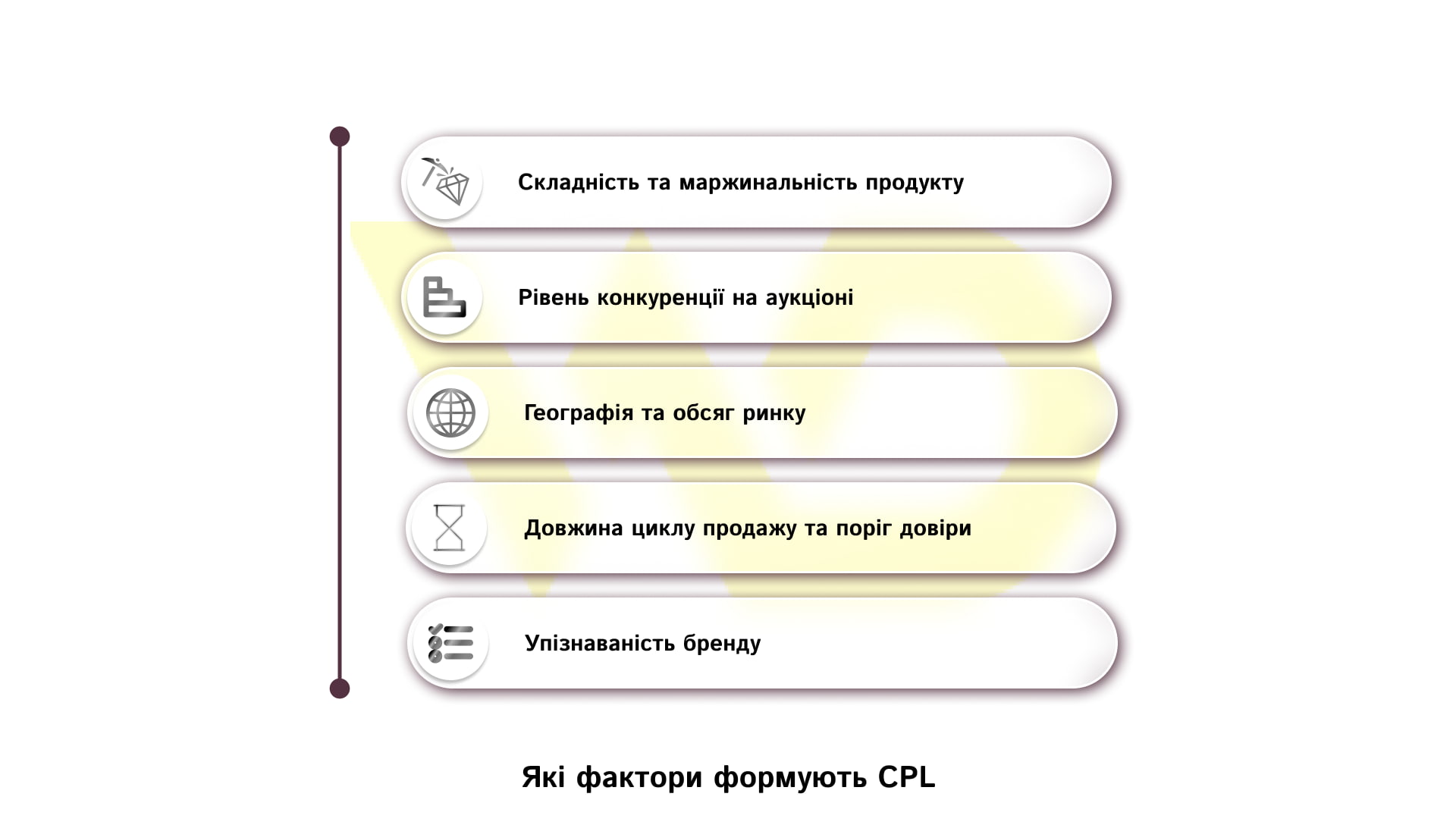
Product complexity and margin
Impulse-buy and mass-market products, such as a smartphone case, have a minimal decision-making threshold because the buyer acts on emotion, and the risk of a financial mistake is negligible. In contrast, building a frame house or implementing an ERP system involves high-cost, high-risk transactions, where, in the B2B segment, an entire team is involved in the decision-making process. Since the profit margin from selling a single complex product is measured in thousands of dollars, the business has a high acceptable budget for customer acquisition. This raises the overall bar for acceptable CPL in the niche: a company is willing to pay anywhere from $50 to $150 for a qualified lead, since the total profit from the deal fully covers these costs.
Level of competition in the auction
The Google Ads and Meta Ads platforms operate on a real-time auction model. In highly competitive industries such as finance, legal services, real estate, or insurance dozens of well-funded companies compete for the attention of the same target audience. Market saturation with similar ads automatically drives up the cost per thousand impressions (CPM) and the cost per click (CPC). When a single click on an ad cost not $0.30 but $5–$12, the total cost per lead increases proportionally, even with a perfectly optimized landing page.
Geography and market size
The cost of purchasing traffic is directly tied to the population’s purchasing power and the density of local businesses. Launching ad campaigns in major metropolitan areas or affluent international markets requires significantly larger investments, as businesses compete in auctions against international brands with massive budgets. In small regional cities, the auction is less crowded, and user attention is cheaper, which makes it possible to secure initial leads at a significantly lower price.
Sales cycle length and trust threshold
For inexpensive products, the path from the first ad view to filling out a form takes just a few minutes. With expensive or niche services, users almost never provide their contact information on the first interaction they need time to compare alternatives, read reviews, and assess risks. To «nurture» such a potential customer, businesses have to build multi-level funnels, use retargeting, create content sequences, and repeatedly bring the person back to the site. Each additional touchpoint requires new ad impressions, which increases the total cost of acquiring a single lead.
Brand awareness
A company’s established reputation and media presence act as a catalyst for conversion. When a potential customer sees an ad for a brand that the market already trusts, their skepticism is alleviated even before they visit the website. This ensures a high conversion rate for the landing page. Since the cost per lead is calculated as the ratio of the cost per click to the website’s conversion rate, a well-known brand’s high conversion rate allows it to acquire leads at a significantly lower cost compared to a newly established company, which has to factor in additional advertising expenses to overcome the audience’s distrust.
A CPL is considered acceptable if it fits within your company’s financial model.
For example, if the profit margin per transaction is 50,000 UAH, then a CPL of 2,000 UAH can be extremely profitable. If, however, the average order value is 1,000 UAH, then even a CPL of 300 UAH will result in a loss.
Why CPL is rising: 8 main reasons
If the cost of acquiring a lead begins to rise sharply without any apparent change in the advertising budget, this signals problems in the marketing system. System diagnostics allow you to identify the specific link in the chain where efficiency is being lost.
- Creative and ad message burnout. When the same banners or videos are displayed for an extended period, the audience becomes desensitized to them. The CTR drops, forcing ad algorithms to raise the cost per click.
- Audience fatigue. Targeting overly narrow segments results in ads being shown to the same people multiple times. Impression frequency increases, while response rates decline.
- Increased competition in the auction. The entry of new players or seasonal budget increases by major brands drive up the cost per thousand impressions (CPM) for all market participants.
- Unbalanced changes to the landing page. Design updates, changes in form placement, loading speed issues, or technical glitches reduce the site’s conversion rate, which automatically increases the cost per lead.
- Loss of relevance between the ad and the offer. If the ad creative promises a 30% discount, but on the landing page the user sees the standard price, most visitors will close the site without completing the desired action.
- Overcomplicating the sign-up form. Adding required fields such as middle name, address, or additional questions creates a barrier for the user and reduces the number of completed forms.
- Technical glitches in the analytics system. A Meta pixel failure, errors in Google Analytics 4 configuration, or a lack of event tracking via the Conversions API result in some conversions not being recorded in the dashboard, which artificially inflates the calculated CPL.
- Retraining of advertising platform algorithms. Haphazard changes to targeting, budgets, or bidding strategies reset the training phase of Meta Ads and Google Ads algorithms, causing temporary price spikes.
Understanding these causes allows you to avoid panic-driven budget cuts and focus your efforts on addressing specific problem areas in the campaign.
How to lower CPL without sacrificing lead quality: 7 practical steps
Reducing the cost per lead should be done without compromising lead quality. The goal of optimization is to increase conversions at every stage of the user journey, not simply to generate as many cheap leads as possible.
Seven practical tools are used to systematically reduce the cost of leads:
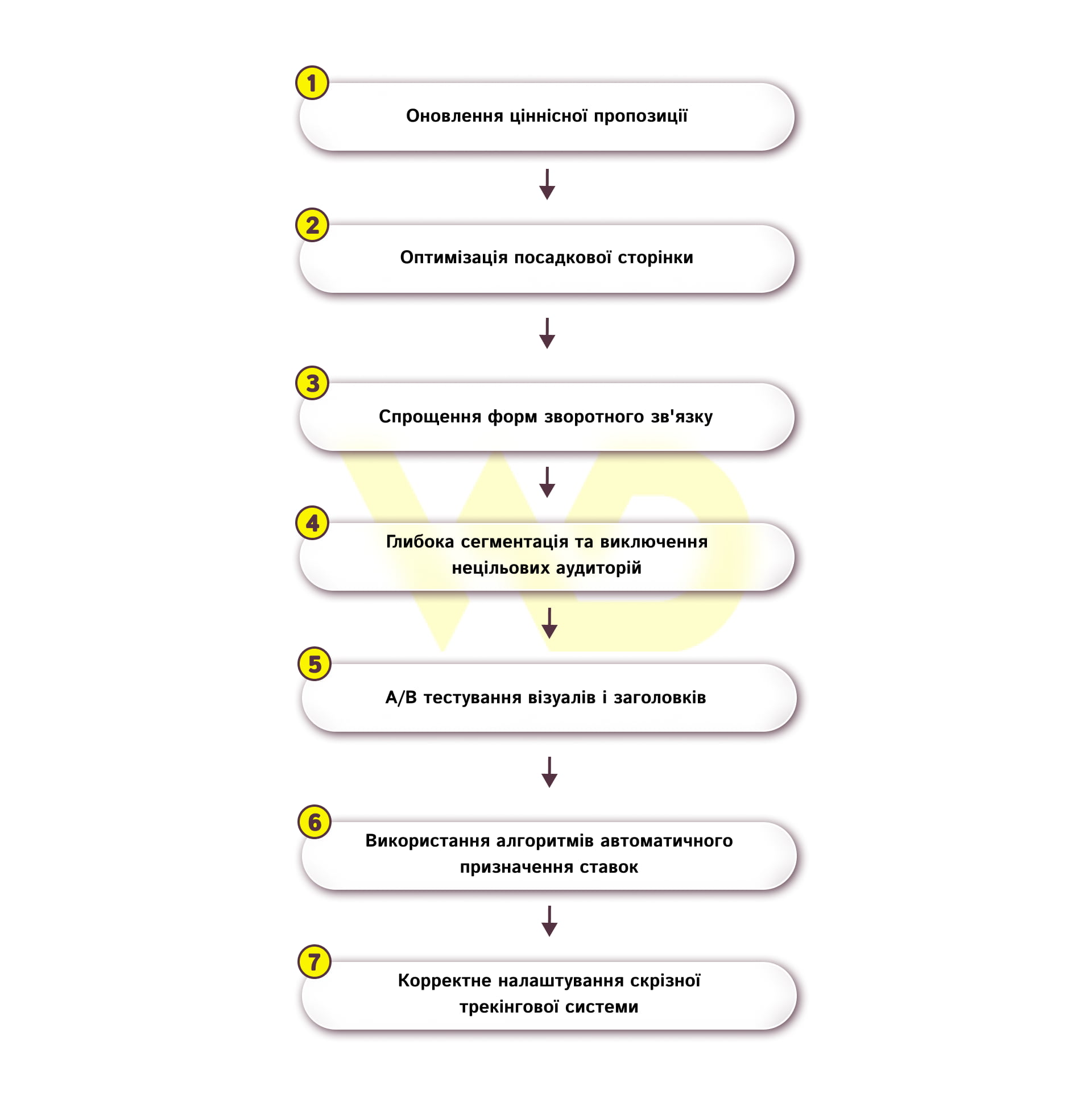
- Update your value proposition. Instead of the abstract «Schedule a consultation», offer a clear benefit: «Get a cost estimate and a materials savings checklist in 15 minutes».
- Optimize the landing page (CRO). Increase the site’s loading speed, adapt the mobile version, place the main lead form on the first screen, and reinforce credibility with social proof (case studies, reviews, certifications).
- Simplify feedback forms. Include only the necessary fields for initial contact (name and phone number/messenger). It’s better to gather additional details about the client’s needs during the manager’s first call.
- Deep segmentation and exclusion of non-target audiences. Exclude current customers, people who have already submitted an inquiry, as well as irrelevant regions or age groups from your ad impressions.
- A/B testing of visuals and headlines. Systematically test different creative formats (static banners, short videos, UGC content) and calls to action (CTA), keeping only the ads with the highest CTR and conversion rates active.
- Use automated bidding algorithms. After collecting initial statistics (at least 30–50 conversions per week), switch your campaigns to Target CPA (Target Cost Per Acquisition) or Target ROAS strategies in Google Ads and Meta Ads.
- Properly configure an end-to-end tracking system. Implement the Meta Conversions API (CAPI) and Server-Side Google Tag Manager. This recovers up to 15–20% of data lost due to ad blockers and browser restrictions, giving the algorithms more information for optimization.
Optimization is not a one-time action but a continuous process of proposing and testing hypotheses, where each change is evaluated based on its impact on the final cost per lead.
Why a CPL of 150 UAH might turn out to be more expensive than a CPL of 400 UAH
An obsession with minimizing CPL often creates the illusion of marketing success, behind which real financial losses are hidden. When the primary goal of an ad campaign becomes the cheapest lead, the business risks filling the funnel with ineffective traffic and paralyzing the sales department’s operations.
To see this effect in practice, let’s compare two approaches to promoting a company that sells and installs solar power plants. With the same monthly budget of 60,000 UAH, marketers employed different customer acquisition strategies.
|
Metric / scenario |
Campaign A (focus on low CPL) |
Campaign B (focus on qualification) |
|
Acquisition strategy |
Broad audience, one-click form, promise of a «gift» |
Narrow targeting, on-site calculator with 4 questions |
|
Advertising budget |
60,000 UAH |
60,000 UAH |
|
Leads generated |
400 |
150 |
|
Cost per lead (CPL) |
150 UAH |
400 UAH |
|
Sales department conversion rate |
2% |
16% |
|
Number of sales |
8 deals |
24 deals |
|
Customer Acquisition Cost (CAC) |
7,500 UAH |
2,500 UAH |
The first campaign delivered an attractive media metric the CPL was only 150 UAH. However, most of the 400 applicants turned out to be casual users who clicked for a freebie or out of curiosity. Sales managers spent hundreds of work hours on ineffective cold calls, and the customer acquisition cost (CAC) reached 7,500 UAH.
In the second campaign, the CPL was 2.6 times higher 400 UAH per lead. But thanks to preliminary screening via the calculator, only those who actually planned to invest in solar energy were referred to the sales department. As a result, the conversion rate increased eightfold, and the company closed three times as many deals on the same advertising budget, reducing the actual CAC to 2,500 UAH.
This example clearly shows that chasing the lowest CPL without linking it to sales conversions undermines the business’s bottom line. The effectiveness of advertising can only be assessed in terms of the final CAC and the amount of net profit generated.
Remember! A low CPL is an attractive metric for impressive reports, but true marketing success is measured by net profit and the final CAC. Evaluate advertising holistically, look beyond the initial lead, and build analytics based on the connection between marketing and the sales department only then will your advertising budget translate into predictable business growth.

commercial offer
Other articles by the author

08/07/2026
Donor analysis isn't about examining a single metric; it's about comparing several metrics against one another.

17/04/2026
Automating SMM processes is a practical necessity for businesses operating in an environment characterized by a high volume of content, limited resources, and constant competition for audience attention.

29/01/2026
Search Generative Experience (SGE) is Google's approach to search that uses generative artificial intelligence to generate concise, coherent answers to user queries.
Latest articles by #PPC

30/09/2026
Google's main focus in 2026 was the large-scale rollout and deep algorithmic integration of the AI Overviews (AIO) tool.

29/09/2026
A content pipeline transforms the creation of content from a spontaneous creative process into a managed production system. In such a system, AI serves as a powerful assistant.

24/09/2026
While feeds were previously viewed as a purely technical feature for running contextual ads in Google Ads, today their quality directly determines the share of impressions across all sales channels.