

 30/09/2026
  1009
1009

Інтернет-маркетинг
простою мовою
Content of the article
A complete overview of the Google 2026 update: the future of AI search, threats, and new opportunities

Digital marketing is undergoing its most radical transformation in the last fifteen years. The traditional model, in which a search engine served solely as a «link index» and redirected users to external websites, is finally becoming a thing of the past. The integration of generative artificial intelligence directly into Google search results has changed the very essence of the search experience, and now the algorithm aims not to find a relevant page, but to generate a comprehensive answer on its own.
In this article, we’ll take a detailed look at Google’s key updates for 2026, analyze the phenomenon of declining organic CTR due to zero-click search, and explore the mechanics of the new GEO initiative.
Google updates: how AI has completely reshaped search results
Google’s main focus in 2026 was the large-scale rollout and deep algorithmic integration of the AI Overviews (AIO) tool. Whereas generative answers previously appeared only for a narrow category of experimental queries, today the AI block is displayed at the very top of the search results page (SERP) for most informational and comparative queries.
According to official materials from Google Search Central, updates to the ranking algorithms are aimed at meticulously selecting the sources from which the generative model synthesizes the summary text. The traditional «10 blue links» have been pushed far down the page, giving way on the first screen to an interactive answer block, multimedia cards, and detailed action scenarios.
|
Comparison Parameter |
Traditional search results |
Generative Results (AI Overviews) |
|
User’s primary goal |
To find a relevant website and navigate to it |
Get a ready-made answer without leaving the page |
|
Placement of primary content |
Title and snippet |
AI-generated text on the first screen |
|
Format of information presentation |
List of ranked links |
Interactive summary card with sources |
|
Criteria for ranking in the top results |
SEO factors (links, keywords, technical quality) |
Added value, unique data |
Let’s look at a practical example. When a potential buyer searches for «how to choose a CRM system for a small business», AI Overviews doesn’t just show articles from a few blogs.
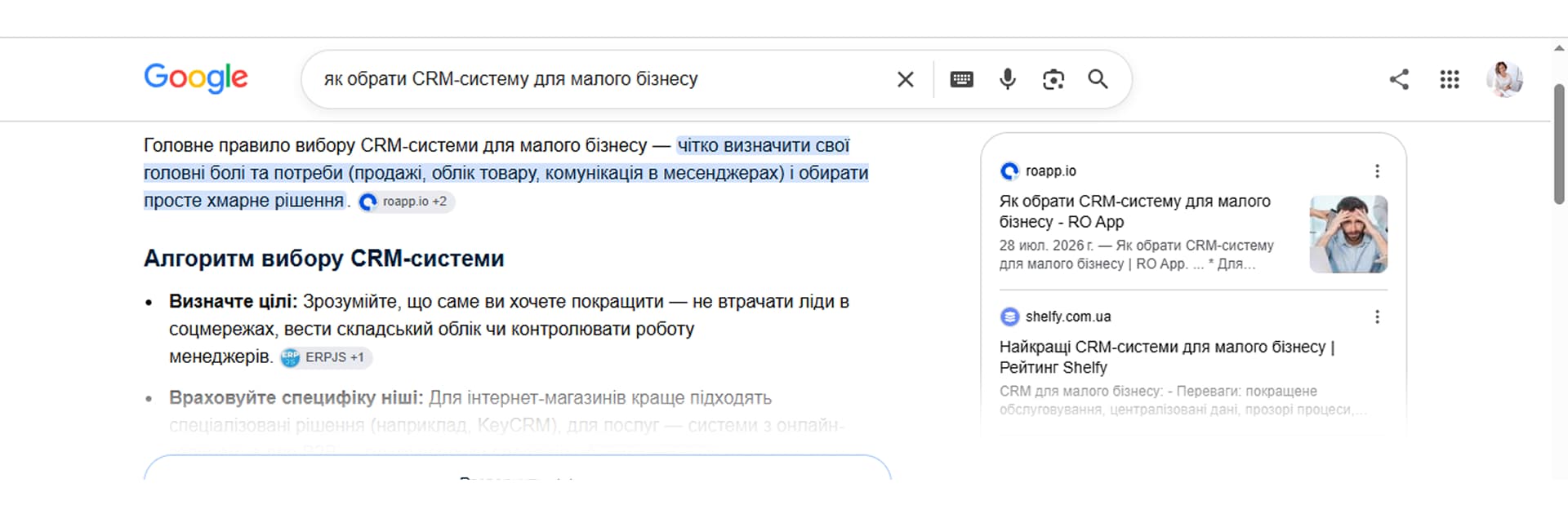
AI instantly generates a comparative checklist, groups solutions by niche, and displays a brief summary of reviews. For the user, this saves time, but for review sites and content platforms, it means losing that initial visit.
The modern SERP has become dynamic and conversational. Google no longer treats a query as a set of separate words the algorithm analyzes the user’s intent in the context of their previous actions, geolocation, and personal profile.
The zero-click phenomenon and the decline in traditional organic traffic
Changes to the search interface have directly impacted the economics of customer acquisition. The main threat to businesses lies in the rapid growth of the share of «Zero-Click Searches» search sessions that end without a single click to an external website.
Research by Gartner indicates that the total volume of traffic from traditional search engines is declining by 25% due to a shift in user attention toward AI assistants and generative content blocks. At the same time, SparkToro Search Research reports that over 60% of information queries on Google are resolved directly on the search results page.
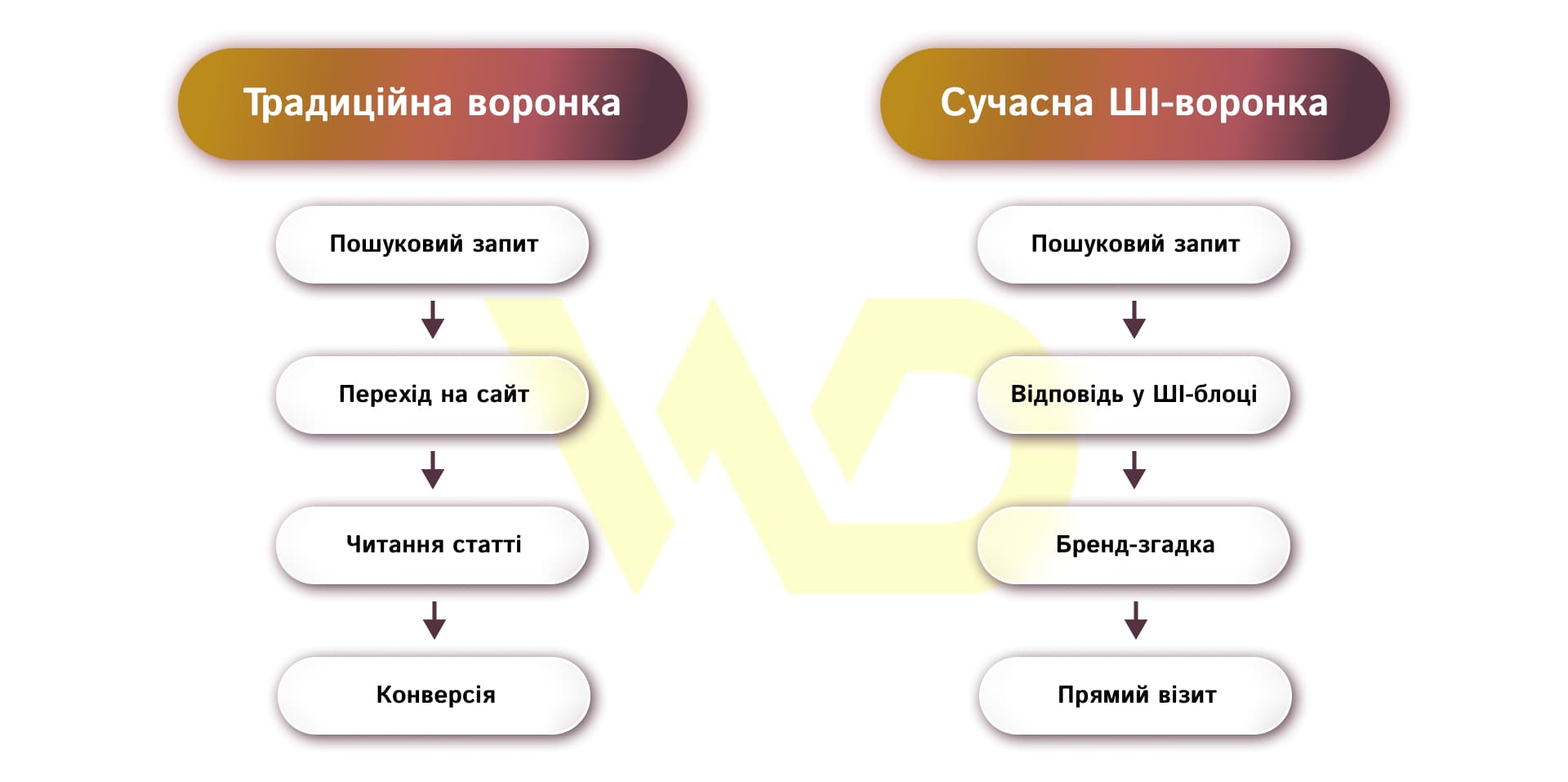
This phenomenon hits the top of the marketing funnel (TOFU—Top of Funnel) the hardest. Articles in the «what is…», «how to…» or «Top 10 Tips…» formats, which for years generated massive amounts of free traffic, no longer deliver the usual volume of clicks.
As a result, businesses are facing rising customer acquisition costs (CAC). If a company continues to rely solely on traditional content marketing without adapting to the new rules, the cost of creating articles remains high, while the number of leads generated drops rapidly.
The shift from SEO to GEO
Despite the risks, Google transformation opens a new window of opportunity for brands willing to adapt their strategies. Traditional search engine optimization (SEO) is being replaced by GEO (Generative Engine Optimization) a set of actions aimed at making your website’s content a fundamental source for generating answers via artificial intelligence.
Adapt your SEO to the new reality of search
The experts at WEDEX will help you optimize your website not only for search engine results but also for generative systems. We’ll combine SEO and GEO to give your content a better chance of becoming a source for AI-generated answers.
The key to understanding Google algorithms is the patent for the Information Gain Score. Google AI model evaluates whether a specific page contains unique facts, original research, new figures, or practical experience not found in other sources. If an article is merely a high-quality rewrite of existing material, its chance of appearing in the AI Overviews section is zero.
|
Criterion |
Classic SEO |
Generative Engine Optimization (GEO) |
|
Ranking basis |
Keywords and meta tags |
Text completeness and unique semantic entities |
|
Content optimization |
Keyword density, LSI words |
Direct, structured answers to questions |
|
Value of information |
Depth of coverage of a predefined topic |
Information growth (primary research, data) |
|
Trusted sources |
Anchor text and backlinks |
Brand mentions, citations in authoritative media |
Let’s look at an example of how the concept of information growth can be applied. Instead of publishing a general article titled «Logistics Trends 2026», a B2B logistics company conducts its own survey of 100 retailers and publishes exclusive statistics on delivery delays. AI Overviews recognizes this unique dataset and uses this specific company as the primary source for generating a quote in the AI block.
The source base for GEO is built on structured data (Schema.org), clear headings, and concise summaries at the beginning of each section. It is easier for AI to parse statements formulated in the language of facts and cause-and-effect relationships.
E-E-A-T and brand equity as the main shield against updates
Artificial intelligence has learned to generate vast amounts of text in a matter of seconds, leading to an influx of low-quality content on the internet. In response, Google has significantly tightened its requirements for E-E-A-T factors (Experience, Expertise, Authoritativeness, Trustworthiness).
Google official Search Quality Guidelines state that genuine human experience has become the primary filter against faceless AI-generated content. The algorithm looks for the presence of an author’s perspective, photo reports, practical case studies, and reviews from industry experts with a proven reputation.
To protect a website from algorithmic penalties, a business must build a strong digital presence. Google must clearly identify your brand in its Knowledge Graph as an expert in the relevant field.
Building brand equity involves the company’s regular presence on external authoritative platforms, participation in industry-specific multimedia, and an increase in the volume of direct brand queries in search. Brand traffic is the most resilient to any algorithm changes.
How to adapt your business’s marketing strategy
Adapting to the new reality of search requires a reevaluation of key performance metrics and approaches to content creation.
To maintain business stability and growth in the era of AI-powered search, we recommend implementing the following strategic steps:
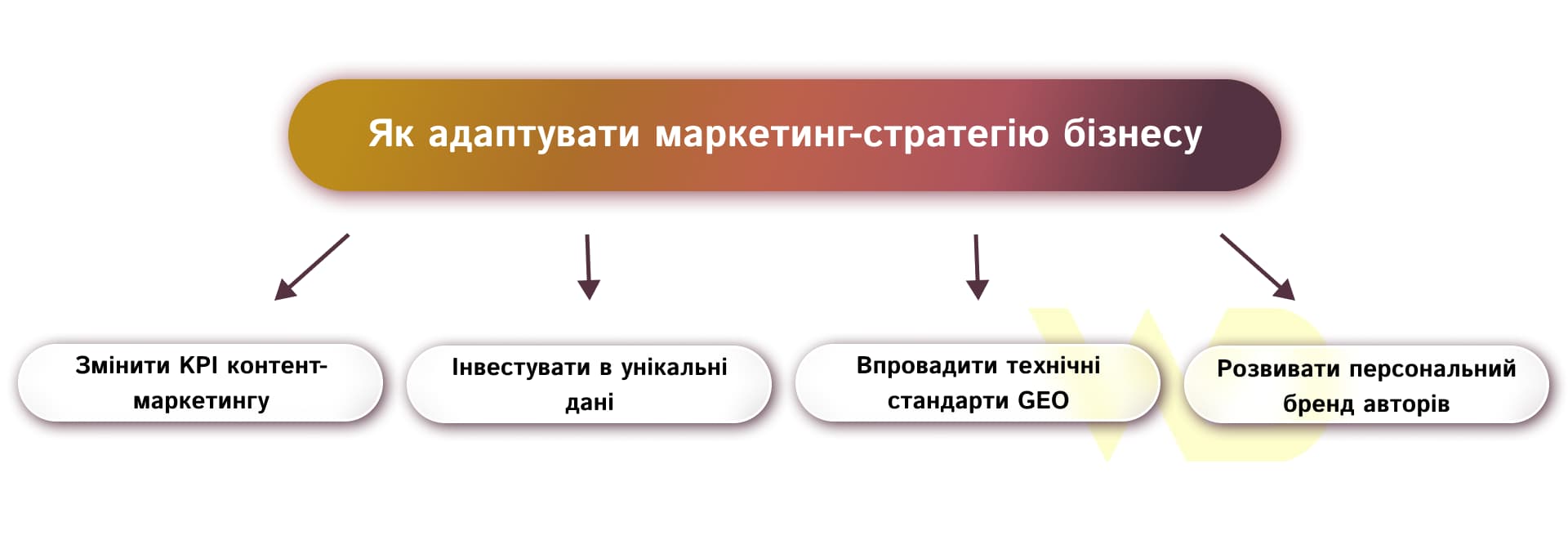
- Revise content marketing KPI. Stop evaluating effectiveness based on total traffic volume. The primary metrics should be the generation of qualified leads (MQL/SQL), growth in brand-related searches, and measurement of the share of presence in AI-generated answers.
- Invest in unique data. Redirect budgets from creating superficial content toward conducting industry research, experiments, gathering analytics, and producing expert interviews.
- Implement GEO technical standards: Mark up all website content with microdata, optimize loading speed, and ensure a simple structure for answers to frequently asked questions (FAQ).
- Develop authors’ personal brands. Every piece of content on the website should be attributed to a specific author with a link to, for example, their LinkedIn profile, publications, and real-world industry experience.
Google transformation in 2026 does not mark the decline of SEO, but rather its transition to a new level of maturity. Search algorithms are leaving behind the era of mechanical keyword optimization and forcing businesses to focus on real value for the customer. The winners in the new era of AI-powered search will be companies that can combine deep expertise, a strong brand, and adaptability to new search result formats.

commercial offer
Other articles by the author
26/08/2026
TikTok has long since ceased to be merely an entertainment platform and has evolved into an effective channel for promotion, lead generation, and building brand relevance.

20/03/2026
An ambassador isn’t just a marketing channel—it’s a multifunctional resource: trust, content, traffic, reputation support, and product narrative.
30/09/2026
Google's main focus in 2026 was the large-scale rollout and deep algorithmic integration of the AI Overviews (AIO) tool.
Latest articles by #SEO
30/09/2026
Google's main focus in 2026 was the large-scale rollout and deep algorithmic integration of the AI Overviews (AIO) tool.

29/09/2026
A content pipeline transforms the creation of content from a spontaneous creative process into a managed production system. In such a system, AI serves as a powerful assistant.

24/09/2026
While feeds were previously viewed as a purely technical feature for running contextual ads in Google Ads, today their quality directly determines the share of impressions across all sales channels.