

 13/11/2026
 882

Інтернет-маркетинг
простою мовою
Content of the article

Customer acquisition cost (CAC): calculation formula, benchmarks and common mistakes

Any business that systematically invests in advertising and sales will sooner or later ask itself whether these investments are paying off. If you simply increase budgets without calculating how much each new customer costs, you can easily end up with a cash flow gap even with high sales figures. The direct link between marketing costs, funnel conversion rates, and actual profit makes understanding unit economics a matter of the company’s survival.
In this article, we’ll explore how to calculate customer acquisition cost, which benchmarks to use as a guide, and what mistakes to avoid when analyzing this metric.
What is CAC and why calculate it
Customer Acquisition Cost (CAC) is the total amount a company spends to acquire one new paying customer over a specific period.
For owners and managers, this metric isn’t just for making reports look good it’s for making concrete management decisions:
- understanding the actual cost of acquiring each new customer;
- to compare the effectiveness of different advertising channels and traffic sources;
- to allocate and plan the marketing budget effectively;
- assessing whether advertising can be scaled up without the risk of loss;
- assessing the ratio of acquisition costs to the revenue the customer will generate over the entire duration of the relationship.
An important caveat: a low CAC alone does not necessarily mean your marketing is working perfectly. A channel may attract very «cheap» customers who make a single purchase for a minimal amount and never return. Conversely, a high CAC can be entirely justified if customers stay with you for years and regularly make large purchases. Therefore, it makes no sense to look at this metric in isolation from other business indicators.
CAC formula: how to correctly calculate customer acquisition cost
The formula looks like this:
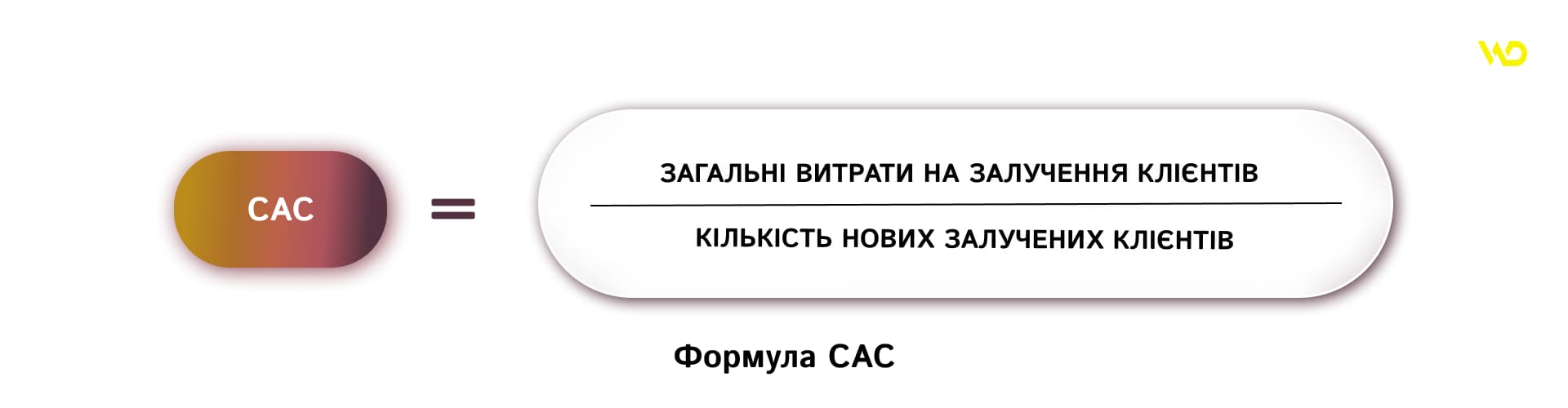
The key question here is what exactly to include in «total costs». If you only count the direct advertising budget, the metric will be skewed. For a complete calculation, you need to account for all related expenses:
- budgets for targeted, contextual, and display advertising;
- salaries for marketers, targeting specialists, and sales managers (for the portion of their time spent specifically on acquiring new customers, rather than on serving existing ones);
- payments for the services of agencies, freelancers, and contractors;
- software costs: CRM systems, analytics services, end-to-end analytics, and call tracking;
- content creation, video production, design, and printing.
In practice, there are also two distinct approaches:
- Paid CAC — calculates the cost of acquisition solely from paid channels (Google Ads, Meta Ads, etc.);
- Blended CAC — the average across the entire business, where total costs are divided by the total number of new customers (including those who came via word of mouth or organic traffic).
You can’t directly compare the two. Blended CAC will almost always be lower because free traffic dilutes the overall figures, but Paid CAC more accurately shows how much managed growth costs you.
Let’s look at an example. Imagine that a company spent 120,000 UAH on marketing and customer acquisition in a month, of which 80,000 UAH went to advertising and 40,000 UAH to paying specialists and services. During this time, 40 new customers were acquired.
CAC = 120,000 UAH / 40 = 3,000 UAH
In other words, acquiring a single customer costs the company an average of 3,000 UAH.
It’s also important not to overlook the length of the sales cycle. If it takes 2–3 months in your niche from the first contact to payment, it’s not advisable to divide the current month’s expenses by the number of new customers acquired that same month. You need to account for the time lag and set up attribution correctly.
CAC benchmarks: how to evaluate your numbers
There is no universal figure that would be considered the norm for everyone. What might be a terrible result for an online clothing store could turn out to be excellent for a B2B company. It all depends on the average order value, margin, purchase frequency, and competition.

- Guidelines based on market data.
According to global studies, the average customer acquisition cost in the U.S. market varies significantly by niche:
|
E-commerce (B2C) |
$45–150 depending on the product category |
|
B2B SaaS |
From $200–500 for small businesses to $5,000+ in sales to the corporate segment |
|
Financial and insurance services |
$175–450+ due to high auction costs |
|
Online education |
$100–400 |
There is no single public database with benchmarks for the Ukrainian market. Western benchmarks can be used to understand the proportions between industries, but they must be adjusted for local purchasing power and lower traffic costs.
- Analysis of your own metrics (LTV/CAC).
Market benchmarks cannot replace your financial model. The best way to evaluate CAC is to compare it to LTV (Lifetime Value) — that is, the revenue a customer generates over the entire duration of their relationship with you.
Ratio = LTV / CAC
A 3:1 ratio is considered the classic benchmark in business. This means that over the course of the relationship, a customer should generate three times more revenue than what you spent to acquire them.
- 1:1 or less the business is operating at a loss and losing money on every transaction;
- 2:1 — there is a profit, but the margin of safety is very low;
- 5:1 or higher — excellent margins, but the business owner may be too cautious and not investing enough in marketing, which is why growth is slow.
Important! When calculating LTV, focus specifically on net profit margin, not revenue. If a product has a high cost of goods sold, even an LTV-to-CAC ratio of 4:1 based on revenue could still result in a loss.
Common mistakes in calculations
Due to distorted figures, companies make the wrong decisions: they either scale up unprofitable areas, draining their budget, or, conversely, are afraid to invest in effective growth tools.
Let’s look at the most common mistakes.
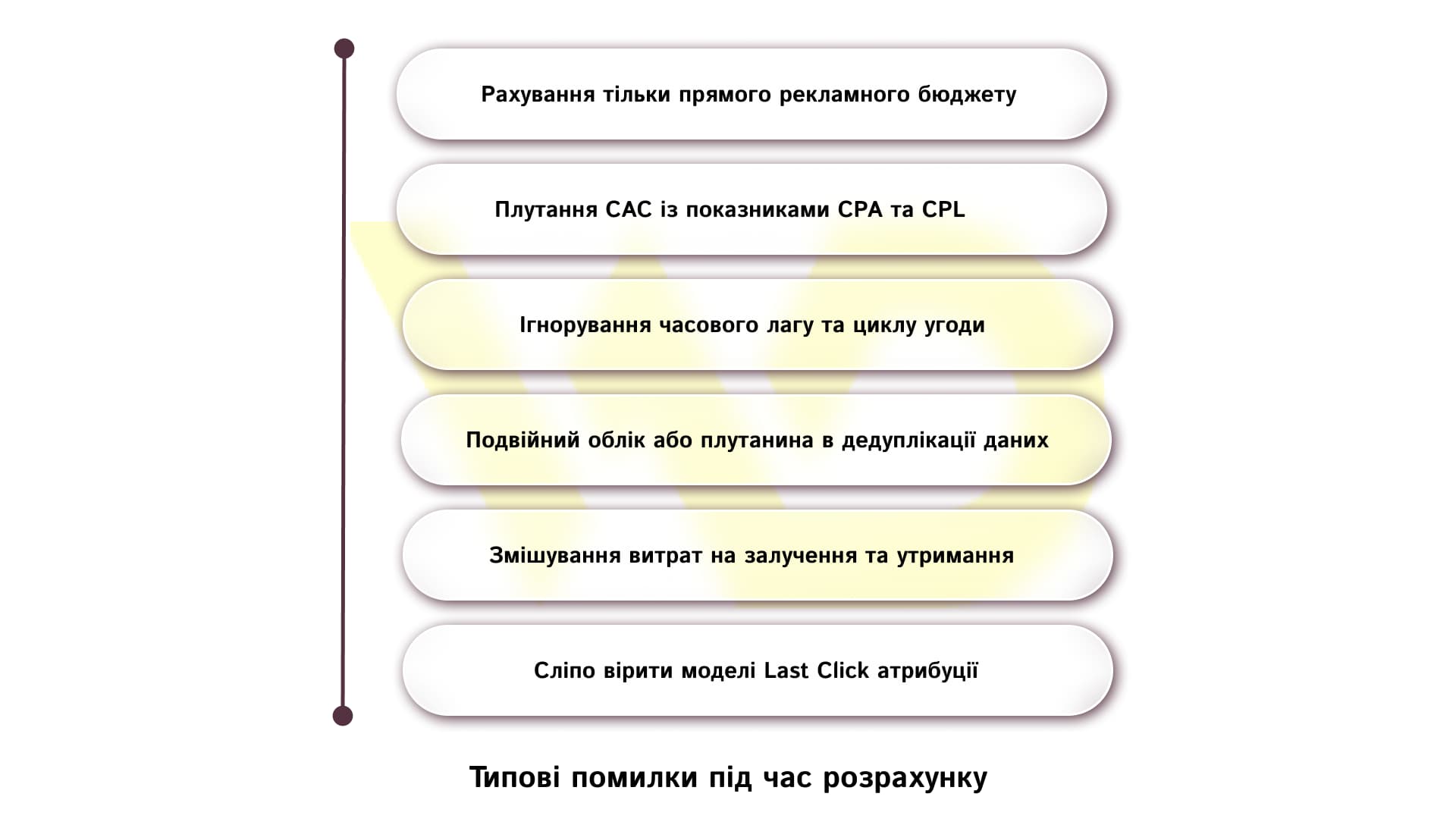
Calculating only the direct advertising budget
The most common mistake is dividing spending on Google or Meta Ads by the number of new customers acquired. Ignoring the payroll costs for targeting specialists and sales managers, agency commissions, and service fees artificially lowers the actual CAC by 30–50%. As a result, the business owner is led to believe that customer acquisition costs next to nothing and that the channel is highly profitable, even though, when all overhead costs are factored in, it’s actually operating at a loss.
Confusing CAC with CPA and CPL metrics
CPL (Cost Per Lead) is the cost of generating a lead or contact, while CPA (Cost Per Action) is the cost of a specific target action such as downloading a price list, registering for a webinar, or subscribing. CAC is the cost of an actual customer who has paid the company. If the conversion rate from an inquiry to a payment is only 10%, then your CAC will be ten times higher than your CPL. Confusing these metrics leads to reports that are overly optimistic but financially unfounded.
Ignoring the time lag and deal cycle
In the B2B segment, real estate, or complex services, it takes anywhere from a few weeks to half a year from the first click to signing a contract. If you compare March’s advertising spend with the number of customers who paid in March but entered the funnel back in January, you’ll end up with distorted analytics. March’s marketing efforts may appear to be a «failure» on paper simply because the deals haven’t closed yet.
Double counting or confusion in data deduplication
When the same customer interacts with multiple ads, fills out a form on the website, and calls the hotline before making a purchase, different departments may count them multiple times. As a result, the number of people acquired in reports artificially increases, and the calculated CAC becomes misleadingly attractive.
Mixing acquisition and retention costs
Including costs for customer service, the customer care department, regular email newsletters, or special discounts for loyal customers in the CAC formula is a methodological error. These investments are aimed at repeat sales and should be classified as customer retention costs and factored into LTV calculations, not CAC.
Blindly trusting the Last-Click attribution model
If your analytics system attributes 100% of the credit to the last touchpoint such as a Google brand search or a direct visit to the website you’re cutting out the initial sources from the chain. Disabling «ineffective» Last-Click-based targeting on social media or in display advertising often leads to the top of the funnel drying up, and the flow of new customers coming to a complete halt.
To protect your business from systemic analytical errors, follow three simple rules.
- Establish a uniform set of guidelines. Include a clear list of expense categories included in the calculation in the company’s internal financial policy, and do not change the methodology from month to month.
- Set up end-to-end analytics and deduplication. Integrate your CRM with ad platforms and analytics services to track the actual customer journey from the first click to payment.
- Evaluate CAC over time. Analyze the acquisition cost for new and repeat customers separately, taking into account the average deal cycle in your niche.
Avoiding these common pitfalls allows you to transform CAC calculations from a mere formality into a reliable benchmark for budget planning and optimizing advertising strategies.
How to use CAC for decision-making
Calculating customer acquisition cost only makes sense if it drives action. Track this metric regularly using a clearly defined methodology, and compare it across different channels, products, and audience segments.
A rise in CAC can be due to seasonality, increased competition, reaching new audiences, or testing higher-priced products. Similarly, a drop in CAC isn’t always a win if the average order value or audience quality has also declined.
The key is to view CAC holistically: alongside profitability, LTV, and payback period. Only this approach allows you to objectively assess the state of your business, reallocate budgets in a timely manner, and scale up without unpleasant financial surprises.

commercial offer
Other articles by the author

08/05/2026
For local businesses, a Google profile is often the first point of contact, even before a visit to the website or a phone call.

08/07/2026
ChatGPT can already search the web, provide quick answers, and display relevant sources, which means it’s important for businesses to be clear, cited, and verified in the digital space.

04/03/2026
A loyalty program is not just a discount tool, but a multidimensional business strategy.
Latest articles by #Useful tips
13/11/2026
For owners and executives, this metric is not just for making reports look good, but for making specific management decisions.

09/11/2026
AI is no longer just a technological trend for large corporations; it has become a practical tool for small and medium-sized businesses.

29/10/2026
Effective business storytelling structures information in such a way that the reader can sense the brand's evolution and the logic behind its decisions.