

 29/10/2026
 894

Інтернет-маркетинг
простою мовою
Content of the article

From dry facts to a captivating story: how to design an «About us» page

Potential customers look for confirmation of a company’s reliability not only in price lists or product descriptions, but also in specialized presentation sections of the website. That is why understanding how to write about a company and how to design the «About Us» page transforms from a technical copywriting task into a strategic business issue.
In this article, we’ll explore how to transform a formal company profile into a dynamic communication tool, what information to include on the page, how to structure the logic of business storytelling, which facts truly build audience trust, what visual elements to use to complement the text, and how to strike a sensible balance in SEO optimization.
What the «About Us» page should convey
Most commercial websites include a section that visitors turn to when they have the most doubts. However, businesses often treat it as a mere formality: they list the year of founding, the number of employees, a list of services provided, and throw in a few generic phrases about a personalized approach or dynamic growth. This happens because of a misconception that the page is merely for internal reporting, even though, from the visitor’s perspective, the «About us» page serves to mitigate risks. It should reveal who is behind the offering, what principles guide the team, and why this brand can be trusted.
To ensure that the text about the company conveys a comprehensive picture of the brand, it’s important for the business to answer a set of fundamental questions:
- Who we are and what we specialize in: a description of our business activities, scale, and key niche;
- What exactly we do and who we serve: defining the target audience, its needs, and areas of focus;
- What problem does the product or service help solve: highlighting the practical benefits for the consumer;
- What makes us unique or sets our approach apart: quality standards, unique technologies, and in-house process control;
- how and why the company was founded: a brief background or the idea that formed the basis for the project;
- What substantiates our expertise: tangible results, case studies, certifications, and the experience of leading specialists;
- What principles and values guide the company’s activities: ethical and operational guidelines for interacting with clients.
When deciding what to write on the «About us» page, it’s important to remember: these points shouldn’t read like a questionnaire. The main goal is to build a coherent, natural narrative from separate blocks of meaning, where one idea logically follows from the next.
Special attention should be paid to distinguishing between objective facts and subjective self-assessment. Phrases such as «we are the undisputed market leader» or «our specialists provide the highest level of service» do not inspire trust without evidence. They are perceived as standard advertising hype.
In other words, trust is built through verifiable data: precise production volumes, the specific number of completed projects, the presence of international certifications (such as ISO), a description of the company’s material and technical resources, transparent statistical samples, and so on.
How to turn a set of facts into a story
A common mistake in content development is turning the text into a dry, chronological list of events or a disjointed list of achievements. Even compelling metrics lose their impact if there’s no narrative connection between them. High-quality business storytelling, on the other hand, structures information in such a way that the reader can sense the brand’s evolution and the logic behind its decisions.
The classic structure of a company page can follow this sequence:
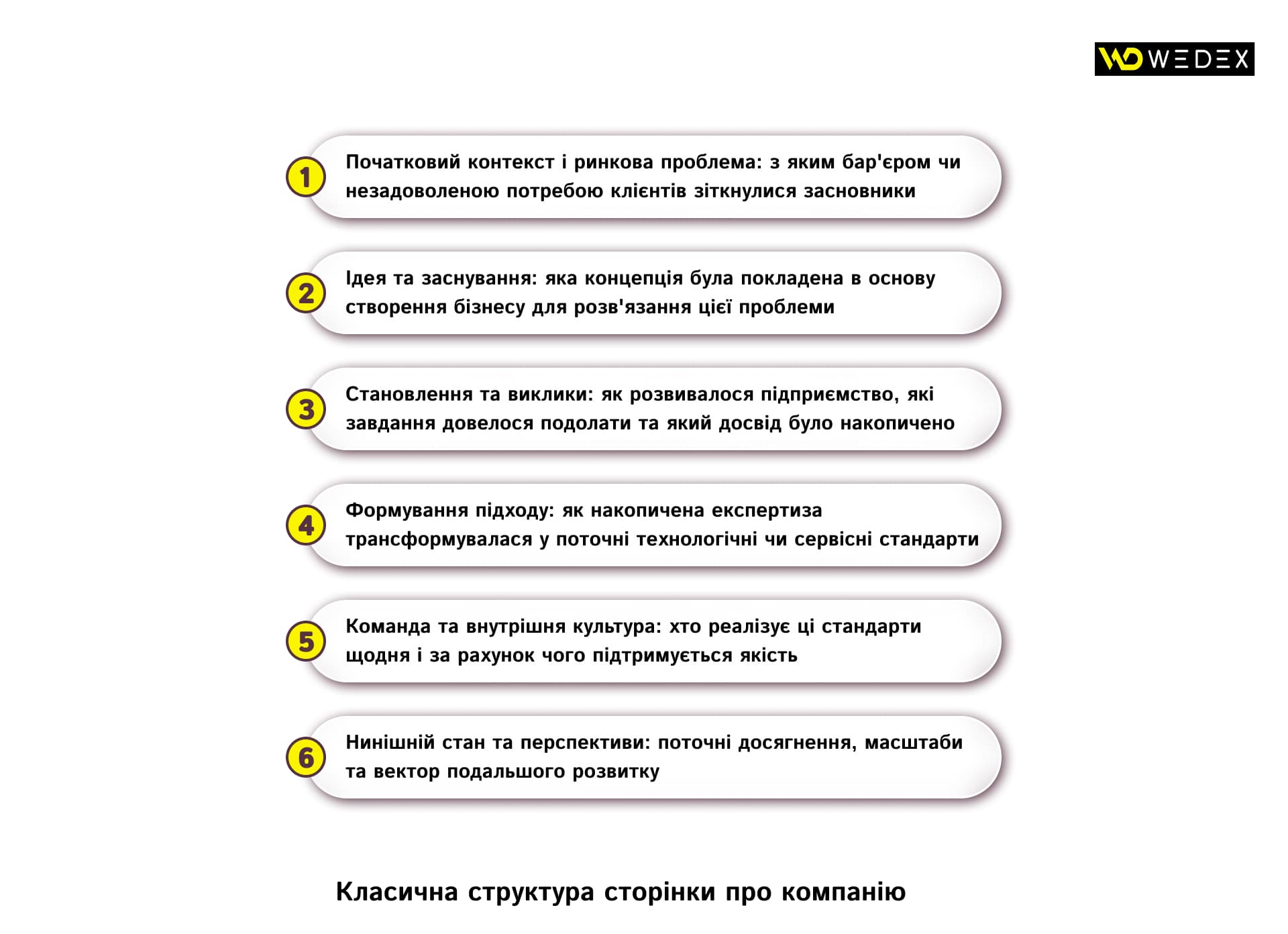
The narrative structure always depends on the specifics of the business. For a young startup, the main focus is on an innovative idea and the flexibility of the solution to the problem. For a mature manufacturing company, the focus is on the evolution of its capabilities, stability, and standards proven over the years. For a service or technology business, the emphasis is on the depth of the team’s expertise and its ability to adapt quickly to market demands.
To better understand how dry information is transformed into a meaningful story, let’s look at two hypothetical examples.
Example 1
A manufacturer of building materials |
|
|
Dry description of facts |
A Meaningful story |
|
«Our company was founded in 2012. We manufacture facade panels and thermal insulation. We have our own factory, modern equipment, and a large warehouse. Our products meet quality standards, and our prices are the most competitive on the market». |
«In 2012, we started out as a distributor of imported facade materials. Over time, it became clear that most foreign panels were not designed to withstand the extreme temperature fluctuations of our climate after 3–4 years, the coating would crack. This prompted us to establish our own production facility. We developed a composite formulation with added reinforcing fibers and launched an automated pressing line. Over the past 12 years, the company has manufactured more than 1.5 million square meters of panels for 450 projects across the country, guaranteeing the structural integrity of the facade for 25 years». |
Example 2
E-commerce logistics company |
|
|
Dry description of facts |
A narrative story |
|
«We are a leading logistics operator. We provide fulfillment, warehousing, and delivery services for online stores. We ensure fast order processing, high accuracy, and a personalized approach to each client». |
«The project grew out of our own pain points in retail: during seasonal sales, our own stores lost up to 15% of orders due to delays at our partners’ warehouses. In 2018, we decided to build a logistics complex focused on the automated sorting of small-item goods. Thanks to the implementation of our in-house WMS system, the time from the moment a purchase is placed on the website to the completion of the package has been reduced to 11 minutes. Today, the 8,000-square-meter warehouse serves 120 online stores, processing over 25,000 shipments daily with a picking accuracy of 99.8%». |
Both examples demonstrate how specific background stories and metrics create a compelling context rather than simply listing standard benefits.
What elements should be added to the «About us» page
The page’s core text should be supported by high-quality visuals and functional elements. Understanding how to design a «About us» page involves selecting meaningful sections that make the information easier to digest and reinforce every word spoken. Let’s look at the key design elements.
- Photos of the team and management.
Real photos of key specialists, top managers, and employees performing their tasks. This eliminates the sense of anonymity, demonstrates the company’s transparency, and humanizes the brand. Using stock photos featuring foreign models creates a sense of insincerity.
- Timeline.
An interactive or static timeline featuring key milestones, such as the opening of new branches, the launch of production lines, and entry into new markets. It demonstrates the company’s growth trajectory and stability.
- Featured blocks with facts and figures
Measurable metrics presented in separate boxes: number of completed projects, warehouse space, engineering staff, geographic coverage, etc. These blocks are easy to read at a glance.
- Certificates, licenses, and awards.
A gallery of documents certifying the right to perform work, compliance with international quality standards, or achievements in professional competitions. This is an important factor in mitigating risks in the B2B segment.
- Portfolio and project results.
Concise showcase pages for completed projects or case studies with links to detailed descriptions. They shift the conversation from theory to practice.
- Testimonials from clients and partners.
Quotes from real clients, including their names, job titles, and company logos. Official letters of appreciation on company letterhead inspire the highest level of trust.
- Video content.
A short promotional video, a tour of the production facility, or a clip of the founder speaking. Video allows you to convey the atmosphere and scale of your operations in just a few minutes.
- Information on geography and infrastructure.
Service area maps, photos of offices, laboratories, or showrooms with exact addresses.
- Links to social media and media outlets.
Mentions in industry-specific media or active corporate pages that demonstrate the brand’s public engagement and transparency.
- Call to action (CTA).
A closing section with an invitation to take the next step download a detailed presentation, sign up for a tour of the facility, or request a quote.
It’s important to note: you don’t need to include all of these elements on a single page. The structure of the «About us» page should be flexible and tailored to the specifics of your niche, available photo and video materials, and verified facts.
How to format text so it actually gets read
The vast majority of visitors do not read solid blocks of text word for word; instead, they scan the page with their eyes in search of key points. For the text about the company to be read, it must be properly formatted and free of visual clutter.
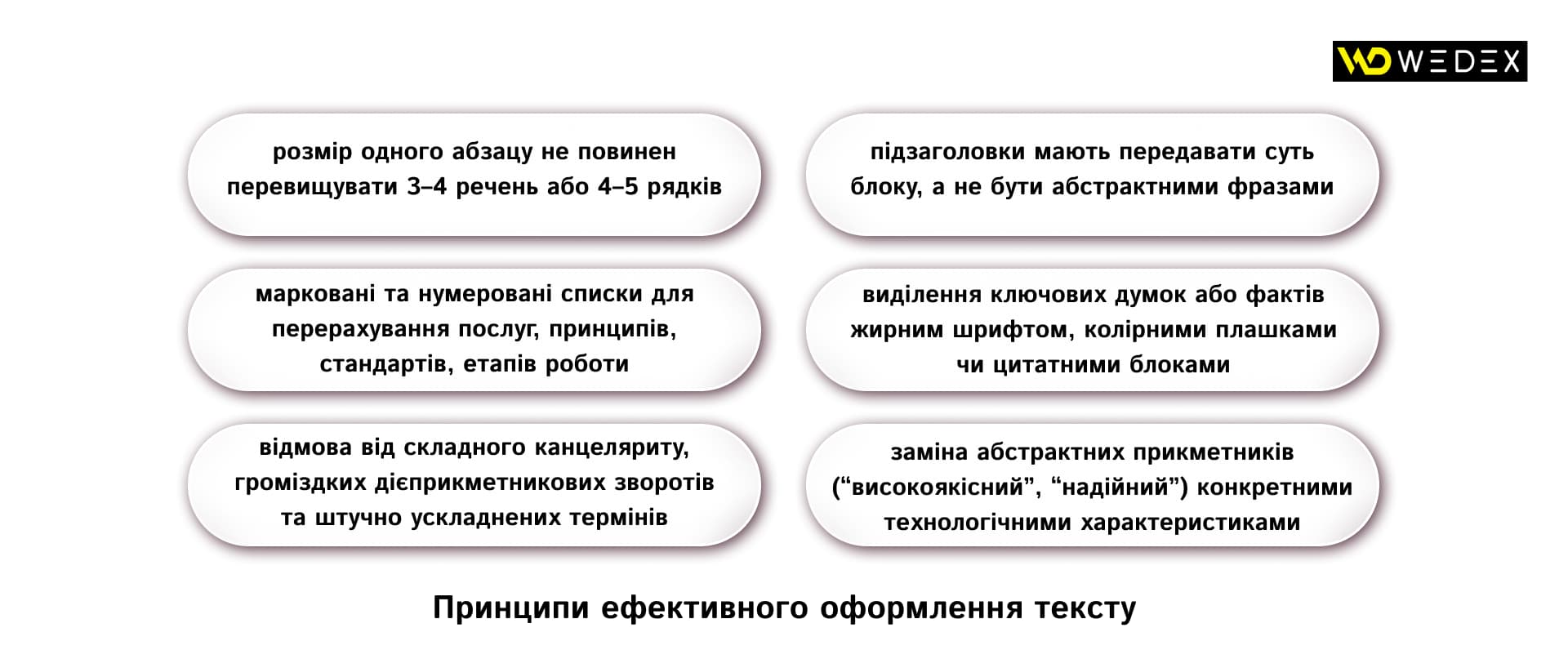
A separate issue when writing is excessive «we-centrism». When a description follows the pattern of «we created», «we offer», «we are proud of» the text turns into a self-indulgent monologue with no room for the client’s interests.
Shifting the focus is achieved by presenting information through the benefits to the client and objective facts.
|
The «We-Centric» approach |
Factual approach (benefit-oriented) |
|
We use only the best state-of-the-art equipment from leading brands. |
Parts are machined on Mazak 5-axis milling machines with a precision of 0.005 mm. |
|
We offer top-notch service and care about every customer. |
Each project is assigned a dedicated engineer who provides with weekly reports and remains in contact. |
|
We pride ourselves on fast delivery of goods throughout the country. |
Shipments are made within 3 hours of order confirmation using our own fleet of vehicles. |
Thanks to this rewriting, the text loses its tone of self-praise and becomes a compelling argument in favor of collaboration.
SEO for the «About us» page
Attempting to turn the «About Us» section into a platform for active SEO promotion using commercial keywords often results in a loss of readability and a drop in conversion rates. This page primarily serves to build reputation and trust, so SEO should play only a supporting role here.
Best practices for SEO optimization of the page:
- brand-related queries: the page is the primary destination for search queries related to the company’s name, its founders, reviews, and reputation;
- Geographic and niche targeting: Naturally mentioning the company’s field of activity and region (for example, «design bureau in Lviv») helps search engines accurately categorize the site;
- natural text: avoid inserting direct commercial phrases such as «buy a machine tool, price in Kyiv». Key phrases should be organically woven into the narrative about the company’s history and approaches;
- Technical meta tags and microdata: It is highly valuable to correctly fill out the Title and Description tags, H1–H3 headings, and implement microdata (Schema.org/Organization), which includes contact information, business details, and social media profiles.
The main SEO rule for this page: content is created for real readers and to earn their trust, while search engines merely index properly structured information.
And remember! Instead of treating the «About Us» section as a one-time task during website development, treat it as an annual «brand reality check». Conduct a simple test: have someone outside your industry or a new client read this page and ask what exactly they remember about your approach. If the response consists only of clichéd phrases about «reliability and high-quality service», that’s a clear sign the page lacks fresh facts and an emotional connection. Regularly reviewing and updating this section isn’t just about website maintenance it’s also a great opportunity for the team itself to periodically pause, reassess its own benchmarks, and clearly document the new milestones your business has achieved over the past year.

commercial offer
Other articles by the author

24/09/2026
While feeds were previously viewed as a purely technical feature for running contextual ads in Google Ads, today their quality directly determines the share of impressions across all sales channels.

26/10/2026
The effectiveness of inbound marketing is based on an understanding of exactly how consumers make their choices. This process is rarely strictly linear.

16/06/2026
Performance marketing is an approach to promotion in which the primary goal is not abstract reach, but a specific and measurable result.
Latest articles by #SEO
29/10/2026
Effective business storytelling structures information in such a way that the reader can sense the brand's evolution and the logic behind its decisions.
26/10/2026
The effectiveness of inbound marketing is based on an understanding of exactly how consumers make their choices. This process is rarely strictly linear.

20/10/2026
Ben Hunt's model is a tool that helps break down a customer's path to purchase based on their level of awareness and select the right messages for each stage.