

 16/06/2026
  1435
1435

Інтернет-маркетинг
простою мовою
Content of the article
- /01 What is performance marketing
- /02 How performance marketing differs from traditional marketing
- /03 How performance marketing works within the sales funnel
- /04 Key performance marketing channels
- /05 Key performance metrics
- /06 How to build a performance strategy
- /07 What you need to prepare before launch
- /08 When performance marketing delivers the best results
- /09 Common mistakes that reduce effectiveness

What is performance marketing: a complete guide to results-driven marketing

Performance marketing has become particularly important for businesses in an environment where every advertising dollar must be controlled and its results understood. Companies increasingly expect not just a presence in the media space, but measurable action: leads, purchases, registrations, or other conversions that can be linked to advertising and subsequent revenue. That is why approaches where campaign goals, results tracking, and optimization work as a unified system are particularly valued today.
In this article, we’ll explore what performance marketing is, how it differs from the traditional approach, how it works within the sales funnel, and why it doesn’t deliver full results without the right analytics. We’ll also focus on key metrics, the logic behind strategy development, and how businesses can assess their readiness to launch such campaigns.
What is performance marketing
Performance marketing is an approach to promotion in which the primary goal is not abstract reach, but a specific and measurable result. This could be a sale, a lead, a phone call, a registration, a subscription, or any other action that is important to the business. The essence of the approach is that campaigns are evaluated based on how well they drive the desired action, not just on how many people saw the ad.
In practical terms, performance marketing relies on three things:
- a clearly defined business goal;
- accurate conversion tracking;
- continuous optimization.
If a company cannot measure user behavior, the advertising system does not have enough data to effectively learn and improve results. That is why official Google Ads and LinkedIn tools structure their work around the selected goal, conversions, and results, which must be tracked separately.
How performance marketing differs from traditional marketing
Performance marketing and traditional marketing should not be viewed as mutually exclusive approaches. Both help businesses grow, but they operate with different goals and evaluate results differently. While traditional marketing is often aimed at building brand awareness, trust, and a long-term brand image, performance marketing focuses on specific, measurable actions: leads, sales, sign-ups, or other business outcomes.
To better understand the difference between these approaches, let’s examine them based on key criteria.
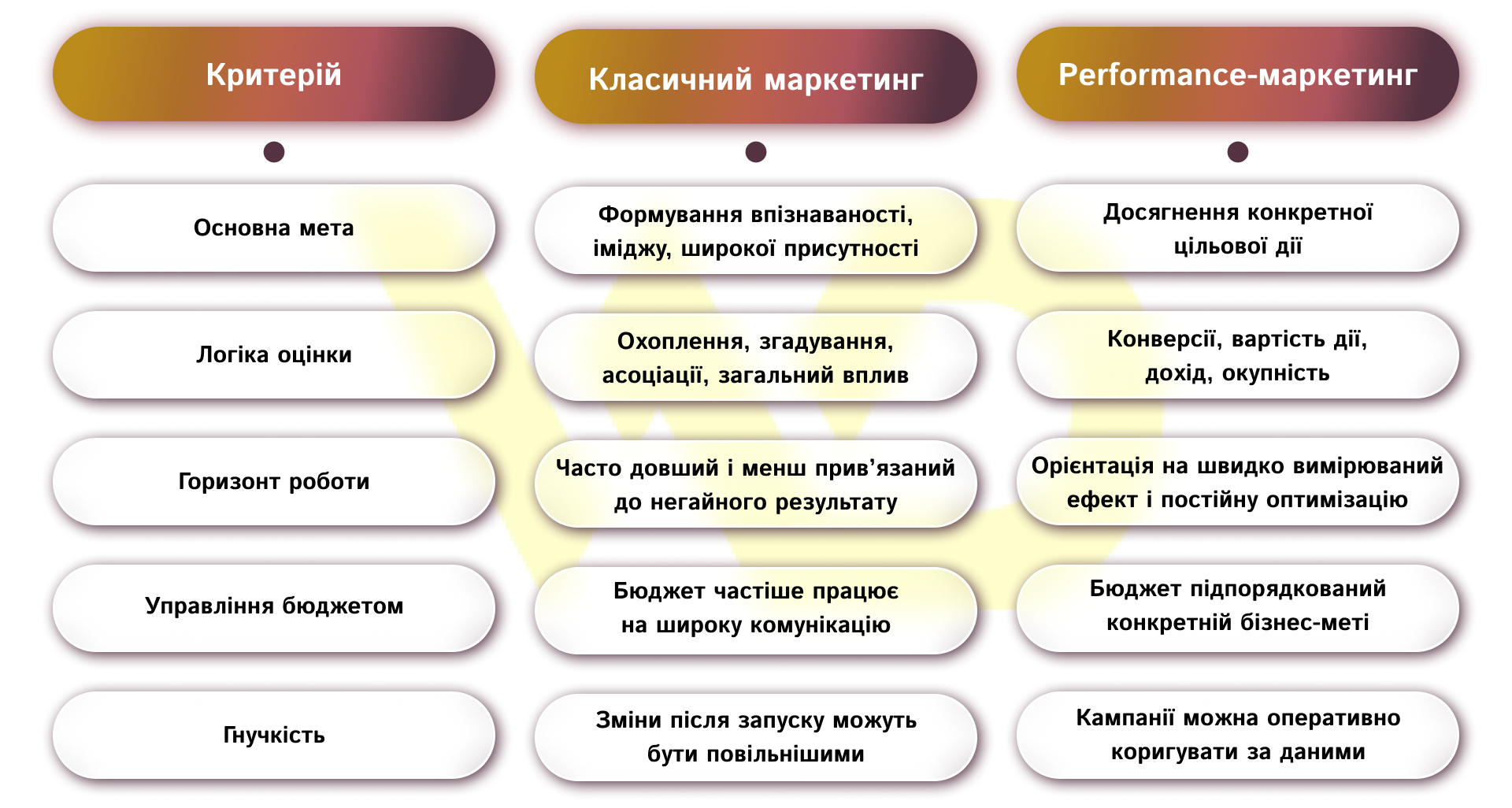
The performance approach does not negate traditional marketing, but rather shifts the focus: instead of general visibility, the emphasis is placed on a specific, measurable result. That is why it is important to define the campaign’s goals in advance on advertising platforms and focus on actions that truly add value to the business. In this model, advertising becomes not just a way to promote yourself, but a tool that can be evaluated through real metrics and adjusted as needed.
In other words, the difference between these approaches lies not in which one is «better,» but in the specific problem it solves.
How performance marketing works within the sales funnel
Performance marketing does not exist separately from the sales funnel it operates right within it. Let’s break down this process step by step.
First contact with the brand
At the beginning, a person is just getting to know the company, product, or service. Their attention is still unstable, so you shouldn’t push for a sale right away. Instead, it’s important to explain briefly and clearly what value the offer brings and why it might be useful right now.
Comparison and consideration stage
Once interest has been piqued, the user begins to compare options, look for details, and assess whether the brand can be trusted. At this point, a clear information structure, strong arguments, examples, social proof, and a simple path to the next step become particularly important.
Decision-making stage
The most important stage of the funnel is the moment when a person is almost ready to take action. Here, convenience, persuasiveness, and the absence of unnecessary barriers become decisive. If the form is too complicated, the offer isn’t convincing, or the page loads slowly, even an interested user may not complete the conversion.
After conversion
The work doesn’t end at the moment of the application or purchase. In many niches, it is the subsequent interaction that determines the real value of the customer:
- repeat purchases;
- additional inquiries;
- returning to the brand;
- referrals.
That’s why performance marketing looks beyond a single action it evaluates the entire user journey and how effectively the business supports them at every step.
This is precisely where the power of performance marketing lies: it doesn’t just bring people into the funnel, but helps build it so that every stage works toward the result.
Key performance marketing channels
In the performance approach, channels are chosen not based on the principle of «that’s where everyone is right now», but on their ability to drive the user to a specific action at every stage of the funnel.
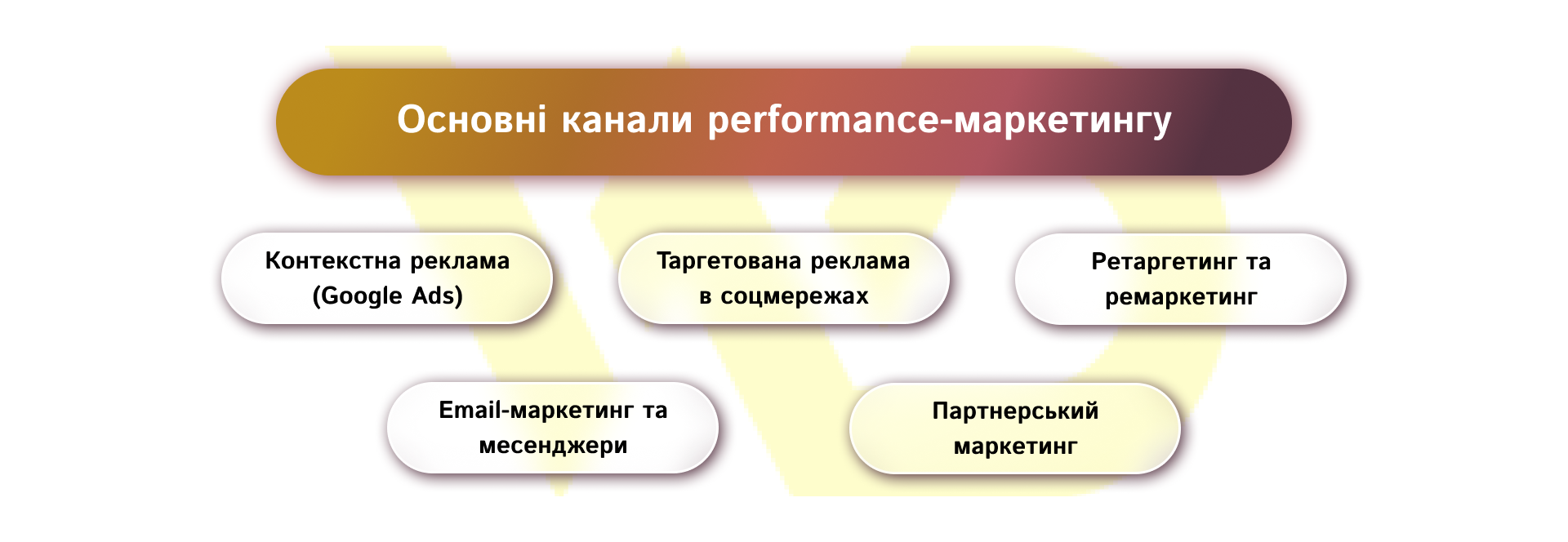
- Contextual advertising (Google Ads). The #1 tool for working with high demand. The user is already searching for a specific product or service in the search engine, so the likelihood of conversion is highest here. This also includes product campaigns (Performance Max), which automatically display products across various Google services.
- Targeted social media advertising (Meta Ads, LinkedIn Ads). Works with both cold and warm leads. Allows you to reach audiences based on demographics, interests, behavior, or job titles. Visual content and the precision of the offer play a key role here.
- Retargeting and remarketing. A «catch-up» advertising strategy. It brings people back to the site who have already interacted with the brand for example, added an item to their cart but didn’t buy it. Since the audience is already familiar with the product, the cost per conversion is usually the lowest here.
- Email marketing and messengers (CRM marketing). A channel for working with an existing customer base. Automated email sequences or messages in chatbots help nurture leads, stimulate repeat sales, and extend the customer lifecycle without additional costs for buying traffic.
- Affiliate marketing (Affiliate / CPA marketing). A model in which a company pays third-party partners, such as webmasters or bloggers, exclusively for acquired customers or completed target actions.
Most often, marketers combine several tools to capture both immediate demand and win over those who are on the fence.
Advertising that delivers results
The WEDEX team sets up Google Ads and social media ads, configures retargeting, and optimizes campaigns so you get more qualified leads.
Key performance metrics
In performance marketing, there is no room for subjective opinions like «I like this banner». Numbers are what matter. To understand how effectively every hryvnia is spent, marketers track a system of interconnected metrics.
|
Metric |
What it means |
Why it matters |
|
CTR |
Ad click-through rate. |
Shows how much the creative and text engaged the audience. |
|
CPC |
Cost per click. |
Helps assess the level of competition in the auction and the appeal of the ad. |
|
CPL |
Cost per lead (contact). |
Shows how much it costs the business to receive one completed form or phone call. |
|
CPA |
Cost per action (e.g., a purchase or subscription). |
The main performance metric for a specific campaign. |
|
CR |
The conversion rate of a landing page or ad. |
Shows what percentage of users completed the target action. |
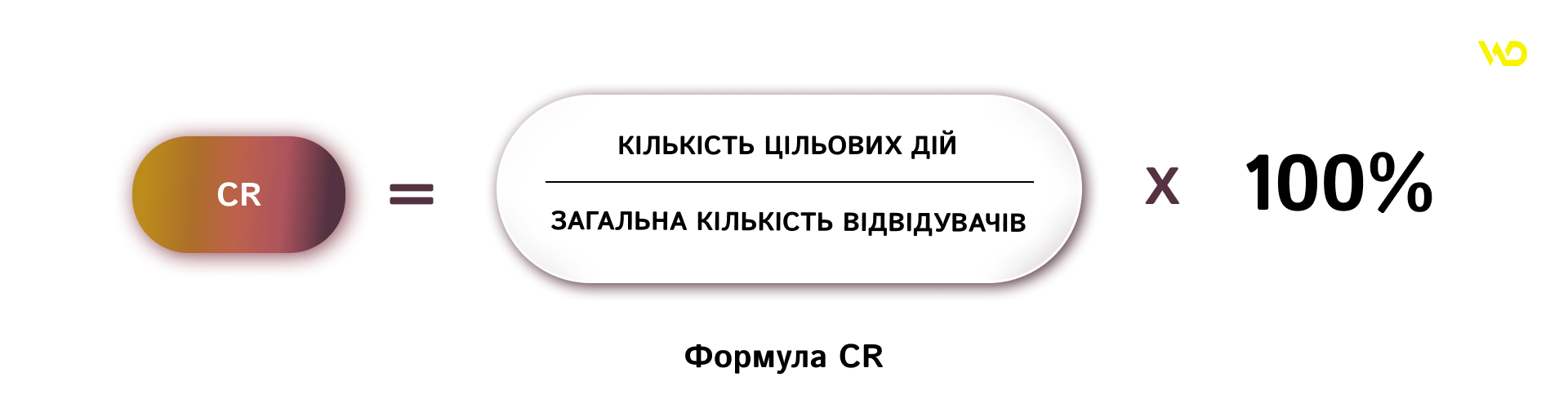
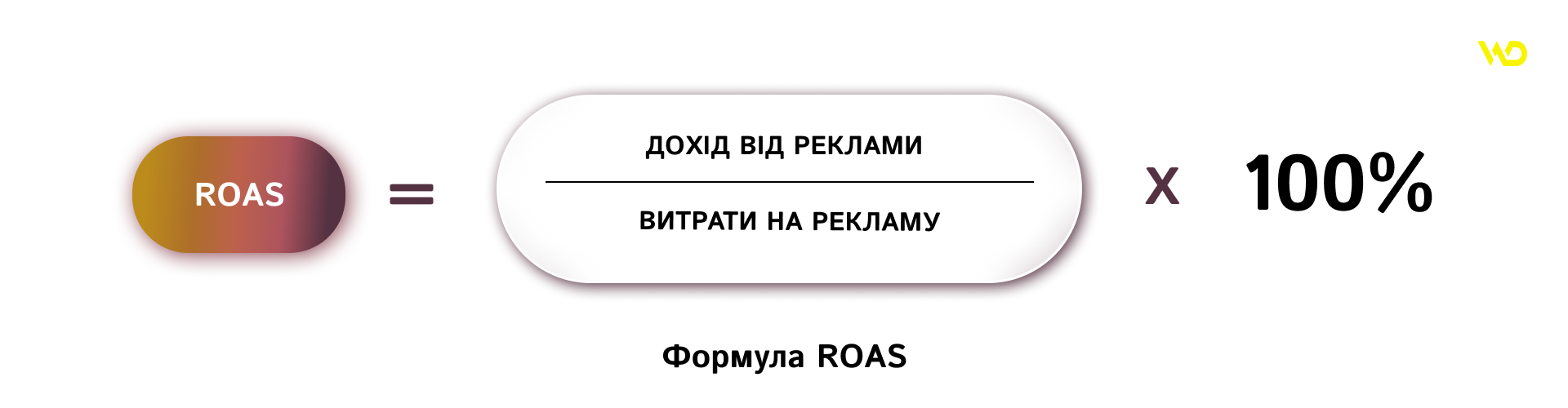
To calculate ROI and financial performance, analysts use formulas for key business metrics.
- CR (Conversion Rate)
- ROAS (Return on Advertising Spend). Shows how many hryvnias of revenue were generated for every hryvnia spent directly on advertising.
- LTV (Lifetime Value). The total profit a company receives from a single customer over the entire duration of their relationship. If the customer acquisition cost (CAC) is higher than the customer’s LTV, the business is operating at a loss.
When analyzing these figures, it’s important to remember the main rule of the performance approach: no metric is considered in isolation. A high CTR (click-through rate) makes no sense if the website’s conversion rate (CR) is zero, and clicks that are too cheap (CPC) often attract a non-target audience that doesn’t buy anything. All these indicators are links in a single chain. The marketer’s task is to view this picture holistically and manage campaigns so that optimizing individual metrics always leads to growth in the main result actual profit in the company’s account.
How to build a performance strategy
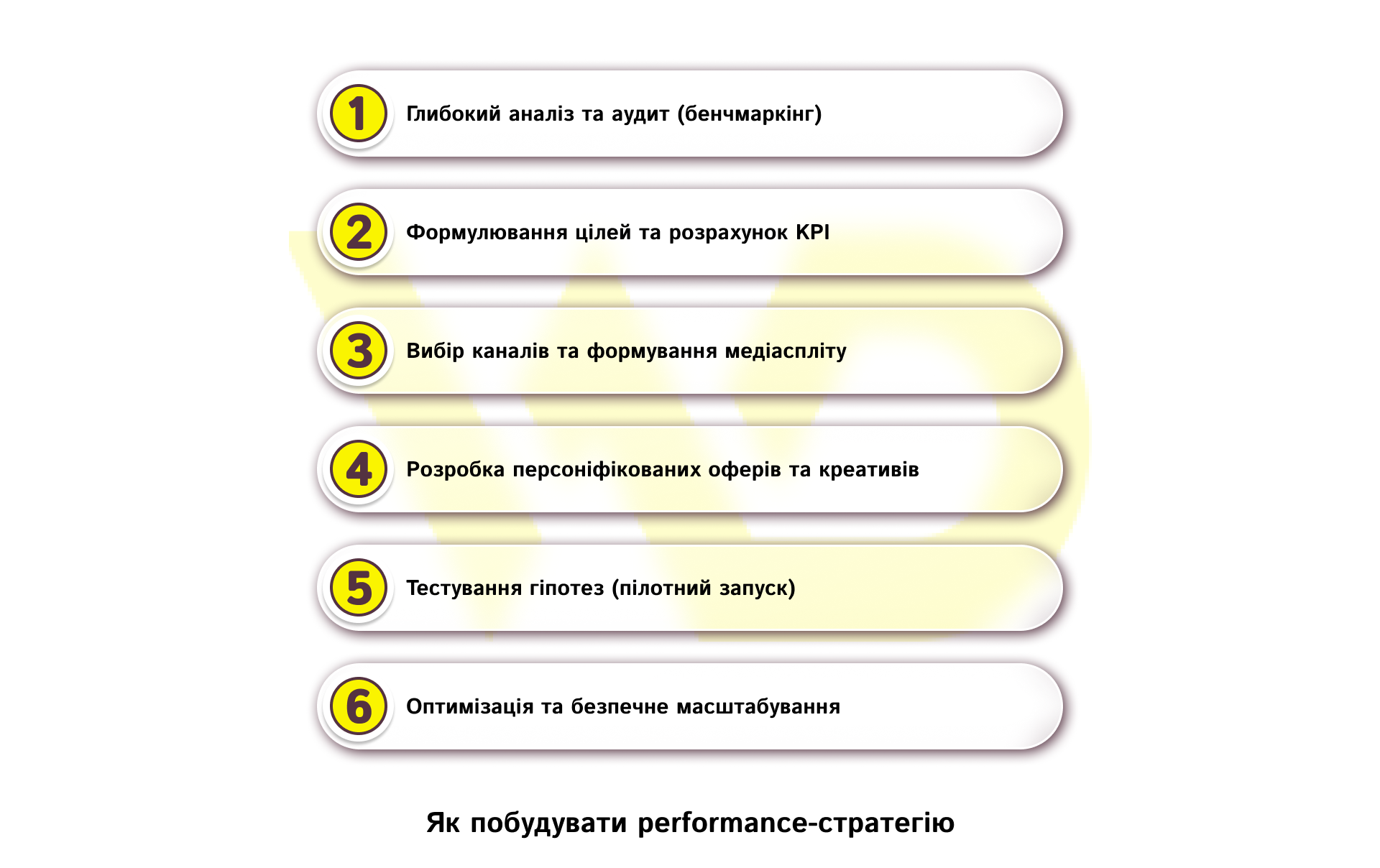
A strategy in performance marketing is a clear framework where every step is guided by math and business results. Creating such a system consists of six sequential steps.
In-depth analysis and audit (benchmarking)
Before launching an ad campaign, you need to assess the current state of your business’s «foundation», analytics, and unit economics. At this stage, marketers analyze competitors using services like Similarweb or the Meta Ad Library to understand their offers and traffic sources. A technical audit of the website is also conducted: they look for gaps where users are being lost. For example, if the mobile version takes longer than 3 seconds to load, the business is guaranteed to lose up to 50% of mobile traffic before users even get to know the product.
Formulating goals and calculating KPI
Goals must be clear and quantified using the SMART methodology. The customer acquisition cost (CAC) at which the business remains profitable is calculated. Example of a proper goal: «Generate 500 initial sales with an average order value of 2,500 UAH at a customer acquisition cost (CPA) not exceeding 450 UAH over the next 30 days».
Selecting channels and creating a media mix
The budget is allocated based on where the target audience is located and at what stage of the demand funnel they are. For e-commerce, a classic media mix might look like this:
- 50% — Google Shopping (product ads for high demand);
- 35% — Meta Ads (social media for demand generation and lead generation);
- 15% — retargeting those who left without making a purchase.
In the B2B sector, the focus shifts to search ads, LinkedIn, and content marketing.
Developing personalized offers and creatives
A single «one-size-fits-all» banner no longer works. A unique creative matrix is created for each target audience segment, addressing the user’s specific pain points. The modern performance standard is the use of dynamic creative optimization (DCO), where the system automatically combines different headlines, descriptions, and images to select the best option for each individual user.
Hypothesis testing (pilot launch)
At the start, a test budget is allocated, typically amounting to 10–20% of the total budget. Campaigns run for a limited period, ranging from 7 to 14 days. The main goal of this stage is not immediate super-profits, but rather the collection of initial statistics. Meta or Google’s ad algorithms need to reach a critical mass of conversions (typically, at least 50 target actions per ad group per week) in order to learn and stabilize the cost per lead.
Optimization and safe scaling
Based on the collected data, marketers pause ads and audiences that aren’t delivering results or make the lead cost too high. The budget is redirected to effective channels. An important rule of scaling: budgets for successful campaigns should be increased gradually no more than 15–20% every 2–3 days. If you double the budget abruptly, the ad system algorithms will reset their learning, the auction will overheat, and the cost per conversion will skyrocket.
Building a performance strategy is not a linear process with a final endpoint, but a cyclical spiral. After completing the scaling phase, the team analyzes the new data and returns to the first step, but at a higher level using actual figures from their own dashboard rather than assumptions. It is this continuous cycle that allows a business to transform marketing from a risk area into a predictable source of revenue.
What you need to prepare before launch
Performance marketing does not tolerate chaos. If you drive traffic to an unoptimized website, you’re simply giving money away to ad networks. Let’s look at what needs to be set up before launch.
- Web analytics. An integrated and verified Google Analytics 4 (GA4) system. All macro- and micro-conversions (phone clicks, form submissions, adding to cart) must be tracked accurately.
- Ad pixels and tracking codes. The website must have Meta Pixel, Google Ads Conversion Tracking, and other tags from the platforms you plan to use installed. This is necessary for building retargeting audiences and training algorithms.
- Ready-to-go landing pages. Verified website loading speed, mobile responsiveness, and user experience (UX). The text on the page must clearly match the offer the user sees in the ad.
- Technical access and accounts. Business Manager (Meta) and Google Ads accounts created and verified; payment methods configured.
- Target audience data and CRM integration. Up-to-date information on current customers (database of phone numbers or emails) is required to create lookalike audiences. It is recommended to set up lead transfer from the website directly into the sales department’s CRM system.
Important! If a sales manager takes two days to process an ad lead, performance marketing is not to blame for the lack of profit. End-to-end analytics must link the ad click to the final transaction in the CRM.
When performance marketing delivers the best results
The performance approach is a powerful tool, but it is not a universal cure-all for all business problems. It works best where the user’s path to purchase is clear and demand is already established.
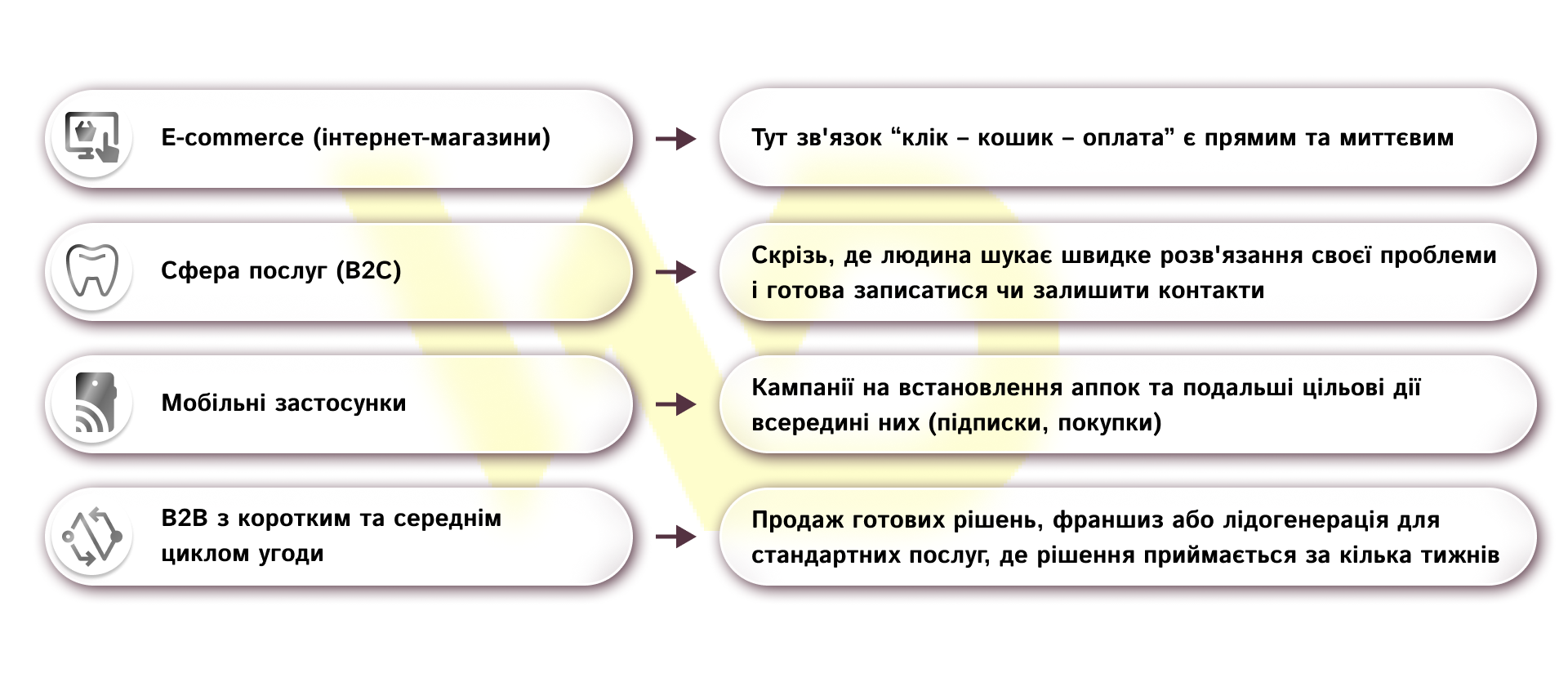
The approach demonstrates maximum effectiveness in the following niches:
However, in these cases, the results will be weaker or take longer:
- Startups with a fundamentally new product. If people aren’t yet aware of your technology, they won’t search for it on Google. First, you need to create demand through traditional marketing (reach, media placements, bloggers), and only then bring in performance marketing.
- Complex B2B or Enterprise segments. If the sales cycle lasts from 6 months to a year, and decisions are made by the board of directors, performance advertising will help establish the initial contact, but the final result will depend on the sales team’s efforts and the long-term building of trust.
- The luxury segment and emotional brands. Purchasing supercars or premium jewelry rarely follows the «saw a banner — submitted a request» pattern. Here, the brand’s image and prestige play a primary role.
So, we see that performance marketing delivers maximum results when advertising systems work with already established and clear demand. The key is to clearly assess the stage your business is at right now.
Common mistakes that reduce effectiveness
Even a meticulously developed performance strategy can prove ineffective during implementation. Let’s examine six key execution errors that negate the benefits of this approach and lead to inefficient budget allocation.
Incorrect web analytics setup
In performance marketing, analytics is the foundation for making any decisions. If Google Analytics 4 tags or other tracking tools are configured incorrectly for example, if transactions are duplicated or micro-conversions aren’t recorded advertising system algorithms receive distorted data. As a result, artificial intelligence optimizes campaigns for the wrong target actions, leading to inefficient budget spending.
Low landing page conversion rate
High-quality traffic is only half the battle. If a user clicks on a relevant ad and lands on a site with slow loading times (over 3 seconds), an inconvenient mobile version, or an overloaded order form, they will leave the page without taking any action. In this case, the problem lies not in the quality of the ad setup, but in technical and UX barriers on the website itself.
Single-factor evaluation of campaign effectiveness
Attempting to evaluate results based solely on intermediate metrics, such as a high CTR (click-through rate) or low CPC (cost per click), is a common mistake. Ads with a low cost per click can drive a large volume of non-targeted traffic that does not convert into sales. In contrast, campaigns with a higher cost per click often demonstrate a higher ROAS. Evaluation must be comprehensive and focused on the final financial result.
Lack of systematic testing
Marketing hypotheses and creatives tend to quickly lose relevance due to audience «burnout». Without regular testing of new formats, headlines, offers, and targeting, campaign effectiveness inevitably declines. A performance-driven approach requires a continuous search for new effective connections and constant content updates.
Incorrect choice and inconsistency of KPIs
Focusing exclusively on quantitative metrics, such as «maximum number of cheap leads (CPL)», often harms the business. Ad systems optimize campaigns for a given parameter, but the leads generated may turn out to be irrelevant to the sales department. Key marketing metrics must be directly aligned with real business metrics and revenue.
Premature conclusions and campaign termination
Modern advertising platforms operate on the basis of machine learning, which requires time (the so-called «learning window») and the accumulation of a certain number of conversions to stabilize the cost of the target action. Making radical changes or pausing a campaign 24–48 hours after launch disrupts the algorithms and prevents the campaign from reaching its planned targets.
Avoiding these mistakes allows you to build a predictable system where every optimization step is based on accurate data, not subjective assumptions.
And success in performance marketing ultimately rests on three pillars:
- having a clear and quantified business goal;
- flawlessly configured analytics;
- a team’s willingness to constantly experiment and improve results.
This isn’t magic or a lottery it’s consistent work with data. The moment you stop viewing marketing as an expense and start seeing it as a managed investment, your business moves to a whole new level of scalability.

commercial offer
Other articles by the author

19/06/2026
Crowd marketing involves placing useful, organic mentions of a brand, product, or service on platforms where your audience is already engaging.
10/09/2026
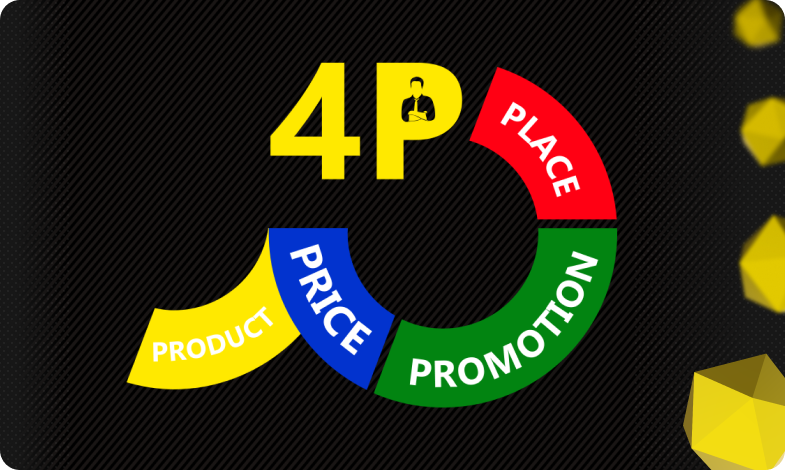
The 4P model serves as an architectural foundation that transforms disparate marketing activities into a single, manageable system.

08/07/2026
Donor analysis isn't about examining a single metric; it's about comparing several metrics against one another.
Latest articles by #Useful tips
16/09/2026
Choosing between search engine optimization and pay-per-click advertising is one of the most critical decisions when developing a marketing strategy.

04/09/2026
When two different users search for the exact same word in a search engine, they may get completely different lists of web pages, and the websites themselves are constantly changing their positions in the search results.

02/09/2026
Guest blogging remains one of the most effective tools for promoting a business, yet there are still many misconceptions surrounding it.