

 08/07/2026
  1247
1247

Інтернет-маркетинг
простою мовою
Content of the article
- /01 Metrics that lie on their own
- /02 A network, not a single website
- /03 Check the hosting: when the metrics differ but the address is the same
- /04 Domain history: what the wayback machine hides
- /05 Price and quality — where’s the truth, and where’s the trap
- /06 Anchor text as a detector
- /07 Technical integrity: redirects and more
- /08 Niche context: when the problem isn’t on your end
- /09 Why you shouldn’t disavow everything
- /10 Checklist before choosing a donor

How to analyze donors and avoid falling for PBN scams
Buying links is easy. Buying a good link is much harder. And this is where most specialists make the same mistake: they look at a single metric most often DR and stop there. But DR can be faked. Traffic can be faked. Even a «not spam» label from a tool guarantees nothing, because no service actually knows for sure whether it’s spam or not it’s just a guess.
This is where we need to pause. Analyzing a link source isn’t about checking a single metric; it’s about comparing several metrics against each other. Each one can be misleading in its own way, but together they almost always reveal a fake. Let’s figure out what to look for, where the pitfalls are, and how to avoid buying a number instead of a link.
Metrics that lie on their own
Let’s start with the basics: no tool has — or intentionally creates — a single «spam score». Ahrefs explicitly states this in its help documentation: they don’t provide a specific toxicity metric because it’s unclear exactly which factors Google considers—and with what weight—when evaluating a link, and Google doesn’t disclose its criteria in detail. Another article in this help center puts it even more bluntly: DR or UR on their own is never sufficient grounds to determine whether a link source is toxic or not.
In other words, if you see a DR of 60 and think, «Oh, this is a good link source» you’ve already made a mistake in your approach, even if the number itself is correct. Let’s break down why each metric on its own is unreliable.
- DR is calculated based on the number and weight of links pointing to the donor site itself. If the donor is part of a closed network where ten sites link to each other in a circle, the DR increases artificially, with no relation to its actual authority in the eyes of real people.
- Traffic can be inflated with bots, or it can be earned honestly — and on the surface, these two situations look the same until you look deeper: Is the distribution of traffic by country logical? Is the distribution across pages natural? Does traffic grow gradually or in a single spike?
- The number of keywords can also be misleading. A site might rank for a thousand keywords at positions 90+ — which, in reality, don’t bring a single visitor — and while the metric «keywords: 1,000» looks impressive on paper, it has zero real value.
- Domain age is a whole other story. An older domain inspires trust, which is precisely why expired domains are bought and filled with spam: the age remains, but the site inside has long since changed.
- Another metric that’s often overlooked is the ratio of the number of links to the number of unique donor pages. A donor that gave you one link from a single page and a donor that gave you thirty links from thirty different pages on the same site are both counted as «one donor» in many reports. But the value is completely different: thirty links from a single domain almost always means that someone has placed you in a template that repeats on every page of the site (footer, sidebar, category footer), rather than mentioning you in the content intentionally. One high-quality contextual link is worth more than ten template-based ones.
The conclusion is simple: always check several metrics together, not just one. If the DR is high but traffic and keywords are zero something’s wrong. If there’s traffic but the country distribution is absurd (a site with Cyrillic-language content gets 90% of its traffic from Indonesia) something’s wrong. A single metric never provides an answer—only questions.
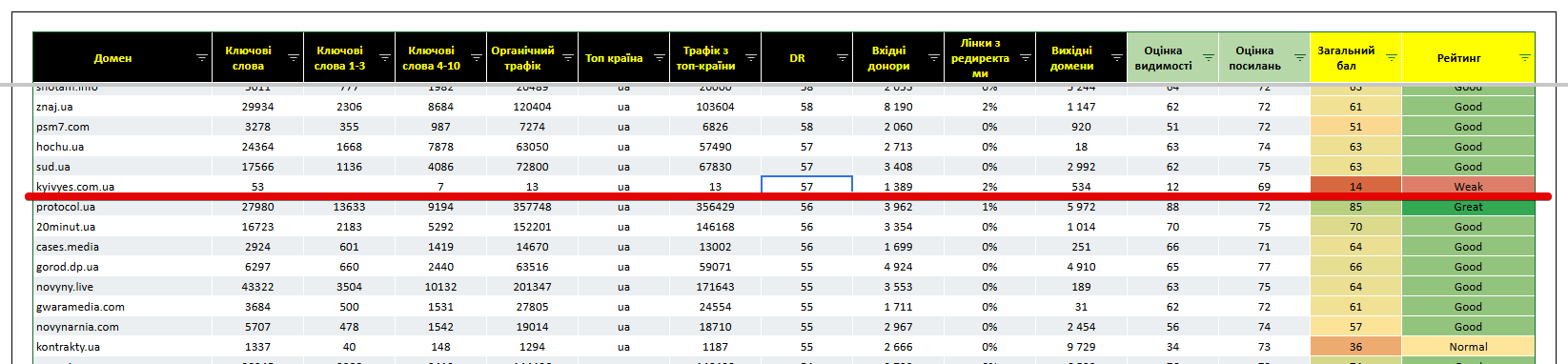
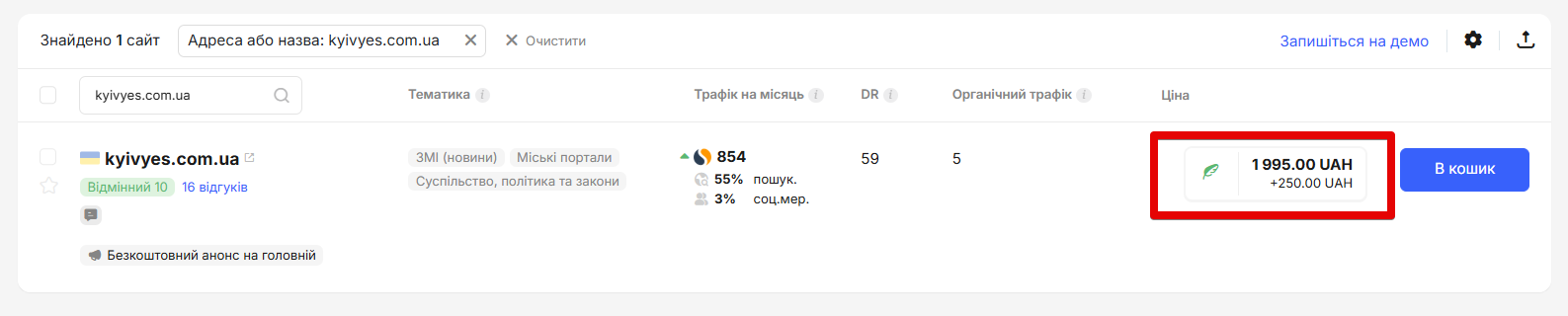
Take note! With a DR of 57, this donor has virtually no traffic or keyword queries. And don’t be lazy — check the price Collaborator is asking for placement on this «promising» domain; you’ll be surprised.
Okay, you probably won’t look anyway, so here it is — 2,000 UAH for an «empty» donor:
A network, not a single website
The easiest way to spot a PBN is not to analyze a single site, but to look at several potential donors at once. A PBN (private blog network) is a group of sites that link to each other and to the network’s clients, and it is precisely this cyclical nature that is their weakness.
Here’s how it looks in practice. You’re reviewing a list of twenty potential donor sites, and you see the following:
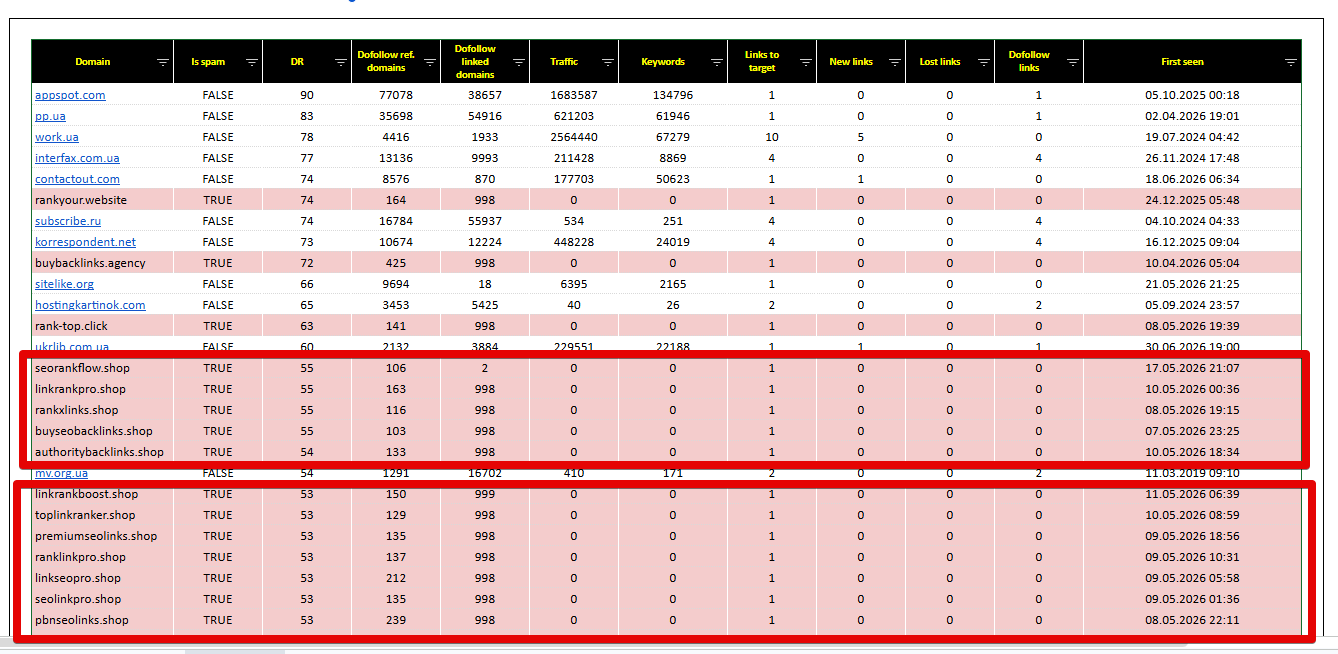
Different names, different URL, yet the DR is consistently close to one, and the number of inbound donors and outbound domains differs by only a few percent, at most. Independent sites that just happen to look similar don’t produce this pattern on the real, organic web, DR and the number of referring sites are always unevenly distributed, because each site grows according to its own history. But here, we have a group of sites that look as if they were created using the same checklist and stuffed with the same set of internal links. This is the hallmark of a single infrastructure serving multiple domains at once, rather than three separate owners. And that’s just the tip of the iceberg!
Another telltale sign of a network is templated domain names. PBN and mass link-building services often churn out domains following the same pattern: some SEO keyword plus a generic suffix, all on non-standard domain extensions like .shop or .store, purchased in bulk. One such domain isn’t particularly suspicious, but ten with the same pattern are a clear signal that the entire group should be investigated.
In terms of content, PBN pages also often look the same: a short piece of text on a random topic, a bunch of ads or stock images, and no connection between the articles on the site. This is described in materials about typical signs of PBN the content exists not for the reader, but so that the page technically has a reason to link somewhere.
Check the hosting: when the metrics differ but the address is the same
Metrics can be tweaked, and text can be written individually for each site, but it’s much harder to obscure the infrastructure. That’s why one of the most reliable checks isn’t done in Ahrefs, but in a standard IP address lookup service.
If several «independent» domains from the list are on the same IP subnet, with the same host, and the same NS records — that’s no longer a coincidence. Google explicitly states that its SpamBrain spam detection system focuses precisely on these infrastructure signals: shared hosting, identical technical fingerprints in backlink profiles, and matching anchor text across the web (more details here). In other words, this isn’t just a «just in case» check it’s the very same principle the search engine itself uses.
It’s easy to check: take the IP of each donor from the list (any «what is my IP» service for a third-party domain will give you this in seconds) and see if the first three blocks of the address are repeated across several «different» sites. If so you’re not looking at twenty separate sites to review, but in fact a single seller who has simply split their network across different domain names.
Domain history: what the wayback machine hides
A domain may have perfect current metrics but a terrible past that no DR or traffic metric will reveal.
A classic scenario with expired domains: the site was a normal, active project for years, then the owner abandoned it, the registration expired, and someone else snapped up the domain specifically for its accumulated backlink profile. The metrics remain almost the same because the old backlinks and the domain’s age don’t disappear, but the actual content of the site can become completely different.
You can check this using the web.archive.org archive, and there are three things to look for.
- Topic consistency. If a domain used to be a dental clinic’s website, then became a shoe store, and is now a casino portal, each change in topic drastically reduces the value of the old links, since they were acquired in a completely different context.
- «Parking» periods. It’s normal to have one or two archived versions with an ad placeholder between owners, but if a domain has been sitting there for years as a blank page with ads rather than as an actual website its backlink profile is mostly junk.
- Frequency of archive snapshots. A popular, active website is archived dozens of times a year, while a domain that was simply registered at some point and never updated has only one or two random snapshots in its entire history (more details on these criteria here).
This check takes a few minutes per domain, but it’s precisely what captures what no digital metric can: whether there’s a real history behind the impressive metrics, or if it’s just an empty shell purchased specifically to build up a backlink profile.
Price and quality — where’s the truth, and where’s the trap
It’s logical to expect that a more expensive donor domain is better than a cheap one. On average, across the market, this is true. But that’s precisely why there are always two types of exceptions hidden within this pattern and both are valuable.
The first type is undervalued domains. A domain with genuinely strong metrics (traffic, keywords, clean reputation) that’s being sold cheaply simply because the owner doesn’t understand pricing or doesn’t know how much their site is actually worth. Such finds are rare, but they offer the best value for money, and it’s worth actively seeking them out rather than buying the first domain that comes along at the right price.
The second type consists of overpriced donor sites. A well-known brand, a recognizable name — and the seller sets the price based on brand recognition rather than actual SEO value. If the metrics of such a site are actually average or weak, you’re paying for the name, not for link equity.
And there’s one more pattern worth knowing. In most donor markets, there’s a «flat zone» — a price range within which quality remains virtually unchanged. Here’s what it usually looks like when you break down a sample of several hundred donors by price range and calculate the average quality score in each:
|
Price Range |
Average Quality Score |
|
0–15 USD |
31 |
|
15–60 USD |
34 |
|
60–120 USD |
58 |
|
120–250 USD |
71 |
|
over 250 USD |
84 |
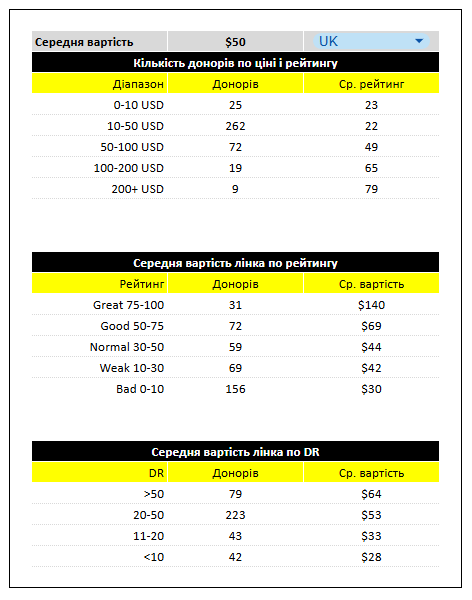
Look at the first two rows. A $15 donor and a $55 donor yield virtually the same score — 31 versus 34. A three- to four-fold difference in price and almost no difference in quality. But between $60 and $120, the score suddenly jumps to nearly double. This is the flat zone: the $10–$50 range in this example almost always represents overpaying for the same level of quality you could get for the lowest price. A real leap in quality begins only at a certain threshold, and this threshold varies in each specific niche. In some cases, it’s $50; in others, it’s a different figure, but you can find it using the same method: break down your sample of donors into price brackets and calculate the average score in each.
Practical takeaway: Before purchasing a batch of donors, it’s worth establishing this price-quality relationship on your own sample, rather than relying on the intuitive assumption that «more expensive is better». The flat zone eats up your budget without delivering results, and the outliers on both sides are exactly where you can either save money or waste it.
Here’s an example from a real analysis in a popular niche:
Anchor text as a detector
Here’s something almost no one pays attention to, but it’s the first thing you should look at the text of the link itself. Anchor text sometimes reveals the linking site more clearly than any digital metric.
Imagine a link whose anchor text doesn’t sound like a mention of your brand or a keyword, but rather like a ready-made advertising slogan, something along the lines of «After using Service X, my traffic grew by 200%». This isn’t a random coincidence of words — it’s promotional text from the link seller themselves, inserted as anchor text on dozens of websites simultaneously, which they also sell as ad placements. In this case, the donor site isn’t just low-quality — it’s actively serving as an advertising platform for someone else’s business, and your site just happened to end up there.
It’s pretty easy to check this. If the anchor text is longer than a typical phrase and sounds like text from a marketing landing page rather than a natural link in an article, that’s a reason to check how many other linking sites are using the same text. If the exact same «review» appears on dozens of domains, it’s no longer a coincidence among different authors — it’s a single template distributed across the web.
Technical integrity: redirects and more
The metrics may be perfect, but the link still won’t work as intended — due to a technical issue on the donor’s end.
The most common issue is a redirect. The link doesn’t lead directly to the target page but goes through one or more intermediate redirects. Google explicitly highlights the category of «sneaky redirects» in its guidelines when different content is shown to the user and the search engine through a chain of redirects. Even if a specific case isn’t that malicious, the mere fact of a long chain of redirects can dilute the link equity passed along, especially if the type of redirect is technically incorrect.
Rule of thumb! If a donor site has a high proportion of outbound links with redirects more than one-third of all outbound links that’s a reason to manually check exactly where these redirects lead and how they’re implemented before paying for placement. Good metrics here aren’t a guarantee; they simply haven’t detected the problem yet.
Niche context: when the problem isn’t on your end
One of the most useful skills when analyzing your own backlink profile is being able to distinguish a personal problem from a widespread one.
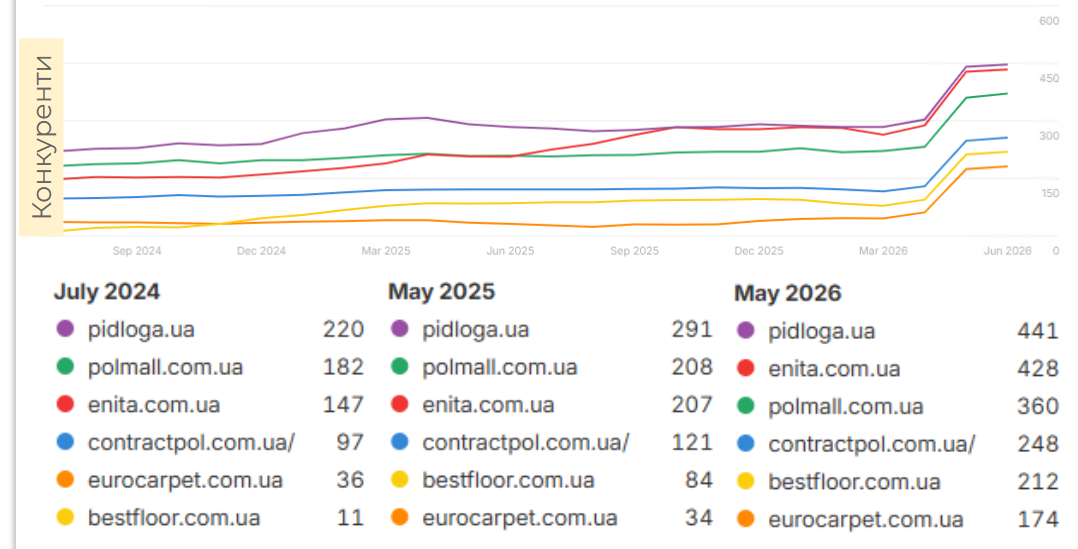
If you see a sharp spike in toxic links on your site over the past few months, the first thing that comes to mind is that someone is deliberately targeting you. But before jumping to that conclusion, it’s worth checking your competitors in the same niche over the same period. If everyone is showing the exact same pattern the same starting month, the same magnitude of the spike it’s not a personal attack; it’s a massive, automated wave of link spam that has swept across an entire market segment at once, without targeting specific sites.
This check is important not just for peace of mind. It changes your strategy: a targeted attack is worth investigating (where it came from and why specifically you), while an industry-wide wave is easier to accept as background noise and focus on your part of the work — building a high-quality profile — rather than fighting something that affected the entire market at once.
Here’s an example from an analysis for one of our clients; pay special attention to April–June 2026:
Why you shouldn’t disavow everything
The natural impulse here is: you’ve found toxic links, so you need to immediately disavow them all using the Google Disavow Tool. In reality, this often does more harm than good.
Since the Penguin 4.0 update, Google has, for the most part, simply ignored bad links rather than penalizing websites for them (see this article for more details). Google’s official documentation explicitly states that, in most cases, Google is capable of determining which links to trust on its own, and most websites don’t need the disavow tool at all.
There is also concrete experimental evidence showing why mass disavowal is dangerous. Joshua Harvik from Ahrefs conducted an experiment in which he used the disavow tool to remove all links that an SEO tool had flagged as «toxic» or «potentially toxic». The result was a 7% loss in organic traffic. In other words, the tool mistakenly flagged links that were actually benefiting the site as harmful, and the mass removal sacrificed real benefits in order to combat an imaginary threat.
Disavowing links only makes sense in specific situations: when there’s a manual penalty from Google in Search Console, or when you’re absolutely certain that specific links are the result of malicious actions for example, links purchased by someone else for negative SEO against you. In all other cases, the right strategy is not to rush to clean up your profile, but to focus on building high-quality backlinks that will eventually outweigh the noise.
Here’s an interesting side note about the very nature of link-selling sites: a study of 44,000 sites that sell link placements showed that after one year, 12,000 of them had simply disappeared from the web, and only 6,600 had traffic exceeding 1,000 visitors per month (https://editorial.link/bad-backlinks/). This serves as a reminder that the market for paid link donors is inherently unstable, and a donor that’s profitable today may simply no longer exist a year from now.
Checklist before choosing a donor
A minimum set of things to check before purchasing ad placement, not after:
- The DR aligns with traffic and keywords — there’s no discrepancy, such as a high DR with zero traffic.
- The DR and the number of incoming/outgoing domains do not match those of other donors on the list — three or more identical numbers indicate a network, not a coincidence.
- The IP address and hosting provider do not appear in multiple formally different donor domains.
- The domain’s thematic stability throughout its entire existence in the Wayback Machine — no sudden changes in niche.
- The percentage of outbound links with redirects is below 30%.
- The anchor text does not appear identically on dozens of other domains and does not sound like a seller’s advertising slogan.
- The price corresponds to the median for this DR level on the real market and does not fall into the «flat» overpriced zone.
- The trend of similar toxic donors appearing has been verified among competitors to distinguish an industry-wide trend from a personal attack.
The complete checklist I’ve compiled and use consists of 36 items — everything from thematic relevance to checking the hosting and domain history in the Wayback Machine. I’m sharing it separately as a bonus to this article — a Google Sheets spreadsheet, ready to copy: Donor verification checklist—advanced (for experts).
Every few months, here at WEDEX, we run every new donor profile through a list like this before recommending an advertising budget to a client. It takes a little longer than just looking at the DR, but it’s precisely this extra time that distinguishes a link that lasts for years from one that disappears along with the network that sold it.
Do you have any questions or need a website audit?
Checking donors is just one part of ensuring safe promotion. If you want to assess the condition of your website or its backlink profile, or get recommendations for future SEO, the WEDEX team is ready to help.

commercial offer
Other articles by the author

01/07/2026
An effective profile header isn't just attractive text it's a clearly structured, modular system in which each element serves a specific marketing function.

16/07/2026
The official launch of OpenAI ad testing on February 9, 2026, was a historic moment that marked the emergence of an entirely new media channel for promoting businesses.

29/05/2026
In a business context, Telegram Premium isn't just a status symbol—it's a set of features that make communication faster, more intuitive, and more convenient for customers.
Latest articles by #SEO

09/09/2026
The Facebook lead form helps businesses collect contact information from potential customers directly from an ad, without requiring them to visit the website.

08/09/2026
Today, an influencer is a distinct media platform with its own editorial policy, a keen understanding of its audience, and an established level of trust.

04/09/2026
Instagram Shopping is a set of Meta features that allows businesses to integrate their product catalog with their social media profile.