

 21/04/2026
  1812
1812

Інтернет-маркетинг
простою мовою
Content of the article
- /01 How to understand that AI really brings customers
- /02 Why the volume of AI traffic does not show its real value
- /03 How to separate AI channels in analytics
- /04 What audiences should be gathered to see the business effect
- /05 What metrics show the value of AI traffic
- /06 How AI enhances personalization

Does AI bring customers: real opportunities and prospects for business

AI is rapidly changing the way users search for information, compare options, and make purchasing decisions. For businesses, this means a new reality where part of the interaction with a brand may start not with a search engine or advertising, but in AI services. In such a situation, it is important not only to record the presence of AI traffic but also to understand whether it really brings customers and how it affects applications, sales, and repeat visits. In this article, we will analyze how to evaluate AI as a source and an amplifier of demand, what metrics help to see the real value of such traffic, and how businesses can use this data in practice.
How to understand that AI really brings customers
«AI brings customers» doesn’t just mean a direct application after the first contact. In most businesses, AI influences the user journey gradually: first, it helps to find a brand or product, then clarifies the need, then compares options, and only then pushes to make a request or purchase. That is why AI should be evaluated not by a single transition but by how it changes user behavior at different stages of the funnel.
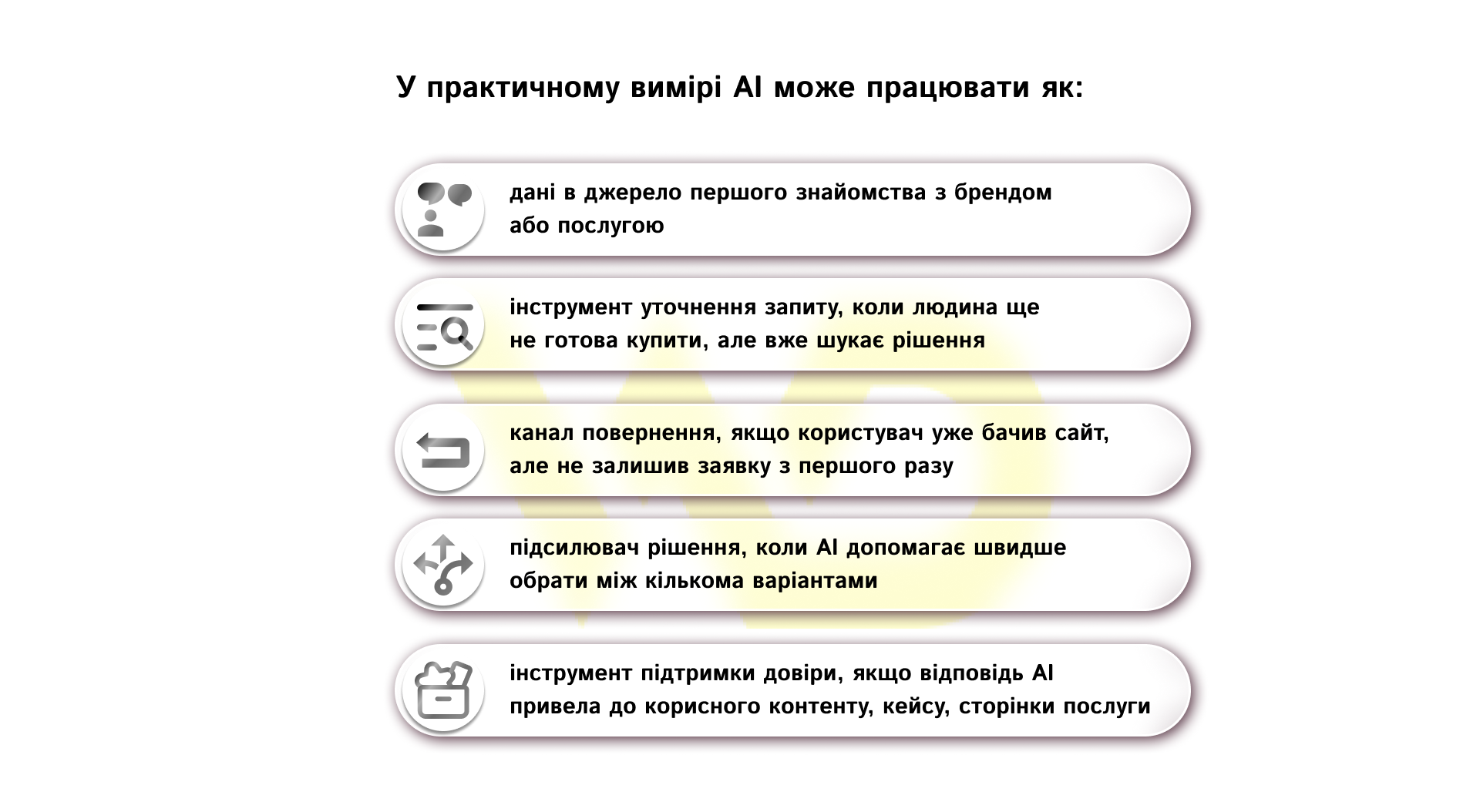
That is why it is important to evaluate an AI channel both by the number of sessions and whether it leads to repeat visits, deeper page views, interaction with commercial blocks, and movement towards conversion. In this sense, AI may not always result in an instant sale, but it often becomes an important link between interest and decision.
Why the volume of AI traffic does not show its real value
The number of sessions alone does not answer the question of AI effectiveness. A low-volume channel can provide much better quality of interaction than a source with high traffic but low engagement.
But in practice, the same volume of sessions can mean completely different things. In one case, these are short visits with no further action, in the other — contacts, after which the user reads several pages, returns to the site and leaves a request later. For businesses, these scenarios have different values, although they may look similar in analytics if you look only at the traffic numbers.
That is why when evaluating an AI channel, you should consider
- user engagement after the transition;
- repeat visits and return to the website;
- movement towards conversion, not just the fact of entry;
- traffic quality compared to other sources;
- the difference between new users and those who have interacted with the brand before.
In other words, AI traffic should be analyzed as a behavioral signal, not as a regular engagement channel.
How to separate AI channels in analytics
To evaluate the contribution of AI to customer acquisition, you need to separate AI sources into a separate group and analyze them as an independent channel. This is the only way to understand whether AI really influences user behavior or whether its role is limited to occasional short visits.
In Google Analytics 4, it is convenient to use custom channel groups for this purpose. This approach allows you not to mix AI traffic with search, referrals, or direct conversions. As a result, businesses get a clearer picture: where exactly the user came from, how they behaved on the website, and whether this visit was part of the further path to conversion.
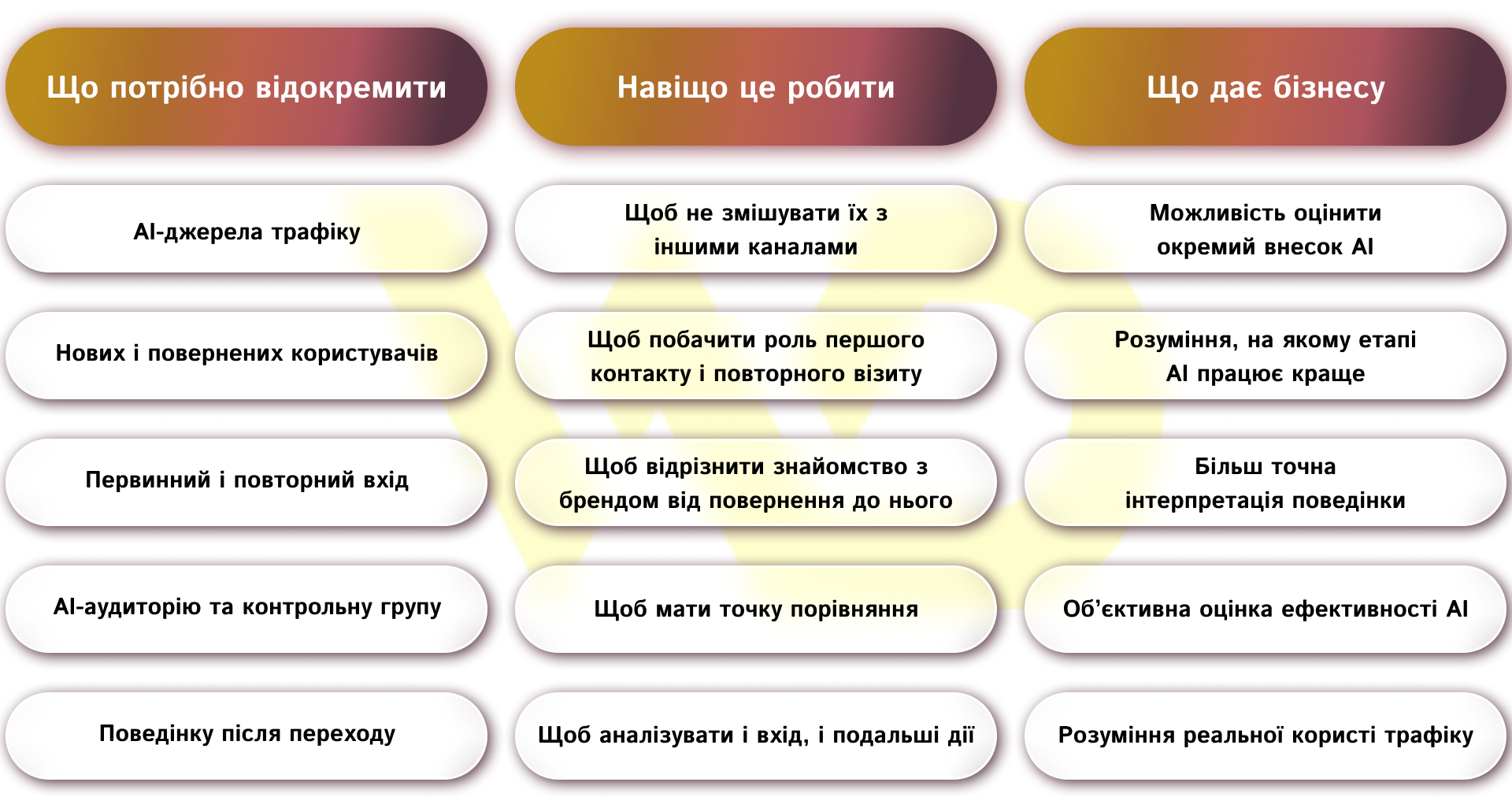
This approach is especially important for businesses where the path to the application is not limited to one touch. If a user came through AI and then returned directly or through search, it doesn’t mean that AI didn’t work. On the contrary, in many cases, it triggers further interest and helps the brand stay in the spotlight. Therefore, it is important to track the role of AI in the entire sequence of interactions in analytics.
What audiences should be gathered to see the business effect
It is necessary to look at different groups of users separately, as AI can work at different stages of user interaction with a brand. Segmentation allows you to see not only traffic but also the business logic behind it. Therefore, let’s analyze what audiences should be considered when analyzing the effectiveness of AI use.
- Users for whom AI became the first contact with a brand.
This is the audience that first came to the website through an AI source. This segment helps to understand whether AI is capable of opening a new audience and generating initial interest in the brand.
- Users with any interaction via AI.
It is important to take into account everyone who has ever accessed a website through an AI channel. This group shows the broader impact of AI on the user journey and allows you to estimate how often this channel participates in the overall funnel.
- Users who returned via AI after a previous contact.
This segment often provides the most interesting picture for businesses. If a person has already seen a brand before and then returned via AI, it may mean that the channel helped them come to a decision or clarify their choice.
- Users without AI interaction.
This group is needed as a control group. Without it, it is impossible to understand whether the behavior of the AI audience differs from the rest of the users and whether this channel has a real advantage.
- Users who convert not immediately but after repeated visits.
This segment is especially important for complex services and products with a longer decision-making cycle. It shows whether AI helps people not just visit the website but return to the brand at the right time.
Looking at these audiences separately, it becomes clear that AI does not always work as a direct sales channel. Often, its value lies in leading users to conversion, building trust, or accelerating return to the brand. That’s why segmentation gives businesses a much more accurate picture than the usual click-through count.
What metrics show the value of AI traffic
In addition to the source of the conversion, you need to analyze user behavior after the interaction, focusing on metrics that reflect the quality of traffic and its impact on conversion.
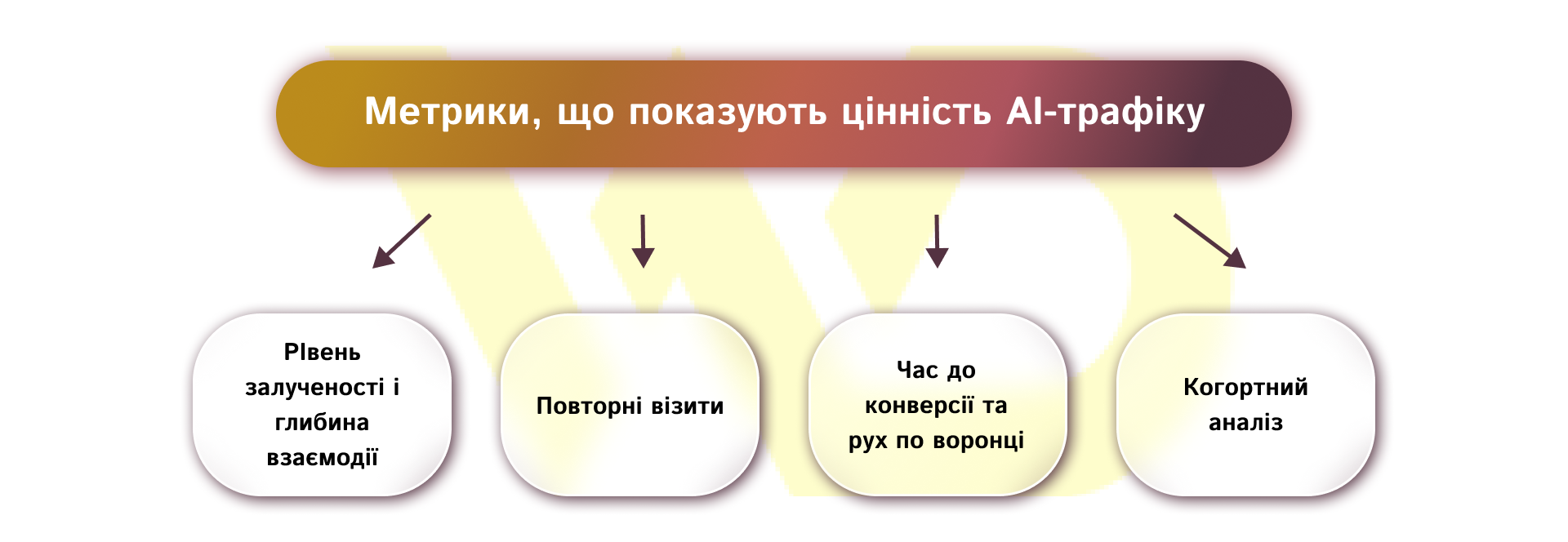
Level of engagement and depth of interaction
To evaluate the quality of AI traffic, it is important to look not only at the fact of the conversion but also at how the user behaves afterwards. If a person leaves a website quickly, it does not mean that the source is not interesting, but such behavior does not confirm its value. Instead, a high level of engagement and a greater depth of browsing show that AI has brought in a user who is truly interacting with the content and continues to move within the site.
Repeat visits
Special attention should be paid to repeat sessions. For businesses, this is one of the strongest signals that a user didn’t just accidentally click on a link, but returned to the brand after the first contact. In many niches, it is the repeat visit that is the point where the readiness for a request or purchase is formed. Therefore, if the AI audience returns more often than other segments, this already indicates its role in warming up demand.
Time to conversion and funnel movement
Another important metric is the time that elapses from the first contact to the targeted action. If AI shortens this path, it means that it helps the user to navigate faster, narrow down the choice, and come to a decision. If the conversion doesn’t happen immediately, but after a series of returns, this is also a useful result, because AI could be the trigger that sparked further interest. This is the difference between «traffic» and «influence on the funnel».
Cohort analysis
For a longer decision cycle, cohort analysis in GA4 is especially useful. Google describes it as a tool that allows you to group users into cohorts and track how their behavior changes over time. This allows you to see not only the one-time effect of AI traffic, but also how it affects further activity: whether users return, how quickly they convert, and whether they differ from other groups. For businesses, this is a more accurate picture than analyzing one session or one channel.
Looking at AI traffic through behavioral metrics, the main thing becomes clear: its value is not always in direct conversion, but often in preparing the user for it. That’s why engagement, repeat visits, time to application, and cohort dynamics are more important than simple session counts.
How AI enhances personalization
It is important to consider AI in marketing as a tool that affects the quality of user experience. Let’s analyze how artificial intelligence helps to enhance personalization.
- More precise content and matching intent.
One of the key advantages of AI is the ability to quickly create content that better suits a specific request or audience segment. In practice, this means more relevant texts, precise wording, and faster adaptation to different interaction scenarios. The user receives a response that is closer to his or her real need, rather than a general message «for everyone».
- Scaling personalization without losing quality.
AI allows you to scale personalization without a proportional increase in costs. What used to require separate scenarios, segments, and manual work can now be implemented faster and more flexibly. This is especially important for businesses with a large number of products or different audiences, where standard approaches to communication no longer have the desired effect.
- Impact on readiness to interact.
Personalization directly affects how quickly a user moves to the next stage of the funnel. If the content and messages meet expectations, it is more likely that a person will stay on the site, return again, or perform the targeted action. In this context, AI works not as a separate channel but as a factor that enhances the effectiveness of all contact points.
- Quality control and limitations.
The use of AI requires systematic control, and this should always be kept in mind. Automatically generated content may contain inaccuracies, simplifications, or biases, so it should be checked before use. In addition, the effectiveness of personalization should not be assessed intuitively — it should be confirmed through metrics and testing, including incremental impact analysis.
As a result, AI should be viewed as a tool that enhances the relevance and effectiveness of marketing, but only works correctly when combined with analytics and quality control. It is this approach that allows not only automating processes but also getting tangible business results.

commercial offer
Other articles by the author

24/03/2026
Today, artificial intelligence enables businesses to generate visuals quickly, scale creative options, and accelerate the iteration process.

02/03/2026
Your website is no longer just a showcase, but one of the main channels for sales, communication, and brand positioning.

02/07/2026
In B2B marketing, it’s important to generate not just leads, but contacts from people who are genuinely interested in the topic and willing to engage further with the company.
Latest articles by #Marketing

20/10/2026
Ben Hunt's model is a tool that helps break down a customer's path to purchase based on their level of awareness and select the right messages for each stage.

29/09/2026
A content pipeline transforms the creation of content from a spontaneous creative process into a managed production system. In such a system, AI serves as a powerful assistant.

10/09/2026
The 4P model serves as an architectural foundation that transforms disparate marketing activities into a single, manageable system.