

 06/10/2026
  945
945

Інтернет-маркетинг
простою мовою
Content of the article
- /01 What is outdated content
- /02 Why updating is more cost-effective than creating a new article
- /03 How to conduct an audit and determine which old articles to update first
- /04 How to effectively revamp an article
- /05 GEO optimization: how to adapt updated content for AI search
- /06 How to measure the effectiveness of an update

SEO and GEO: how to update outdated content for Google and artificial intelligence

Most companies that have been investing in content marketing for years eventually run into a strange anomaly. The number of blog posts is growing, but overall organic traffic stagnates or even begins to decline. New content requires ever-larger budgets, but the return on investment for each subsequent article decreases.
The main reason for this problem is outdated content that quietly accumulates on the site and drags its rankings down. With the advent of artificial intelligence and generative search (Google AI Overviews, ChatGPT Search, Perplexity), the challenges have only increased. Now, search engines and language models require not just volume of text, but factual accuracy, relevance, and a clear structure.
In this article, we’ll explore how to conduct a systematic audit of your blog archive, why updating old content often yields a significantly higher ROI than creating new articles from scratch, and how to adapt existing content to meet the requirements of traditional SEO and modern GEO-optimization.
What is outdated content
A common mistake many people make is to consider content outdated only when there’s a note at the top of the article saying something like «published in 2021». But losing relevance is a more complex process that involves whether the material meets user needs and search algorithm requirements.
Content is considered outdated when it has lost its informational or business value. This happens in several cases:
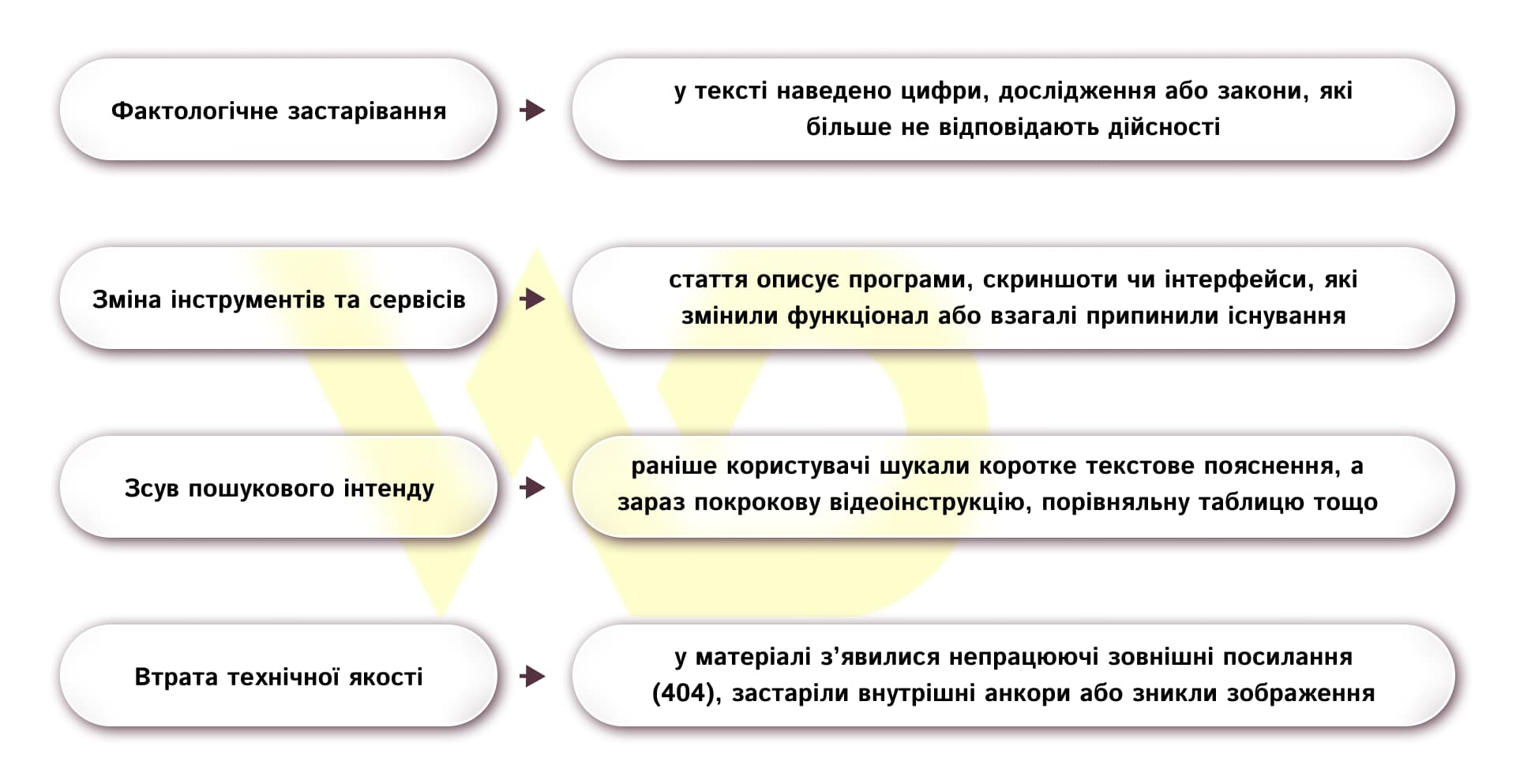
Some companies try to solve the problem the easy way by mass-updating the publication date in the CMS to the current year without editing the text itself. However, such actions are not only ineffective but also dangerous for the website.
Simply changing the publication date is not enough. Google recommends updating the date only when the page has actually undergone significant changes. It’s not worth artificially «refreshing» content without adding meaningful new information.
Google detects substantial changes through text reindexing. If the algorithm sees that only the date in the meta tags has been changed while the text itself remains untouched, the page loses credibility, and its rankings may drop even further.
Why updating is more cost-effective than creating a new article
From a business perspective, updating content is a rational way to protect existing investments. Creating each article for a corporate blog costs money because it involves the work of an author, an editor, an SEO specialist, a designer, and a content manager. When an article becomes outdated and loses traffic, the company effectively loses a digital asset.
Updating existing pages has three key economic advantages over writing new content.
- Preserving and leveraging accumulated authority.
An old page already has a history, Google indexing, behavioral factors, and, most importantly, external links (backlinks). A new article starts from scratch and takes months to gain the trust of search engine crawlers.
- Faster results at a lower cost.
Revising an existing article requires 40–60% fewer team resources than researching a topic, drafting a new technical brief, and writing the text from scratch. At the same time, search engines typically respond to updates on an authoritative page within 1–3 weeks, rather than 3–6 months.
- Lower customer acquisition cost (CAC).
Restoring lost organic traffic on existing pages allows you to generate leads without increasing your paid advertising budget.
Updating content isn’t about abandoning the creation of new content; it’s a way to balance your content strategy. While new articles gradually gain traction, an updated archive ensures a steady flow of targeted visitors.
How to conduct an audit and determine which old articles to update first
Trying to update all blog posts at once is an inefficient use of resources. You need to establish a clear system of priorities based on analytics data. Data from Google Search Console and Google Analytics 4 is used to conduct the audit.
All articles in the archive should be divided into four categories.
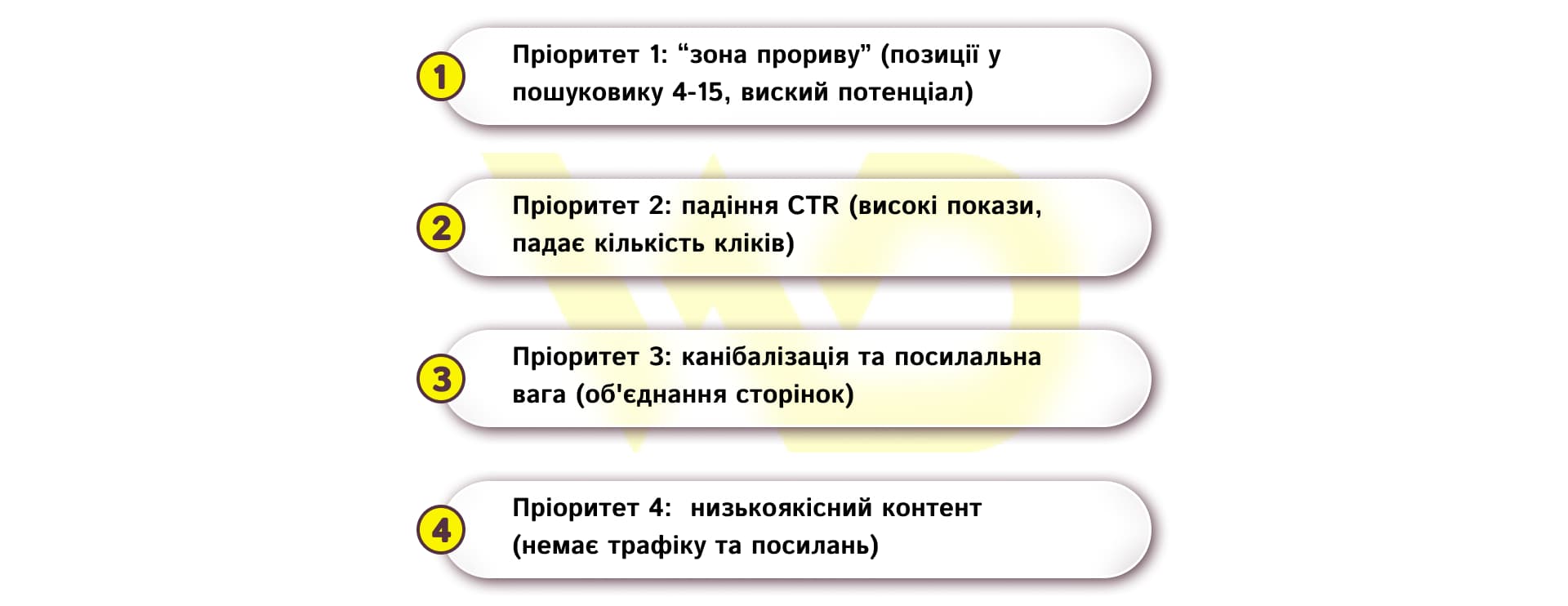
- Pages in the «breakthrough zone».
These are articles that rank between 4th and 15th in search results. Google already understands them, and they have high impressions, but they’re just a hair’s breadth away from making it into the top 3.
- Articles with high impressions but a low CTR.
If an article frequently appears in search results but users don’t click on it, the problem usually lies in an outdated title, an irrelevant description, or a headline that doesn’t match current search intent.
- Pages with a high backlink profile that have lost traffic.
These are articles that have high-quality external links from other resources, but the content itself is outdated. Google ranks them lower in search results because the information is no longer relevant.
- Ineffective and Duplicate Pages
Articles with zero traffic, no backlinks, and outdated topics should either be deleted or merged with stronger content.
Clear prioritization ensures that the team focuses its efforts only on content that has real potential to convert into organic traffic and leads.
How to effectively revamp an article
Once you’ve identified which pages need «revitalization», the question of methodology arises. Updating isn’t just a cosmetic fix involving correcting a few typos or changing the date. To ensure that search engines and users perceive the content as fundamentally new, the work is carried out on two levels: a deep restructuring of the text’s structure and its technical overhaul.
Reformatting the text: from dry theory to a practical guide
Instead of simply adding new paragraphs to the old framework, treat the article as a fundamentally new product and drastically increase the value density in each section.
First and foremost, change the presentation format itself. If the material previously resembled a dry theoretical lecture, transform it into a practical guide. Add fresh screenshots of real interfaces, comparison tables, or ready-made checklists that readers can immediately save and use in their work.
The next important step is to reinforce the text with real human experience. With the emergence of thousands of similar pieces of content generated by artificial intelligence, search engines place a particularly high value on the E-E-A-T factor. Include a brief story from your own experience in the article, analyze a real-life company case study, or even explain common mistakes using «what not to do» examples.
In addition, it’s helpful to expand on the content by including specific use cases. Instead of general descriptive statements, include separate sections with answers to practical questions for example, how the proposed solution works for small businesses or what to do on a limited budget. This will not only make the text more engaging but will also naturally cover related search micro-queries that users might use to find you.
Let’s look at a practical example. Suppose you have two medium-length articles: «How to set up Facebook Ads» and «How to choose an audience for Facebook Ads». Instead of editing them separately, take the strongest URL, rewrite it as a comprehensive guide titled «The complete guide to setting up Facebook Ads» and incorporate the best sections from the second article into it. You take the old URL of the second article, deactivate it, and set up a 301 redirect from it to the main article, concentrating all the link equity in one place.
Technical relaunch: how to signal search engine crawlers
A high-quality rewrite won’t reach its full potential if the search bot doesn’t realize that the page has undergone fundamental changes. Immediately after editing the text, you need to move on to the technical settings.
First and foremost, you should restructure the internal linking system. The updated article shouldn’t remain an «isolated island». Find a few more recent articles on your site covering a related topic and add contextual links from them to the updated page. This will give Google’s crawlers a clear signal to follow a priority path and quickly reindex the content.
At the same time, update the meta tags to reflect current click-through rates (CTR). The title tag should explicitly mention the update and offer added value to the reader. For example, instead of the outdated «Website optimization: a guide», the phrase «Website optimization: a step-by-step guide + checklist» will work much better.
Also, don’t forget to implement the special Schema.org microdata. Using the FAQPage type for blocks of questions or the HowTo type for instructions allows your snippet to take up more space in Google search results and stand out from the competition. And to avoid waiting weeks for the algorithms to detect the updates on their own, submit the URL for forced reindexing via Google Search Console immediately after publication.
GEO optimization: how to adapt updated content for AI search
Updating text to meet Google classic requirements is only half the battle. Today, more and more users are searching for information through generative systems. This has created a new trend in marketing — GEO (Generative Engine Optimization) — which involves optimizing content so that it becomes a source of answers for artificial intelligence.

It’s important to understand that GEO doesn’t replace traditional SEO; rather, it builds upon it. Language models operate on the RAG (Retrieval-augmented generation) principle: they first search for authoritative pages through Google’s standard search index and then synthesize an answer for the user based on those pages. If a page lacks basic search visibility, artificial intelligence simply won’t notice it.
To understand exactly what causes artificial intelligence to cite one website and ignore another, researchers from Princeton University, Georgia Tech, and the Allen Institute for AI conducted a fundamental study of GEO factors. In the study «GEO: Generative Engine Optimization», presented at the KDD 2024 conference, the authors tested various methods of adapting content for generative search engines. In particular, adding statistics, citations, and links to sources improved content visibility metrics in certain experiments. At the same time, the effectiveness of these methods varied depending on the query, topic, and other conditions; therefore, the study’s results do not mean that a particular technique is guaranteed to ensure a website is cited by a generative system.
To ensure your updated content appears in AI search engine results, follow a few simple rules for presenting information:
- Use the «inverted pyramid» principle.
Start each important section of the article with a direct, clear, and concise answer to the question in the headline literally 2–3 sentences. Only after this direct answer should you expand on the details, arguments, and explanations. It’s much easier for artificial intelligence to read and cite a ready-made summary.
- Include factual accuracy and precise data.
Instead of vague phrases like «many companies are increasing sales», provide specific figures: «according to a study, 64% of companies….» AI is sensitive to «hallucinations», so algorithms prioritize content with concrete facts and references to authoritative sources.
Adapting your content to GEO requirements allows you not only to maintain organic traffic from traditional Google but also to stay ahead of the competition by becoming the go-to source for answers in the new era of AI search.
How to measure the effectiveness of an update
To determine whether updating your content was worthwhile, you need a thorough data analysis. However, the most common mistake is trying to evaluate the results the very next day after publication. Search bots and language models need time to crawl the page, detect changes, and recalculate its ranking weight. You should wait at least 2–4 weeks before collecting the first reliable data from analytics services.
Traditional SEO metrics in search console and GA4
To evaluate traditional search engine optimization, the key metrics are the trends in impressions, rankings, and user behavior:
- Changes in rankings and impressions: if an article was in the «breakthrough zone», the main indicator of success is its move into the top 3 for primary and related LSI queries;
- Increase in CTR: improvements to the title and description should be reflected in a rise in the click-through rate (CTR) relative to impressions in Google Search Console. Even without a drastic change in ranking, a more accurate snippet can significantly increase traffic;
- Behavioral factors: updated, well-structured, and engaging content should better retain readers. Pay attention to increases in average session duration and engagement metrics in Google Analytics 4.
Tracking visibility in GEO and AI systems
Assessing the impact of GEO optimization is somewhat more complex, as traditional analytics systems are only beginning to adapt to artificial intelligence. However, you can already focus on two key metrics:
- the emergence of referral traffic: in GA4 reports (the «Traffic Acquisition» section), monitor for visits from sources such as perplexity.ai, chatgpt.com, or copilot.microsoft.com;
- direct citation monitoring: periodically enter the article’s key search terms into Google AI Overviews, Perplexity, and ChatGPT Search. If the algorithm generates a response that links to your updated article or cites your facts, your GEO optimization has been successful.
Business metrics and final ROI
Ultimately, the main benchmark for a business isn’t just traffic, but the page’s actual conversion rate. Compare the number of target actions such as inquiries, subscriptions, or orders from the page for the month before the update and the month after. If the number of leads has increased with minimal team resource expenditure, this is the best confirmation that the investment in updating the archive has fully paid off.
Systematically updating outdated content transforms your blog from a passive archive into an active profit-generating tool. By combining classic SEO methods with the requirements of GEO and AI search, your business gains the ability to grow steadily in organic search results, saving money and strengthening its authority in the market.

commercial offer
Other articles by the author

29/05/2026
This is actually very important for businesses, because when content loses visibility, it doesn't just affect «pretty statistics» it also impacts real results.

26/03/2026
A gradual approach to integrating artificial intelligence is truly important because it helps avoid a number of risks and mistakes.

28/01/2026
When user attention is limited, competition for each click increases, and the cost of customer acquisition rises, the way information is presented often matters more than the product itself.
Latest articles by #SEO

29/09/2026
A content pipeline transforms the creation of content from a spontaneous creative process into a managed production system. In such a system, AI serves as a powerful assistant.

10/09/2026
The 4P model serves as an architectural foundation that transforms disparate marketing activities into a single, manageable system.

08/09/2026
Today, an influencer is a distinct media platform with its own editorial policy, a keen understanding of its audience, and an established level of trust.