

 17/04/2026
  1723
1723

Інтернет-маркетинг
простою мовою
Content of the article

Will AI texts be caught by Google filters?
Artificial intelligence is a common tool in content marketing in 2026. But for businesses, the key question is not whether it can be used, but how to do it without risking SEO. In this article, we will analyze whether AI texts can fall under Google filters, where the line between useful automation and risky content is drawn, and how businesses can use artificial intelligence to help promote their business instead of hindering it.
AI and SEO: tandem or confrontation
AI can be useful at the stage of content preparation, but it does not replace an editor, SEO specialist, and product expert. This is especially important for businesses because search engine optimization is not about volume for the sake of volume, but about content and relevance.
In practice, AI can be used for the following purposes:
- creating a draft of an article
- preparing the structure of the material;
- generating headline options;
- Adaptation of text to different formats;
- speed up routine descriptions of goods or services.
For example, an online store can use it to create a draft description of a category, and an editor or SEO specialist will supplement the text with unique product characteristics, delivery terms, real benefits for the buyer, and examples of use. In this format, AI removes some of the mechanical work, and humans are responsible for meaning, accuracy, and benefit. It is this combination that usually yields a normal search result.
Promoting an online store requires more than just AI
We’ll help you optimize your site’s structure, content, and product pages so that your site is useful to users and effective for search engines.
For a better understanding, let’s look at a specific example.
|
Poorly generated text |
Well-generated text |
|
A smartphone is a modern device that has many functions and is suitable for various tasks. It has a good camera, a powerful processor, and a stylish design. This smartphone will be a great choice for any user. |
The Samsung Galaxy A14 smartphone is equipped with a 6.6″ PLS LCD display (2408×1080), Exynos 850 processor, 4-6 GB of RAM, and a 5000 mAh battery that provides up to 8-10 hours of active screen time or up to 2 days of operation with moderate use. The main camera is 50 megapixels (f/1.8): during the day it takes clear pictures, in the dark, noise and loss of detail are noticeable. Suitable for basic tasks — messengers, browsing, video — without a performance margin for heavy games. |
|
The apartment is for sale in a good area of the city. It has a convenient layout, modern renovation and is suitable for comfortable living. This is a great option for a family or investment. |
2-room apartment for sale with an area of 62 m² in the area of Nezalezhnosti Street (Dnipro). The area has a well-developed infrastructure: there is a school, supermarkets and a transport interchange within 5 minutes on foot. The apartment was renovated in 2022, has a separate kitchen of 12 m² and a glazed balcony. Suitable for a family with a child or as a ready-made option for rent without additional investments. |
|
The car is in good condition, fully ready for use. A reliable, comfortable and economical option for daily use. It does not require investments and will be an excellent choice for a new owner. |
Toyota Corolla 2022 with a 1.6-liter gasoline engine and fuel consumption of about 6.8-7.2 l/100 km in a mixed cycle is for sale. The mileage is 85 thousand km, the car was serviced in accordance with the regulations, there is a service history and confirmed maintenance records. The body is without serious damage, the interior is well maintained, does not require dry cleaning or restoration. The car is technically sound and does not require urgent investments. |
The problem arises when a business tries to scale content without adding value. Google explicitly warns that mass creation of pages using generative AI without any benefit for people is an abuse of large-scale content. The same risky scenario includes pages that consist of paraphrased or organized material without new content.
Google’s position on AI texts
The Google Search Central blog explicitly states that ranking systems seek to reward original, high-quality content that demonstrates E-E-A-T — expertise, experience, authoritativeness, trustworthiness. That is, expertise, experience, authoritativeness, and trustworthiness.
At the same time, Google clearly distinguishes between the auxiliary use of AI and attempts to manipulate the search results. In its documents, the company explains that the use of automation, including AI, to create content with the main goal of influencing search positions is a violation of spam policies.
After the 2024 updates, the emphasis became even stricter on mass content without value. Google added a separate category of scaled content abuse to its spam policies and explicitly stated that this includes the generation of a large number of pages using generative AI without any additional benefit to the user. Such pages can be ranked lower or not included in the index at all in the desired form. For businesses, this means the risk of losing traffic: even a large number of pages will not work if they do not meet user expectations.
Google also advises looking at content through the prism of Who, How, Why — who created the material, how it was made, and why. Authors should make clear the authorship, creation process, and, when appropriate, explanations about the use of AI or automation. This does not boil down to a formal «generated by AI» label. It is about user trust.
If the reader can logically understand who is behind the material, what the text is based on, and why it was created, it works for both the brand and SEO.
Whether to use AI texts on your website or not
The answer to this question depends on business objectives, budget, and content quality requirements. Texts generated with the help of artificial intelligence do have significant advantages, but they also carry a number of risks. That is why the decision should be made not emotionally, but taking into account the tasks for which you plan to use such content.
Advantages of AI content
The use of artificial intelligence to create texts may be appropriate in the following cases:
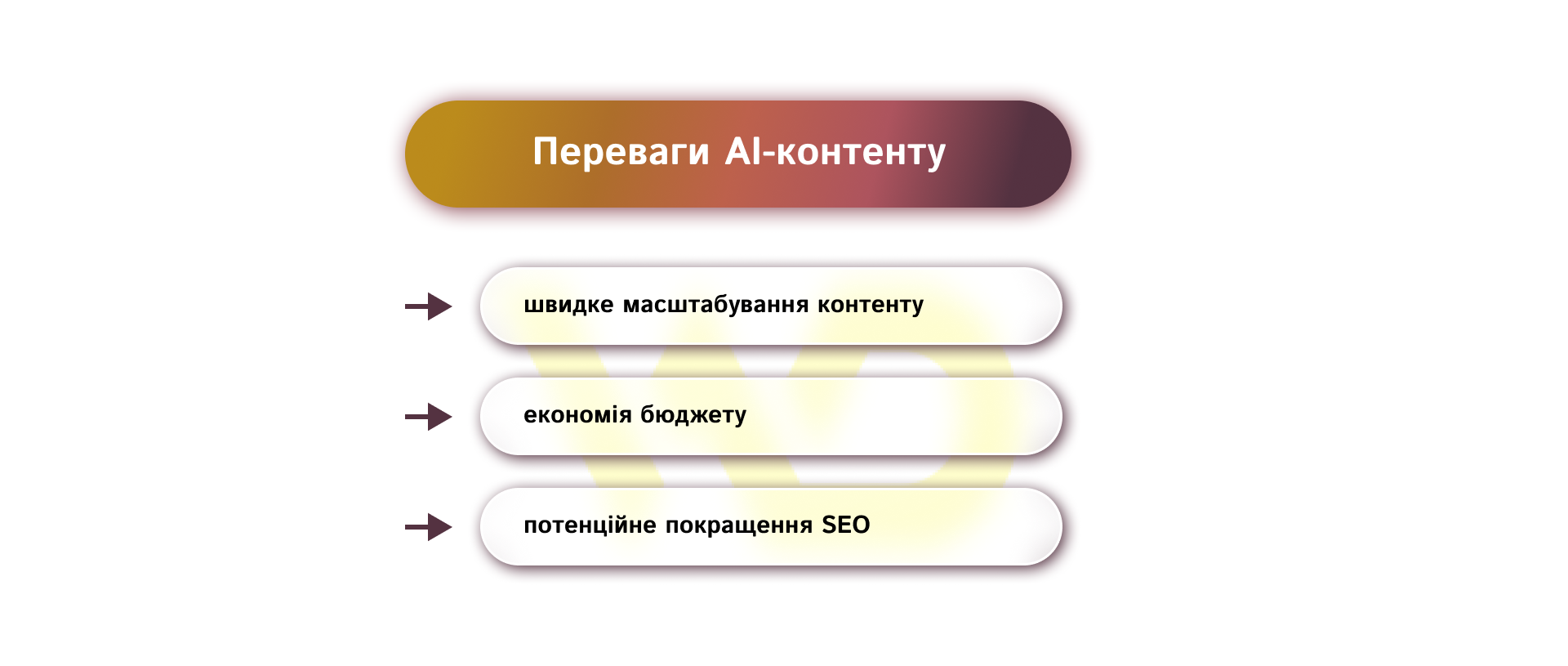
- Fast content scaling.
AI can create texts much faster than humans. This is especially useful when you need to quickly prepare a large number of materials: blog articles, product descriptions, texts for categories, or localized versions of a website. Where a human author would need time to research a topic, structure thoughts, and write, artificial intelligence can offer a draft in just a few minutes.
- Budget savings.
Working with an experienced writer or editor is usually more expensive than generating text through an AI service. For in-depth analytical materials, such an investment is quite justified, but for simple informational texts or basic descriptions, automation can be a more profitable alternative. At the same time, it should be borne in mind that some tools work on a subscription basis, so the savings will not always be absolute.
- Potential improvement of SEO.
Artificial intelligence services analyze large amounts of data and help to quickly find popular phrases, keywords, and typical user queries. This allows you to create texts that better meet search demand. But this effect is only possible when the content is not a mechanical set of keys but truly meets the requirements of quality and usefulness.
At first glance, the benefits of AI content look convincing. That is why many companies are already testing it in their workflows. However, before relying on automation alone, it is important to consider the weaknesses of this approach.
Disadvantages of AI texts
Despite their obvious convenience, texts created by artificial intelligence have significant limitations. And they often cause problems with quality, audience trust, and search engine rankings.
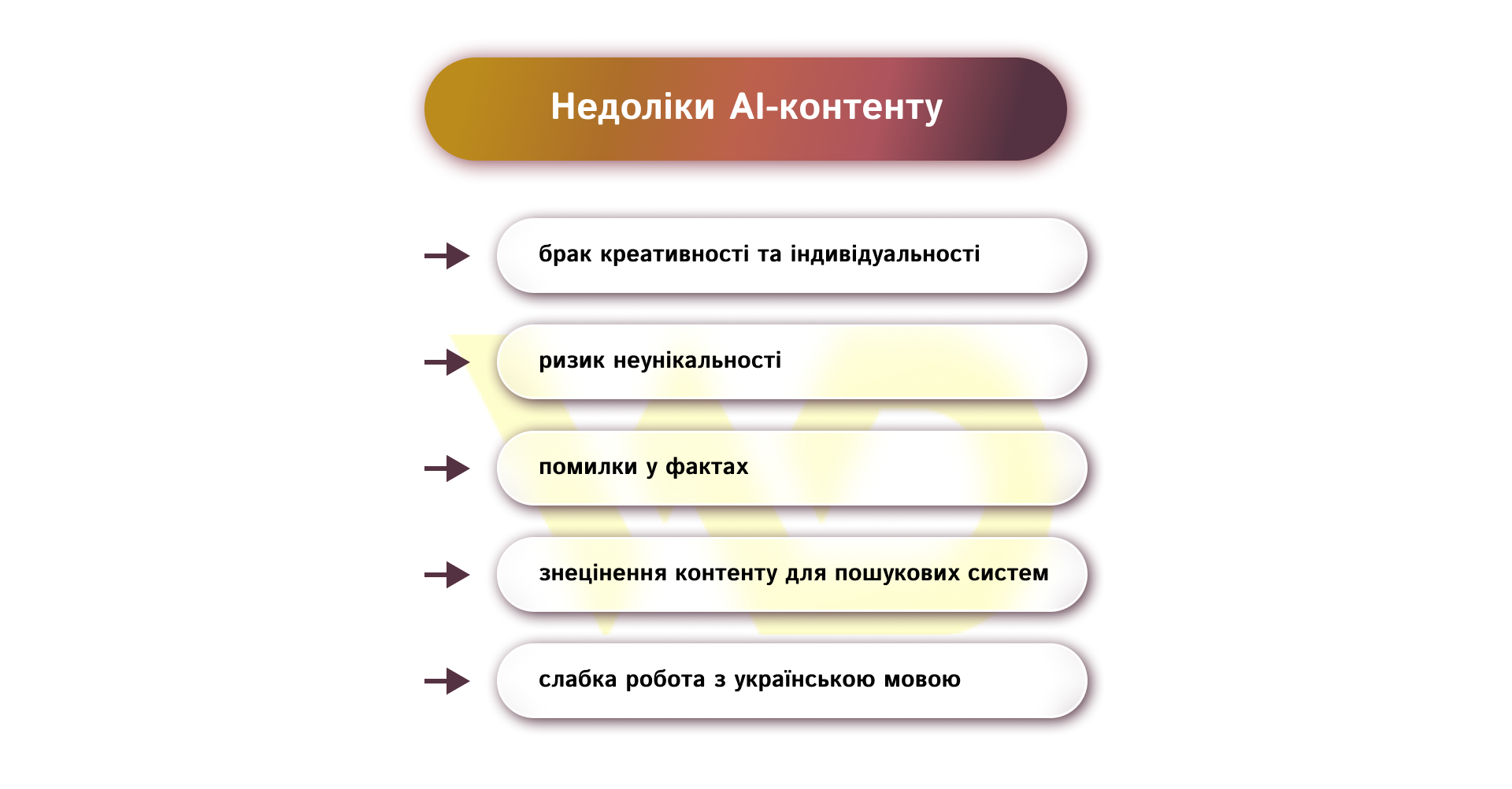
- Lack of creativity and individuality.
AI works on the basis of templates, algorithms, and available data. As a result, texts are usually structured, logical, and grammatically correct. But unfortunately, they often lack emotion, character, and a lively author’s tone. For a brand, this means a loss of recognition, because the developed tone of voice in such materials is often blurred or disappears altogether.
For example, a page generated entirely by AI often contains general phrases without specifics. Instead, the finalized material with examples, explanations, and expert opinion holds the user’s attention better and has a higher chance of ranking.
- Risk of non-uniqueness.
Artificial intelligence doesn’t create knowledge from scratch — it rethinks existing information. As a result, the text may be too similar to other materials on the web or repeat common wording without significant novelty. If you don’t manually check and revise the content, you risk getting a text that looks like a compilation without depth or authority.
- Errors in facts.
Another serious drawback is inaccuracy. AI may provide outdated or incorrect information if it does not receive up-to-date data or is not properly verified. As mentioned earlier in this article, this is especially dangerous for topics related to health, finance, security, or legal issues.
- Devaluation of content in the eyes of search engines.
With the development of generative tools, Google has become even more attentive to the quality of materials. Search engines focus not on the fact of using AI, but on the value of the text for the reader. If a page is created only to rank in the SERPs but does not provide any real benefit, its chances of success in search are significantly reduced.
- Poor work with the Ukrainian language.
Language quality should be taken into account separately. Many AI tools are not yet very accurate with the Ukrainian language. There may be bad phrases, stylistic errors, unnatural wording, or strange use of keywords. As a result, the text looks mechanical and requires serious editing before publication.
Remember. The key risk for businesses is not the use of AI but the illusion that it can replace expertise. In reality, the winners are those sites that use AI for speed but leave control over the content to the team.

commercial offer
Other articles by the author

08/07/2026
Donor analysis isn't about examining a single metric; it's about comparing several metrics against one another.

19/06/2026
Crowd marketing involves placing useful, organic mentions of a brand, product, or service on platforms where your audience is already engaging.

17/08/2026
Mass copying of text, photos, or videos not only reduces a website’s uniqueness but also creates legal and SEO-related risks.
Latest articles by #SEO

06/10/2026
From a business perspective, updating content is a sensible way to protect existing investments.

02/10/2026
For businesses, CPL is the primary metric for measuring how effectively ads and landing pages convert cold traffic into initial leads.

29/09/2026
A content pipeline transforms the creation of content from a spontaneous creative process into a managed production system. In such a system, AI serves as a powerful assistant.