

 19/06/2026
  1228
1228

Інтернет-маркетинг
простою мовою
Content of the article
- /01 What is crowd marketing and why is it important for businesses
- /02 Pros and cons of crowd marketing
- /03 Where crowd marketing delivers the best results
- /04 How to build a crowd marketing strategy
- /05 How to choose platforms to ensure maximum impact
- /06 Launching a campaign: how to put your strategy into action
- /07 How to measure results
- /08 How to choose a crowd-marketing contractor
- /09 How crowd marketing fits into the overall promotion system
How to build an effective crowd-marketing strategy to promote a website

When a business promotes a website, it’s not enough to simply run ads or fill pages with content. People want to see real recommendations, other users’ experiences, and confirmation that the company can be trusted. That is why crowd marketing remains an important tool in digital promotion, as it helps not only draw attention to the brand but also build trust in it through organic mentions on relevant platforms.
In this article, we’ll explore how to build an effective crowd marketing strategy for website promotion: where to start, how to choose platforms, which mention formats work best, and how to evaluate the results of such efforts.
What is crowd marketing and why is it important for businesses
Crowd marketing involves placing useful, native mentions of a brand, product, or service on platforms where your audience is already engaging. But the point isn’t to «shove» a link down people’s throats; it’s to organically fit into the conversation and provide a genuinely helpful answer
That is why effective crowd marketing almost always looks like a recommendation from an experienced community member, rather than an advertisement.
At its core, this approach delivers several key benefits to a business:
- the brand is mentioned more often in a relevant context, thereby increasing its recognition;
- some users visit the website from thematic platforms, which brings additional traffic;
- crowd marketing can reinforce behavioral signals if, after clicking through, a person finds exactly what they were looking for on the site;
- the tool helps supplement SEO with more natural external mentions, rather than just classic links from link exchanges or bulk purchases.
At the same time, it is important to understand the limitations of this tool. Google warns that links or pages created primarily to manipulate rankings may be considered spam, and spam created by users in comments and on forums poses a separate risk to the site.
Pros and cons of crowd marketing
Like any promotion tool, crowd marketing has its strengths and weaknesses.
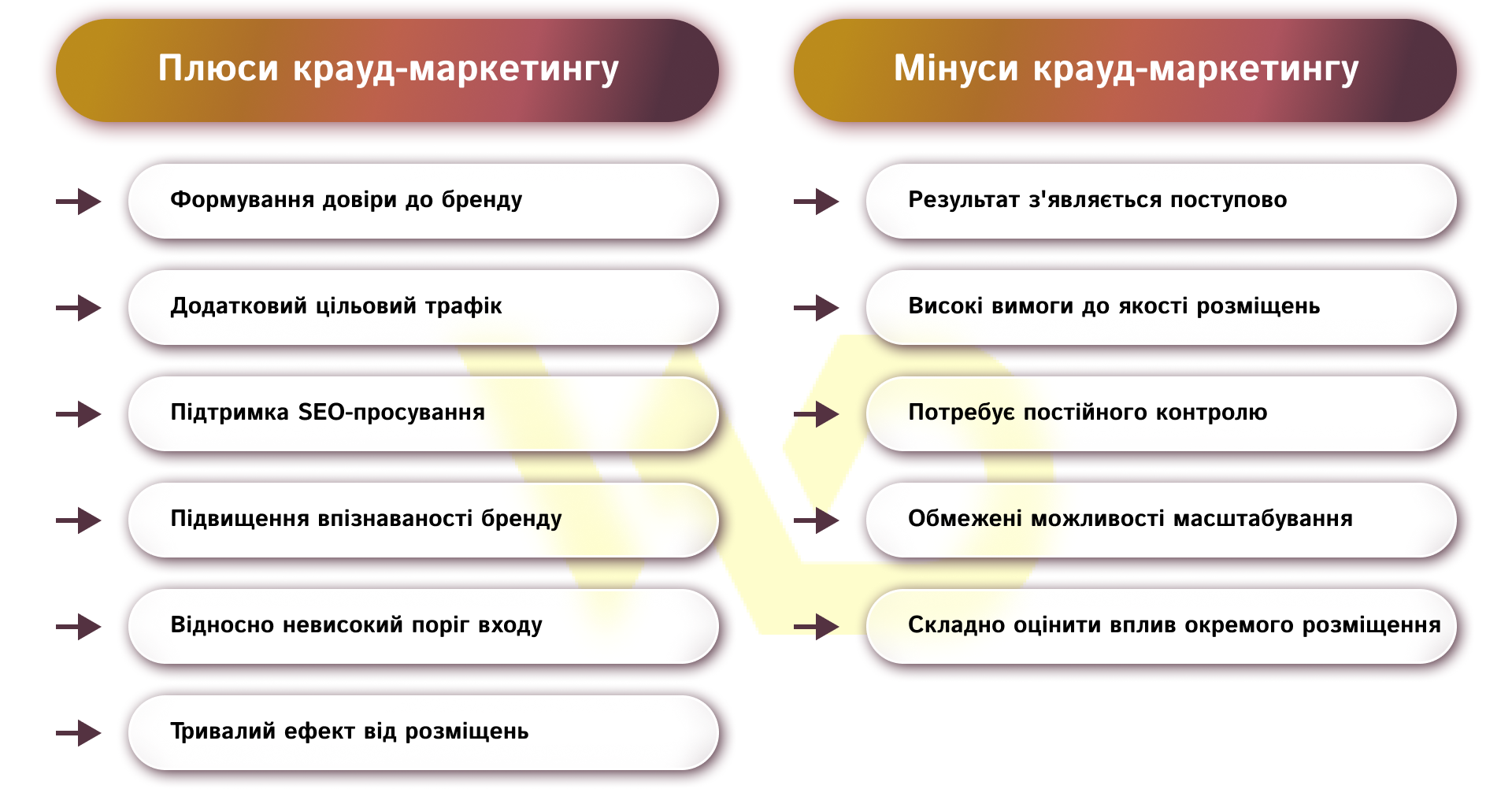
The effectiveness of crowd marketing largely depends on the quality of its implementation: a well-structured campaign can become a valuable source of traffic and brand trust, while a superficial approach often fails to deliver the expected results. Therefore, before launching a campaign, it is important to understand both the advantages of this tool and its limitations.
|
Advantages |
What it offers businesses |
|
Building brand trust |
Mentions in real discussions are perceived more naturally than direct advertising, so they can positively influence the decisions of potential customers |
|
Additional targeted traffic |
Users visit the site from platforms where they are already interested in the relevant topic or looking for a solution to a specific problem |
|
Support for |
Organic mentions and links help make the site’s external profile more diverse and natural |
|
Increased brand awareness |
Even without visiting the site, users begin to see the company name more often in relevant contexts |
|
Relatively low entry barrier |
Compared to many other promotion channels, crowd marketing does not require large budgets at the start |
|
Long-lasting effect from placements |
High-quality discussions can remain visible in search results and drive traffic for a long time |
At the same time, crowd marketing cannot be called a universal solution for all business tasks.
|
Disadvantages |
What to consider |
|
Results appear gradually |
Unlike contextual advertising, crowd marketing rarely produces immediate results and requires time to build up results |
|
High requirements for |
Irrelevant platforms or generic posts may not be helpful and could even harm the brand’s reputation |
|
Requires constant monitoring |
It is necessary to regularly analyze platforms, update the topic database, and track campaign performance |
|
Limited scalability |
Not all niches have a sufficient number of high-quality thematic resources to actively expand the campaign |
|
It is difficult to assess the impact of individual placements |
The result is often shaped by the cumulative effect of mentions, so it can be difficult to determine the contribution of each individual post |
Despite certain limitations, for many companies, the advantages of crowd marketing outweigh its disadvantages. This is especially true for businesses operating in competitive niches that aim to attract traffic and gradually build brand trust through a natural presence in relevant discussions.
Where crowd marketing delivers the best results
Crowd marketing works best where people are already discussing problems, sharing experiences, and looking for practical advice.
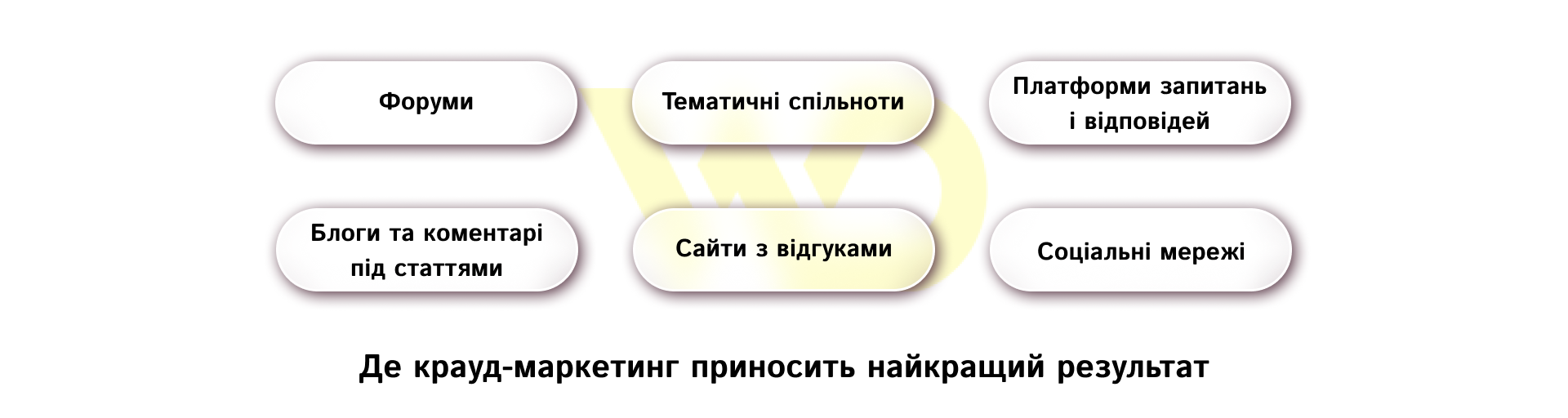
In such places, a brand can appear in the form of a relevant answer or a helpful recommendation. Therefore, it’s important to choose not just popular platforms, but those with an active audience and genuine interest in the topic.
- Forums.
This is one of the most natural formats for crowd marketing. On forums, people often ask specific questions, compare options, and seek the experiences of other users. Short, informative answers with a relevant mention of the brand or solution work well here.
- Thematic communities.
In niche communities, you can find an audience that is already interested in a specific topic or niche. This allows you to more accurately address the user’s needs and make the mention more natural and useful.
- Q&A platforms.
These resources are suitable for situations where a person is looking for a specific solution. If the answer is to the point and helps clarify the issue, the brand mention is perceived as part of expert advice rather than advertising.
- Blogs and comments under articles.
Here, crowd marketing works when a comment adds to the topic rather than repeating the article or simply leaving a link. Detailed, logical, and relevant answers that truly add value to the discussion are best received.
- Review sites.
Such platforms help build trust in the brand if the mention comes across as an honest user experience. This is especially useful for businesses when it’s important to bolster their reputation before the first contact with a customer.
- Social media.
On social media, the best results come from comments, participation in discussions, and organic recommendations in threads where the audience is already discussing the relevant product or service.
Carefully selected platforms help make crowd marketing not just a box-ticking exercise, but a real part of your promotion strategy.
How to build a crowd marketing strategy
Crowd marketing only yields results when it is launched not haphazardly, but as part of a well-thought-out strategy. Here, it is important not just to post mentions of the brand, but to understand exactly why they are needed, who they should be addressed to, and in what situations they will be appropriate. Let’s take a step-by-step look at what helps make crowd marketing truly effective.
Step 1. Define your goals
You need to start not with platforms, but with goals. The business must clearly understand what exactly crowd marketing should deliver: additional traffic, increased brand awareness, SEO support, reputation building, or a combination of these objectives. When the goal is vaguely defined, all subsequent actions turn into a series of isolated posts with no clear outcome.
Step 2. Describe your audience through real-life scenarios
Next, you need to do more than just name your target audience; you need to understand how they behave in real life.
- What questions does the user ask before making a purchase?
- What stops them?
- Where do they look for confirmation that they’ve made the right choice?
- In what language do they express their doubts?
This is especially important for crowd marketing, because the message should sound as if it were written by a real person for another real person, not like a pre-written ad.
Step 3. Select topics and platforms
Next, create a map of topics and platforms. It’s important that the platform is thematically relevant to the product, has active engagement, and allows for a natural mention without violating community guidelines. Not every platform is equally suitable for a direct link, so choose carefully. In some cases, a mention without an active link works better if that makes it look more natural and useful to the reader.
Step 4. Consider the communication format
The same approach won’t be equally effective across different niches. For complex B2B products, expert explanations, real-world examples, and answers to specific questions work best. For e-commerce — short recommendations, comparisons, and user stories. For local businesses — mentions in the context of experience, convenience, or service.
Step 5. Make every post feel natural
If the text sounds like an advertisement, users quickly lose trust in it. Therefore, a brand mention should appear in a logical place, such as in response to a question, as an example from experience, or as useful advice. It is this naturalness that makes such communication convincing and helps it fulfill its purpose.
Step 6. Prepare your communication for future scaling
Once the basic logic of the strategy is clear, it can be scaled up by expanding the list of platforms, testing different formats of mentions, and amplifying the approaches that generate the best response. At this stage, it is especially important to maintain consistency: the strategy must remain natural, relevant, and useful to the audience.
It is precisely this approach that allows you to build crowd marketing as a systematic promotional tool.
How to choose platforms to ensure maximum impact
Selecting platforms is one of the most critical parts of the entire process. For a business, a mistake here is costly, as the wrong platform can not only yield zero results but also damage brand perception. Therefore, it is worth evaluating not only the topic but also the nature of the discussions, the quality of moderation, the level of trust in the community, and the organic nature of the conversation itself. If there is no lively dialogue on the platform, even a well-written comment will not work as effectively as it would in an active environment.
Special attention should be paid to whether the platform allows for the natural integration of the brand without direct pressure. On some resources, simply mentioning the company or product name without an active link is sufficient. On others, a link may be appropriate, but only if it genuinely helps address the user’s query.
Successful crowd marketing is always based on the logic of utility. The user should feel that they’ve been given a helpful tip, not just fed an advertisement.
Launching a campaign: how to put your strategy into action
Once the strategy is ready, it’s important not to jump straight into mass posting. Crowd marketing yields the best results when the launch is gradual, with each stage having its own goal. This approach not only helps avoid mistakes but also helps you understand which platforms, topics, and communication formats truly work for your specific business.
Let’s break down the steps:
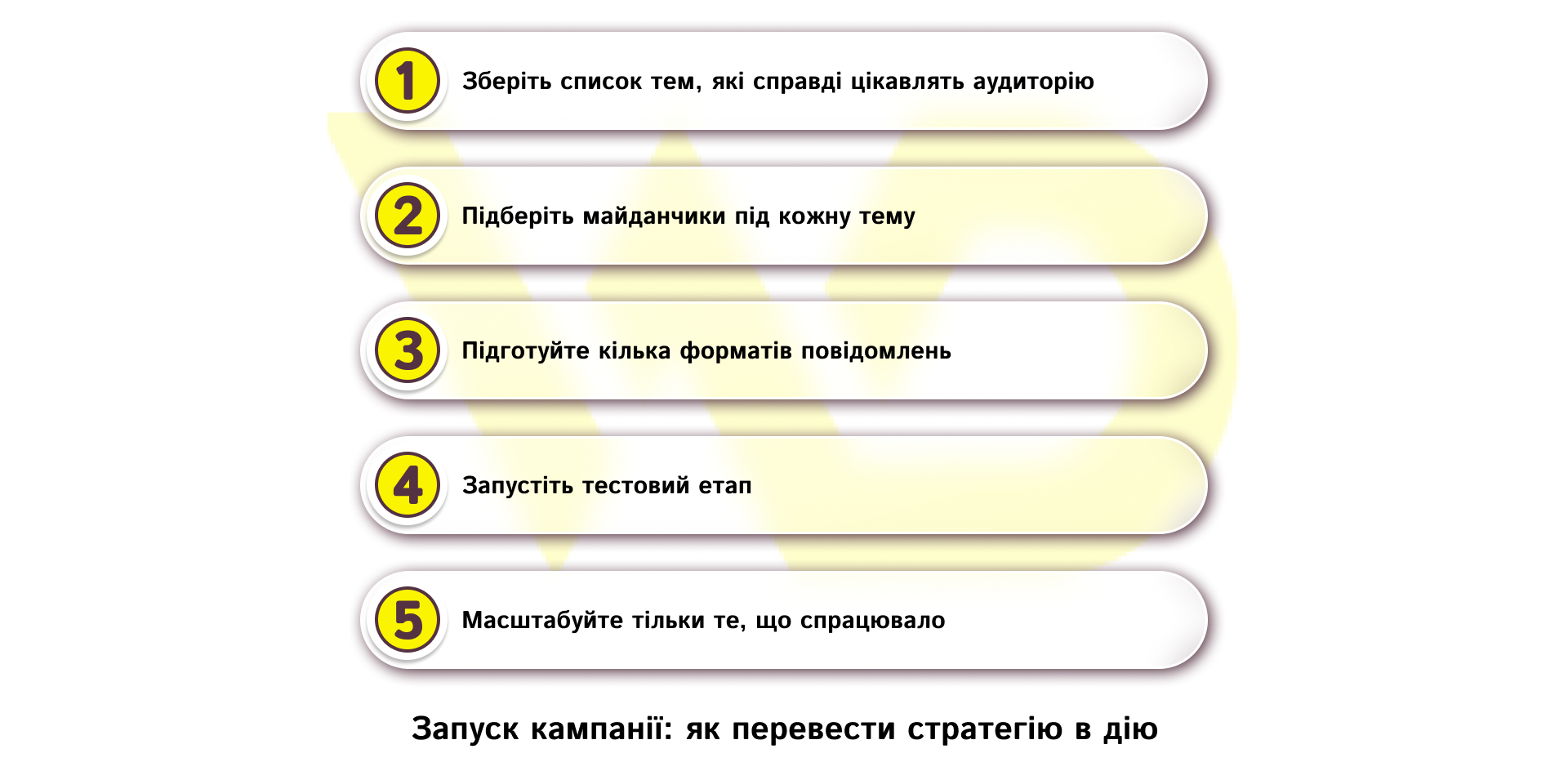
Compile a list of topics that genuinely interest your audience
Start by identifying topics that resonate with potential customers. To do this, it’s helpful to analyze inquiries to the sales department, questions on social media, comments under posts, customer reviews, and search queries.
For example, if a company sells a CRM system, the audience may be interested not only in the software itself but also in sales automation, manager oversight, integration with other services, or calculating the return on investment. These are the topics that create a natural context for future brand mentions.
The more precisely the topics are selected, the higher the likelihood that a comment or recommendation will meet the user’s need at the moment they are actively seeking a solution.
Select platforms for each topic
The next step is to find relevant platforms. It would be a mistake to focus solely on a platform’s popularity. It is far more important to assess the quality of the audience and the level of discussion activity.
When selecting platforms, pay attention to several factors:
- whether the platform’s topic aligns with your business;
- the presence of active discussions and new posts;
- user activity in the comments;
- the level of moderation;
- the ability to organically join the discussion.
For example, for an online electronics store, a niche forum with a few thousand active participants may be much more useful than a large general portal with hundreds of thousands of visitors who aren’t interested in this topic.
Prepare several message formats
One common mistake is using the same text across different platforms. Every community has its own communication style, so the message format needs to be adapted to the context.
In practice, you can use:
- short answers to specific questions;
- detailed expert comments;
- recommendations based on personal experience;
- comparisons of different solutions;
- additions to an existing discussion.
It is especially important to avoid promotional language. Users quickly recognize attempts at direct promotion, so such posts are often ignored or deleted by moderators. Responses that first help solve the problem and only then mention the brand as one of the possible options work much better.
Launch a test phase
Even the best strategy needs to be tested in practice. That is why, before a large-scale launch, it is advisable to conduct a test campaign that includes:
- testing several different types of platforms;
- testing the audience’s reaction to different post formats;
- measuring the number of website visits;
- identifying the topics that generate the most interest.
A test launch helps you gather real data instead of relying on assumptions. It often turns out that the platforms you were most focused on yield fewer results than small niche communities with an active audience.
Scale only what has worked
After analyzing the results of the test period, you can move on to expanding the campaign. But scaling should not happen by increasing the number of posts at any cost, but by strengthening the areas that have already proven effective.
At this stage, you typically increase the number of similar platforms, expand the list of topics for discussion, use the most successful post formats, and regularly update your platform database.
It’s important to remember that crowd marketing is a long-term effort. A single post rarely yields tangible results on its own. The effect builds gradually through the brand’s consistent presence in relevant discussions and the natural development of trust among the audience.
That is why, after launching a campaign, it is important to continue working with platforms and regularly analyze its effectiveness. Without measuring results, it is difficult to understand which actions benefit the business and which require adjustment.
How to measure results
When using crowd marketing, it’s much more important to see if it helps the site gain more visibility, traffic, and engagement. To do this, it’s helpful to combine data from Google Search Console and Google Analytics. Search Console shows how the site performs in search, while Analytics helps you understand what happens after users land on the site.
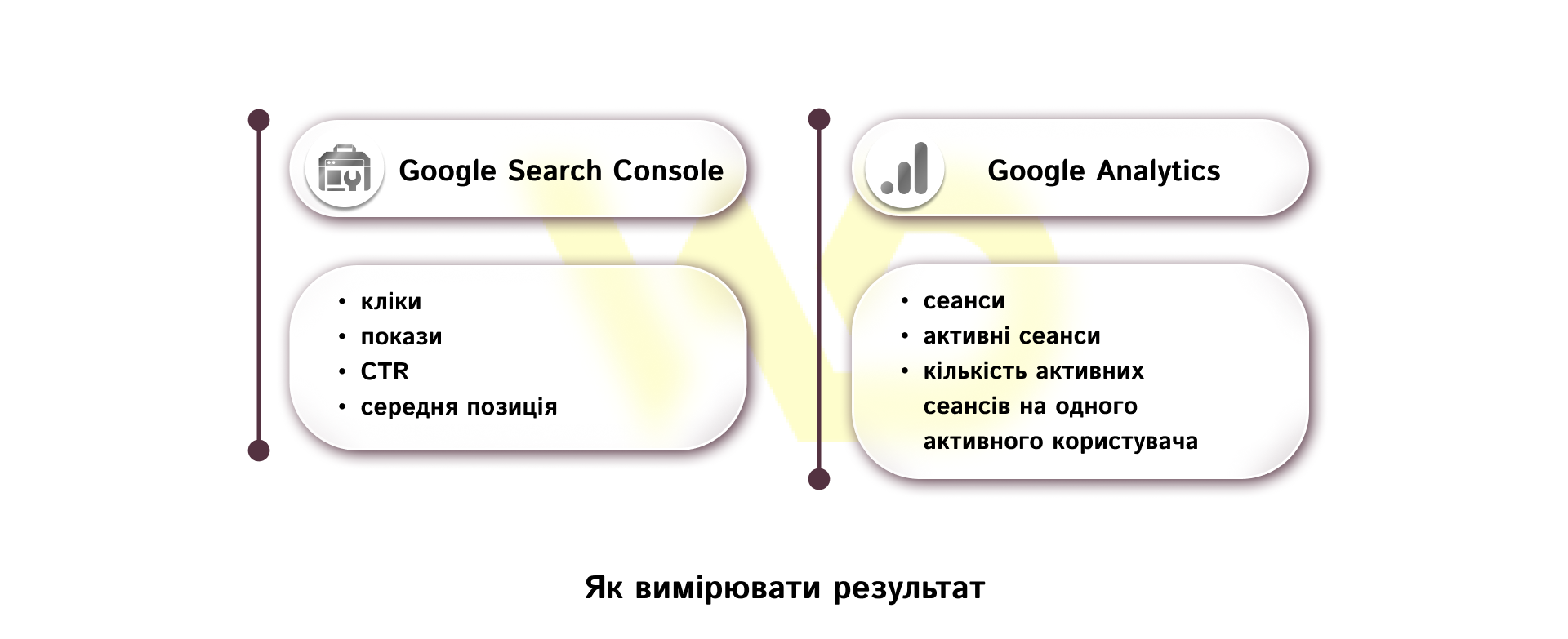
The Performance report in Search Console is particularly useful, as it shows clicks, impressions, CTR, average position, as well as a breakdown by queries, pages, and countries. This is helpful when you need to understand whether crowd placements have a noticeable effect on specific pages or brand-related queries.
In Google Analytics, you should look at sessions, active sessions, and the number of active sessions per active user. These metrics show not just that users have visited the site, but whether they are actually engaging with it after arriving from other platforms.
For convenience, it’s best to track these metrics before launching the campaign and then compare them at regular intervals. This makes it easier to see exactly what has changed after the crowd-marketing activity, rather than confusing its effect with the site’s overall trends.
How to choose a crowd-marketing contractor
Building an effective crowd marketing campaign requires time, experience, and constant work with platforms. That is why many companies outsource this task to external specialists or agencies. However, the result largely depends on how well the process is organized and how well the contractor understands the specifics of the niche.
When selecting a contractor, it’s important to look beyond just the number of platforms in their database or the cost of services. It’s far more important to understand how the work is structured and whether the contractor is focused on long-term results.
A reliable partner is usually distinguished by several characteristics:
- conducts a preliminary analysis of the niche and competitors;
- selects platforms tailored to a specific business rather than using a generic list of resources;
- creates unique messages instead of using boilerplate text;
- provides reports with a list of placements;
- helps evaluate campaign results based on actual metrics, not just the number of mentions.
Special attention should be paid to the approach to placements. If a contractor promises quick results through a large number of links, this isn’t always an advantage. For modern SEO, the relevance of platforms, the naturalness of mentions, and the value to the audience are far more important.
It is also advisable to clarify how communication takes place during the project. Crowd marketing rarely works on a «set it and forget it» basis. An effective campaign requires analysis, testing of new platforms, and gradual adjustment of the strategy based on the results obtained.
Regardless of whether crowd marketing is handled in-house or outsourced to an external contractor, the key criterion for success remains a systematic approach. It is this approach that allows individual brand mentions to be transformed into a full-fledged tool for supporting the company’s growth in the market.
How crowd marketing fits into the overall promotion system
Crowd marketing is not a standalone activity. It does not replace SEO, content marketing, or PR, but rather reinforces them. If the website features high-quality content and the brand receives relevant mentions in thematic discussions, the business develops a more cohesive presence in search results and in the eyes of the audience.
In other words, it is not a «one-time» tool. It helps maintain trust, provides users with additional touchpoints with the brand, and gradually strengthens the website’s visibility where people are already seeking advice and comparing options. That is precisely why crowd marketing should be planned alongside other channels, not separately from them.
If you view it specifically as part of a system, the logic becomes very clear:
SEO brings the user to the search → content answers their query → crowd marketing builds trust and helps the brand appear «alive» in real-world discussions
This is especially valuable for businesses because purchasing decisions are often made not after a single interaction, but after multiple touchpoints with the brand across various channels.

commercial offer
Other articles by the author

20/03/2026
An ambassador isn’t just a marketing channel—it’s a multifunctional resource: trust, content, traffic, reputation support, and product narrative.

12/08/2026
More and more professionals in traditional fields are choosing hands-on online courses to quickly acquire in-demand skills and break into the IT and marketing industries.

08/05/2026
For local businesses, a Google profile is often the first point of contact, even before a visit to the website or a phone call.
Latest articles by #SEO
16/09/2026
Choosing between search engine optimization and pay-per-click advertising is one of the most critical decisions when developing a marketing strategy.

04/09/2026
When two different users search for the exact same word in a search engine, they may get completely different lists of web pages, and the websites themselves are constantly changing their positions in the search results.

02/09/2026
Guest blogging remains one of the most effective tools for promoting a business, yet there are still many misconceptions surrounding it.