

 27/07/2026
  1248
1248

Інтернет-маркетинг
простою мовою
Content of the article
- /01 What is an anchor text and how does it work
- /02 Types of anchor text
- /03 The anchor list as a cohesive website ecosystem
- /04 The golden rule of safe promotion
- /05 Step-by-step algorithm for developing an effective anchor text list
- /06 How Google evaluates the text surrounding a link
- /07 How to monitor link quality without blowing your budget

What is an anchor list: definition, types, and role in link building for SEO

Today, link building is a capital-intensive investment in brand recognition. Effective management of a backlink profile requires a systematic approach, the foundation of which is designing the correct structure of text links.
In this article, we’ll take a detailed look at the inner workings of safe link building: the classification of anchor text, how to protect a website from search engine filters, and a step-by-step guide to building a robust link profile for a company.
What is an anchor text and how does it work
An anchor is the text of a link that a user clicks on in an article or post, and the browser redirects them to the company’s website.
In the website’s code, this is set up very simply. To turn ordinary words into links, a short HTML code containing the target page’s URL is used. It looks like this: <a href=”[https://yourcompany.com](https://yourcompany.com) “>effective marketing strategies</a>
For the average reader, all this technical code remains invisible. On a computer or smartphone screen, they’ll see only the neat phrase «effective marketing strategies», seamlessly integrated into the sentence.
But for Google search bots, this text is an extremely important clue. Google doesn’t just record that one website links to another; it carefully reads the words within the link to understand exactly what information awaits the user further on.
For example, if an authoritative resource links to your page using the phrase «marketing strategies», Google algorithm logically concludes that this site truly contains useful and expert content on marketing, since it’s recommended by others.
That’s exactly why the words you choose for your links directly determine which search queries will help your business rank at the top of search results.
Types of anchor text
To build a safe backlink profile, experts use a comprehensive classification of anchor text. Understanding these types allows businesses to flexibly manage their site’s relevance and avoid raising red flags with search algorithms by combining different types of text phrases.
|
Anchor type |
Meaning |
Example |
Risk level (for SEO) |
|
Brand |
Company name, brand name, domain name, or founder’s name |
«marketing agency experts (company name) », «according to (company name)» |
Minimal risk; builds trust with search engines |
|
Anchor-free |
The page’s clean URL in its original technical form |
[https://site.com](https://site.com), [www.site.com](https://www.site.com) |
No risk; the most natural type of link |
|
Exact match |
A commercial keyword that exactly matches the customer’s query |
«buy a diesel generator», «car rental in Kyiv» |
High risk, requires strict moderation |
|
Partial match |
A commercial keyword supplemented with additional words or a geographic qualifier |
«reliable diesel generator for home», «car rental prices» |
Moderate risk, perceived more leniently by the system |
|
Commonly used |
Navigational keywords that prompt the user to take action |
«here», «more details», «follow the link», «source» |
No risk, effectively diversifies the profile |
|
Media anchor |
A link embedded in a banner or image. The Alt tag serves as the anchor. |
Code description: alt=”50 kW industrial generator” |
Minimal risk; drives traffic from Google Images |
Each of these types serves a unique function within the overall promotion strategy. A sound strategy is never built on just one type of anchor text but uses them as a comprehensive toolkit, where high-risk commercial queries are always balanced by completely safe branded and non-anchor links.
The anchor list as a cohesive website ecosystem
When a company begins to systematically work on off-page optimization, individual links are consolidated into a single ecosystem.
An anchor list is a complete inventory of all text phrases, words, and URL contained in hyperlinks pointing to your website from all third-party web resources on the internet.
It is essentially a digital snapshot of a business’s link history, reflecting the website reputation across the global web.
For modern SEO, the anchor list is the most important strategic asset and, at the same time, an area of heightened focus. When evaluating the quality, relevance, and authority of an online project, Google’s algorithms do not analyze each link individually but rather the entire anchor text profile as a whole. They assess its thematic coherence, growth dynamics, and, most importantly, its level of naturalness.
The concept of naturalness is a key criterion that search engines rely on when evaluating websites. In real life, if a website’s content is truly useful, different people will link to it in completely different ways. Some will include the company name, such as; others will copy the link; and still others will simply write «read more here». If, however, a company’s anchor text consists mainly of similar commercial queries like «price of legal services», search engine bots will instantly identify this as an attempt at artificial manipulation and search engine optimization.
It’s important to understand that a high-quality anchor text list isn’t a static document that can be created once and for all. It’s a dynamic structure that must constantly evolve and be adjusted.
As consumer trends change, new products are added to the company’s lineup, or Google’s search algorithms are updated, the anchor text strategy must quickly adapt to new market realities, ensuring the stability of the website’s rankings.
SEO that works in the long term
The WEDEX team provides comprehensive SEO services: from technical optimization and content management to building a high-quality backlink profile. We’ll help strengthen your website’s position and increase its visibility in search results.
The golden rule of safe promotion
To prevent a website from falling under Google strict filters and penalties, its links on the internet must appear as natural as possible. The main rule of safe marketing is simple: there should be significantly more unobtrusive links without exact commercial phrases than aggressive advertising.
A general formula to use as a guideline looks like this:
- 70–80% — safe base (natural mentions):
-
- non-anchor text: clickable indicators such as «here», «source», «more details», «on this site»;
- direct URL: when a link like site.com or [https://site.com](https://site.com) is simply inserted instead of text;
- branded links: mentions of your company name or brand.
- 20–30% — commercial anchor text:
-
- links that use the exact or partial keywords you want to rank for, such as «buy a laptop in Kyiv» or «apartment renovation cost».
This balance shows search engine crawlers that your site is growing organically, and that people are sharing links to you simply because they like your product or content.
However, you shouldn’t blindly copy standard percentages, since each industry has its own ranking rules:
- «simple» niches, such as express flower delivery or taxis: here, the level of commercial spam online is traditionally higher. Search engines understand this specificity and are usually lenient toward a higher number of commercial keywords in anchor text;
- High-stakes niches, such as medicine, law, finance, and large-scale B2B: Google has very strict requirements for content expertise and authority in these areas (the E-E-A-T concept). The slightest overuse of commercial keywords—and the site instantly loses its search rankings.
Instead of guessing percentages based on intuition, it’s better to study in detail those who are already succeeding in your field. The entire analysis process can be broken down into four simple steps.
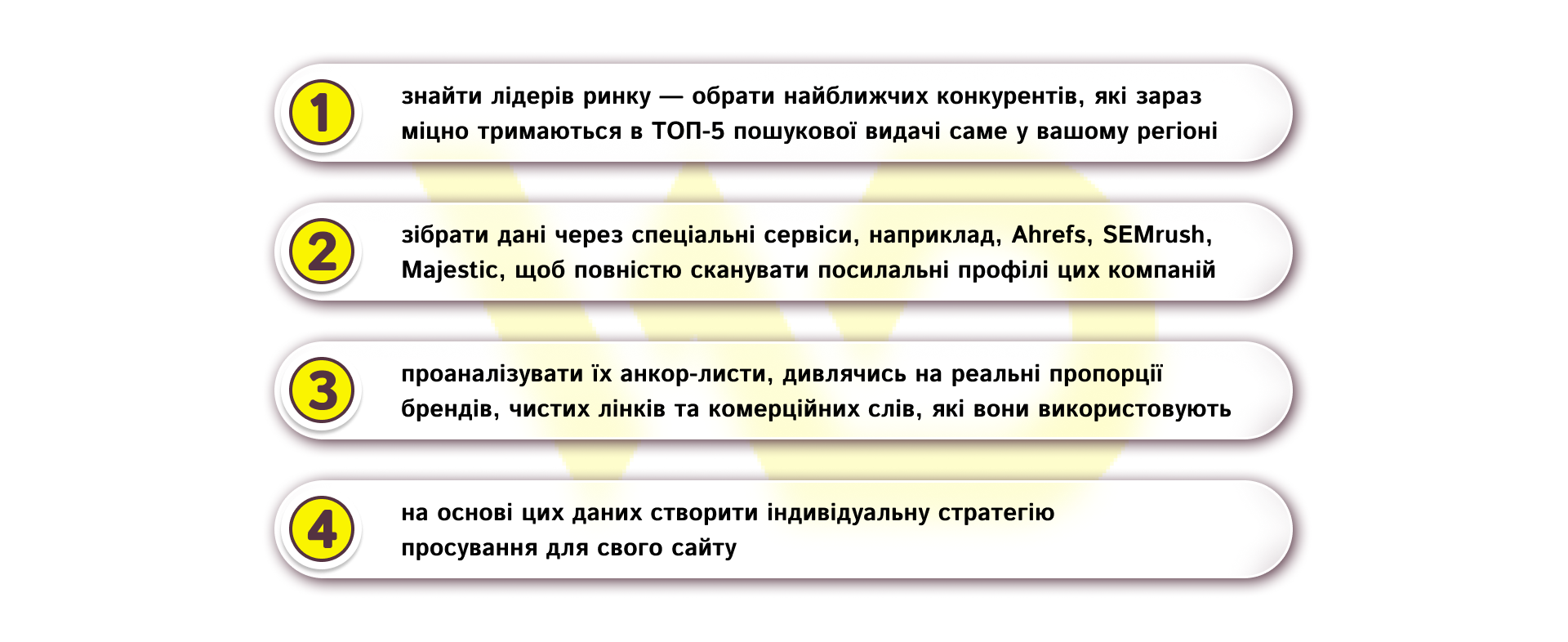
Creating an anchor text list based on real niche data — rather than random guesses — reliably protects your site from sudden drops during Google regular updates. Only after you’ve clearly defined your safe limits and proportions can you confidently move on to the actual keyword research and designing the architecture of your future backlinks.
Step-by-step algorithm for developing an effective anchor text list
The process of creating a professional anchor list requires a strict sequence of steps, precise calculations, and an understanding of the website’s architecture. Each step logically follows from the previous one, forming a solid foundation for the company’s off-page promotion.
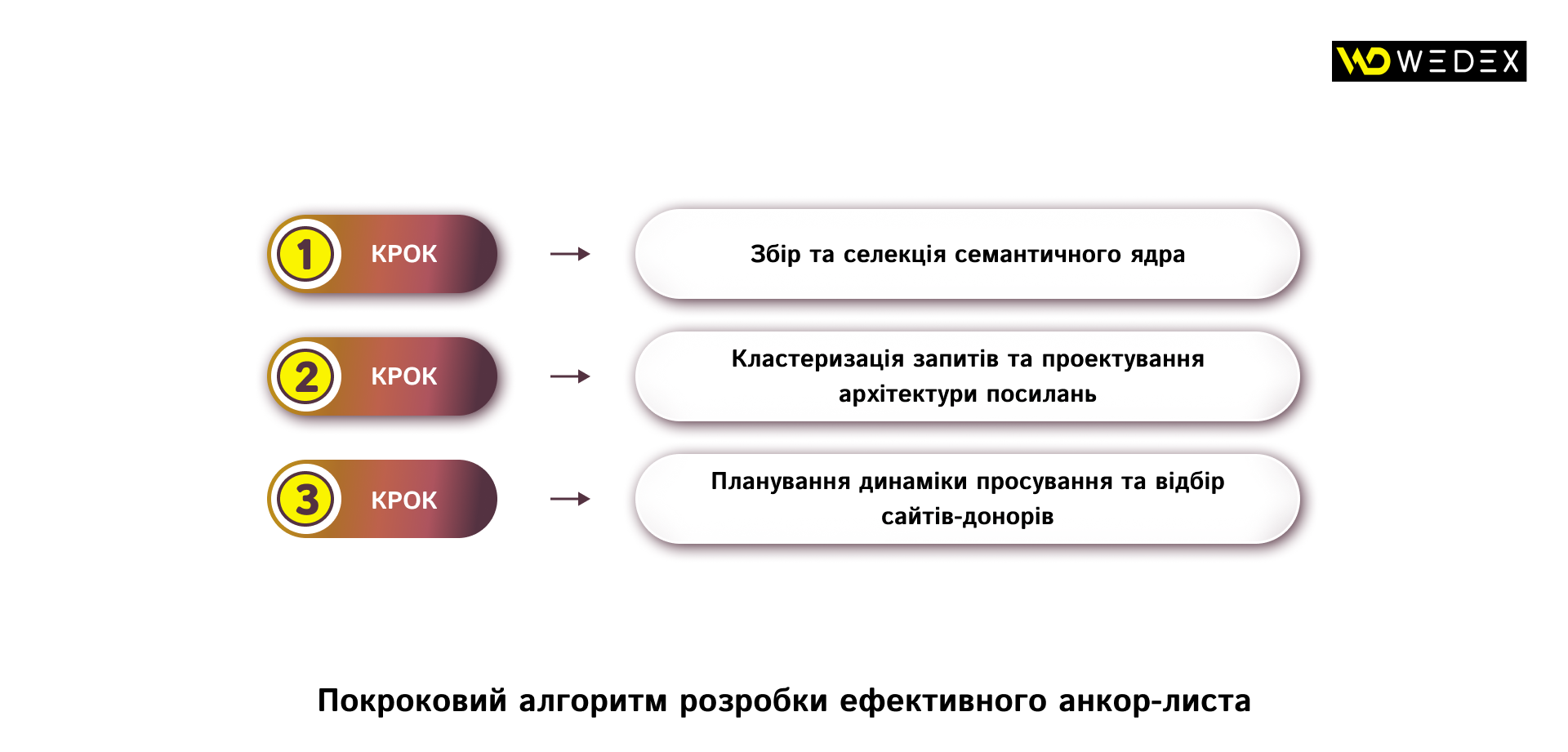
Step 1. Collecting and selecting the semantic core
The foundation for building an anchor list is gathering a comprehensive pool of keyword queries that customers use to search for your products or services. As mentioned above, analytical tools are used to collect semantic data, which must be classified by search volume. For off-page promotion, you cannot rely solely on high-volume queries, which require massive budgets. It is strategically important to select a combination of several high-frequency queries, several dozen medium-frequency queries, and a large number of low-frequency, highly specific queries. Low-frequency queries are the easiest to promote, and it is precisely these that provide the business with a quick return on investment and targeted conversions in the early stages.
Step 2. Clustering queries and designing the link architecture
After collection, keywords are divided into logical groups (clusters), each of which is linked to a specific type of page on your website.
There is a clear rule for weight distribution here:
- the site homepage is promoted primarily through branded anchors and direct URL, building the company overall authority in Google eyes;
- product and service categories, as well as specific landing pages, bear the brunt of commercial and diluted anchor text with transactional prefixes;
- informational sections and the corporate blog are promoted using informational queries and long-tail keywords, which helps attract a warm audience that is in the decision-making stage.
Step 3. Planning the promotion strategy and selecting donor sites
The final step is to create a detailed schedule for link placement and establish strict criteria for the platforms where they will be published. The growth of your backlink profile should be smooth and gradual, especially if your website was recently launched
Platforms for link placement should be selected based on the principle of maximum quality, not low price. Links placed on authoritative industry resources, well-known online media outlets with high organic traffic, and blogs by thought leaders bring real value to your business. The main criteria for evaluating a donor site are high-quality content, the absence of link spam, and complete thematic relevance to your business.
Strict adherence to this sequence helps avoid haphazard actions and ensures that every hryvnia invested in link building will work to strengthen the website rankings.
How Google evaluates the text surrounding a link
Modern search engine crawlers have become much smarter. Thanks to artificial intelligence, Google no longer views anchor text as a word detached from reality. Today, the system carefully analyzes all the «surrounding» content — the sentence, paragraph, and even the overall topic of the article in which your link appears.
This radically changes the work of copywriters and the overall approach to publishing. Previously, you could simply buy a bunch of links and insert them into clunky text written purely for the sake of quantity. Today, this is a surefire way to lose rankings and waste your budget.
The text surrounding the link must now be engaging, logical, and useful. If the article is written in simple, human language, explores the topic in depth, and the link to your site appears as an organic addition that genuinely helps the reader learn more Google will award such a link the highest score.
Three rules for a high-quality link profile
To ensure the link performs at its best and doesn’t raise any red flags with search engines, follow a few simple guidelines when creating content:
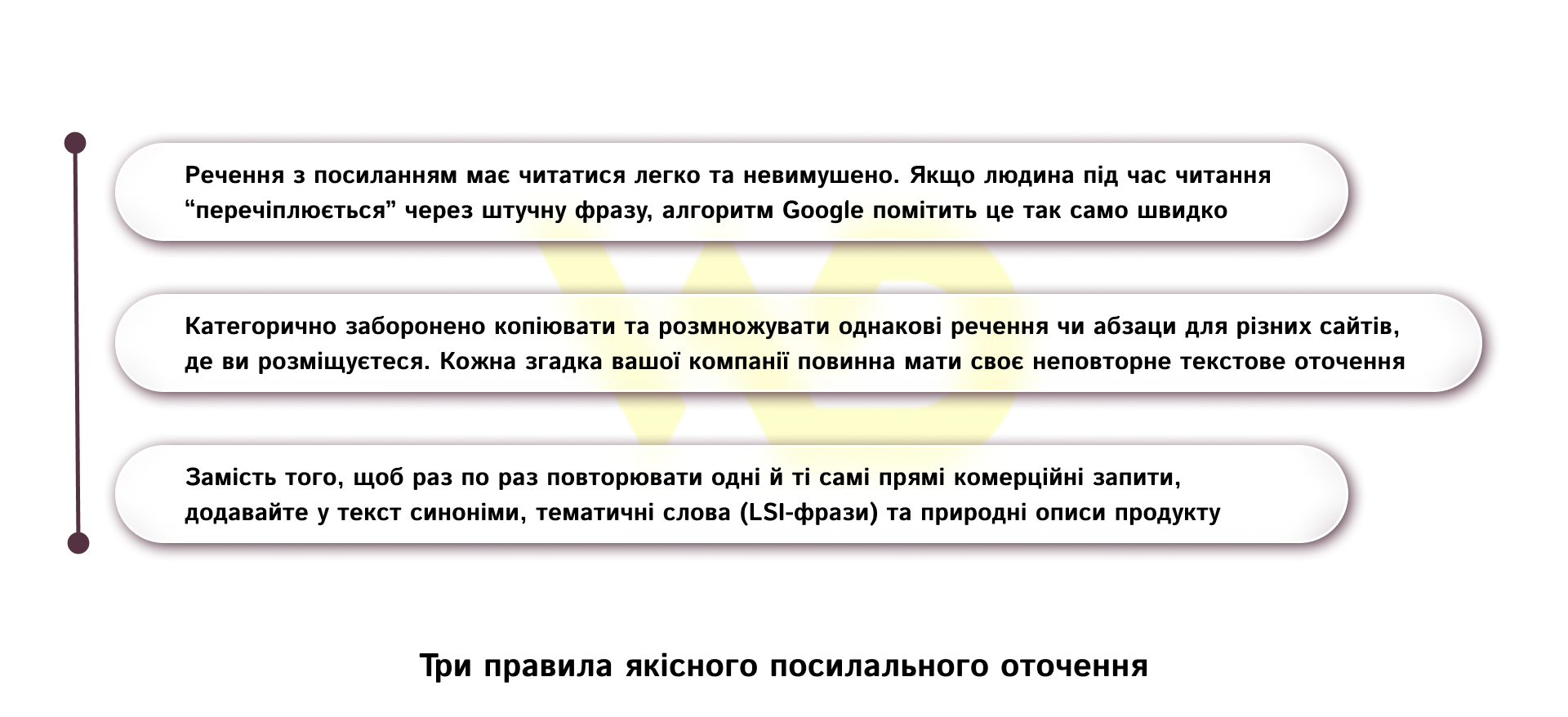
Of course, creating such natural content requires much more time and effort from a copywriter than simply churning out content using a template. However, it is precisely this approach that guarantees long-term and stable results for a business. When Google sees that a link is surrounded by high-quality, relevant text, it assigns significantly more authority to your site. And this automatically makes the company’s entire link-building strategy many times more effective.
How to monitor link quality without blowing your budget
A company executive or marketing director doesn’t necessarily need to get bogged down in routine technical processes. However, it’s important to understand how safely your contractors are promoting your business. The state of your anchor text list is the best indicator of your SEO team performance.
To protect your investment in promotion, your business only needs to monitor three key metrics.
- Link velocity. Links to your site should appear smoothly and gradually. If contractors offer you «package» solutions involving the simultaneous placement of hundreds of links turn them down. This is a surefire way to trigger Google’s filters.
- Competitor activity (Negative SEO). Unscrupulous competitors may deliberately flood your site with thousands of spam links containing toxic anchor text. Regular monthly monitoring will help you detect an attack in time and block it using the Google Disavow Tool.
- Brand profile alignment. In a transparent and high-quality link-building strategy, your company name and the exact website address will always be the most frequent elements in the overall list.
Link building is a long-term process that doesn’t deliver instant results overnight, but step by step, it builds your business’s online presence. By investing in a natural and diverse anchor text profile today, you’re building a solid digital asset. It is this foundation that will allow your website to consistently maintain its leading position in search results for years to come, regardless of future changes to search engine algorithms.

commercial offer
Other articles by the author

10/09/2026
The leader's primary goal is to create conditions under which every employee works to the best of their ability, with a clear understanding of the overall direction.

24/04/2026
That is why, in marketing, it is important not just to describe a product’s features, but to translate them into the language of needs.

12/08/2026
Understanding your audience forms the basis for every decision: from choosing the color scheme for your designs to setting up complex funnels in Meta Ads.
Latest articles by #SEO
22/10/2026
To properly link Instagram to Facebook, you need to distinguish between the different types of accounts within the Meta ecosystem, since confusion between a personal profile and a business page is the most common cause of errors during setup.
09/09/2026
The Facebook lead form helps businesses collect contact information from potential customers directly from an ad, without requiring them to visit the website.
08/09/2026
Today, an influencer is a distinct media platform with its own editorial policy, a keen understanding of its audience, and an established level of trust.