

 12/08/2026
  1418
1418

Інтернет-маркетинг
простою мовою
Content of the article

How to find and engage your target audience on Instagram

Today Instagram has definitively transformed from a photo-sharing platform into a highly competitive business ecosystem. Meta algorithms are designed to maximize auction precision, and the cost of acquiring a qualified lead is constantly rising. Under these conditions, promoting «blindly» or using outdated templates only leads to the rapid depletion of your advertising budget.
In this article, we’ll break down a systematic approach to building an SMM strategy: from in-depth audience segmentation using modern marketing frameworks to practical engagement tactics, Direct messaging automation, and converting followers into loyal customers.
The role of the target audience in Instagram marketing
A target audience isn’t just an abstract group of followers, but a clearly defined segment of users with similar needs, purchasing triggers, and the highest conversion potential. Understanding your buyer forms the basis for every decision: from choosing a color scheme for your designs to setting up complex funnels in Meta Ads.
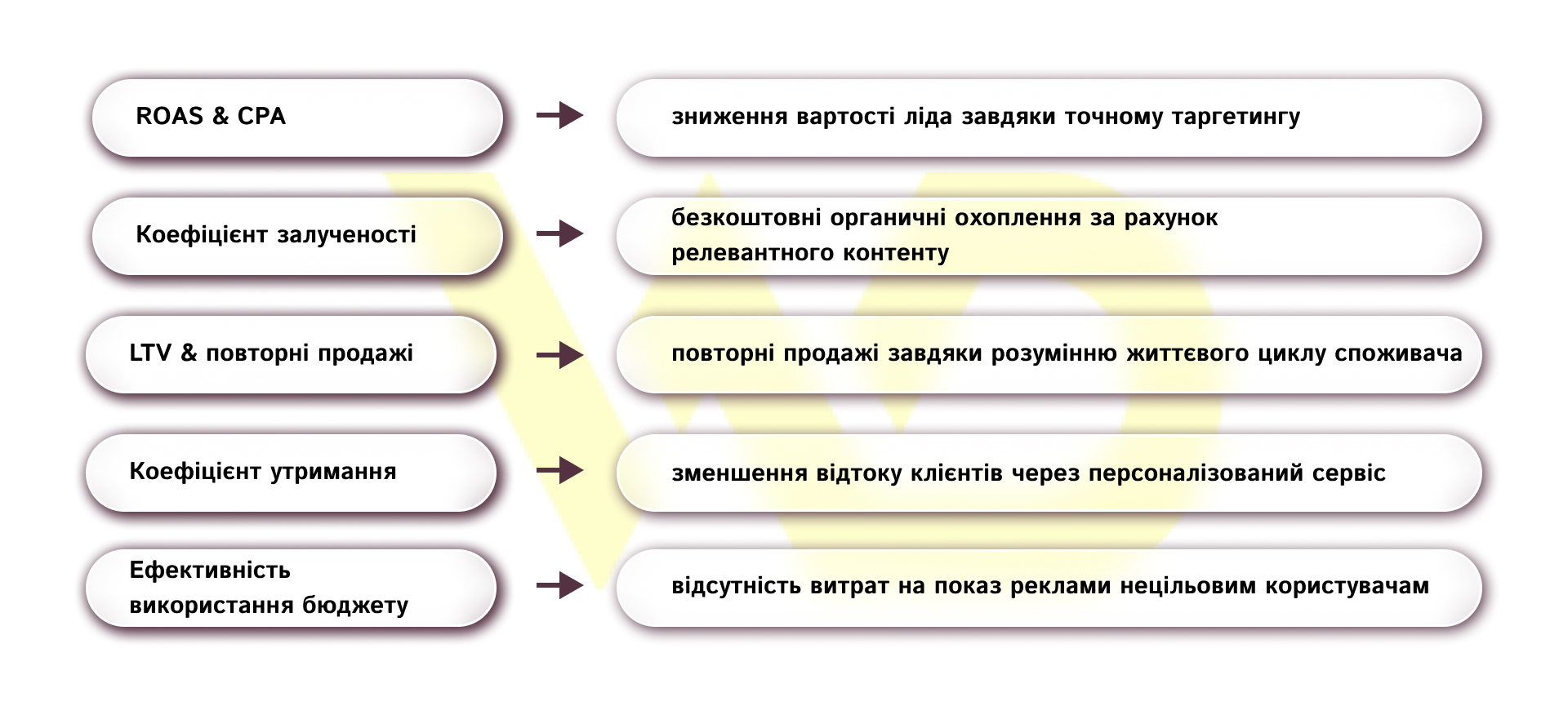
An in-depth analysis of the target audience impacts key financial metrics for your business on social media:
- increased return on ad spend (ROAS): when ads are targeted at a specific segment with its unique «pain points», the click-through rate (CTR) increases, and the cost per lead (CPL) decreases significantly;
- optimization of the engagement rate (ER): content created to address the audience’s current needs elicits a natural response saves, reposts, and comments which signals Instagram’s algorithms to provide a free organic boost;
- increased LTV: understanding the customer lifecycle allows you to offer additional products at the right time that is, to perform upsells and cross-sells and turn one-time buyers into brand advocates;
- reduced costs of correcting mistakes: preliminary research into audience barriers prevents the launch of products or services that won’t be in demand on the market.
Peter Drucker, the father of modern management, also confirms the importance of the target audience in his book «The effective executive»:
The most important thing in communication is to hear what has not been said.
An example of ignoring this principle is when a premium furniture brand tries to sell sofas through posts offering generic discounts for «anyone doing home renovations». Instead, an analysis of the target audience shows that their customers don’t need discounts, but rather confidence in the durability of the materials and 3D visualizations tailored to their interior design. Shifting the content focus from «price» to «personalized design project» immediately improves the quality of incoming inquiries.
That is precisely why audience analysis must precede the creation of a content plan or the launch of advertising campaigns. Without this fundamental step, any SMM activities turn into chaotic experiments with a high risk of loss.
Audience segmentation and customer profile
Audience descriptions such as «men and women aged 25–45 living in large cities» have long since ceased to work in targeted advertising. To build high-conversion funnels in marketing, marketers use Mark Sherrington 5W methodology and the Jobs-to-be-Done (JTBD) concept, which explores what «job» your product needs to perform for the customer.
The 5W methodology allows you to break down your audience into several microsegments based on clear criteria.
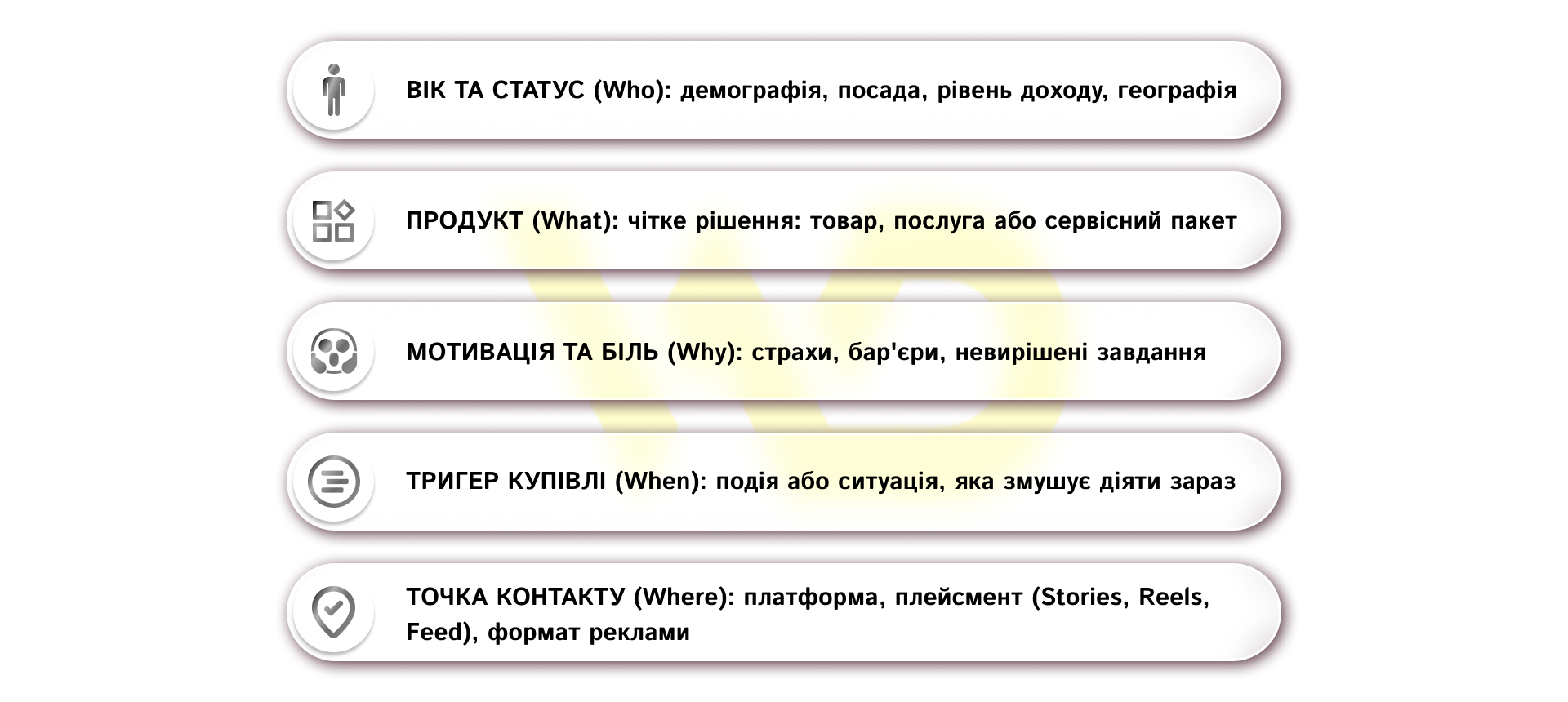
The 5W Segmentation Framework for Instagram
Instead of a general description of the audience, the 5W methodology allows you to break down consumers into several distinct segments in detail. This enables you to tailor your content strategy to the actual needs of customers in both B2B and B2C segments.
Who: defining the consumer profile
The first step involves clearly identifying the personal, professional, and social characteristics of your potential buyer. The tone of voice and visual style of the content depend on this parameter.
- In the B2B segment, for example, for a marketing agency, the target audience consists of small and medium-sized business owners, marketing directors (CMO), or department heads who make decisions about hiring contractors.
- In the B2C sector, for an online clothing store, the consumer profile consists of busy professional women aged 28–38 with medium to high incomes.
Understanding a client’s social status allows you to build a dialogue based on shared values and in a language they understand.
What: Identifying the actual product
This parameter defines exactly what the consumer is buying in terms of value, not just the physical characteristics of the product or service. The customer always buys the end result or a convenient solution to their problem.
- In the B2B niche, businesses don’t just order «Instagram posts», but rather comprehensive SMM promotion and systematic lead generation that delivers measurable leads into the CRM system.
- In the B2C segment of the apparel retail market, women don’t buy individual skirts or blouses; instead, they purchase ready-made capsule wardrobes for the office, which eliminate the need to mix and match outfits every day.
A clear understanding of the product allows you to create offers that sell the end benefit, not the process.
Why (Why?): analysis of pain points and motivation
This parameter addresses the underlying reasons for making a purchase specifically, the fears, barriers, or problems the customer seeks to eliminate with your solution.
- In the B2B sector, the main pain point for entrepreneurs is the lack of a systematic sales approach via social media and a chronic lack of time to handle marketing on their own.
- In the B2C segment, the key trigger for a busy woman is the daily lack of time to choose and coordinate outfits every morning before work.
When the content on your profile precisely addresses these pain points, audience trust increases, and price resistance decreases significantly.
When: identifying the trigger moment
Purchases rarely happen spontaneously without an external or internal impetus. It’s important to identify specific situations or scenarios that prompt a person to seek a solution right now.
- For a marketing agency’s B2B clients, such triggers often include cash flow gaps, sales stagnation, or a period of active company scaling when internal resources are no longer sufficient.
- In B2C retail, the motivation is a change of season, a rapid promotion, or an upcoming important event that requires a new look.
Tracking these moments helps launch targeted campaigns with relevant offers at the right time.
Where: touchpoints on Instagram
The final element identifies specific locations and formats for engaging with the audience within the social network.
- For a B2B audience, the main touchpoints are expert Reels analyzing real-world case studies, live streams featuring analytics, and private messaging via Direct, where the details of a partnership are discussed.
- In the B2C segment, native engagement occurs through dynamic Reels featuring product demos, daily interactive Stories, and eye-catching ads in targeted campaigns.
The right placement ensures that your advertising message reaches the consumer in the format that’s most convenient for them.
A systematically developed 5W matrix allows you to create a comprehensive understanding of each segment of the target audience and tailor your content strategy accordingly.
In addition to the 5W framework, it’s important to segment potential customers based on their position in the marketing funnel.
- ToFu (Top of Funnel), cold audience: aware of the problem but does not yet know how to solve it. Requires educational and expert content.
- MoFu (Middle of Funnel), warm audience: compares different methods of solving the problem and product options. Needs comparisons, portfolios, and case studies.
- BoFu (Bottom of Funnel), hot audience: ready to make a purchase and choosing between you and your direct competitors. Needs a clear USP, reviews, and calls to action (CTA).
For example, if you sell apartment renovation services, the ToFu segment searches Instagram for «kitchen design ideas», MoFu analyzes «mistakes to avoid when choosing a renovation contractor», and BoFu searches for «turnkey renovation estimates for a two-bedroom apartment». Creating content tailored to each of these stages allows you to smoothly guide the user from their first encounter with your brand to closing the deal. After all, marketers know that
Marketing is no longer about what you produce, but about the stories you tell — Seth Godin, marketer and bestselling author, in his book «All Marketers Are Liars».
Deep segmentation is the foundation for creating relevant content. When each segment sees materials that correspond to its current stage in the funnel, conversion to the desired action increases significantly.
Algorithm and methods for finding potential customers
After formulating hypotheses about target audience segments, you need to identify where they are most concentrated on Instagram. The search focuses on analyzing the digital footprints users leave on the platform every day.
A systematic audience discovery process includes three main areas:
- In-depth competitor analysis. Select 5–10 direct and indirect competitors with high activity levels. Examine the profiles of users who leave meaningful comments, review saves and reposts under posts, and analyze negative reviews;
- Working with niche hashtags. Use geographic tags (#renovationkyiv), intent-based tags (#buydresskyiv), and interest-based tags (#crossfitukraine) to find niche communities;
- Geolocation and local communities. For local B2C businesses, analyze posts within a 1–3 km radius of your location and accounts of related businesses with a similar audience.
For clarity and a better understanding, let’s consider a local children’s center. Instead of buying ads in city-wide public groups, marketers collected geotags from private maternity hospitals, children’s cafes, and recreational parks. Analyzing the accounts of parents who had checked in at these locations allowed them to create a highly targeted offer featuring a free trial class.
Regular use of these techniques allows you to continuously expand your pool of potential customers and stay on top of changes in audience behavior.
Audience analytics tools and services
Manual analysis provides a qualitative understanding of the audience, but automated tools are necessary for scaling the business and regularly testing hypotheses. A modern SMM specialist toolkit combines Meta internal solutions with external analytics platforms, allowing for the study of user behavior at various stages of interaction with the brand.
It’s important to structure the analytics process as a multi-tiered system: from the initial collection of basic demographic data to in-depth reputation monitoring and filtering out non-targeted traffic.
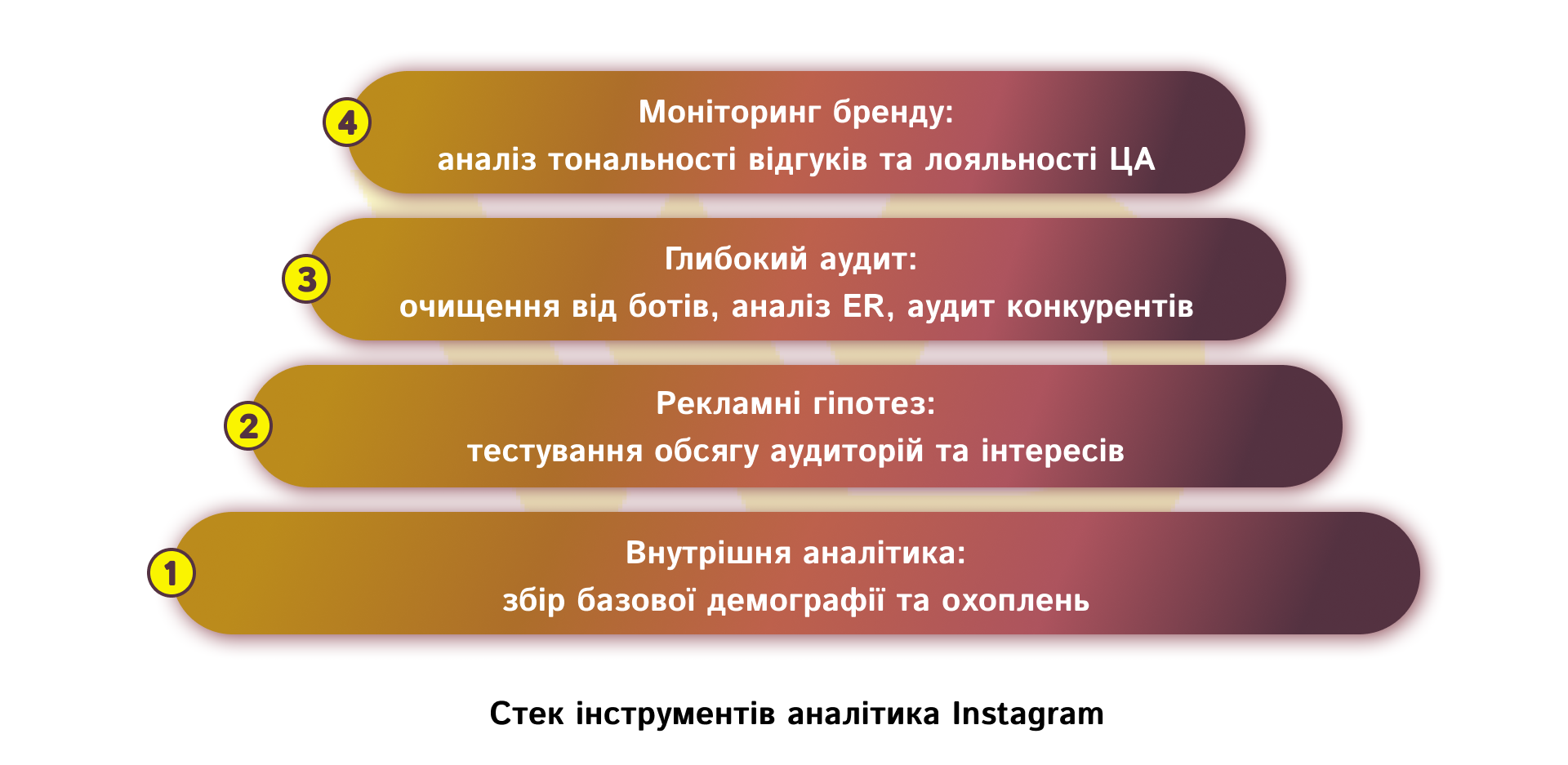
Using specialized services at each of these levels helps filter out «junk» traffic — such as bots, mass followers, and spam accounts from the analysis. This allows you to build a marketing strategy based on real behavioral data from a target audience with purchasing power.
Let’s take a look at which target audience analytics services are most commonly used in the B2B and B2C segments.
|
Tool |
Category |
Key features |
What it’s used for |
|
Internal analytics module |
Analysis of age, gender, top cities, and periods of peak subscriber activity |
Optimization of posting times and adjustment of the content plan |
|
|
Advertising tool |
Audience size estimation based on interests, behavioral factors, and devices |
Market size validation prior to launching paid advertising |
|
|
Third-party SaaS service |
In-depth verification of accounts for bots, analysis of demographics and audience growth |
Competitor analysis and blogger audits before purchasing ads |
|
|
Corporate platforms |
Brand sentiment monitoring, ER analysis |
Comprehensive reputation and engagement analytics for major brands |
While basic Meta Business Suite reports and periodic audience testing in Ads Manager may be sufficient for a small local business, for a national brand or marketing agency, using external analytics platforms is a mandatory quality standard for protecting advertising investments.
Strategies for driving audience engagement to an account
Engaging your target audience requires a synergy between paid and organic traffic. Relying on just one channel is risky, as algorithm changes can drastically reduce organic reach, while rising ad auction bids can increase the cost per lead.
A three-pronged engagement strategy delivers the best results.
- Organic engagement (Reels & Instagram SEO): short videos that address specific target audience queries and feature text optimized for search algorithms.
- Paid traffic (Meta Ads): using Lookalike audiences based on CRM data, automated Advantage+ campaigns, and retargeting warm users.
- Influencer marketing (collaboration with bloggers): working with micro- and nano-influencers (1k–50k) to generate native recommendations with high credibility.
Let’s look at an example of a comprehensive campaign for an online foreign language school. The agency launched a series of short Reels breaking down common mistakes in spoken language. Users who watched the videos were funneled into a retargeting funnel in Meta Ads and received an offer to download a free guide. At the same time, three nano-bloggers ran a challenge to learn 10 words a day. This synergy resulted in a 42% reduction in the cost per subscriber acquired.
Building a multi-channel acquisition system ensures a steady influx of new users regardless of seasonal fluctuations or platform algorithm updates.
How to retain acquired customers
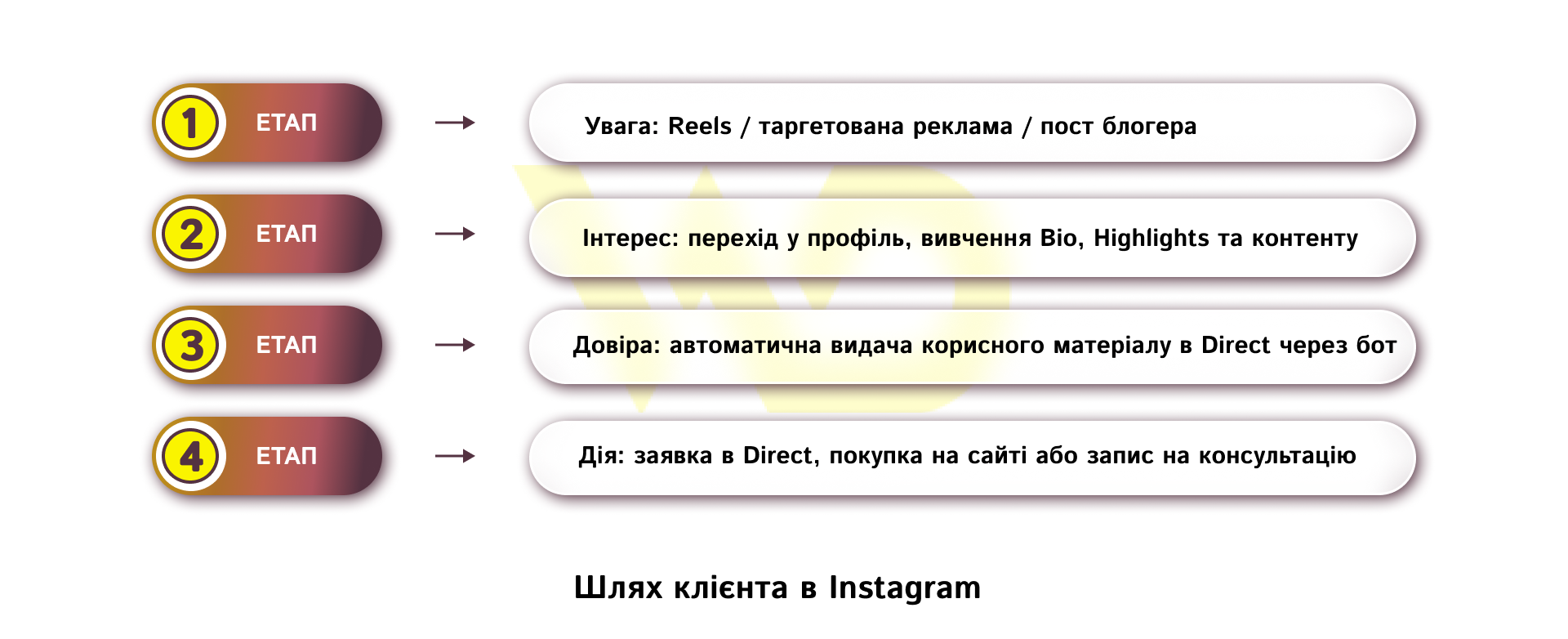
Acquiring followers is just the beginning of the funnel. True monetization occurs during the retention phase, when a casual visitor becomes a loyal customer through the profile’s established infrastructure.
The key elements of this infrastructure are:
- An optimized profile bio: a clear USP, location, and call to action (CTA) with a link to a multi-link.
- Pinned Stories (Highlights): «Services», «Case Studies», «Pricing», and «FAQ» sections to address objections.
- Automation in Direct (ManyChat): chatbots for instant delivery of lead magnets and 24/7 lead qualification.
- Interactive content plan: polls and quizzes in Stories to maintain a high engagement rate (ER).
Analysis of key metrics — CAC (customer acquisition cost) and LTV (lifetime value) — serves as an indicator of the effectiveness of the chosen SMM strategy. If the acquisition cost exceeds the profit margin on the first sale, systematic retention becomes the only way to ensure a positive ROI for the marketing campaign.
Therefore, an Instagram marketing strategy is not a static document but an ongoing process of testing hypotheses and optimizing metrics. Defining a target audience profile, segmenting it in depth, and using modern analytical tools allow you to build a sustainable engagement system and turn the company’s account into a predictable profit-generating channel.

commercial offer
Other articles by the author

05/02/2026
When a brand tells stories about people, challenges, and solutions, it becomes more understandable and relatable to the customer.

12/08/2026
Broken links and non-existent pages aren't just technical flaws in a website they're a direct path to losing potential customers and dropping in search engine rankings.

08/07/2026
Donor analysis isn't about examining a single metric; it's about comparing several metrics against one another.
Latest articles by #Useful tips
16/09/2026
Choosing between search engine optimization and pay-per-click advertising is one of the most critical decisions when developing a marketing strategy.

04/09/2026
When two different users search for the exact same word in a search engine, they may get completely different lists of web pages, and the websites themselves are constantly changing their positions in the search results.

02/09/2026
Guest blogging remains one of the most effective tools for promoting a business, yet there are still many misconceptions surrounding it.