

 27/05/2026
  1590
1590

Інтернет-маркетинг
простою мовою
Content of the article

How search engines work: what you need to know before promoting your website

Website promotion only makes sense when you understand exactly how a search engine views pages, what it can index, and what signals it uses to generate search results. For businesses, this isn’t a technical detail it’s the foundation for SEO, content, website structure, and launching ads. In this article, we’ll look at how search engines work, the stages a page goes through before appearing in results, and what to consider before launching an SEO campaign.
What is a search engine
A search engine is not just a search bar. According to Google’s logic, it is a fully automated system that regularly crawls the web using web crawlers, finds pages, adds them to the index, and then returns the results most relevant to the user’s query.
In other words, a search engine works like a large library. It finds new content, then describes it, and only then decides whether to display it in the results. Therefore, it is critical for a business that its website pages get indexed otherwise, they simply won’t appear in search results and won’t be able to generate traffic.
How a search engine finds and crawls pages
Google does not have a single registry of all web pages, so new URLs are discovered during web crawling. The search engine finds pages in various ways.
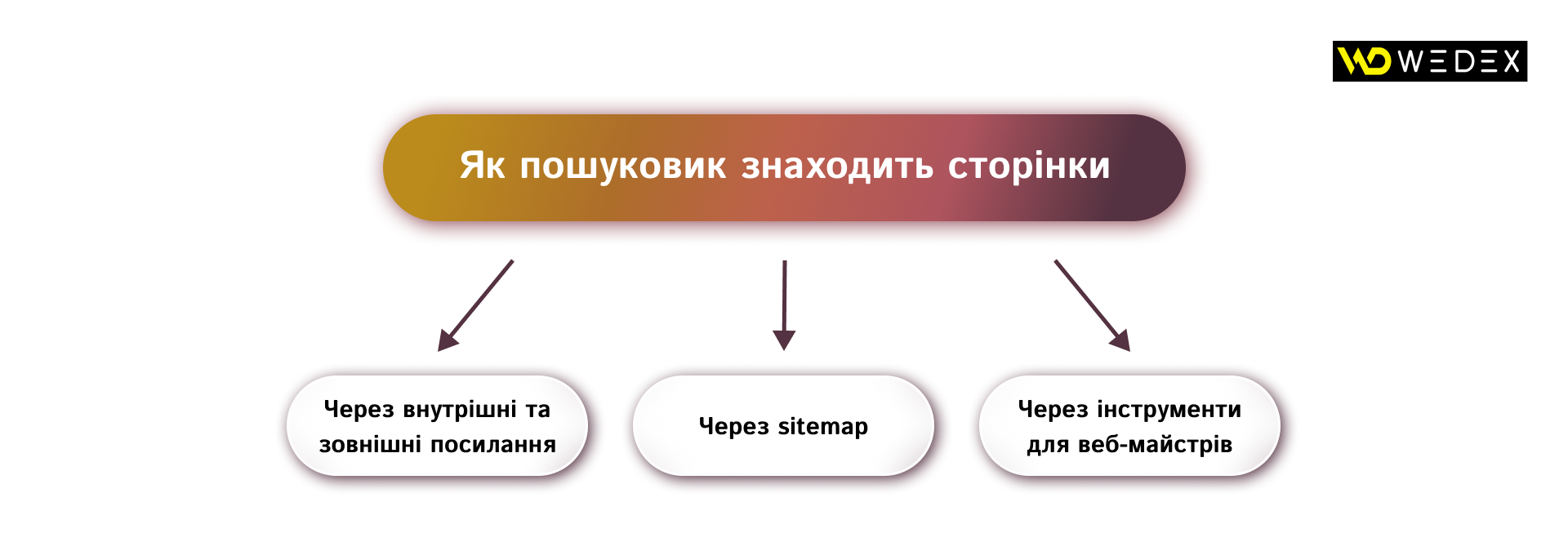
- Through internal and external links. If a page is linked to from already known resources, the search bot follows those links and discovers the new URL.
- Via a sitemap. A special file in which the site owner lists important pages for indexing.
- Through webmaster tools (Search Console). This allows you to notify the search engine about new pages or updates.
Once a URL is detected, the page may be crawled by Googlebot, which determines how often and to what extent to crawl the site.
Important! If there are no internal or external links leading to the site, and there is no sitemap or proper technical structure, it is more difficult for the search engine to find new pages. Therefore, promotion begins even before working on content that is, with the correct site architecture.
After discovering a URL, Googlebot visits the page and fetches its content: text, images, and videos. During crawling, Google also renders the page and executes JavaScript using the latest version of Chrome. This means that content loaded solely via scripts must be accessible for rendering; otherwise, the search engine may not see it.
Googlebot does not crawl everything without restrictions. It takes website accessibility into account, may reduce crawl frequency if it detects server issues, and does not visit pages that are closed to crawling or inaccessible without authorization.
Technical errors can halt promotion even before the ranking stage.
How a page gets indexed
Indexing is the stage at which the search engine analyzes a page’s content, determines its canonical version, and stores the information in its index. Only after this does the page have a chance to appear in search results for relevant queries. However, the mere fact of being crawled does not guarantee indexing: Google may crawl a page but not add it to its database for display in search results.
Several practical factors influence the decision to index:
- The page’s accessibility. If the search engine can’t open it, it won’t be able to evaluate the content.
- Whether it is blocked by technical restrictions, such as robots.txt or meta noindex.
- Clarity of the canonical version. This helps avoid confusion between duplicate URLs.
- Whether the page duplicates other URLs. In this case, the search engine may select one primary version and disregard the rest.
If a site has duplicate pages, especially in directories, filters, or similar listings, the search engine may select only one primary version. Therefore, for such sites, it is important to manage duplicates, canonicalization, and technical directives even before launching active SEO.
It’s also worth noting: robots.txt is not a way to hide a page from search results; for this, Google recommends using noindex or password-protecting the page.
And there is one more point that is often underestimated. Indexing depends on both technical factors and the quality of the page itself. If the content is weak or too similar to other pages, the search engine does not always consider it valuable enough for the index. Therefore, before promoting a page, it is worth checking whether it truly provides a distinct benefit to the user.
What signals determine search results
That is why, in some cases, short, highly specific pages perform better in search results, while in others, detailed content that thoroughly covers the topic does.
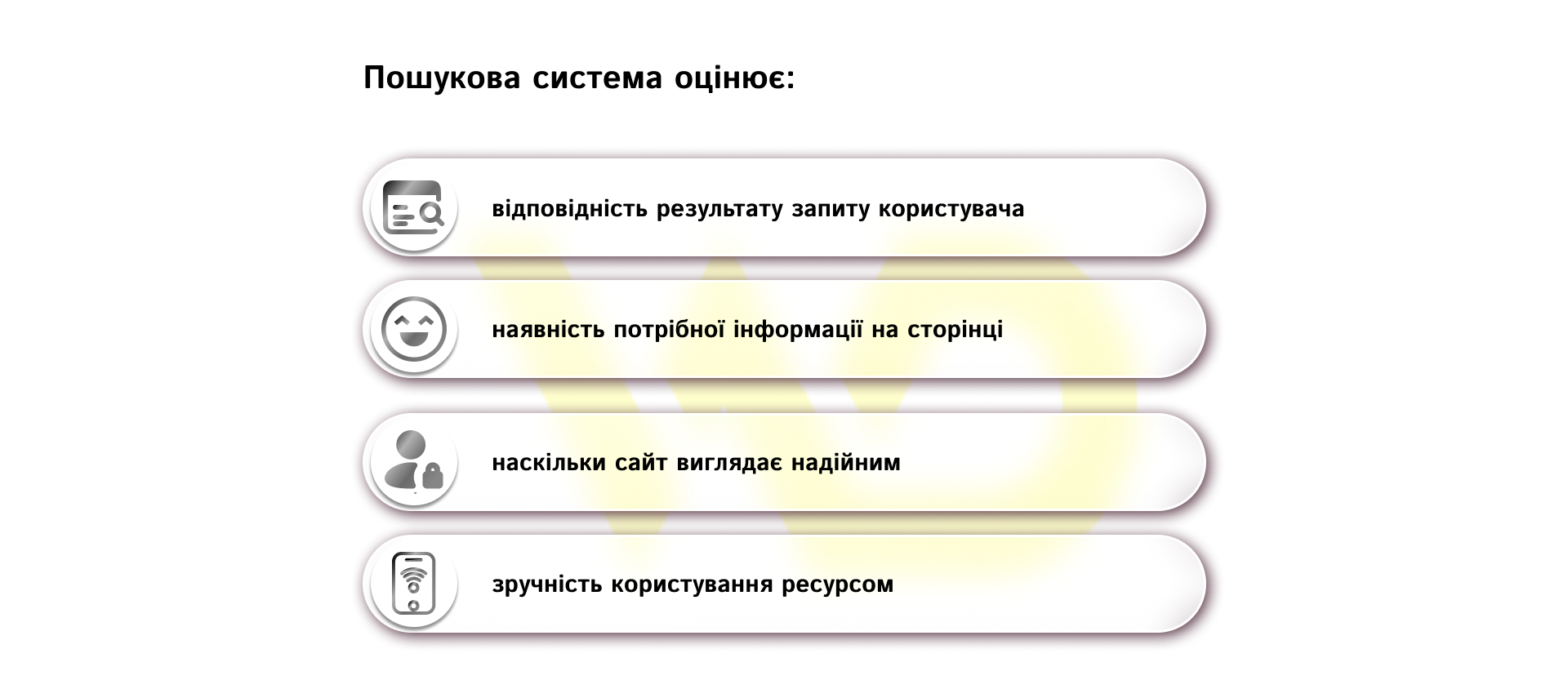
Search results are influenced by both general and page-specific signals. A search engine may take into account:
- content quality;
- structural logic;
- internal links;
- technical accessibility;
- relevance of information;
- other site characteristics.
At the same time, strong metrics for the entire domain do not mean that every individual page will automatically rank highly Google evaluates pages separately.
The context of the query also plays an important role. The same phrase can have different meanings for people in different cities, countries, or even on different devices. For example, for the query air conditioner repair», local search results may prioritize companies in the user’s city rather than general informational pages. Therefore, businesses should tailor their content to the specific needs of the customer behind the query, rather than just focusing on keywords.
This principle is also clearly evident in commercial niches. For the query «buy an office chair», the search engine will typically display pages with product listings, prices, and specifications. But for the query «how to choose an office chair», the results more often include review articles with advice. In other words, even similar words can lead to different results if the user’s intent differs.
How to help the search engine better understand your content
Another useful tool is structured data. It acts as a kind of hint for the search engine, helping it understand more precisely what exactly is on the page a product, service, event, review, or a Q&A section. This is especially important for search because the same page may be clear to a human but not to an algorithm. This is where structured data adds clarity.
Google recommends using the JSON-LD format and not adding markup to pages where there is no content visible to the user. This is an important detail because search engines don’t like artificiality. They respond better to a structure that logically reinforces the page’s actual content, rather than attempts to «convince» them with technical tricks lacking a factual basis.
It’s important to remember: structured data does not replace meaningful content and does not guarantee high rankings. It simply helps the search engine «read» the page faster and more accurately.
What to check before launching SEO promotion
Before starting promotion, make sure the site is technically ready to work with search engines. Even strong content won’t deliver results if pages are difficult to find, crawl, or index correctly.
перевірити свої рейтинги
Аж ось ринуло від сходу ясне проміння, мов руки, простяглось до лісу, обняло його
|
What to check |
Why is this necessary |
What happens if you skip this |
|
Page crawlability |
So that the search engine can open and read the page |
Some pages may remain unindexed |
|
Indexing of important URL |
To ensure the right pages appear in search results |
The site will not receive traffic to key pages |
|
To help search engines find main pages faster |
New URL may be discovered more slowly |
|
|
Robots.txt and meta noindex |
To avoid blocking important content from search |
The search engine may not display the page in results |
|
Canonical URL |
To avoid duplication and confusion between pages |
The search engine may choose the wrong version of the page |
|
Mobile version |
To ensure the site works correctly on smartphones |
Some users and signals will be lost |
|
Loading speed |
To ensure the page doesn’t create unnecessary barriers for the user |
The risk of a poor user experience and traffic loss increases |
So, it is technical readiness that determines how quickly a search engine can crawl the site and start including its pages in search results. Therefore, before focusing on SEO, it is important not only to create content but also to ensure that the site’s infrastructure functions smoothly.

commercial offer
Other articles by the author

17/04/2026
Microsoft Copilot is an AI assistant built into the company's workflows, while the business version is specifically designed for corporate data, applications, and information security.

02/07/2026
In B2B marketing, it’s important to generate not just leads, but contacts from people who are genuinely interested in the topic and willing to engage further with the company.

15/04/2026
Meta AI is an AI-powered chatbot built on the LLaMA 3 language model.
Latest articles by #SEO
06/10/2026
From a business perspective, updating content is a sensible way to protect existing investments.

30/09/2026
Google's main focus in 2026 was the large-scale rollout and deep algorithmic integration of the AI Overviews (AIO) tool.

29/09/2026
A content pipeline transforms the creation of content from a spontaneous creative process into a managed production system. In such a system, AI serves as a powerful assistant.