

 22/04/2026
  1714
1714

Інтернет-маркетинг
простою мовою
Content of the article

What is a portfolio and how it helps a specialist find a job

In today’s labor market, competition is shifting from formal resumes to real evidence of competence. It is important for businesses to quickly assess a candidate’s experience and how they work, what tasks they solve, and what results they bring. That is why a portfolio is becoming a key tool that allows a specialist to prove his or her expertise in practice, and an employer to reduce hiring risks.
In this article, we will look at what a portfolio is, what formats are used today, how to properly prepare it for specific tasks, and what mistakes should be avoided to increase the chances of successful employment.
What is a portfolio?
A portfolio is a collection of works, projects, cases, and materials that confirm the professional level of a specialist. Unlike a resume, which usually presents only facts about experience and skills, a portfolio shows work in action: how a person thinks, makes decisions, and solves problems. That is why it is considered as a proof of competence, not just an appendix to a candidate’s application.
For the employer, it is a convenient way to quickly understand whether a specialist meets the requirements of the role. For the candidate, it’s an opportunity to point out their strengths and confirm them with examples. Adobe’s recommendations specifically emphasize that a strong portfolio starts with a goal: first, you need to determine why it is being created, and only then choose the format and content.
How a portfolio helps you find a job
A portfolio works as a tool of trust. When a recruiter or manager sees not only the words in a resume but also real projects, it is easier for them to assess the level of a specialist. This is especially important in professions where the result can be shown: in design, marketing, content, UX/UI, copywriting, analytics, product and project work. LinkedIn advises to show not just works, but a real impact on the business or user, as this is what convinces best.
Another advantage of a portfolio is that it helps you stand out among candidates with similar experience. If two people have similar resumes, but one can show a structured case with a task, process, and result, it is he who looks more convincing. That is why a portfolio should be built not as a set of random files, but as a brief history of professional experience, where each work has its own role.
Types of portfolios
Portfolios can be classified not only by file format, but also by how it works for the candidate’s task. For a business audience, it is more convenient to look at it through three prisms: the way it is presented, the type of content, and the purpose of use. This approach helps to immediately understand which format will be most convincing in a particular situation.
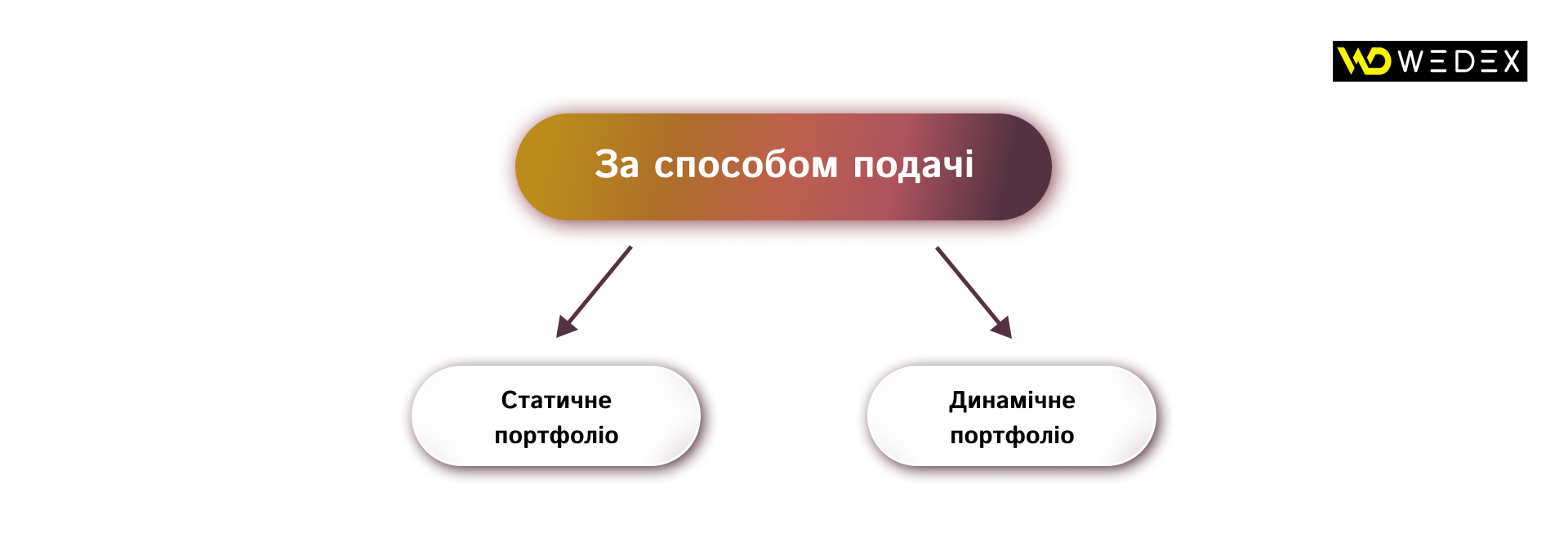
A static portfolio is a format that is viewed without interaction:
- PDF;
- presentation;
- printed version.
It is suitable when you need to quickly send a selection of works to a recruiter, add it to your resume, or use it at an interview. Its advantage is that the structure is easy to control, and the content does not depend on the technical nuances of viewing.
A dynamic portfolio is:
- a website;
- an online platform;
- another interactive format.
It gives you more freedom in presenting cases, allows you to add individual pages, links, images, videos, and detailed descriptions. This option is most convenient if it is important to show not one or two works, but a whole system of projects with logic, structure, and development of professional experience.
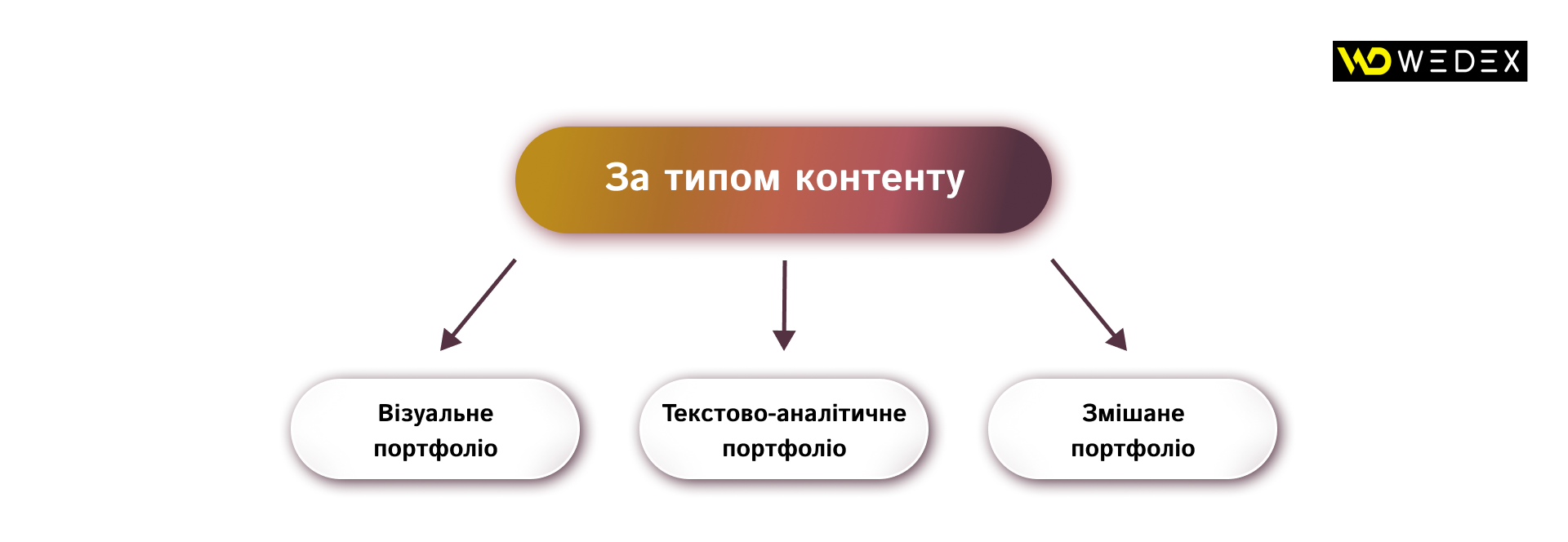
Visual portfolios work best for designers, photographers, illustrators, video makers, and other creative professions. The main thing here is the result itself: composition, style, aesthetics, and level of performance. However, even in a visual format, it is advisable to add a brief textual context so that the employer understands what task the specialist solved.
A textual and analytical portfolio is appropriate for copywriters, marketers, SEO specialists, UX researchers, and project specialists. It is important to show both the work and the logic: what kind of request you worked with, how you approached the task, what tools you used, and what it led to. For business, this kind of presentation is the most valuable, because it demonstrates not just a skill, but professional thinking.
A mixed portfolio combines visual elements, short explanations, and data on the result. This is one of the most powerful formats because it allows you to simultaneously show the quality of work and the practical benefits of the work. It is this approach that best meets the expectations of employers when they need to quickly understand the value of a candidate to a team or business.
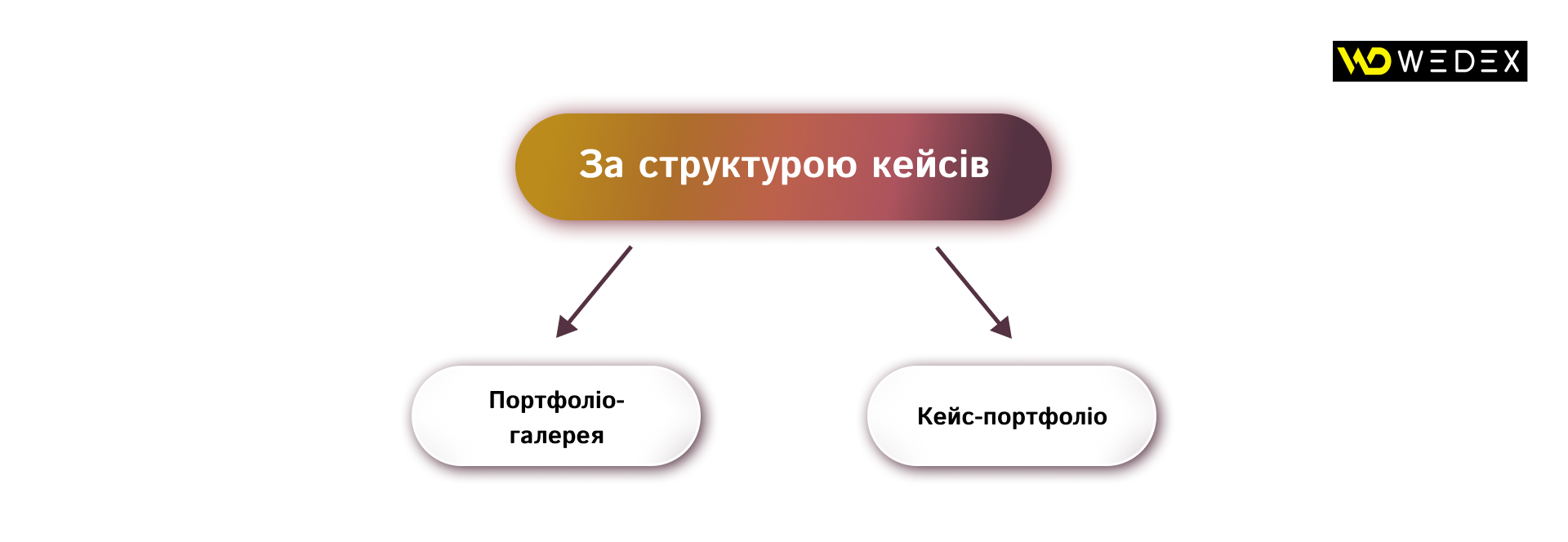
A portfolio gallery is a collection of works without a detailed explanation. It may be appropriate in visual professions where it is enough to show the result. But for most business roles, this format is weaker because it doesn’t answer the main questions about the task and the way it was performed, the effect obtained.
A case portfolio is a stronger option for hiring. Each block here is built according to logic: task, role of the specialist, process, solution, result. This is the format recommended by career resources when it comes to a convincing presentation of professional experience, because it shows not only the work done but also the ability to think systematically.
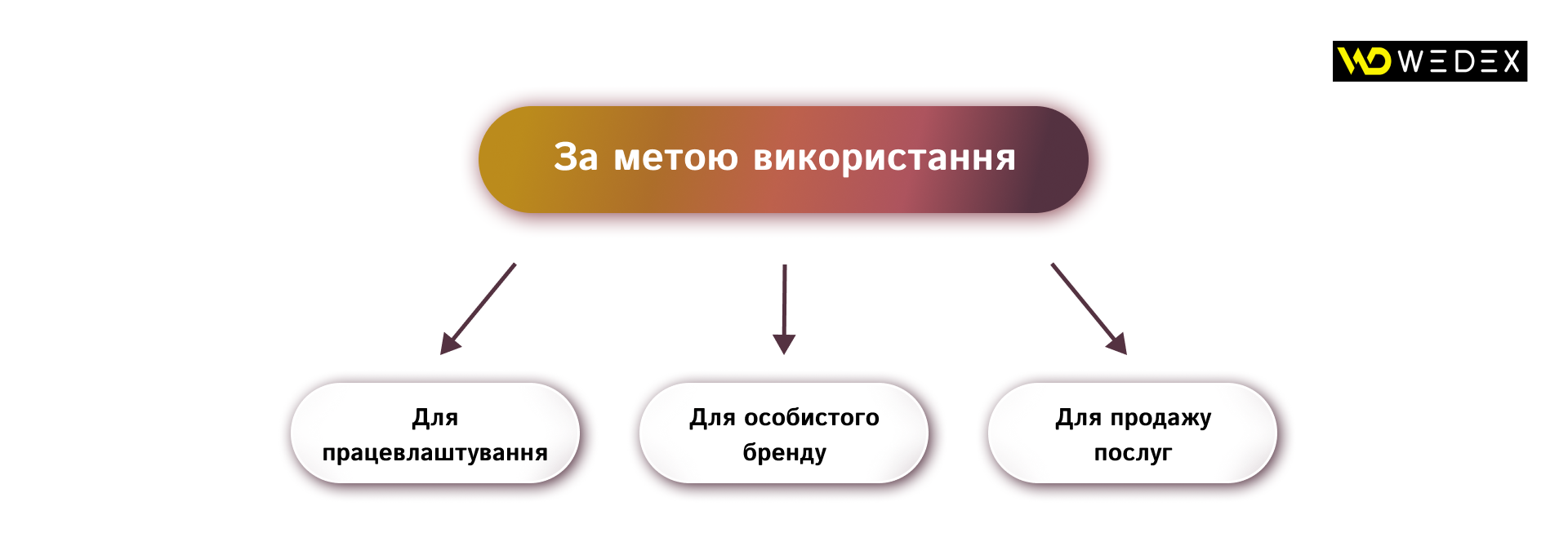
A portfolio for employment should usually be brief, accurate, and as relevant as possible to a particular job opening. Its main task is not to show everything that a specialist has ever done, but to quickly confirm that he or she is suitable for the role. Therefore, such a portfolio should include only those works, cases, or examples that best meet the employer’s requirements. If a person is applying, for example, for an SEO specialist position, it is advisable to show projects with analytics, traffic growth, site structure, or content work, rather than adding third-party materials that are not directly related to the vacancy. This selectivity helps to create the impression of a focused, mature, and professional candidate.
A portfolio for a personal brand can be broader in content, as its purpose is to help you find a job and showcase your expertise, work style, and professional range. In this format, it is appropriate to demonstrate more areas in which the specialist works, expand the description of cases and show different aspects of their experience. This is especially useful for professionals who want to build recognition in their niche, emphasize the depth of their knowledge, or attract the attention of not only employers but also potential clients, partners, or colleagues. In this case, the portfolio works as part of a professional reputation.
A portfolio for selling services focuses not so much on the position or career path as on the practical benefits to the client. It is important to show what problem was solved, what exactly the specialist did, and what result it gave to the business. This format works especially well for freelancers, consultants, marketers, designers, copywriters, and other professionals who sell the result of their work rather than the process. In a portfolio of this type, cases should be structured in such a way that a potential client has no doubt that the specialist understands the business problem and is able to bring the work to a tangible effect.
All portfolio options have one rule: it must work for a specific purpose. That’s why the best portfolio is not the largest one, but the one that clearly meets the task and helps the recruiter quickly understand the value of the specialist.
What to do if you don’t have much experience yet
The lack of commercial experience does not mean that a portfolio cannot be created. At the start of your career, it’s not the number of projects that matters, but the ability to demonstrate your approach to work, thinking, and basic skills. Let’s look at what you can do if you don’t have much experience.
- Use training or test projects.
These can be course assignments, your own initiatives, or even fictional cases that model real business situations. For example, a copywriter can create texts for a fictitious brand, a designer can develop a website or mobile application concept, and a marketer can describe a promotion strategy for a selected company.
- Show the first real projects.
Even if they were free or done for friends. Small tasks, volunteer initiatives, or entry-level freelancing can already become the basis of a portfolio if you describe them correctly: show the task, your actions, and the result.
- Demonstrate not only the final result, but also the process.
This is especially valuable for an inexperienced specialist, as the employer evaluates the level of performance, logic of thinking, approach to the task, and ability to structure the work.
- Pay special attention to the quality of presentation. Even 2–3 well-designed cases with a clear structure will look stronger than a large number of superficial works without explanations.
At the start of a career, a portfolio is not so much a proof of experience as a demonstration of potential and readiness for professional development.
How to create a quality portfolio: a step-by-step plan
For a portfolio to really work for a job search, it needs to be built not as an archive of works, but as a well-thought-out self-presentation tool. That is why it is important to act consistently.
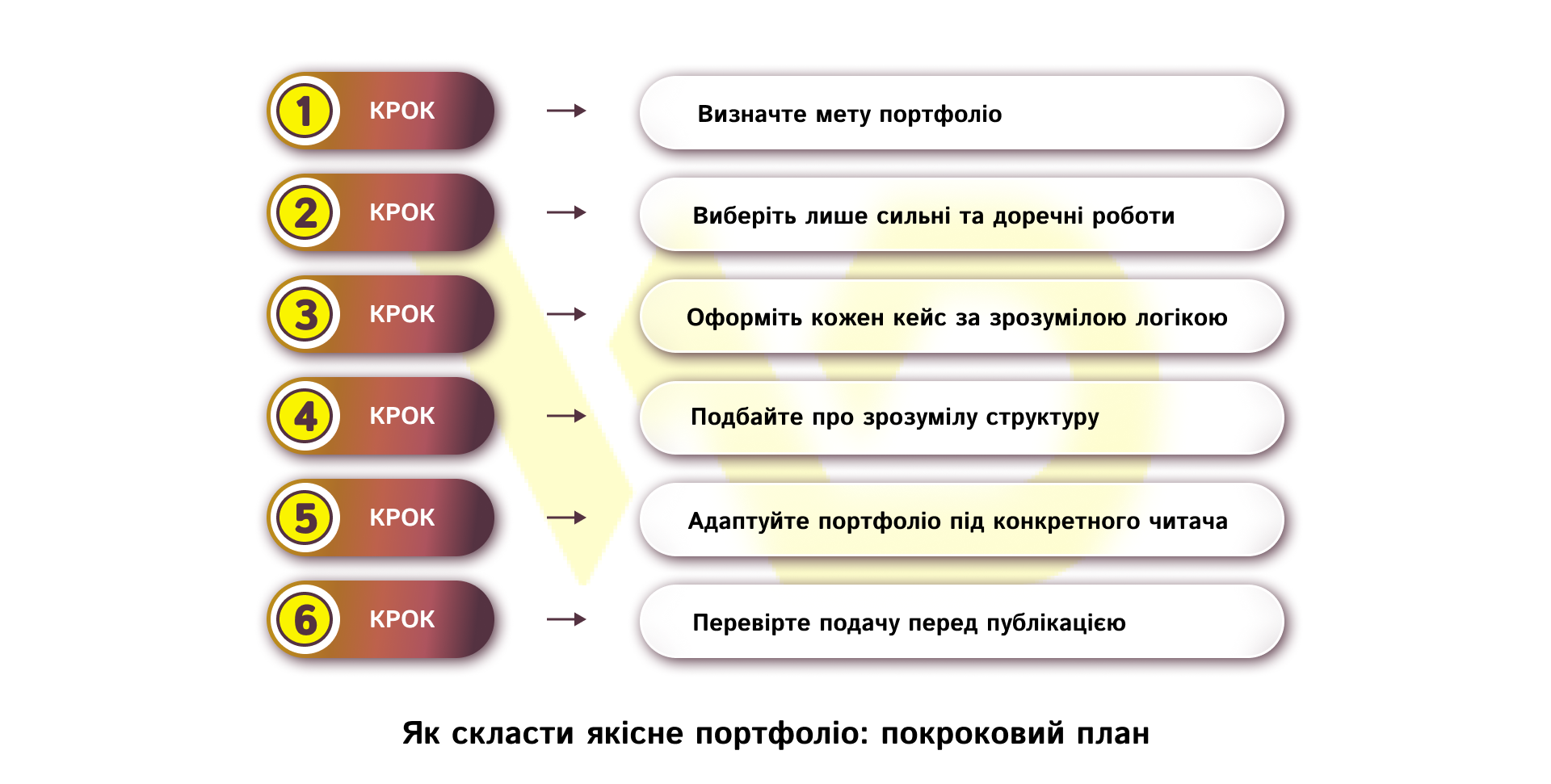
Step 1. Determine the purpose of the portfolio
Before collecting materials, you need to clearly understand why you are creating a portfolio. The content, depth of presentation, and even the format depends on this. A portfolio for a job should be concise and relevant, while a portfolio for clients may contain a wider range of work and cases.
Step 2. Select only strong and relevant work
You don’t need to include everything you’ve ever done. It’s better to leave 5-10 examples that best show your level and meet the target audience’s request. If you are applying for a specific position, choose the cases that most accurately confirm the skills you need.
Step 3. Organize each case according to a clear logic
Each work should answer the basic questions: what was the task, what role did you play, what did you do, and what result did you get. Such a structure makes the portfolio convincing and easy to view. If there are numbers, indicators, or specific changes, they should be included.
To better understand what a strong case looks like, let’s look at a few examples.
Copywriter’s portfolio (textual and analytical format)
Project: texts for the landing page of an online English course.
The task: to increase page conversion and clearly convey the value of the product.
What was there: overloaded text without structure, weak emphasis on the results for the user.
What we did:
- Analyzed the target audience and its needs;
- rewrote the landing page structure (blocks, presentation logic);
- created a new value proposition;
- added trust triggers (reviews, specific learning outcomes);
- optimized headlines for search queries.
Result:
- The page conversion rate increased from 2.1% to 3.8%;
- the number of bounces decreased;
- the client used the new structure as a template for other products.
Conclusion: This case shows not just the ability to write texts, but the ability to influence business results through content.
UX/UI designer’s portfolio (mixed format)
Project: redesign of a mobile food delivery app.
The task: to improve the ordering experience and reduce the number of abandoned carts.
What happened: a complicated checkout scenario, many unnecessary steps, low order completion rate.
What we did:
- Analyzed the user scenario and identified problem areas;
- simplified the user flow (reduced the number of steps from 7 to 4);
- redesigned the interface of key screens;
- added tips and visual accents for navigation;
- tested the new version on users.
Result:
- the number of completed orders increased by 25%;
- the checkout time was reduced;
- the app’s ratings in the stores improved.
Conclusion: the case demonstrates both visual skills and work with user experience and business metrics.
Step 4. Take care of a clear structure
The portfolio should be easy to read. First, a brief introduction of the specialist, then the main cases, and then additional materials that confirm the experience. Everything should be presented sequentially, without a chaotic set of files and without unnecessary information that distracts from the main point.
Step 5. Tailor your portfolio to a specific reader
It’s important for a recruiter to quickly see if you’re a good fit for a vacancy, for a client to understand how you’ll benefit them, and for a partner or employer to assess your work style and professional approach. That’s why you shouldn’t always send the same portfolio to everyone without changes. Sometimes it’s enough to shift the emphasis or bring the most relevant cases to the forefront.
Step 6. Check the submission before publication
The final step is to carefully review the portfolio through the eyes of the employer. Is it easy to open? Is it clear where to start viewing it? Are there any unnecessary details, errors, or outdated materials? A high-quality portfolio should look neat, be up-to-date, and give the impression of a well-thought-out professional product.
Once the portfolio is assembled, it is important not to treat it as a complete document. It’s a working tool that needs to be updated along with new projects, results, and changing professional goals.
The strongest portfolio always looks up-to-date: there are no random works, outdated cases, or unnecessary details that distract from the main point.
For an employer, it is especially valuable when a portfolio does not just demonstrate beautiful examples, but shows consistency, maturity, and the ability to think in terms of task and result. That’s why it’s worth periodically reviewing it through the eyes of a recruiter: is it clear what you did, is your role in projects visible, and does the presentation give the impression of a confident specialist. If these answers are positive, the portfolio works for you even before the interview.

commercial offer
Other articles by the author

08/05/2026
For businesses, Instagram has long been not just a platform for posting content, but also the place where customers form their first impression of a brand.

17/04/2026
Microsoft Copilot is an AI assistant built into the company's workflows, while the business version is specifically designed for corporate data, applications, and information security.

07/09/2026
Hard skills aren't just the names of courses listed on your resume or the number of lectures you've attended they're your practical ability to solve specific business problems.
Latest articles by #Useful tips

22/10/2026
To properly link Instagram to Facebook, you need to distinguish between the different types of accounts within the Meta ecosystem, since confusion between a personal profile and a business page is the most common cause of errors during setup.

20/10/2026
Ben Hunt's model is a tool that helps break down a customer's path to purchase based on their level of awareness and select the right messages for each stage.

06/10/2026
From a business perspective, updating content is a sensible way to protect existing investments.