

 02/07/2026
  1408
1408

Інтернет-маркетинг
простою мовою
Content of the article

Types of ads: how to choose the right format for your business
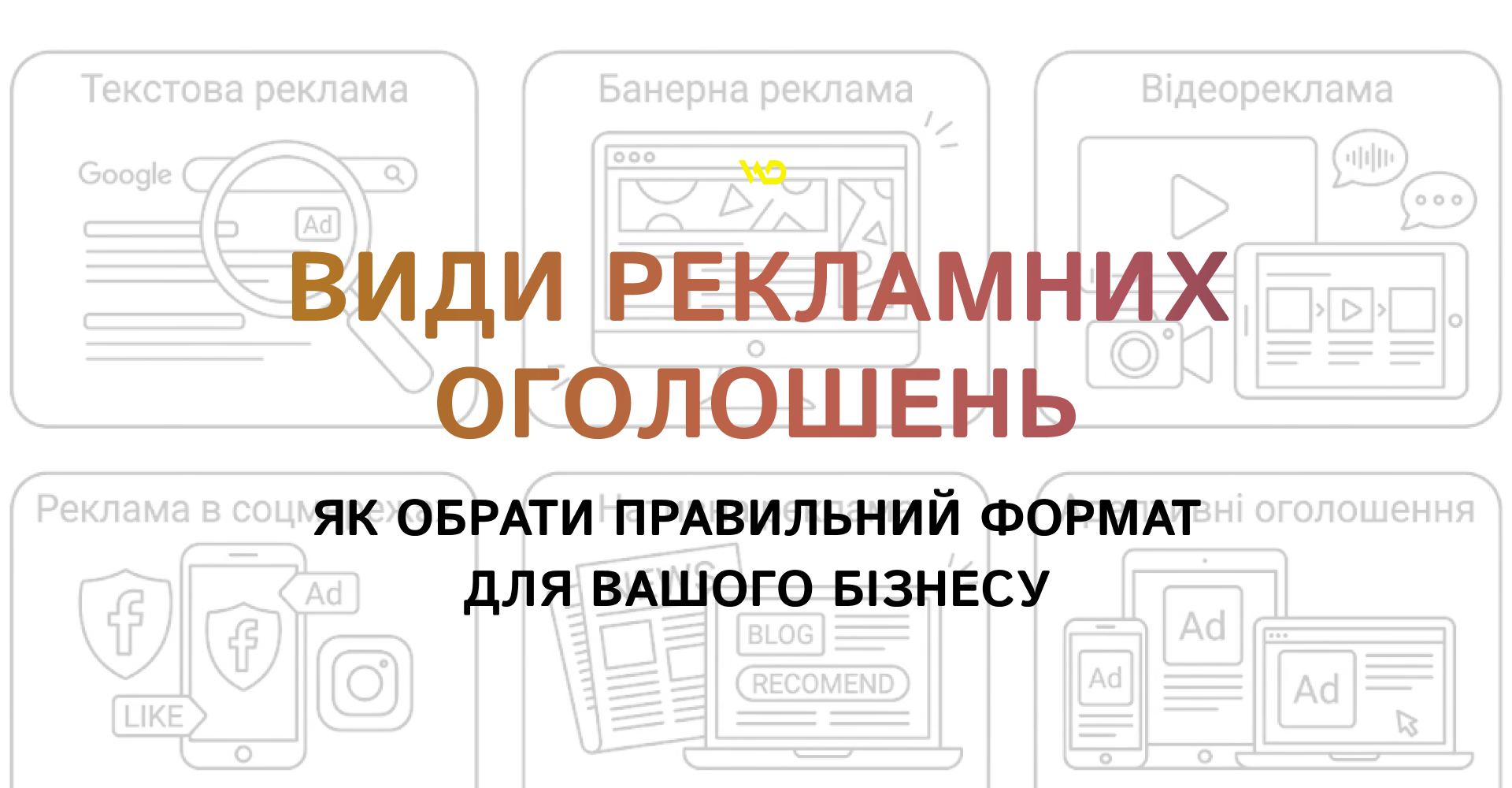
Today’s digital market is constantly flooded with information noise. Consumers see hundreds of commercial offers every day, leading to the development of «banner blindness» the automatic ignoring of typical ads. Under these conditions, choosing the wrong ad format becomes the main reason for low return on investment (ROI) and the rapid depletion of a company’s marketing budget.
In this article, we’ll examine the existing types of advertisements, analyze their structure, and explore how audiences perceive them. You’ll receive a clear step-by-step guide and an industry-specific matrix to help you accurately select effective marketing tools tailored to your specific business goals.
What makes up an ad
Before moving on to the classification of large-scale ad formats, it’s essential to understand the basic elements that make up any commercial creative. Every ad, regardless of the platform on which it’s placed, functions as a single living organism, where each component plays its own specific role in the customer engagement chain. If even one element appears weak or doesn’t fit the overall concept, the entire conversion funnel breaks down.
Marketing practices and the analysis of effective campaigns reveal four fundamental components of a successful advertisement.
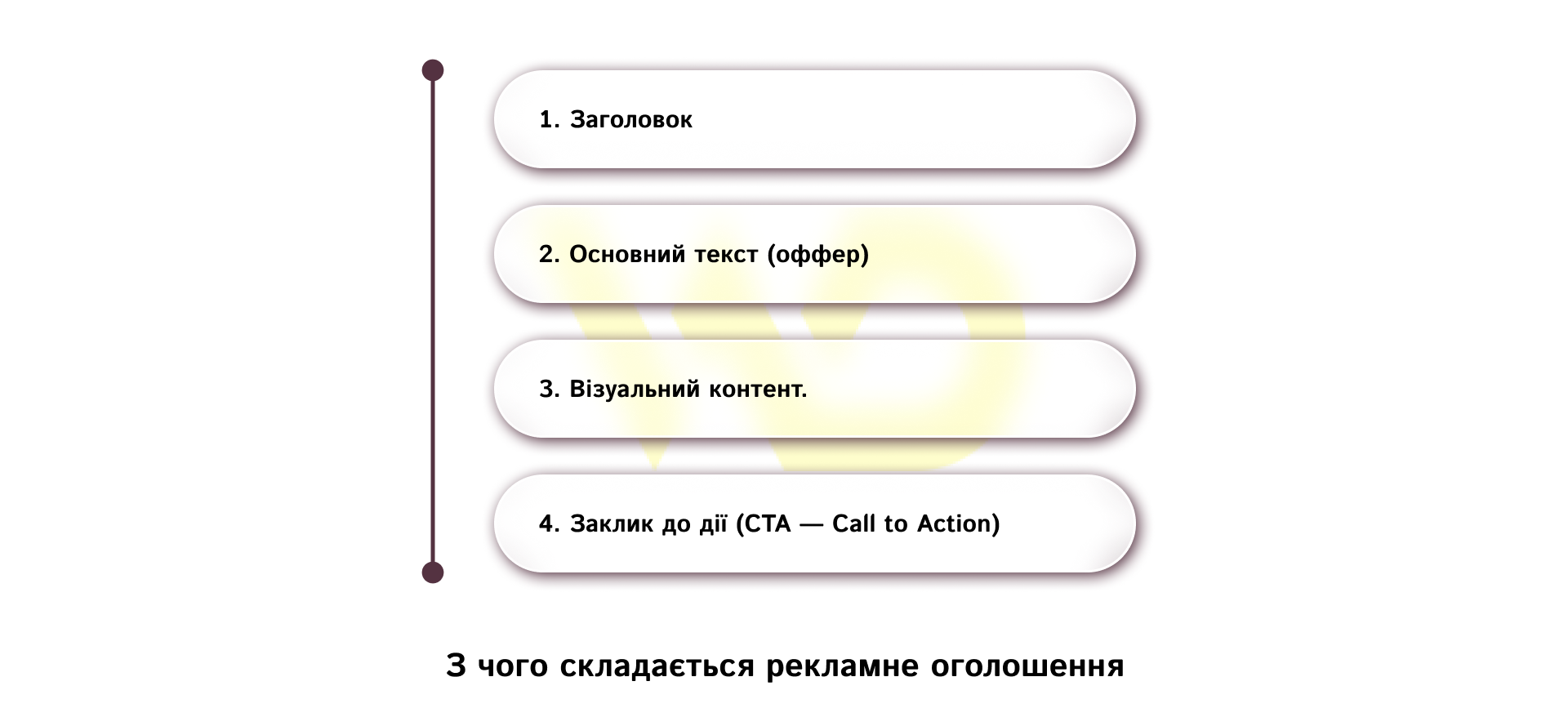
- Headline.
This is the first and most important line of defense in the battle for the user’s attention. Its main task is to catch the eye in a fraction of a second, pique interest, and compel the user to read the ad further. The headline should clearly convey the essence of the offer or address the target audience’s main «pain point».
- Body text (offer).
This is where the unique selling proposition (USP) is revealed. The text explains exactly what benefit the customer receives, why they should choose this particular product or service, what problems it solves, and what rational or emotional arguments speak in the company’s favor.
- Visual content.
This can be a graphic image, a static banner, a product photo, or a dynamic video. Visuals reinforce the text message, create the necessary emotional context, demonstrate the product in action, and help the viewer instantly understand what the ad is about.
- Call to Action (CTA).
The final and most persuasive element of an ad. It clearly tells the user what next step is expected of them: «Buy», «Sign Up», «Download Price List», «Schedule a Consultation», and so on. Without a clear CTA, the ad’s effectiveness drops sharply, as the user is left unsure of what to do next.
All these components must work in synergy, complementing and reinforcing one another.
Only when there is absolute relevance between the headline, graphics, text promise, and call to action can an ad demonstrate a high click-through rate (CTR) and provide the business with a steady stream of targeted leads.
Ad formats by placement
Modern digital marketing offers a wide variety of channels, each with its own unique technical parameters, display algorithms, and rules for interacting with users. To organize this diversity, let’s examine the key types of ads by category, depending on their operating environment and visual display characteristics:
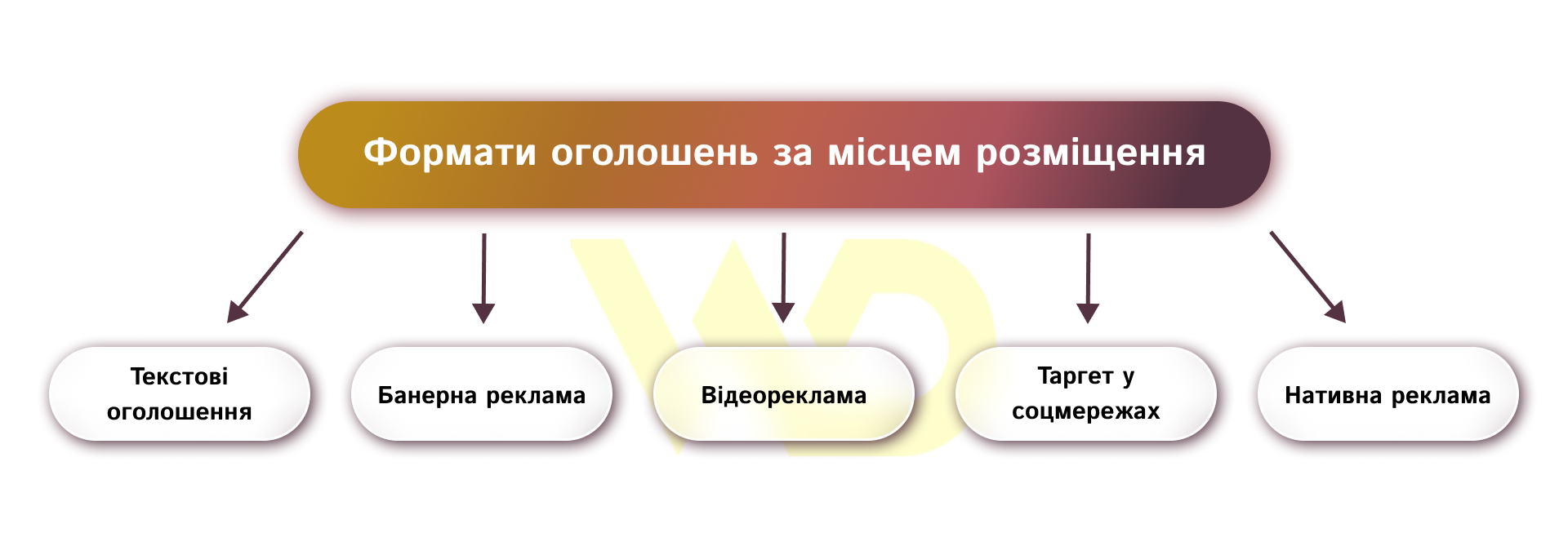
Text ads
This is a classic, time-tested format most commonly found in Google Ads search results. These ads appear in response to specific user queries when users are actively searching for products or services at that very moment. A distinctive feature of this format is the absence of any visual elements the entire burden falls on the skillful use of text and the precision of the wording.
The effectiveness of text ads depends directly on the careful selection of keywords. For example, when a user types «buy a children’s bed in Kyiv» into the search bar, the system shows them text ads that match this intent as closely as possible. Such ads capitalize on the highest demand because they aren’t forced on the user but appear as a helpful response to their current need.
Banner ads
Banner, or display, ads are placed on the Google Display Network (GDN) and on partner websites. Unlike search ads, they target users who are currently reading the news, browsing themed blogs, or otherwise surfing the web. The main focus here is on visual appeal, which is designed to draw the user’s attention away from their current context.
Responsive display ads have become particularly popular. The advertiser uploads several variations of headlines, text, and images, and artificial intelligence algorithms automatically combine them and adapt them to the dimensions and format of a specific ad unit on any website. This helps effectively combat banner blindness and optimize the cost per impression.
Video advertising
The video format is at the peak of its popularity due to the global growth in video content consumption on platforms such as YouTube. Video allows you to tell a brand’s story, visually demonstrate complex product features, and evoke a deep emotional response in the viewer something that is difficult to achieve with static graphics.
In video marketing, there are several key sub formats, each with its own technical and strategic characteristics:
- In-Stream ads. Video ads that are integrated directly into the videos the user is watching. They can play before the main video starts (pre-roll), in the middle (mid-roll), or at the end (post-roll). There are two types: skippable after 5 seconds (allowing you to pay only for full views) and non-skippable (guaranteeing that the viewer will watch the ad until the end; these typically last 15–20 seconds);
- Out-Stream ads. A special video ad format designed exclusively for mobile devices. They are placed on partner websites and in apps outside of video players, for example, within a text article. The video begins playing silently when it enters the screen’s viewport and captures the user’s attention as they scroll through the page;
- Bumper Ads. These are ultra-short, six-second videos that cannot be skipped. Thanks to their dynamic nature and conciseness, they are ideal for a quick brand reminder, launching a new product, or reinforcing a large-scale, wide-reaching advertising campaign.
Using video ads requires more resources during the production phase, but their ability to engage the audience and build long-term brand awareness fully justifies the investment.
Social media targeting
Social media platforms such as Meta (Facebook and Instagram), TikTok, and LinkedIn possess vast amounts of data about their users, ranging from their age and geolocation to their deep-seated interests, professional skills, and purchasing habits. This allows for pinpoint-accurate ad targeting, delivering the right format to interested users.
Promote your business effectively on social media
The WEDEX team will handle the setup and launch of targeted social media ads: from selecting audiences and ad formats to optimizing campaigns for better ROI.
Social media ecosystems offer advertisers a flexible set of tools:
- single image: a concise format consisting of a single high-quality photo or graphic, accompanying text, and a call-to-action button. It works well for simple and straightforward offers that don’t require lengthy explanations;
- carousel (rotating gallery): allows you to display up to 10 images or videos within a single ad, each of which can have its own link. This is a great solution for showcasing a product range, different colors of a single model, or a step-by-step service process;
- collections: a mobile-first format on Instagram and Facebook. It combines a large main video or image with several smaller product cards below it. Tapping on it opens a full-screen catalog where users can browse products without leaving the social network;
- instant experience: a full-screen interactive format that loads instantly when you tap an ad in your mobile feed. Within it, you can combine videos, text blocks, carousels, and call-to-action buttons, creating a mini-landing page effect right within the social platform.
Thanks to this variety, social networks can accompany the customer through every stage of the sales funnel from their first encounter with the company to making a repeat purchase.
Native advertising
Native advertising is a format that integrates as seamlessly as possible into the overall design and editorial content of the platform on which it is placed. It mimics regular informative articles, expert advice, or recommendation sections on major news or information portals.
Users perceive such ads not as aggressive commercial interference, but as a natural extension of the content they chose to read voluntarily. These can include sponsored content such as «10 Tips for Choosing a Car from Leading Experts» or recommendation widgets at the end of news articles. The main value of the native approach lies in the high level of audience trust it fosters and its ability to overcome the psychological barrier of rejection associated with traditional marketing.
Thus, every platform and format have its own unique ecosystem. After familiarizing themselves with the technical varieties of ads, it’s important for businesses to look deeper into how the human psyche reacts to different ways of presenting information.
The psychology of perception: text vs. visuals
The effectiveness of any advertisement is determined not only by its technical settings or budget, but first and foremost by how the human brain processes information. Different ad formats engage different cognitive mechanisms and psychological triggers. Understanding these processes allows marketers to consciously guide users’ attention by choosing the ad format based on the product type and the buyer’s decision-making model.
When processing text and visual ads, the brain exhibits fundamentally different reactions.
- A rational approach in text-based advertising. Text ads in search results appeal to logic, rational thinking, and concrete facts. When a person is searching for a specific service or product, their brain is in an active state of analysis. At this moment, numbers, specific details such as price, delivery times, or warranties, and clear answers to the query work best. Text-based advertising is indispensable in the B2B segment and when selling complex, high-priced products, where emotions take a back seat to pragmatic benefits.
- Emotional triggers in visual formats. Multimedia formats — such as images, banners, and videos — are processed by the brain thousands of times faster than text. Visual content instantly appeals to the subconscious, evoking specific emotions, associations, and aesthetic pleasure. A striking image or a dynamic video can, in a fraction of a second, create a desire to own a product — a key factor in impulse purchases in the B2C sector, as well as in the beauty, fashion, travel, and restaurant industries.
The DataReportal report clearly demonstrates a trend: today’s generation of consumers is increasingly focused on visual search and video content. However, this does not mean that text is losing ground its role is changing. Text in a visual ad becomes a concise compass that channels the emotional impulse triggered by the image into a specific commercial action.
Ultimately, the success of an advertising campaign lies at the intersection of logic and emotion. By drawing on data about how people actually perceive information, we can develop a coherent set of criteria that any business can use to accurately determine the ideal format for its advertising message.
Static or adaptive ads: which to choose
In the past, when choosing between graphic and text formats, businesses opted for «static» ads a fixed banner of a specific size or a clearly defined text ad. Today, the market offers a fundamentally new type of ad: responsive ads. This is a modular format where the final appearance of the ad is determined by artificial intelligence algorithms.
Instead of a single pre-made creative, you upload a set of elements to the system:
- up to 15 headline options;
- up to 4 description options;
- several images of different aspect ratios (square, rectangle) and logos.
Artificial intelligence combines these elements in real time. For one user, this format will appear as a text block in search results; for another, as a large graphic banner on a partner site; and for a third, as a native block in a mobile app.
Here’s why you should choose this type of ad:
- versatile reach: you don’t need to separately commission a designer to create 20 banners of different sizes (300×250, 728×90, etc.). A single responsive ad automatically adapts to any ad space on any website or smartphone screen;
- personalized appearance: the system shows each individual the specific combination of text and images most likely to interest them, based on their previous online behavior;
- Effective countermeasure against «banner blindness»: since ad variations constantly rotate, the audience does not become desensitized to the same image, which keeps the click-through rate (CTR) high.
Thus, when choosing a format for a future campaign, modern businesses no longer need to limit themselves to the rigid «either text or graphics» framework. Adaptive ads combine these elements into a flexible system that automatically finds the ideal visual format for each customer.
How businesses can choose the right format
To avoid wasting your marketing budget on blindly testing all possible tools, you need to take a systematic approach.
Choosing the right ad format is based on three pillars: product specifics, the stage of the sales funnel, and the characteristics of the target audience.
Let’s look at a step-by-step process to help you decide on a format:
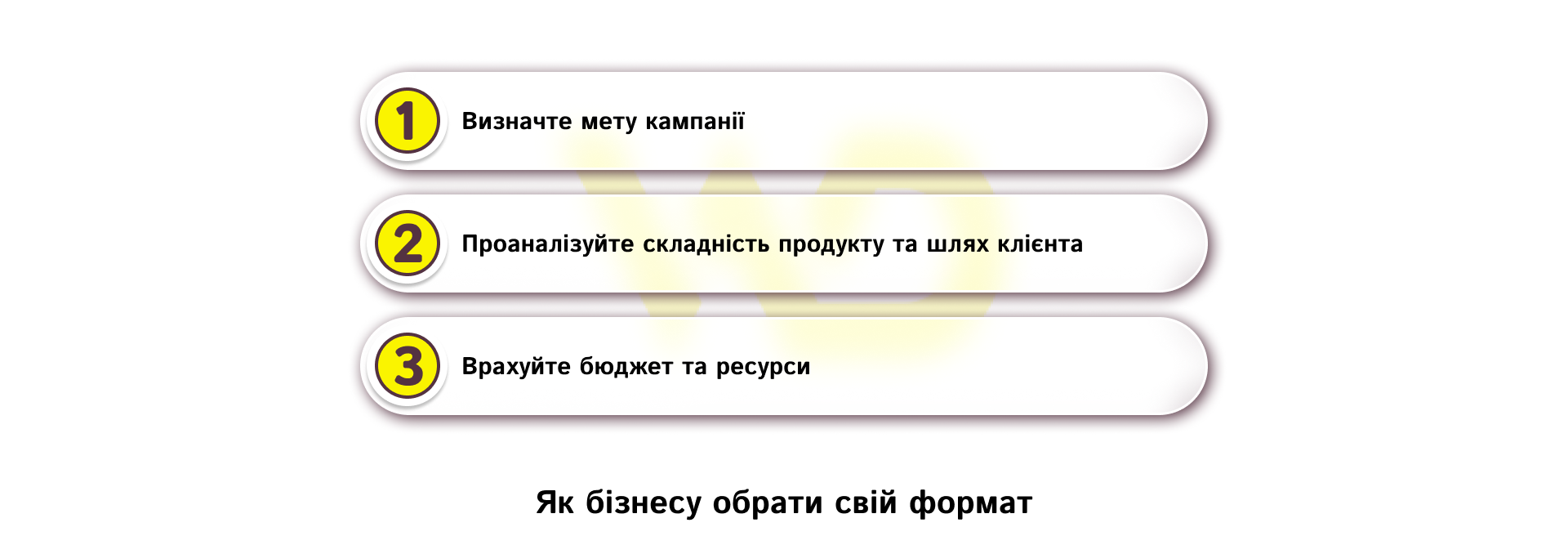
- Define the campaign’s goal.
If your goal is to capture established, high demand — for example, someone is already searching for «washing machine repair» — then your best choice is text-only search ads. If, on the other hand, you’re launching a completely new, innovative product that no one knows about yet, display ads, video formats, and social media targeting come to the rescue they generate initial interest and introduce people to your brand.
- Analyze the product’s complexity and the customer journey.
Simple, mass-market products such as clothing, accessories, food delivery services, and the like require eye-catching visuals, dynamic videos, and carousels that evoke an emotional response and encourage impulse purchases. In contrast, complex B2B solutions, legal services, consulting, or heavy equipment require a rational approach. Here, expert native articles, detailed text ads, and banners that highlight clear business benefits are appropriate.
- Consider your budget and resources.
Creating high-quality video ads or interactive formats requires significant investment in production and design. If your budget is limited, it’s better to start by launching responsive text and image ads, which deliver high ROI through precise targeting and intelligent bid management.
By balancing these factors, you can mix and match formats to guide potential customers through every stage of the decision-making process: from the initial interaction via eye-catching visuals to the final transaction through a targeted search query.
Forecasts: where the advertising market is headed
Analyzing current trends in the digital sphere, we can identify several key trends that will determine the success of advertising campaigns in the coming years.
First, we’re seeing widespread automation. The marketer’s role is shifting from manually adjusting bids to managing data and creative content. Artificial intelligence is taking on the lion’s share of technical work, so a business’s ability to craft meaningful, human, and honest offers that don’t trigger rejection is becoming the key value.
Second, the era of personal data protection and the move away from third-party cookies (a «cookie less future») is forcing companies to rethink their approaches to audience engagement. In this environment, the role of native advertising and high-quality content within a brand’s own platforms is growing significantly.
The advertising of the future isn’t just a «buy with one click» call to action, but rather the building of long-term, trusting relationships with customers through meaningful engagement.
A clear example of a successful strategy is moving away from monotonous templates. Even classic text today needs to be structured properly — that is, using subheadings, lists, and highlights — to align with modern patterns of how users scan information, as they seek answers as quickly as possible.
Test your hypotheses, combine rational text-based formats with emotional visual elements, rely on analytics, and create ads that solve your customers’ real problems.

commercial offer
Other articles by the author

26/03/2026
The benefits of integrating AI into PPC processes go beyond simply “faster text generation.” It’s about a fundamental shift in approach.

02/03/2026
A community manager is responsible for building, developing, and maintaining a community around a brand, product, or project.
19/06/2026
Crowd marketing involves placing useful, organic mentions of a brand, product, or service on platforms where your audience is already engaging.
Latest articles by #PPC
30/09/2026
Google's main focus in 2026 was the large-scale rollout and deep algorithmic integration of the AI Overviews (AIO) tool.
16/09/2026
Choosing between search engine optimization and pay-per-click advertising is one of the most critical decisions when developing a marketing strategy.

04/09/2026
When two different users search for the exact same word in a search engine, they may get completely different lists of web pages, and the websites themselves are constantly changing their positions in the search results.