

 21/01/2026
  2174
2174

Інтернет-маркетинг
простою мовою
Content of the article

Non-price factors of demand: what influences the buyer besides price

In most competitive niches, price has long ceased to be the only argument for choice. Customers compare brands in a comprehensive manner: they evaluate the experience of interaction, trust, reputation, convenience, and alignment with their own values. That is why companies that focus solely on price competition face limited growth and unstable demand.
In this article, we will look at the non-price factors that shape demand, how they work together, and why their systematic consideration becomes a strategic advantage for business.
Non-price demand factors: the essence and role in consumer behavior
Non-price demand factors are a set of conditions and characteristics that influence a customer’s willingness to buy a product or service regardless of the price level. In fact, it is about everything that creates a sense of value: why a customer chooses this particular brand, even if there are cheaper alternatives on the market. Such factors reduce barriers to entry, shorten decision-making time, and directly affect loyalty.
Unlike price, non-price factors work longer and more cumulatively. They shape customer expectations even before the first contact with the product and continue to influence them after the purchase through experience, service, and communication.
The key groups of non-price factors include:
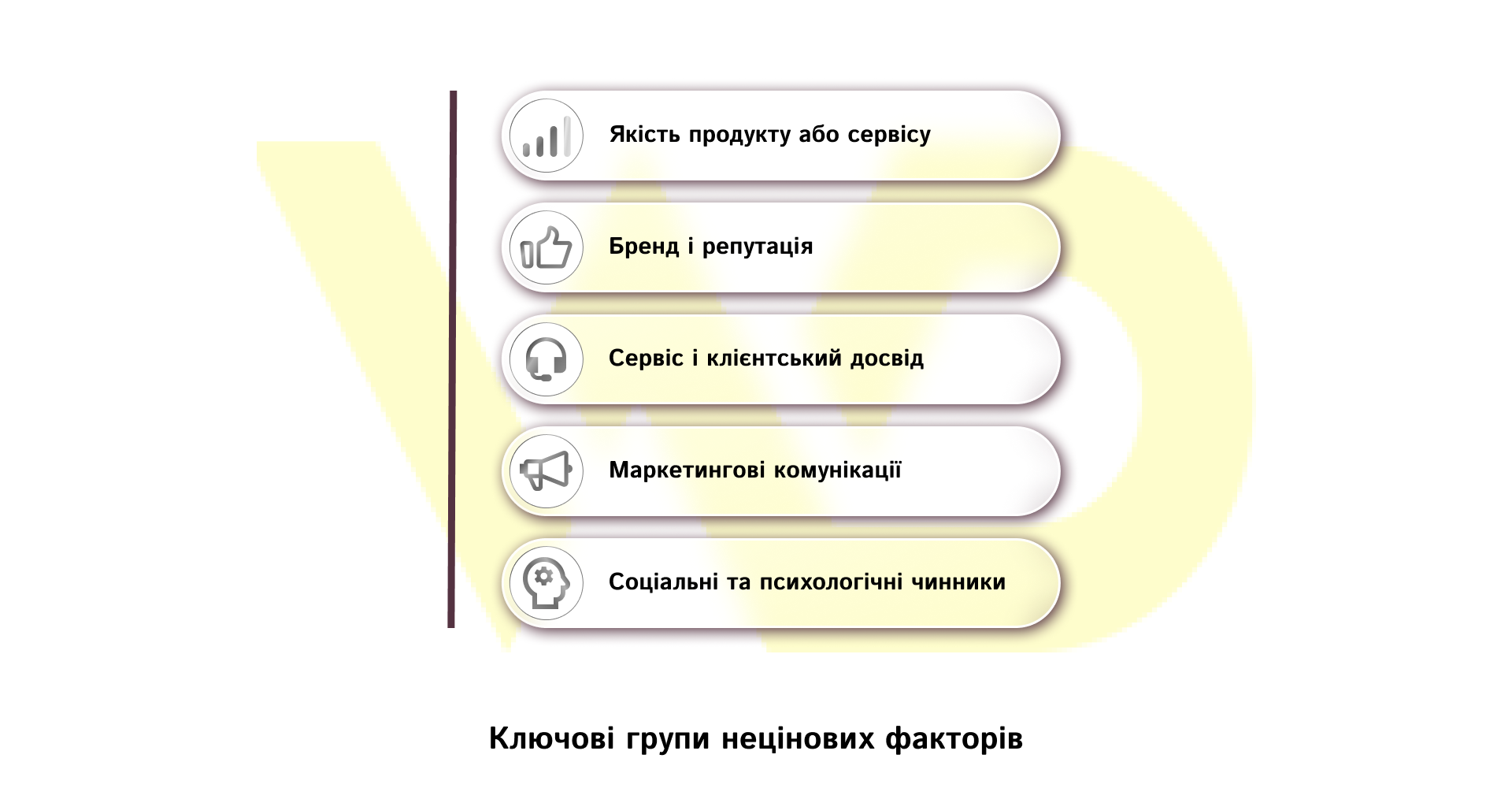
- Quality of the product or service: stability of the result, reliability, functionality and compliance with the declared characteristics. If a product performs its role predictably, the customer is less likely to compare it solely on price.
- Brand and reputation: the level of trust, public expertise, recognition, and established associations. A strong brand reduces the perception of risk and allows clients to make decisions faster.
- Service and customer experience: quality of communication, speed of response, pre- and post-purchase support, ease of interaction. Even at the same price, better experience is often a decisive argument.
- Marketing communications: clarity of messages, consistency of positioning, content relevance, and emotional context. It is communication that explains to the customer what they are paying for and what value they are getting.
- Social and psychological factors: recommendations, reviews, case studies, trends, and compliance with personal or corporate values. Social proof significantly reduces doubts, especially at the stage of choosing between several offers.
In the B2B segment, non-price factors are often even more important than in B2C. Decisions here are made rationally, taking into account risks, long-term consequences, and responsibility. That’s why expertise, reputation, process transparency, and service quality can be decisive even at a higher price.
Market and product factors that shape demand
Demand changes not only due to consumer behavior, but also due to supply parameters, i.e. what businesses can control directly. Understanding these factors allows companies not only to react to the market but also to shape demand strategically.
The main supply-side determinants and their impact are as follows:
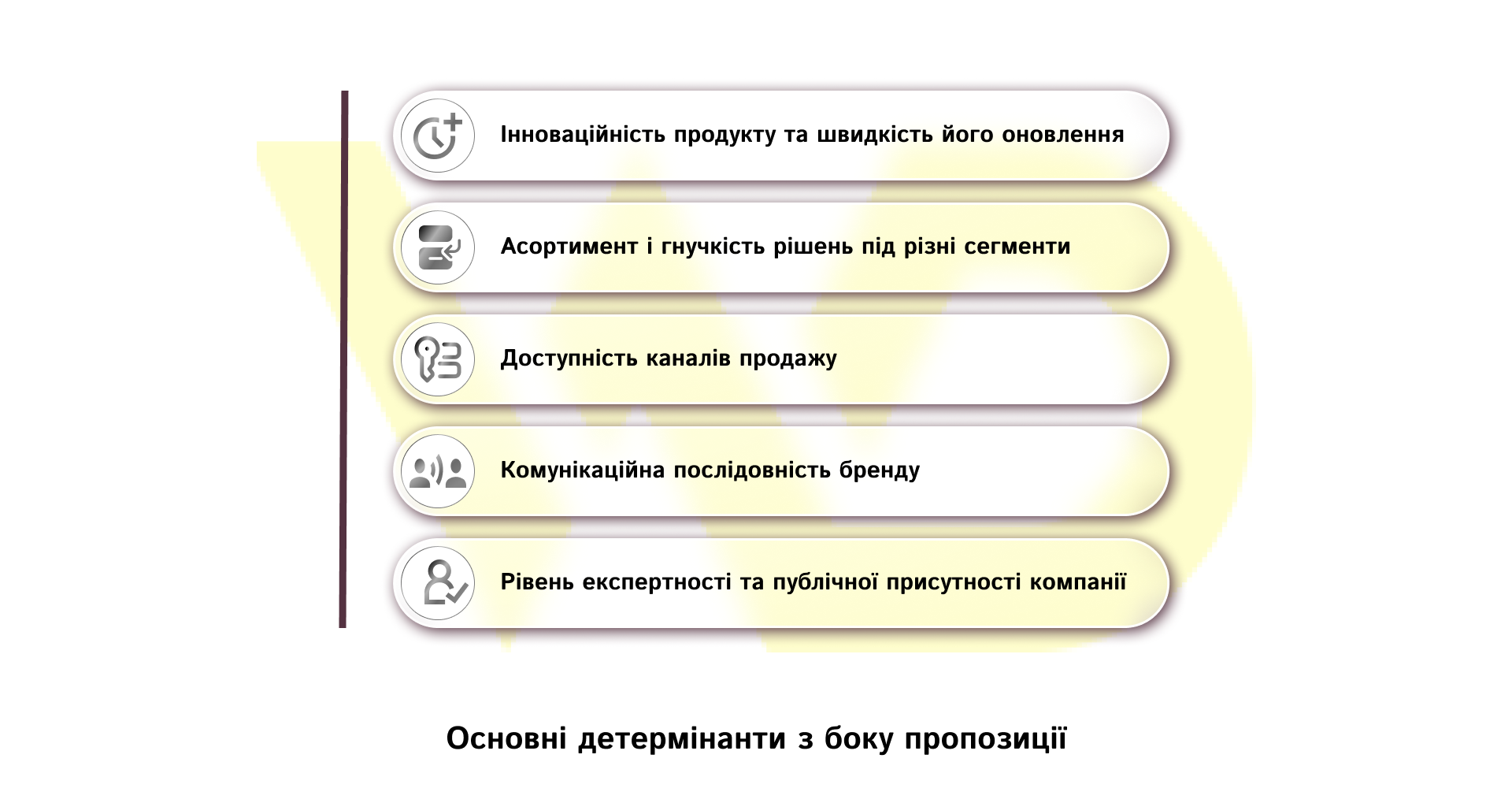
- Product innovation and the speed of its updating.
Continuous improvement of a product or service allows you to stay ahead of the competition, meet new customer needs, and maintain market interest. For example, regular updates to SaaS service features or the launch of new product lines stimulate repeat purchases and attract new customers.
- The range and flexibility of solutions for different segments.
The variety of offers allows you to reach a wider audience and adapt the product to the specific needs of customers. For example, a packaging company can offer standard boxes and customized solutions for corporate clients.
- Availability of sales channels.
The easier it is for a customer to get a product, whether online or offline, the higher the likelihood of a purchase. Multimodal channels, convenient delivery and payment methods reduce barriers for customers and increase conversion.
- Communication consistency of the brand.
Consistency of messages in advertising, on the website, and in social media creates a clear picture of the brand, its values, and benefits. This increases trust and the perception of quality, even if the price is not the lowest.
- The level of expertise and public presence of the company.
Active demonstration of competencies through case studies, articles, webinars, or participation in industry events strengthens brand credibility. Customers are more likely to choose companies that look professional and reliable.
Systematic management of these factors allows businesses to generate demand for a product even before the buyer compares prices or makes a final choice.
Why ignoring non-price factors limits growth
Ignoring non-price factors can significantly limit a company’s growth. Businesses that focus exclusively on price often find themselves dependent on dumping, losing customer loyalty, and facing difficulties in differentiating themselves in a saturated market. Lack of attention to product quality, service, reputation, and communication makes it difficult to scale and makes businesses more vulnerable to fluctuations in demand.
Instead, systematic work with non-price drivers allows you to stabilize demand even in times of market change, increase the average check without reducing conversion, and build long-term brand value. In addition, a strategic approach to these factors makes marketing investments more effective, as resources are directed not just to attract customers, but to create a comprehensive, valuable experience that is difficult to replicate for competitors.
How to effectively use non-price factors of demand
The transition from theoretical knowledge to practical actions is becoming a key element of a successful business strategy. In 2026, companies that continue to invest in the development of non-price factors will have an additional advantage: they will be able not only to respond to market changes, but also to shape demand at the stage of customer decision-making.
The most effective practices include:
- regular research of customer behavior and motivation, which allows to adapt the offer to current needs;
- investing in service and customer experience, not just traffic, to increase loyalty and average check;
- clear product and brand positioning that explains the value to the customer without vague promises;
- synchronization of marketing, sales, and product around a single value for the customer.
In 2026, the importance of such factors will only increase: competition is becoming more complex, and price is no longer the main motivator. Companies that can systematically manage non-price drivers will generate stable demand and create a long-term competitive advantage that cannot be replicated by simply lowering prices. This allows businesses to remain flexible and ready for change, while increasing the efficiency of investments in marketing and product development.

commercial offer
Other articles by the author

05/10/2023
You may be wondering why we don't use the standard web interface to create ads on Google. We use both. There are things that are more convenient to do through the browser version, and there are things that are more convenient to do through this program.

27/12/2024
The Internet is currently changing very rapidly due to the development of artificial intelligence. Google is leading the way in this process. Its new AI Overviews feature demonstrates how technology is making information easier to access. How exactly does it work and why is it so important for users and content creators?

08/10/2018
In 90% of cases, an entrepreneur who has decided to develop his or her business online faces a small problem when choosing a contractor for its promotion. Now I propose you to consider three possible options for choosing people who will be responsible for the development of your website, namely working with a private freelancer, a marketing agency, or inviting a specialist to your office.
Latest articles by #Useful tips

26/10/2026
The effectiveness of inbound marketing is based on an understanding of exactly how consumers make their choices. This process is rarely strictly linear.

22/10/2026
To properly link Instagram to Facebook, you need to distinguish between the different types of accounts within the Meta ecosystem, since confusion between a personal profile and a business page is the most common cause of errors during setup.

20/10/2026
Ben Hunt's model is a tool that helps break down a customer's path to purchase based on their level of awareness and select the right messages for each stage.