

 15/04/2026
  1709
1709

Інтернет-маркетинг
простою мовою
Content of the article
Meta AI review: features and functions of the virtual assistant
Artificial intelligence is rapidly moving from the category of «interesting technology» to a working tool that companies use every day. For businesses, it is no longer an abstract topic, but a way to create content faster, maintain communication with customers, and reduce the workload on the team. Against this background, Meta AI attracts attention not only as another AI service but also as an assistant built into the familiar environment of Facebook, Instagram, Messenger, and WhatsApp. In this article, we will analyze the Meta AI tool and its features.
How Meta AI works
Meta AI is an artificial intelligence-based chatbot created on the basis of the LLaMA 3 language model. The service analyzes user requests and adjusts answers to the context of interaction, making communication more accurate and personalized.
The tool is free and available online as well as in Meta ecosystem products. Meta AI is currently available in 43 countries and supports 12 languages. Meta AI is gradually being launched in Europe, but the service is not yet available in Ukraine or has limited functionality depending on the account and region.
Meta AI is integrated into the company’s key platforms:
- Facebook — improves recommendations and supports the launch of targeted advertising;
- Instagram — helps with content and advertising algorithms;
- WhatsApp and Facebook Messenger — automates responses and chatbots;
- Meta Quest and Meta AI Glasses — provides more interactive interaction in the virtual reality environment.
What business tasks can Meta AI solve?
For businesses, it is important to evaluate any tool not by the list of functions but by the specific tasks it helps to solve. The effectiveness of Meta AI is demonstrated in typical, repeatable scenarios where speed and basic quality are of key importance. Let’s take a closer look at the business tasks of this tool.
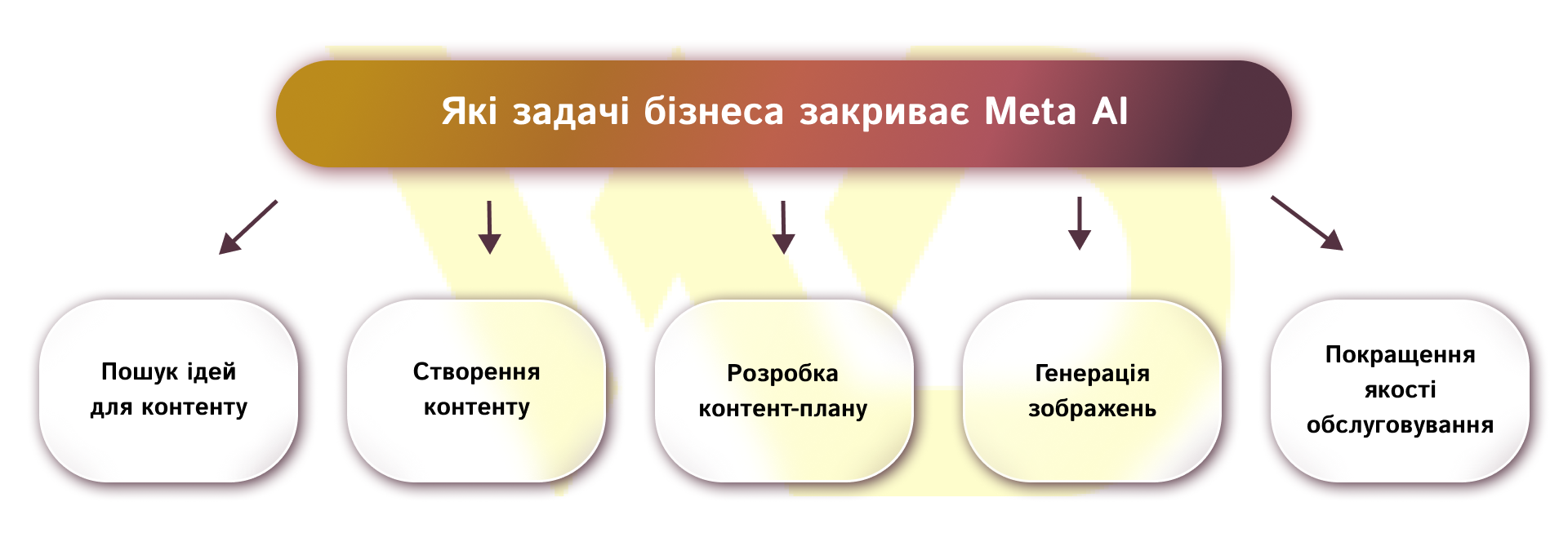
Search for content ideas
Meta AI is useful at the start of work with content, especially when the team faces a lack of ideas or the so-called «blank slate» effect. It’s enough to set the topic, format, and purpose of the material to get options for ideas, possible angles of presentation, and the basic structure of future content. This allows you to determine the direction faster and reduce the time for the preparatory stage.
Content creation
The tool is well suited for generating short text formats: social media posts, advertisements, product descriptions, notes, or summaries of materials. This allows you to quickly get a draft that the team can finalize, taking into account the brand’s style, target audience, and marketing objectives.
This approach is especially useful in situations where you need to quickly prepare several versions of the text for testing or quickly close current communication tasks without attracting additional resources.
Developing a content plan
Meta AI can also be used to create a content plan. The tool is able to offer a structure of publications divided by headings, topics, and formats, which simplifies content planning for a certain period.
This allows businesses to build systematic communication and form the logic of brand presence in the information field faster. This is especially true for companies that run several channels at the same time and need a consistent approach to content.
Image generation
In addition to texts, Meta AI allows you to create visual content — both static and animated images. For this purpose, the Imagine function is used, where the user forms a text query and receives several visualization options.
This approach is convenient for quickly selecting ideas for creatives, preparing draft versions of visuals, or testing different styles before launching an advertising campaign. If necessary, the result can be refined by changing the wording of the request.
Improving the quality of service
Meta AI can also be useful in dealing with customer requests. The tool allows you to generate response templates, personalize messages, and automate part of communication on Facebook Messenger, Instagram, and WhatsApp.
This is especially important for businesses with a large number of requests, where the speed of response affects customer satisfaction and, consequently, conversion. At the same time, automation does not exclude human involvement, but allows you to focus on more complex or non-standard situations.
The difference between Meta AI and ChatGPT
For businesses, it is important not only to compare tools by popularity but also to understand in which scenarios each of them works more efficiently. Meta AI and ChatGPT have a common basis: they both use language models to generate text, ideas, and answers. At the same time, their practical value for companies differs depending on the tasks and environment.
Common capabilities
Both tools can cover basic business needs in content management and communication. In these tasks, Meta AI and ChatGPT perform a similar function: they speed up the preparatory stages of work and reduce the workload on the team.
Key differences in use
The difference between the tools becomes noticeable when it comes to the context of use and the depth of tasks.
Meta AI is integrated into the Meta ecosystem, so it is most effective within social networks and messengers. Its strong point is quick assistance in content creation and communication directly in the environment where businesses interact with their audience. For example, an SMM manager can immediately get text options for a post or a response to a client on Instagram or Facebook without switching between services. This saves time and simplifies the workflow.
ChatGPT, on the other hand, is a more versatile tool. It is better suited for more complex tasks: writing long texts, working out the structure of articles, analyzing information, preparing scripts, or working with content in depth.
In practice, these tools do not compete directly but complement each other. Meta AI is convenient for quick operational tasks within social platforms, while ChatGPT works better as a universal assistant for more complex processes. For businesses, a combined approach may be the best option:
- Meta AI — for operational work with content and communications on social media;
- ChatGPT for the preparation of more complex materials, strategic planning, and analytics.
Such a division allows to increase work efficiency and use the strengths of each tool according to specific tasks.
Things to consider before implementation
Before integrating Meta AI into workflows, businesses should determine in advance what task this tool should solve. To be truly effective, it is important not to rely on it without a system, but to establish a clear framework from the start.
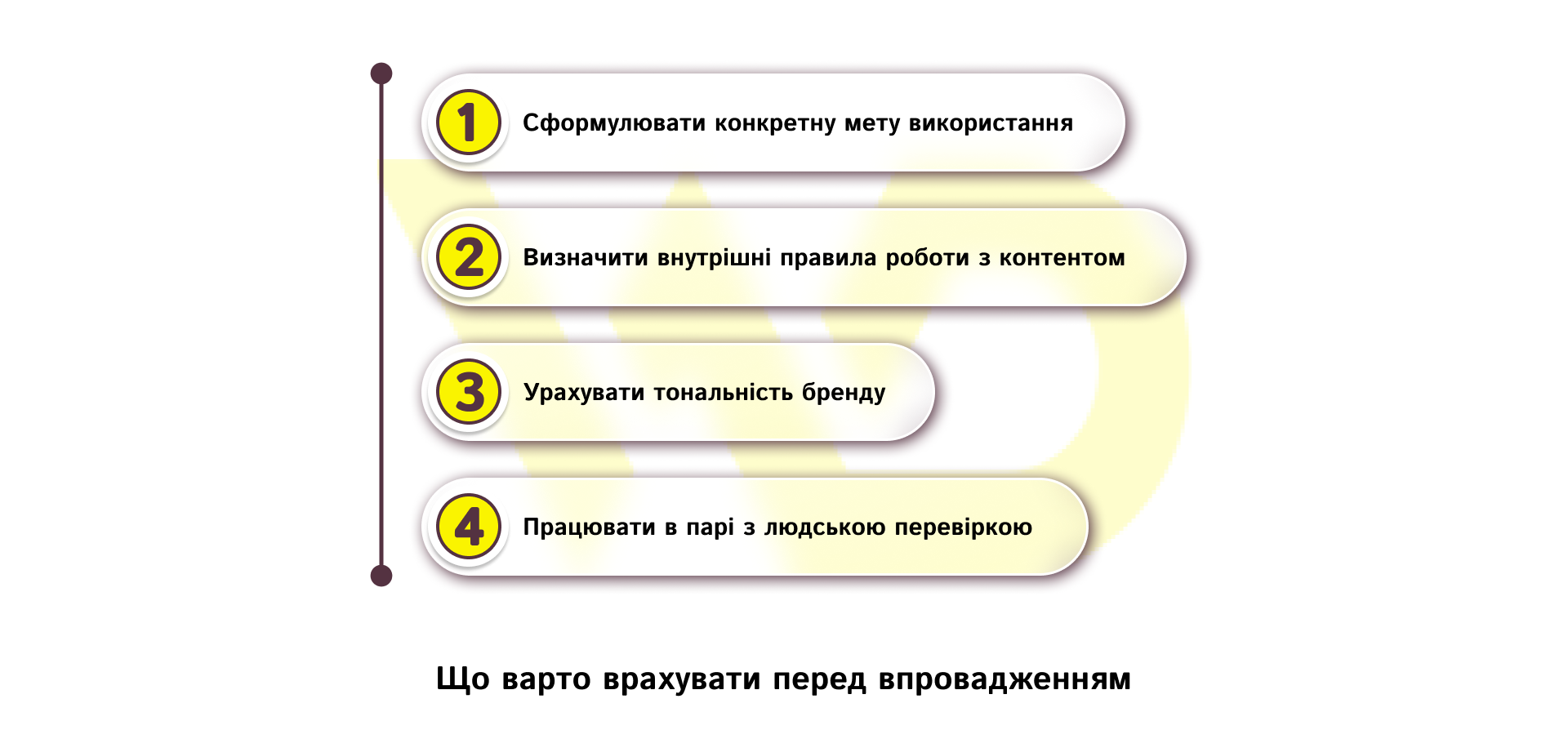
- Formulate a specific purpose of use.
If the task is to quickly prepare drafts, generate ideas, or create basic texts, Meta AI can be useful. However, if you expect full automation of communication, the result may not meet the real needs of the business.
- Define internal rules for working with content.
You should immediately decide which texts can be generated automatically, which materials must be edited, and where artificial intelligence is used only at the stage of idea generation. This approach helps to maintain quality and avoid mistakes.
- Consider the brand’s tone.
Even a quickly generated text does not always convey the desired tone or character of the company. Therefore, it is important that the final material remains recognizable, professional, and in line with the brand’s style after revision.
- Work in tandem with human verification.
Meta AI works best as an auxiliary tool, not as a complete replacement for a specialist. It is the combination of the technology’s speed and the team’s control that produces consistently high-quality results.
Meta AI can become a practical solution for business if implemented gradually, with clear rules and understanding of the limits of use. It works best where speed, basic automation, and support of daily tasks are required without unnecessary complication of processes.

commercial offer
Other articles by the author

02/03/2026
A community manager is responsible for building, developing, and maintaining a community around a brand, product, or project.

30/04/2026
Mandela effect proves that our perception of reality may differ from objective facts.

06/05/2026
A workshop is an interactive, hands-on session during which participants listen to an expert and work together on a specific task.
Latest articles by #Useful tips

29/09/2026
A content pipeline transforms the creation of content from a spontaneous creative process into a managed production system. In such a system, AI serves as a powerful assistant.
10/09/2026
The 4P model serves as an architectural foundation that transforms disparate marketing activities into a single, manageable system.
08/09/2026
Today, an influencer is a distinct media platform with its own editorial policy, a keen understanding of its audience, and an established level of trust.