

 16/09/2026
  1312
1312

Інтернет-маркетинг
простою мовою
Content of the article
- /01 How SEO and PPC work in the modern search ecosystem
- /02 How to evaluate channel effectiveness: calculating CAC, ROMI and customer value
- /03 Key differences between SEO and PPC
- /04 When should a business choose SEO?
- /05 When to launch PPC
- /06 How to generate additional sales through the synergy of SEO and PPC
- /07 How to choose the best approach for your business
SEO vs. PPC: which is more effective for driving traffic and sales
Choosing between search engine optimization and pay-per-click advertising is one of the most critical dilemmas when developing a marketing strategy. Company executives and marketers often seek an answer to the question of whether SEO or PPC is better, hoping to find a one-size-fits-all solution for quickly and inexpensively attracting customers. However, a simplistic comparison of these tools makes no business sense.
In this article, we’ll examine which is more effective SEO or paid search for specific business objectives, how to evaluate them in terms of return on investment, and under what conditions their systematic synergy yields the best results.
How SEO and PPC work in the modern search ecosystem
To make an informed investment decision, it’s important to understand the basic mechanics of how Google’s search results are generated and the fundamental differences between organic visibility and paid advertising.
Search engine optimization (SEO) aims to improve a website’s visibility in organic search results. According to official materials from Google Search Central, the main goal of SEO is to help search engines understand the content of websites and provide users with high-quality, useful answers. Search algorithms evaluate hundreds of factors:
- content relevance;
- technical soundness of the website;
- authority (including the E-E-A-T principles: experience, expertise, authoritativeness, and trustworthiness);
- user experience.
At the same time, Google emphasizes that SEO results take time and usually become apparent over the course of several weeks or months, and following the recommendations does not guarantee specific rankings or a permanent spot on the first page.
Paid search advertising (PPC) operates on a real-time auction system through the Google Ads platform. The advertiser pays for each user click to the website according to the Cost Per Click (CPC) model. Ads typically occupy the most prominent positions above or below organic search results and are marked accordingly.
The main advantage of PPC is its immediate launch: once a campaign is set up, moderated, and budgeted, ads appear in search results right away.
For businesses, this difference creates two completely different financial and operational models. SEO can be compared to building your own real estate property: a company invests in development, high-quality content, infrastructure improvements, and the site’s authority. It is a long-term asset that continues to deliver results even after active work is completed. Contextual advertising is like renting retail space: you get an instant flow of targeted visitors as long as you pay for the space. As soon as the advertising budget runs out, the traffic flow stops immediately.
Understanding this mechanism dispels any illusions businesses may have about the existence of an «easier» or «free» path. Both channels require financial and time resources, but they allocate them over time according to fundamentally different scenarios.
How to evaluate channel effectiveness: calculating CAC, ROMI and customer value
Success is often measured by the number of clicks, sessions, or rankings achieved. However, for a business owner or CFO, these metrics are merely intermediate. A channel’s true effectiveness is determined by its ability to generate profit and return on investment.
A proper comparison of SEO and PPC requires a shift from measuring traffic to a system of end-to-end financial metrics:
- CAC (Customer Acquisition Cost) — the cost of acquiring a customer. This is the total cost to the company of acquiring a single buyer who made a purchase through a specific channel. In PPC, this metric is calculated quite simply: the sum of the advertising budget plus the cost of specialist services divided by the number of deals closed. In SEO, the calculation is more complex, since the costs of development, content, and optimization are spread over the entire lifetime of the created asset.
- CR (Conversion Rate) — the conversion rate. The percentage of visitors who perform a target action (submit a form, make a call, or make a purchase). Conversion is influenced by the relevance of the audience attracted, the quality of the landing page, and the persuasiveness of the business proposition.
- ROMI (Return on Marketing Investment) — return on marketing investment. This metric shows how much net profit each hryvnia invested in the channel generated.
- LTV (Lifetime Value) — the long-term value of a customer. It is the total profit a company earns from a single customer over the entire period of their relationship.
The common claim that SEO is «free traffic» is a dangerous myth for businesses.
Organic traffic requires constant investment in creating expert content, technical support for the website, analytics, and the work of specialists. The difference lies in the dynamics of acquisition costs. In PPC, the cost per click and customer acquisition remains relatively stable or increases due to auction inflation and competition. With SEO, as a website’s authority grows and its semantic core expands, the average cost of acquiring a single visitor or customer decreases proportionally, ensuring a high ROMI in the long term.
Given this, it is entirely incorrect to compare SEO and PPC based on cost per click. An expensive ad click can provide an immediate positive cash flow and high conversion rates thanks to precise targeting of a highly engaged audience. At the same time, investing in SEO may seem unprofitable in the first few months but turn out to be the most cost-effective solution over a two- to three-year horizon.
Key differences between SEO and PPC
To clearly distinguish the scope of application for each tool, it is worth comparing them based on the key operational and financial metrics that a company encounters during its marketing efforts.
|
Parameter |
Search Engine Optimization (SEO) |
Pay-Per-Click (PPC) Advertising |
|
Time to first results |
3–6 months until the first stable sales |
From a few hours to 1–3 days after launch |
|
Nature of financial expenses |
Long-term capital expenditures (CAPEX) |
Current operating expenses (OPEX) |
|
Duration of the effect after expenses cease |
Long-term cumulative effect (inertia) |
Immediate cessation of traffic flow |
|
Targeting accuracy and flexibility |
Limited by algorithms and search demand |
High (geographic, temporal, by device) |
|
Predictability of costs and results |
Moderate (depends on Google’s algorithms) |
High (directly dependent on budget and CPC) |
|
Working with sales funnel stages |
Full coverage (from awareness to purchase) |
Primarily high-demand (Bottom of the Funnel) |
|
Resilience to competitors’ actions |
High (it’s difficult to quickly outrank a high-quality website) |
Low (competitors can outbid you) |
When analyzing these parameters, it’s important to consider their practical significance for the company’s operations. For example, the speed at which results are achieved directly impacts cash flow. If a business is launching a new venture with borrowed funds or limited working capital, waiting six months for SEO results without parallel sales could prove critical. In such a situation, PPC advertising serves as a tool to maintain liquidity, generating the first deals as early as the first week of operation.
On the other hand, the reliance on budget in PPC creates a scaling ceiling. In many niches, as the advertising budget grows, the customer acquisition cost begins to rise because the highest-converting audience has been exhausted. SEO is free from this limitation: expanding the website’s structure and creating content for related, informational, and low-frequency search queries allows you to attract an audience at various stages of the decision-making process, gradually leading them toward a purchase.
In addition, it’s important to consider the psychological factor of audience trust. A significant portion of experienced users subconsciously or consciously skips the first blocks labeled «Ad», preferring organic search results. A company’s presence in the top 3 organic search results establishes its image as an industry leader, which positively impacts conversion rates across all other communication channels.
When should a business choose SEO?
Search engine optimization becomes a fundamental tool in situations where a business is focused on building a sustainable market position and operates in a high-volume search environment. The feasibility of investing in SEO depends on the specifics of the business model and the target audience.
SEO demonstrates a particularly high return on investment for businesses in the following scenarios:
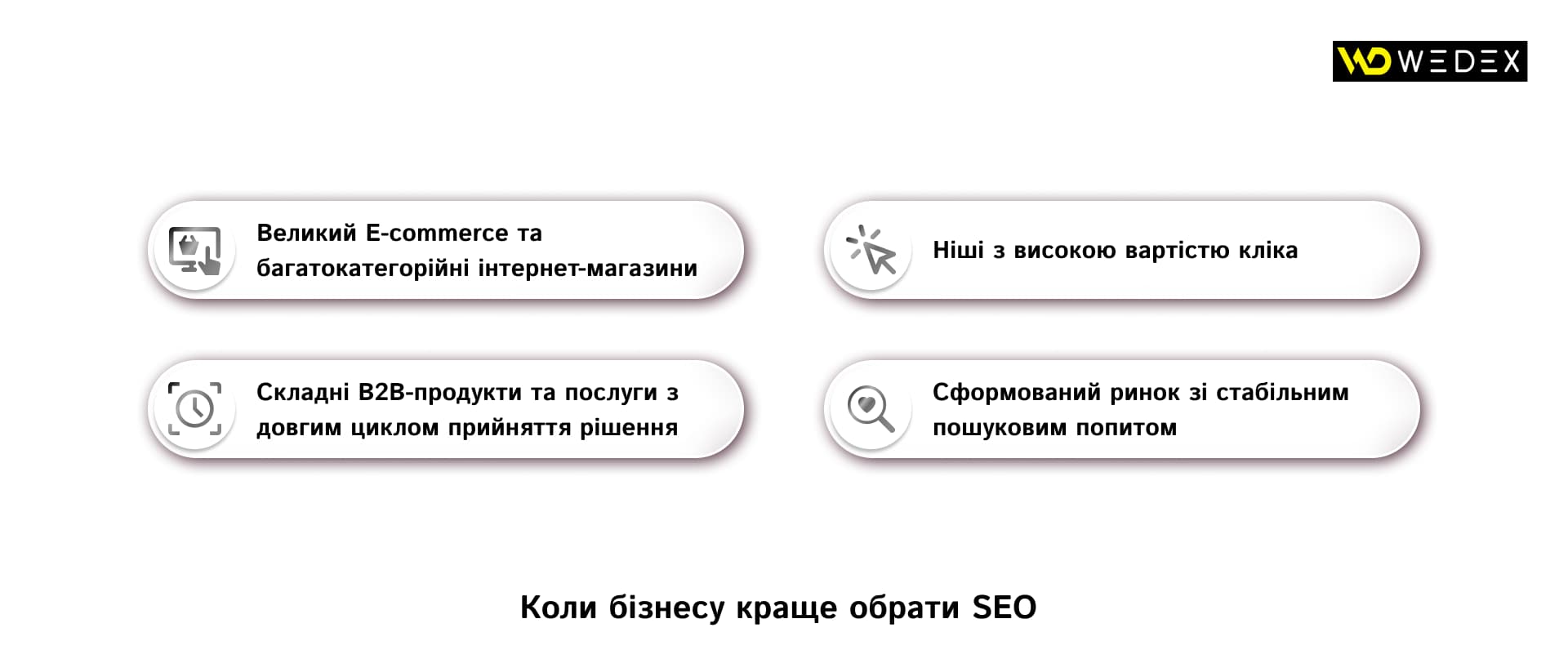
- Large e-commerce and multi-category online stores. When a catalog contains thousands or tens of thousands of stock-keeping units (SKU), purchasing all traffic for low-frequency and category-based queries via PPC becomes economically unfeasible. Organic search allows you to cover the entire spectrum of low-volume demand for free, ensuring a low weighted average cost per acquisition.
- Complex B2B products and services with a long decision-making cycle. If a purchase requires preliminary research, coordination with multiple decision-makers, and comparison of alternatives, the customer seeks information at every stage. SEO-optimized expert articles, guides, and comparative reviews allow you to capture the buyer’s attention as early as the need-identification stage.
- Niches with high cost-per-click. In sectors with fierce competition on Google Ads such as financial services, legal consulting, software development, and so on the cost of a single ad click can reach tens or hundreds of dollars. Under such conditions, building organic visibility is the only way to maintain business profitability.
- An established market with stable search demand. If users generate hundreds of thousands of search queries related to your niche every month, the absence of your website in organic search results means voluntarily ceding market share to competitors.
To realize the benefits of SEO, a company must have an appropriate planning horizon. Investing in organic promotion requires a willingness to allocate resources toward technical improvements to the website, the creation of high-quality text and graphic content, and building domain authority without expecting an immediate return on investment in the first month.
In the long term, a well-optimized website becomes a standalone business asset. Even in the event of a temporary reduction in marketing budgets, the website maintains its ranking in search results and continues to generate leads, providing a safety net for the company.
When to launch PPC
Despite the long-term benefits of organic promotion, there are business situations in which relying solely on SEO is impractical or even risky. Contextual advertising offers a level of responsiveness and control that other traffic acquisition channels cannot match.
Using PPC makes the most sense in the following cases:
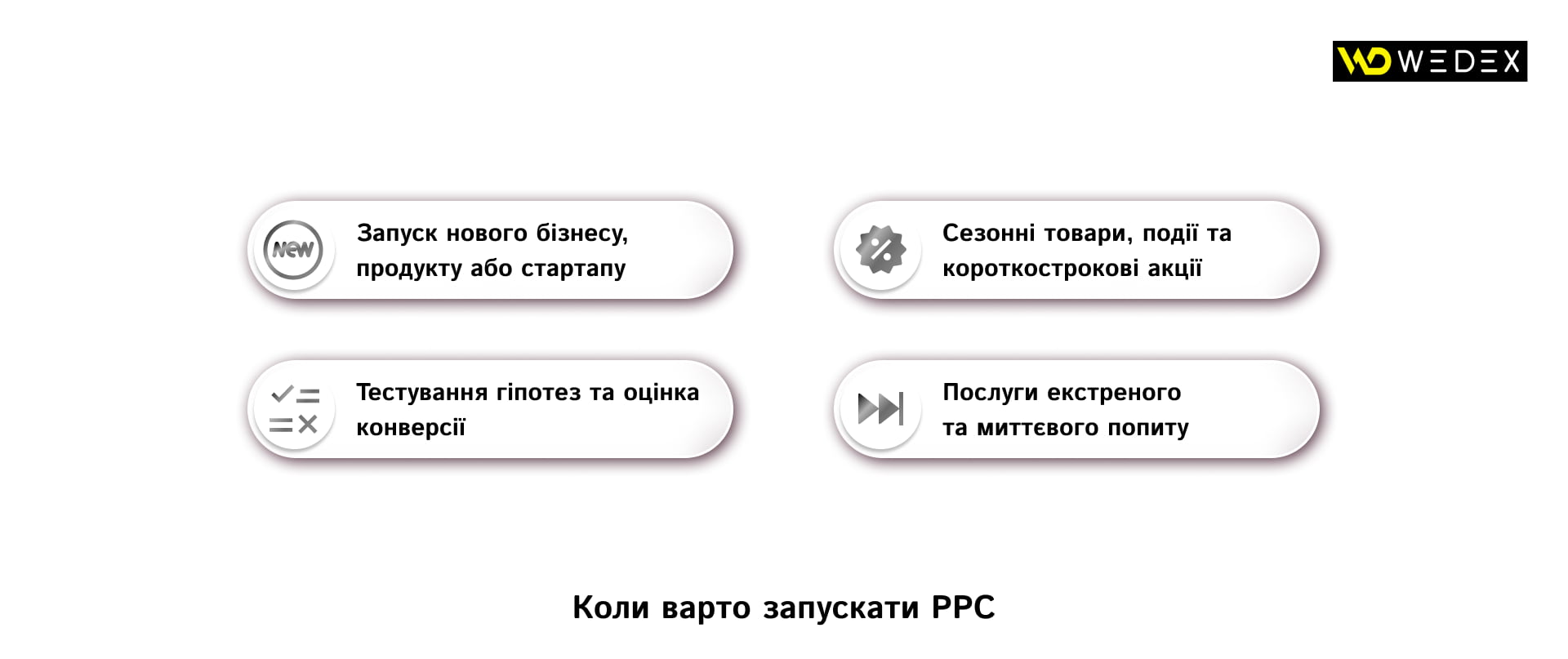
- Launching a new business, product, or startup. A new website needs time to be indexed and gain trust from search algorithms. PPC allows you to attract your first targeted visitors and generate sales on the very day the project launches, providing the company with initial revenue.
- Hypothesis Testing and Conversion Rate Evaluation. Before launching large-scale production or investing in long-term SEO promotion for your business, you need to test demand, pricing strategy, and the conversion rate of your landing page. Contextual advertising allows you to drive 1,000 targeted visitors to your website in just a few days and obtain statistically reliable data.
- Seasonal products, events, and short-term promotions. If a business is tied to specific dates such as Black Friday, sales, conferences, seasonal vacations, and so on the window of opportunity is shorter than the time it takes for a website to reach the top rankings through SEO. PPC allows you to flexibly turn traffic on and off exactly when needed.
- Services for urgent and immediate needs. In situations where a service is needed urgently for example, calling a tow truck, unlocking a door, or fixing a breakdown the consumer, of course, isn’t going to read articles. They’ll click on the first available ad at the top of the search results.
Paid advertising gives businesses complete control. A marketer can change the geographic targeting of ads in minutes, reallocate the budget to more profitable categories, pause a campaign when a product is out of stock, or filter out non-target audiences using negative keywords.
However, it’s important to remember that the speed at which PPC drives traffic doesn’t guarantee automatic sales profitability. If the product’s economics don’t add up due to high cost-per-click or low website conversion rates, scaling up the advertising budget will only accelerate losses.
How to generate additional sales through the synergy of SEO and PPC
In effective marketing practice, the question of «SEO or PPC» is increasingly giving way to the question of their systematic integration. Instead of choosing a single tool, a mature business builds a model of synergy in which the channels complement and reinforce each other.
An example of this practical collaboration is using data from Google Ads to refine an SEO strategy. By running contextual ads, a company obtains precise statistics on which specific search queries yield the highest conversion rates and actual sales. This data is shared with SEO specialists so they can prioritize promoting the relevant pages in organic search results, eliminating the need to waste resources on optimizing for «blind» or non-converting queries.
Conversely, SEO helps optimize PPC spending. Improving the website’s structure, increasing page load speed, and enhancing content relevance — all of which are SEO requirements — directly boost the Quality Score in Google Ads. A higher Quality Score reduces the actual cost per click (CPC) and improves ad rankings without increasing the advertising budget.
|
Sales funnel stage |
The role of PPC in synergy |
The role of SEO in synergy |
Business results of the combination |
|
Creating Demand |
Testing interest in new topics through media ads |
Capturing informational traffic through blogs and guides |
Building brand awareness at minimal cost per contact |
|
Evaluation and comparison |
Retargeting visitors who did not take action |
Providing detailed comparative materials and case studies |
Holding the prospect’s attention and building anticipation for a purchase |
|
Decision-making |
Capturing high-priority transactional queries in special placements |
Brand dominance in the organic top 3 search results |
Maximum market share and high trust |
Capturing the first screen of search results through simultaneous presence in the paid ad block and the organic Top 3 significantly increases the brand’s overall CTR (click-through rate). Consumers see the company both in ads and in organic results, which creates a sense of undisputed market leadership and increases the likelihood of a visit to the website.
In addition, organic traffic serves as an excellent foundation for setting up remarketing campaigns in PPC. Visitors who came to the site via search to read an expert article can be «reached» with targeted ad offers in Google Ads, allowing you to convert cold informational traffic into hot leads.
Get more out of SEO and advertising
The experts at WEDEX will help you align SEO and PPC so that these channels complement each other and your advertising data drives organic growth. We’ll develop a comprehensive strategy tailored to your business goals.
How to choose the best approach for your business
Determining the optimal marketing mix requires a sober assessment of the company’s current state, its financial capabilities, and market conditions. There is no single correct formula: a project in the launch phase and an established national retailer requires fundamentally different approaches to resource allocation.
To simplify your choice, you can use the following table:
|
Business scenario |
Optimal strategy |
First steps |
|
New project with a limited budget |
Focus on PPC (80%) + Basic technical SEO (20%) |
Quick launch of PPC to generate initial revenue; basic website indexing |
|
An established business with stable sales |
A balanced mix of SEO (50%) + PPC (50%) |
Scaling the organic semantic core; optimizing CPC through analytics |
|
Large e-commerce business / niche leader |
Long-term focus on SEO (70%) + Targeted PPC (30%) |
Maximum coverage of low-frequency search queries; PPC for brand protection and promotions |
|
Niche with limited search demand |
Selective PPC / Redirecting to other channels |
Avoid large-scale SEO; use PPC only for specific queries |
Ultimately, comparing SEO and PPC on a «which is better» basis makes little practical sense. Effectiveness is determined not by a debate between tools, but by how well the chosen strategy aligns with your company’s stage of development, budgetary constraints, and financial goals. The most successful companies don’t choose between speed and long-term sustainability they integrate both approaches into a unified customer acquisition system.

commercial offer
Other articles by the author

04/03/2026
TikTok provides a quick snapshot of attention and potential virality, but a clear strategy is needed to turn that attention into real business results.
05/02/2026
Geotargeting is an algorithm that allows content or advertising messages to be shown to users based on their geographical location.
14/08/2026
While most brands focus their budgets on Instagram or Google Ads, Pinterest remains an underrated platform with an audience that has high purchasing power.
Latest articles by #PPC
10/09/2026
The 4P model serves as an architectural foundation that transforms disparate marketing activities into a single, manageable system.

08/09/2026
Today, an influencer is a distinct media platform with its own editorial policy, a keen understanding of its audience, and an established level of trust.
14/08/2026
While most brands focus their budgets on Instagram or Google Ads, Pinterest remains an underrated platform with an audience that has high purchasing power.