

 21/05/2026
  1630
1630

Інтернет-маркетинг
простою мовою
Content of the article
- /01 What does page relevance mean
- /02 How a search engine «sees» a page
- /03 Types of Search Relevance
- /04 What signals help assess relevance
- /05 Why keywords alone do not guarantee relevance
- /06 How to tell if a page is truly relevant
- /07 Where to check a page’s relevance
- /08 What boosts a page’s relevance for a business?

What is page relevance and how do search engines evaluate it

Page relevance should be understood in a broader sense than simply «the presence of keywords in the text». Today, it encompasses a whole range of factors that directly influence how pages are ranked in search results, so it’s worth exploring this topic in as much detail as possible. In this article, we’ll explore what page relevance is, how pages appear in search results, what types of search relevance exist, and how to assess and improve a page’s relevance.
What does page relevance mean
A relevant page is one that most accurately matches the intent of the person who entered the query. In other words, the search engine tries to match not only the words in the query and the words on the page, but also the expected result: whether the user wants to buy, compare, learn about a topic, find instructions, or choose a contractor. That is why the same query can yield different types of results, such as articles, product listings, videos, reference materials, or category pages.
How a search engine «sees» a page
For a page to even compete for relevance, it must go through the basic stages of the search process:
- crawling;
- indexing;
- display in results.
First, Google finds the page, then analyzes its text, images, videos, and other elements, and finally decides whether to display it in response to a specific query. Sometimes a page can be perfectly crafted but still fail to appear in search results simply because it couldn’t be properly crawled or indexed.
This is a crucial point for a business website, as even strong content doesn’t work in isolation. If a search bot can’t read the page, misses part of the content due to JavaScript, encounters technical limitations, or doesn’t receive enough signals from the site’s internal structure, relevance isn’t fully realized. Google specifically notes that during crawling, it can render pages and execute JavaScript, but this does not mean that everything technically complex will automatically be understood and consistently indexed.
Types of Search Relevance
Search engines analyze relevance across multiple levels to determine how useful a result will be to the user. This is why a single page can rank well for one query and poorly for another, even if the subject matter is generally the same.
Most often, three main types of relevance are distinguished.
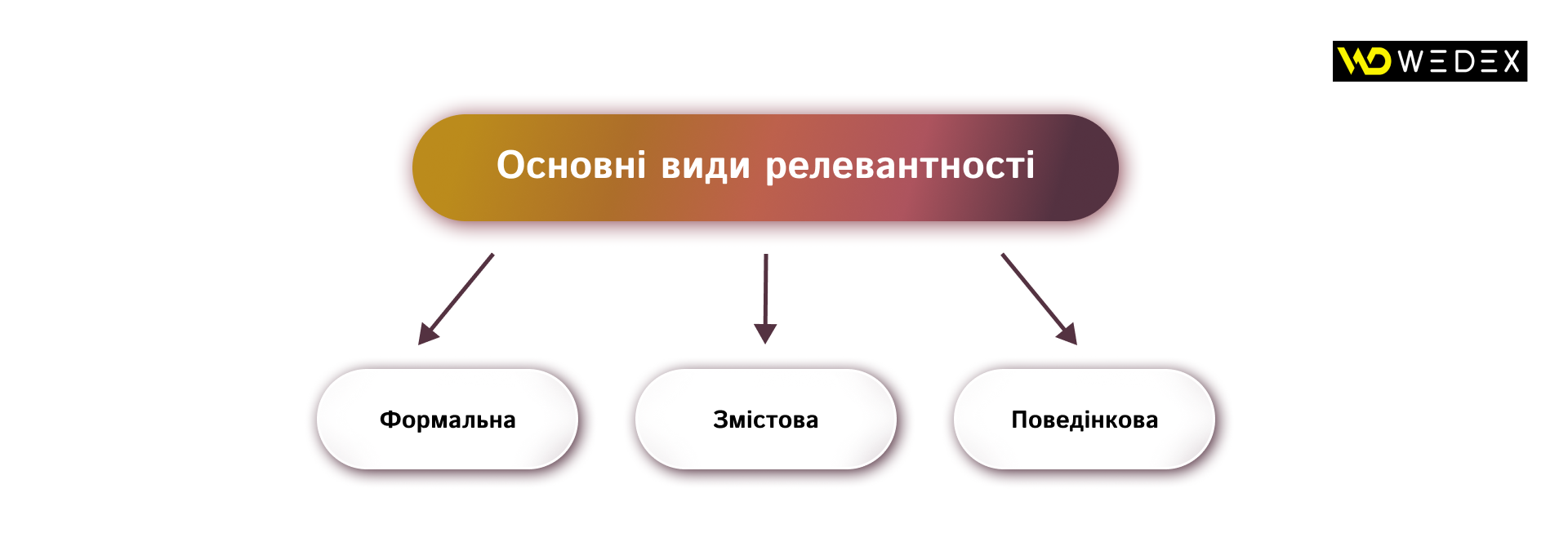
Formal relevance is the basic level of relevance, where the search engine evaluates the presence of keywords in the title, headings, text, URL, meta description, and other page elements. If a user enters the query «turnkey corporate website», the algorithm first looks for pages where this topic is directly mentioned. Formal relevance remains important, because without it, the search engine may simply not understand what the page is about.
Content relevance determines how comprehensively and effectively the page covers the topic. It’s not enough to simply mention the keyword you need to provide comprehensive, structured, and useful information. For example, a page about contextual advertising will be more relevant if it includes a description of how it works, its benefits, the steps to launch it, examples of use, and possible results.
Behavioral relevance is determined based on user interaction with the site. If visitors actively read the content, navigate to other pages, stay on the site, and do not immediately return to the search results, this indicates that the page highly meets their expectations. Such signals help search engines refine the quality of results.
It is important for businesses to work on all three types simultaneously. Only a comprehensive approach ensures steady growth in search visibility.
What signals help assess relevance
Search engines do not use a single «magic» formula for relevance. They take many factors and signals into account simultaneously. Google talks about automated systems that analyze hundreds of billions of pages to show the most useful results.
One of the most obvious signals is the page title. It is often what appears as the headline in search results and helps users quickly determine whether the page matches their query. Google notes that page titles are critical for quickly understanding a result’s relevance, and their quality significantly influences the decision to click. Therefore, it’s important to remember that the title shouldn’t be just an SEO formality, but a short, precise answer to the audience’s intent.
Internal links and anchor text play an equally important role. Links serve as a signal of relevance; they help discover new pages to crawl. If a site’s internal linking structure is logical, it’s easier for the search engine to understand which pages are primary, how they’re interconnected, and the context behind each one. This is also a plus for the user, as it allows them to move more quickly from general information to specifics.
Another important signal is page experience. Google explains that its core ranking systems are designed to reward content that provides a high-quality page experience, but there is no single, definitive criterion for evaluating page experience. Core Web Vitals, secure connections, mobile-friendliness, the absence of excessive ads and intrusive interstitials, as well as a clear distinction between primary and secondary content are all taken into account. For a business website, this directly influences whether a visitor will stay on the page and perceive it as a reliable source.
Improve your website's relevance for Google and users
WEDEX specialists optimize your website's structure, titles, internal linking, and technical factors to help Google better understand and rank your content.
Why keywords alone do not guarantee relevance
Just a few years ago, many people assessed relevance almost mechanically: does the text contain the query, is it in the title, and is the phrase repeated enough times? Today, this approach no longer works as a universal solution. In all its guidelines, Google advises creating only useful, people-oriented content. If the material is written for search bots rather than to solve the user’s problem, it aligns less well with the logic of modern search.
Therefore, a page’s relevance should be based not on frequency, but on the completeness of the answer.
For example, if someone searches for «page relevance», a short definition isn’t enough. Often, they also need examples, evaluation criteria, the impact on SEO, technical signals, and the difference between text relevance and intent relevance. It is this depth that creates a truly strong page for search.
Let’s look at the following example for a better understanding. Imagine two queries. The first is «CRM for small businesses». The second is «what is CRM». In the first case, the user needs a selection of solutions, a comparison of features, and possibly a commercial page or a service overview. In the second, they need a basic explanation of the term. If the same page tries to be a reference guide, a commercial offer, and a landing page all at once, it blurs the focus and becomes less relevant to each of these search intents.
That is why it is important for a business not just to promote a page using a «good keyword», but to clearly match the page type to the query type. A category page should address one scenario, a blog post another, and a service page a third. Search engine s generally reward pages that don’t force the user to guess where they’ve landed or whether they’ll get the information they need.
Another example is a service page for a B2B company. If it contains only general phrases like «we provide high-quality services for businesses», its relevance will be weak. However, if it includes a specific description of the process, an understanding of the client’s goals, examples of results, a clear block structure, and answers to typical audience questions, then such a page better matches the search query and better helps the user make a decision.
How to tell if a page is truly relevant
In a basic check, you should look not at a single metric, but at a combination of factors. If:
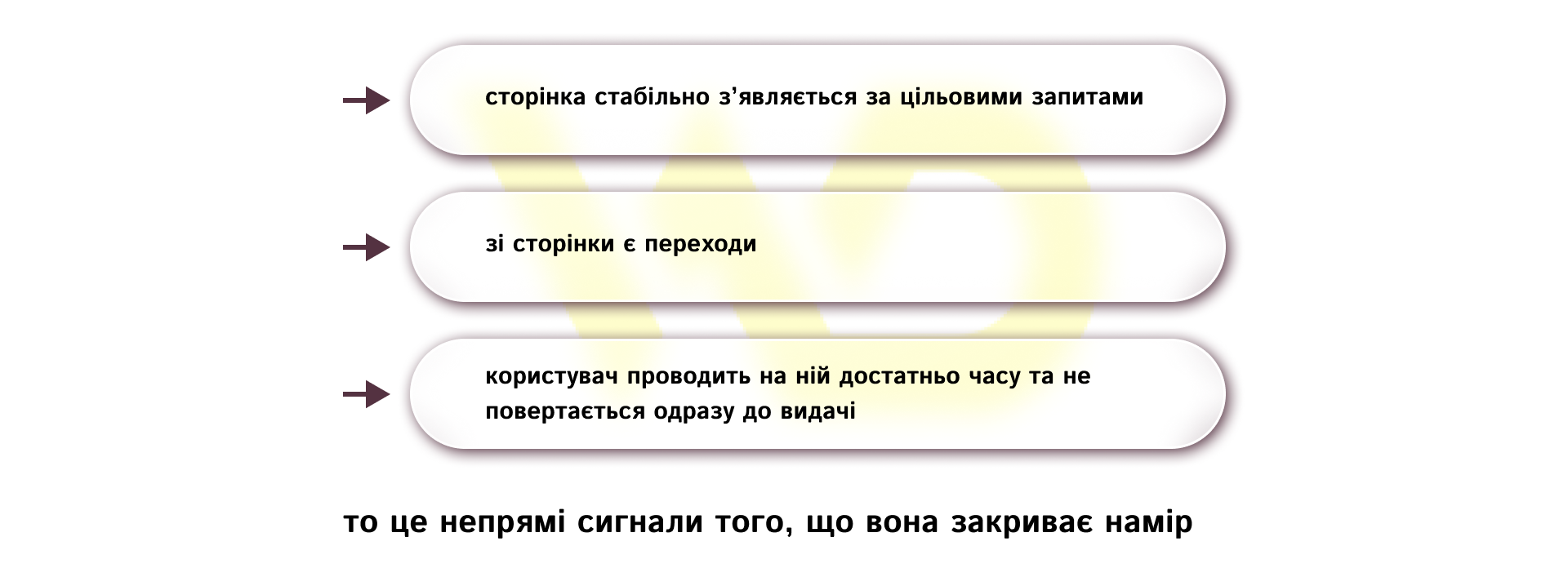
In this sense, relevance is not a one-time state, but a working hypothesis that must be confirmed by search data and audience behavior.
However, it is important not to confuse behavioral observations with direct algorithmic «scores». Google does not define relevance as a simple count of clicks or time spent on a page. It is a much broader model in which behavior, structure, content, and technical quality work together. That is why a page with high traffic may be weak in terms of business results if people visit it with an intent that does not align with your goals.
Where to check a page’s relevance
It’s advisable to check relevance across several channels: directly in search results, through behavioral data, and using SEO tools. This approach allows you to see not only how the algorithm «perceives» the page but also how users react to it.
Manual check in search results (SERP)
The most basic method is to check the page as the user sees it on Google.
What to do:
- enter the target query and see what types of pages rank at the top (articles, categories, landing pages);
- compare your page with competitors in the results;
- assess whether the title and description meet user expectations;
- pay attention to the content format: Google often «suggests» which type of page it considers relevant for this query.
This method allows you to quickly determine whether the page format is correctly chosen for the audience’s intent.
Checking via user behavior
The second level of evaluation involves analyzing actual user interaction with the content. The most commonly used tools are:
- Google Analytics 4 — to analyze engagement rate, time on page, and scroll depth;
- heatmaps (Hotjar, Clarity) — to understand exactly how a user interacts with the page;
- the return-to-search rate (indirectly via behavior or traffic segmentation).
If a page receives traffic but users leave it quickly or do not navigate further on the site, this often signals a disconnect between the search query and the content.
Google Search Console
One of the most accurate free tools for checking relevance. Here, you should analyze:
- which queries bring users to the page;
- the page’s rankings for various keywords;
- CTR (does the title match expectations in the search results);
- pages that rank for «irrelevant» queries.
It’s especially important to look at situations where a page receives impressions for irrelevant queries this is a sign that the search engine isn’t fully interpreting its content correctly.
SEO tools for deeper analysis
Professional tools allow you to assess relevance in comparison with competitors and the market structure. The most commonly used are:
- Ahrefs or SEMrush — to analyze the keywords for which a page ranks and compare it with competitors;
- Screaming Frog SEO Spider — to check the technical elements of the page (title, headings, metadata, internal links);
- Keyword clustering tools — to check whether a page aligns with a single intent or «mixes» several.
Such services help identify structural issues that are difficult to spot manually.
What boosts a page’s relevance for a business?
The best-performing page for a company is one that doesn’t just cover a key topic but helps a user move from a query to a call to action. In other words, it must be clear, logical, fast, useful, and sufficiently in-depth. This is especially important in competitive niches where many pages on the same topic may exist with similar keywords but varying quality of content.
In practice, this means a few things.
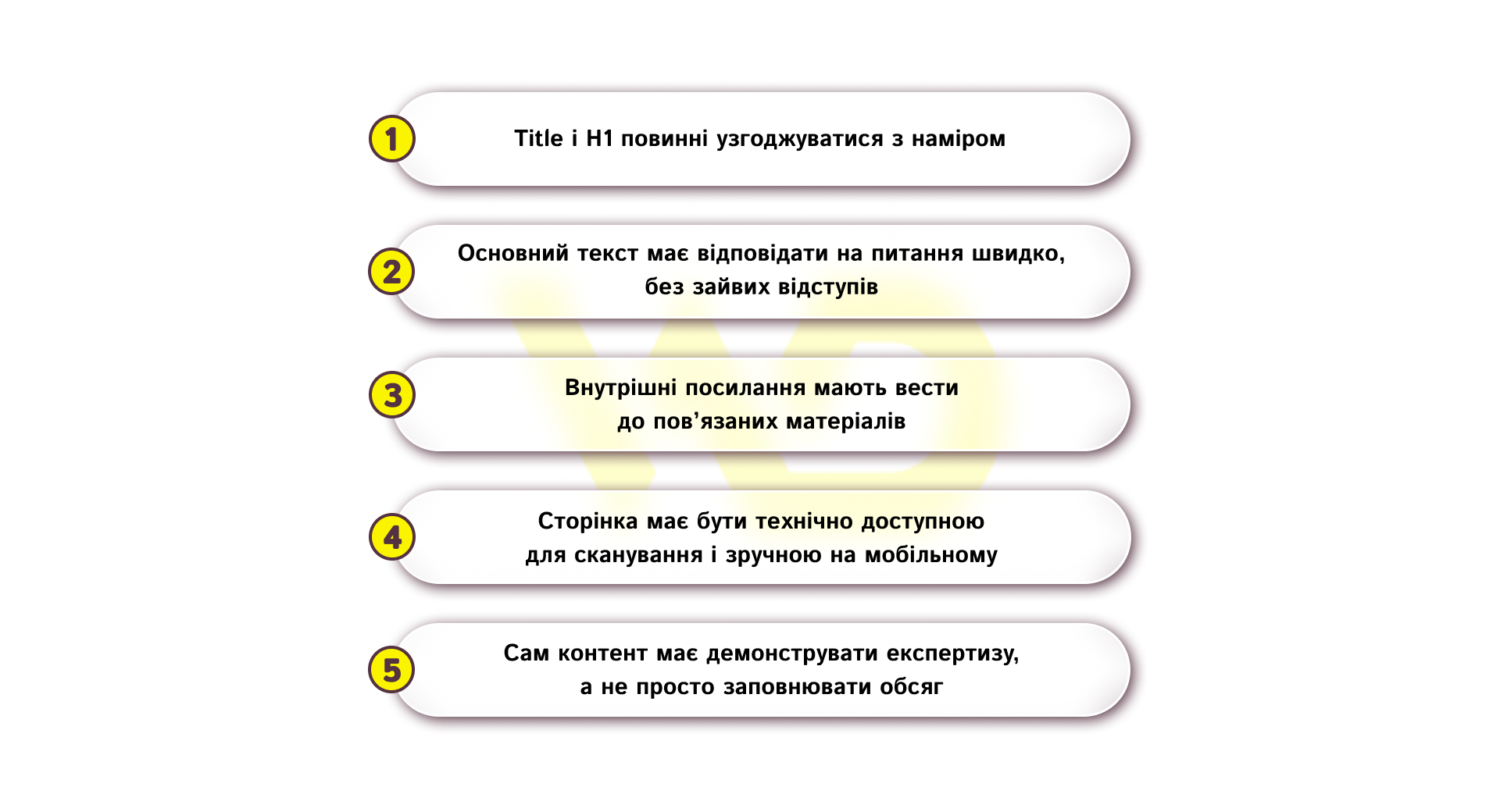
In addition, you need to use keywords wisely:
- avoid keyword stuffing;
- place the most relevant queries at the top of the page;
- add keywords primarily to headings and subheadings;
- use synonyms and avoid repetition.
A page’s relevance is, essentially, the answer to a simple question: does this page truly best help a person right now? For a search engine, this is a complex, multifactorial task, but for a business, it’s a strategic advantage. The more precisely a page matches the user’s intent, the clearer its structure, and the easier it is for the user to navigate, the greater the chance that it won’t just appear in search results but will actually drive the exact audience the company needs to its website.

commercial offer
Other articles by the author

05/02/2026
When a brand tells stories about people, challenges, and solutions, it becomes more understandable and relatable to the customer.

02/07/2026
Choosing the wrong ad format is the main reason for a low return on investment (ROI) and the rapid depletion of a company's marketing budget.
12/08/2026
Broken links and non-existent pages aren't just technical flaws in a website they're a direct path to losing potential customers and dropping in search engine rankings.
Latest articles by #SEO
12/08/2026
Broken links and non-existent pages aren't just technical flaws in a website they're a direct path to losing potential customers and dropping in search engine rankings.

23/07/2026
An RSS feed is a separate file containing a list of a website's latest posts. When a new article, news item, or other content appears on the site, information about it is automatically added to this feed.

08/07/2026
Donor analysis isn't about examining a single metric; it's about comparing several metrics against one another.