

 23/09/2026
  1245
1245

Інтернет-маркетинг
простою мовою
Content of the article
- /01 The role of humans in working with AI
- /02 The economics of time: why speed of generation does not equal productivity
- /03 Key soft skills for interacting with artificial intelligence
- /04 Psychological barriers and why teams sabotage AI implementation
- /05 From chaos to system: how to integrate algorithms into daily practice
- /06 How to establish guidelines for working with AI as a team
- /07 What determines business success in the age of artificial intelligence

Beyond the prompts: what soft skills and critical thinking are needed to work effectively with AI
The rapid pace of development in artificial intelligence has shifted the business focus primarily toward tools. Companies are investing in subscriptions, testing new platforms, and implementing algorithms, expecting an immediate boost in efficiency. In practice, however, effectiveness depends not on the software itself, but on the competencies of the specialists who manage these technologies. Access to technology is no longer a competitive advantage the ability of a team of specialists to integrate these solutions into real-world business processes is what counts.
In this article, we’ll explore exactly which soft skills specialists need to effectively use artificial intelligence in their daily work, why speed of generation does not equal productivity, and how companies can develop a systematic approach to building these competencies.
The role of humans in working with AI
The integration of algorithms into companies’ operations is fundamentally changing the very nature of a specialist’s work. A specialist is no longer merely a generator of work volume they become a systems manager. For example, in the field of digital marketing, tools such as Perplexity AI or Surfer SEO can instantly compile a cluster of anchor text, analyze competitors, or propose a detailed structure for a technical article. However, an algorithm cannot independently assess whether this data aligns with the client’s current strategy and the brand’s communication tone.
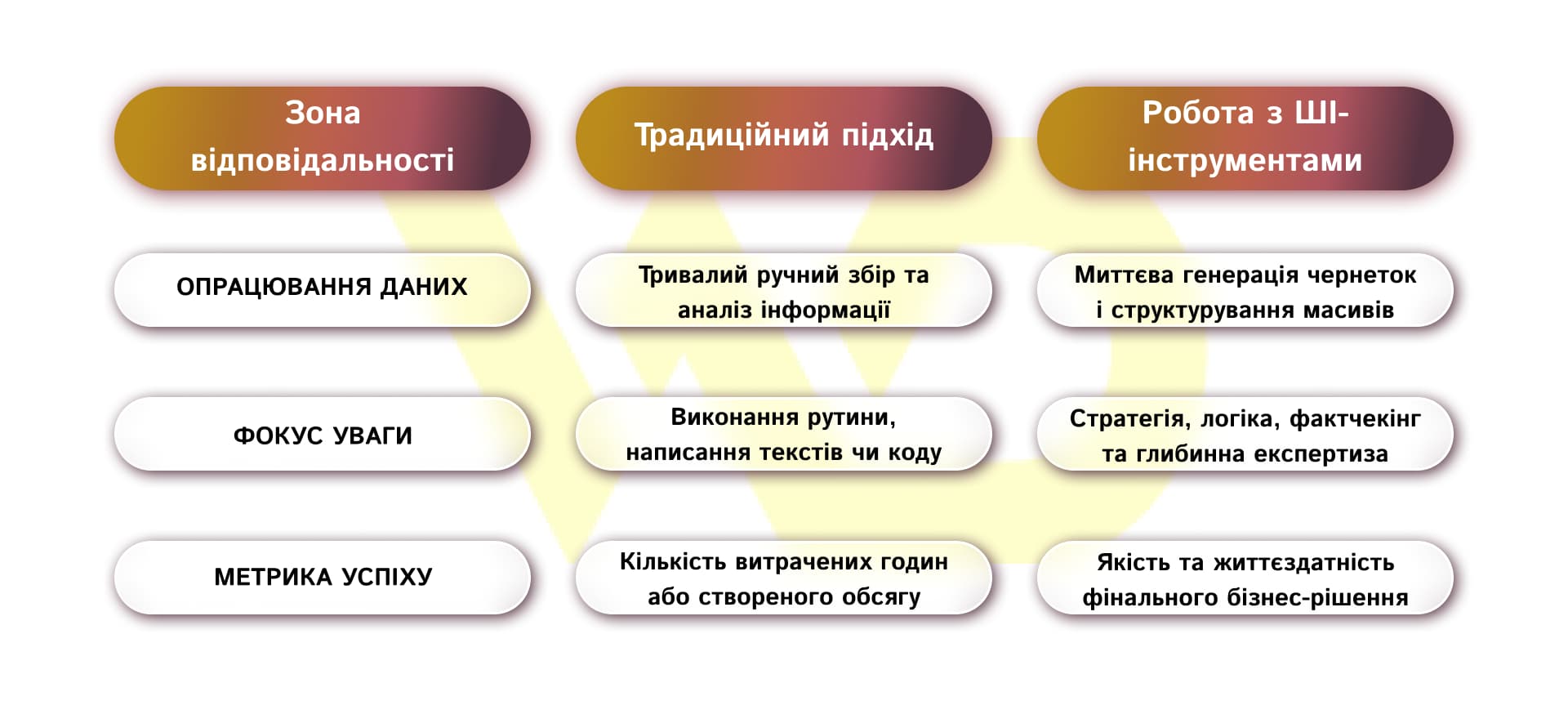
In a traditional marketing project, content generation or compiling a semantic core account for about 70% of working time. Now this figure has been reduced to a minimum, shifting the focus to in-depth analytics and logic verification.
To illustrate this, let’s look at how the key aspects of a specialist’s work are transforming:
The illusion of delegation and quality control
The main risk for businesses during the technology adoption phase is the illusion that algorithms can be entrusted not only with routine tasks but also with thinking. Technology operates strictly within predefined parameters and lacks empathy or an understanding of the company’s overarching goals.
«For most insights generated by generative AI to have a practical impact, they require human interpretation. The ‘human-in-the-loop’ concept is critically important.» — Alex Singla, Senior Partner at McKinsey & Company.
When artificial intelligence takes over the mechanical part of the process, humans are left with a set of critically important tasks:
- defining precise objectives and context before the algorithm begins working;
- verifying the generated data for misinformation (AI hallucinations);
- adapting the created materials to the specific needs of the target audience;
- assessing the safety and feasibility of implementing the proposed solutions in a real-world project.
In the new reality, an employee’s value in the market is determined not by the speed at which they complete basic tasks, but by the quality of their expert oversight. Artificial intelligence is about optimization, but without human expertise, it generates information noise instead of a finished business product.
The economics of time: why speed of generation does not equal productivity
One of the most dangerous pitfalls on the path to implementing artificial intelligence is the misconception that an increase in the speed of content or code creation automatically translates to improved business results. Since algorithms generate content in seconds, teams often fall into a cycle of overproduction: they create dozens of ad creative options, thousands of words of text content, or massive arrays of analytical reports that no one has time to process thoroughly.
The result is a paradoxical situation: there seems to be less time for routine tasks, yet the workload on the team has increased. Specialists spend their entire workday not on strategy, but on editing, filtering, and managing the vast amounts of «digital clutter» produced by the neural network.
True time savings in the age of AI do not lie in doing more of the same work in less time.
Efficiency is measured by the ability to redirect the freed-up resources toward tasks that require exclusively human intelligence: deeply understanding the client’s pain points, developing unconventional positioning, assessing risks, and building long-term strategies. If AI merely increases the level of chaos within a company, this indicates a misunderstanding of the very essence of automation.
Key soft skills for interacting with artificial intelligence
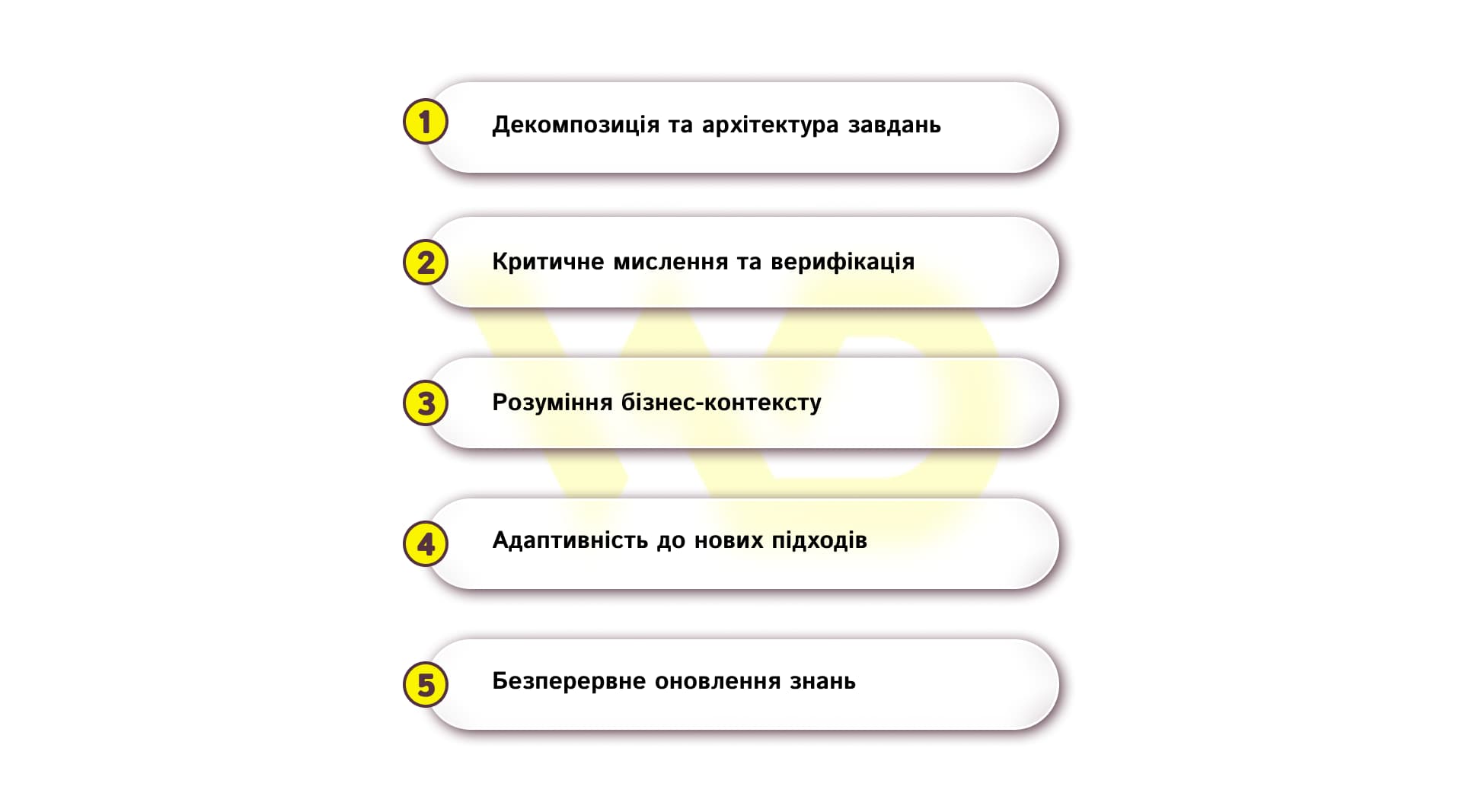
Successful work with neural networks requires the development of five fundamental soft skills that cannot be automated.
Task decomposition and architecture
Artificial intelligence can gather analytics, write code, or propose solutions, but the quality of the result is directly proportional to how a person formulates the initial task. A simple prompt like «conduct a market analysis» is not enough to get an in-depth answer.
A specialist must possess the skill of decomposition the ability to break down a large project into logical stages. Effectively framing a task for AI involves providing the full context:
- who the product is being created for;
- what management or marketing decision it is intended to help make;
- what specific data or constraints need to be taken into account;
- in what format the final result should be presented.
The more precisely a specialist defines the architecture and boundaries of the process, the more useful and accurate the algorithm’s input becomes. Prompt engineering skills stem precisely from a deep understanding of how to break down a complex business task into atomic steps.
Critical thinking and verification
The speed at which ideas, texts, or analytical reports are generated does not guarantee their accuracy. A result produced by a machine cannot be immediately applied to real-world work. Algorithms often produce superficial conclusions or compile unrelated facts.
According to the latest «Future of Jobs» report from the World Economic Forum, analytical and creative thinking remain the most important skills for workers in the age of AI. Critical thinking allows a specialist to distinguish in-depth expert analysis from trivial rewrites, identify logical gaps and factual errors, and ask clarifying questions of the algorithm to improve the results.
At the same time, possessing this skill helps businesses avoid so-called «AI theater» a situation where a company actively discusses the use of new technologies, but in practice, this does not optimize processes and merely mimics innovation.
Understanding the business context
The ability to work with a tool is meaningless when detached from industry realities. Companies need specialists who can identify exactly at which stage of the process the algorithm creates measurable financial or operational value.
For example, for one team, AI will be the best assistant in testing marketing hypotheses and developing strategies for entering new markets; for another, it will automate basic customer support or speed up work with technical documentation. True professionalism lies not in knowing the names of all existing neural networks, but in understanding whether they are relevant to solving a specific customer pain point in a given niche. If a tool is used merely for the sake of the process itself, the company wastes resources without achieving conversion growth or cost reduction.
Adaptability to new approaches
Familiar working algorithms always provide a sense of control, and it’s psychologically difficult to let them go. However, a specialist’s flexibility today lies in the willingness to consciously disrupt processes that have been built up over the years.
Adaptability in the context of AI does not mean mindlessly testing every new platform on the market. Rather, it is a professional habit of regularly auditing one’s own tasks: identifying routine work that can be delegated to a machine and objectively assessing whether a new approach truly improves quality or reduces time spent. A highly adaptable professional views changes in software not as a threat to their role, but as an opportunity to expand their scope of responsibility.
Continuous learning
The concept of lifelong learning is no longer just a competitive advantage it has become a fundamental requirement for professional relevance. During the World Economic Forum in Davos in 2024, IBM CEO Arvind Krishna noted that the «half-life» of professional skills has shrunk from 30 years to seven. What guaranteed success in the labor market just a few years ago is now becoming obsolete due to the emergence of autonomous agents and intelligent systems.
In times of such rapid transformation, a company cannot bear full responsibility for an employee’s training. A business can provide access to subscriptions, allocate time, or create conditions for testing. But internal curiosity, choosing paths for development, and integrating new knowledge into one’s own work remain the personal responsibility of the professional.
Psychological barriers and why teams sabotage AI implementation
Even with a clear understanding of the benefits of technology, the process of integrating it into daily practice often faces internal resistance from employees. This resistance is rarely the result of an outright unwillingness to work it is usually driven by deep-seated psychological and organizational reasons.
Expert syndrome and fear of making mistakes
For experienced senior-level professionals, transitioning into the role of a learner is a serious psychological challenge. Someone who has spent years building a reputation as an expert in their field is faced with the need to figure out unfamiliar tools, ask simple questions, and make mistakes in front of colleagues.
Research from 2025 shows that employees may avoid asking questions out of fear of appearing incompetent, especially in situations where other team members have more experience. A separate study focused specifically on the implementation of AI found that organizational pressure to adopt new technologies can exacerbate older employees’ anxiety about AI training, with the effect being stronger among employees with more seniority.
Therefore, it is important for management to create an environment in which questions, experimentation, and mistakes are not perceived as unprofessional. Mentoring can mitigate the negative impact of anxiety about AI training on employees’ ability to use new technologies effectively.
The gap between theory and practice
A major problem in corporate training is the disconnect between educational programs and real-world operational tasks. When companies hold mass lectures or webinars on the capabilities of artificial intelligence without linking them to the daily responsibilities of specific departments, the knowledge remains abstract theory.
The specialist doesn’t understand exactly how to apply the information they’ve learned to their project, and after the lecture ends, they revert to their usual work methods. Training yields results only when it is integrated into solving specific work cases while meeting current deadlines.
From chaos to system: how to integrate algorithms into daily practice
When a specialist recognizes the need to develop soft skills, the question of practical implementation arises. To avoid the common mistake of spreading one’s attention across all new platforms at once, the process of adapting technologies requires a clear sequence. A systematic approach to AI implementation is built on several interconnected stages.
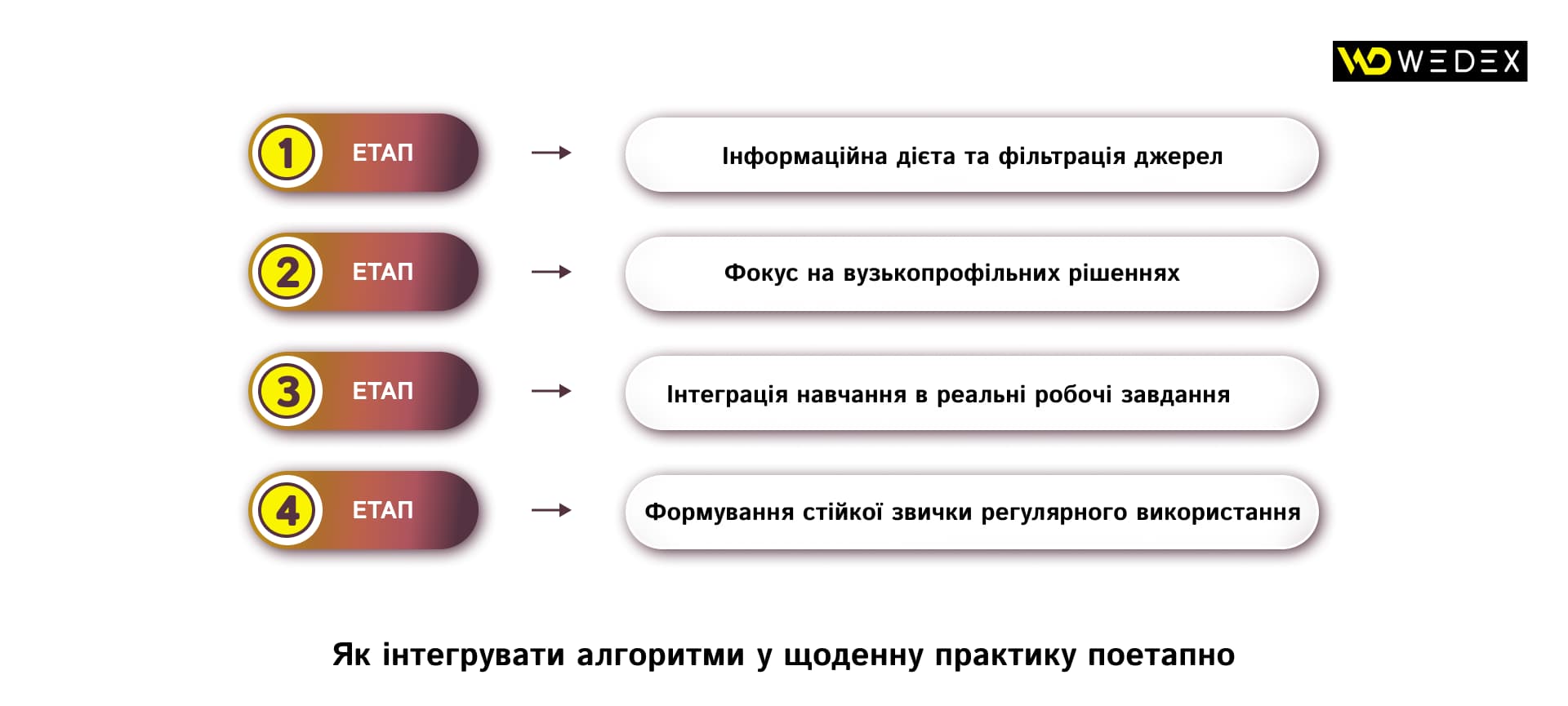
- Information diet and source filtering.
Every day, dozens of new software solutions, forecasts, and analytical reviews appear on the market. Trying to react to every piece of tech news leads to a loss of focus. Specialists who select a limited pool of authoritative experts with a deep understanding of the industry and systematically track their assessments while filtering out superficial information noise achieve more effective results.
- Focus on niche solutions.
Testing the entire spectrum of available tools from code generation to complex design and management consumes too many resources without achieving depth. You should select only those programs that directly address critical tasks in your professional role. For example, developers should focus on code optimization environments; project managers, on automating risk analysis and meeting summaries; and marketers, on tools for content strategy and analytics.
- Integrating learning into real-world work tasks.
As we mentioned above, any knowledge acquired in isolation from daily activities is rarely put into practice. Using algorithms to process real-world datasets, test hypotheses, or structure complex materials allows you to quickly see the measurable benefits of technology in a professional context.
- Developing a sustainable habit of regular use.
Working with algorithms should be viewed not as a one-time learning activity or a short-term experiment, but as an ongoing practice. Professionals who use artificial intelligence daily as an analytical partner to test ideas, compare results, and refine approaches achieve significantly greater professional progress than those who turn to technology only occasionally.
Adhering to this approach transforms the chaotic exploration of software into a structured process for improving personal productivity, where technology harmoniously complements the expert’s experience.
How to establish guidelines for working with AI as a team
A separate issue concerns not only the skills of individual employees but also the rules by which the team uses AI.
If each employee independently decides what data can be shared with an external service, which results need to be verified, and where it’s acceptable to use automatically generated content, the company ends up with an inconsistent process and additional risks. Therefore, it’s important to establish basic principles even before a large-scale implementation.
Determine which tasks can be automated
Not every process is equally suited for AI. Routine operations with clear rules are usually easier to delegate to algorithms, whereas strategic decisions, working with sensitive data, or tasks with a high cost of error require significantly more human oversight.
Establish the level of review
Different types of outputs require different levels of oversight. A draft of an internal document and material intended for clients should not undergo the same review process.
The team must understand in advance when a quick review is sufficient and when a full factual and expert review is necessary.
Identify who is responsible for the final result
The use of AI should not blur accountability. If a text, analytical conclusion, or recommendation is generated by an algorithm, this does not mean that responsibility for its quality shifts to the technology.
A specific specialist must be accountable for the final result and be able to explain why a particular decision was made.
Build an internal database of successful scenarios
If one employee has found an effective way to use AI, their experience shouldn’t be limited to their personal practice. Work scenarios, successful approaches, common mistakes, and verification criteria can be documented and shared within the team.
In this way, the company gradually builds its own system for working with the technology, rather than simply a collection of individual service subscriptions.
What determines business success in the age of artificial intelligence
AI is changing not only individual work processes but also the very structure of professional activity. Tasks that previously required significant time for searching, preparing, or initially processing information can increasingly be automated.
However, this does not eliminate the role of humans on the contrary, it raises the bar for them. As machines take on more routine tasks, professionals need to better understand the task at hand, the context, the risks, and the criteria for a high-quality result.
Therefore, the competitive advantage lies not simply in the ability to use AI. Far more important is the combination of professional expertise, critical thinking, the ability to correctly formulate tasks, adapt to change, and take responsibility for the final decision.
For companies, in turn, it is important not to limit the implementation of AI to the purchase of new platforms. They need to change workflows, train teams on real-world tasks, create a safe environment for experimentation, and measure not the quantity of output generated, but the actual benefit.
In this model, AI does not replace professional expertise but rather enhances it. It is precisely the ability to correctly combine the capabilities of technology with human thinking that will determine who can gain a real business advantage from AI and who will remain merely a user of yet another tool.

commercial offer
Other articles by the author

16/06/2026
Today, naming is a strategic tool that directly impacts customer acquisition cost (CAC), ad conversion rates, legal compliance, and, ultimately, a company’s market value.

02/07/2026
Choosing the wrong ad format is the main reason for a low return on investment (ROI) and the rapid depletion of a company's marketing budget.
23/09/2026
Access to technology is no longer a competitive advantage what matters is a team of experts’ ability to integrate these solutions into real-world business processes.
Latest articles by #Useful tips
23/09/2026
Access to technology is no longer a competitive advantage what matters is a team of experts’ ability to integrate these solutions into real-world business processes.
18/08/2026
For businesses, the main challenge right now is not simply to “produce something,” but to speed up the time it takes for materials to reach the market, reduce the cost of content creation, and, at the same time, maintain the quality and human touch of communication.

16/07/2026
The official launch of OpenAI ad testing on February 9, 2026, was a historic moment that marked the emergence of an entirely new media channel for promoting businesses.