

 18/06/2026
  1343
1343

Інтернет-маркетинг
простою мовою
Content of the article
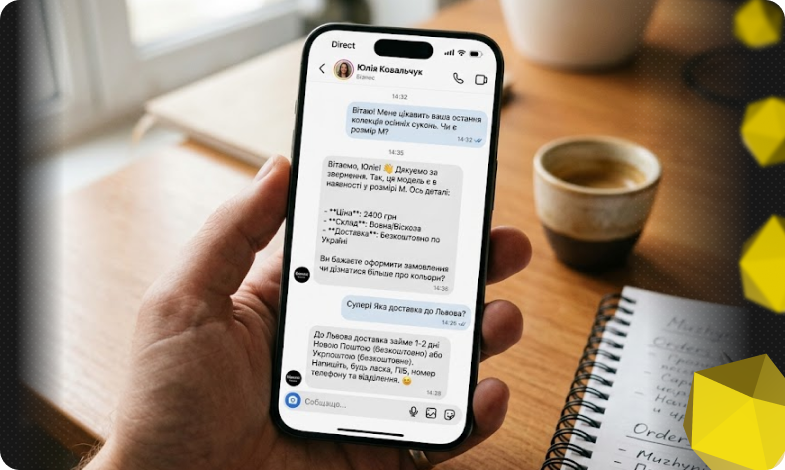
Instagram sales scripts: how to create effective templates for direct messages
Instagram used to be just a platform for visual content, but now everything has changed. For businesses, it’s a channel where purchasing decisions are often made not on the website or in ads, but specifically in direct. A person might see a post, react to a story, or ask a question in a message and it’s often the quality of this dialogue that determines whether a sale happens or not. That’s why sales scripts for Instagram are truly worth special attention.
In this article, we’ll explore how to create sales scripts for Instagram so they help drive sales without turning the conversation into a pushy script.
Why direct has become a full-fledged sales tool
For professional accounts, Instagram provides a separate inbox where it’s easier to organize messages and manage notifications. Additionally, Meta offers tools like Frequently Asked Questions and automated replies in Business Suite to help you start and maintain conversations with customers more quickly. This means that businesses already have the technical foundation for quality communication. But that alone doesn’t sell you also need a conversation flow, i.e., a script.
It is in direct that customers often ask the most practical questions: how much does it cost, what is included in the service, how fast is delivery, is there a warranty, where to start. If the answers are chaotic, different managers say different things, and the tone of communication constantly changes, the brand loses its integrity.
In such a situation, a script acts as a guide: it doesn’t take away the human touch, but helps maintain consistent quality in every interaction.
What is a sales script?
An Instagram sales script isn’t just dry text that you have to copy verbatim. It’s a conversation framework where the following elements are planned out in advance:
- greet the customer;
- gently transition to clarifying the customer’s needs;
- briefly demonstrate value;
- address common objections;
- guide the person to the next step.
Unlike a mechanical template, a script provides the manager with a framework while leaving room for a natural, appropriate response.
This is especially important in business because direct sells not only products or services, but also a sense of attention, order, and professionalism. When a client receives a clear answer without unnecessary delays or fluff, they’re more likely to move from interest to action. That’s why a script shouldn’t be written as if it were for a fancy report, but for a real conversation where simplicity, precision, and respect for the person’s time are valued.
What makes a strong script for sirect
A strong script for direct is built as a sequence of logical elements, where each has its own function and doesn’t overload the conversation. When this structure is thought out in advance, it’s much easier for the manager to communicate naturally, and for the client to move toward a decision without stress.
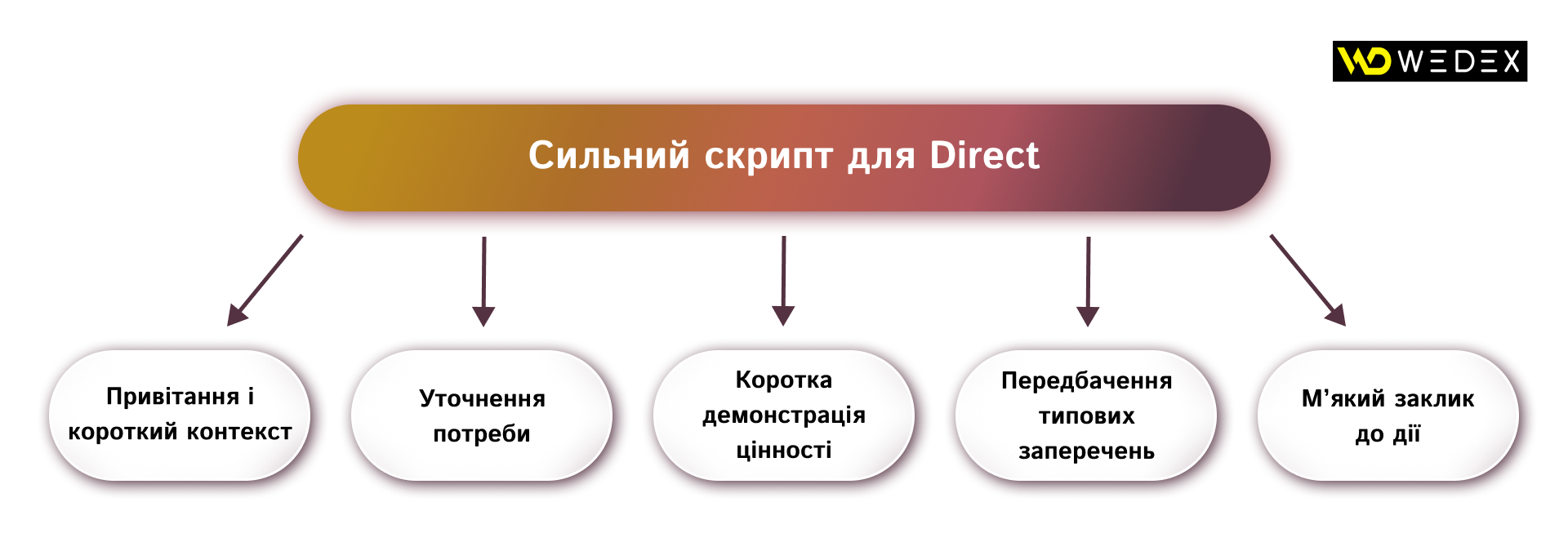
- Greeting and brief context.
The first contact should be informal yet professional, without excessive formality or the feeling of a cold, templated message. It’s important to briefly explain why you’re reaching out or to remind the person of your previous interactions. This kind of introduction breaks down unnecessary barriers and avoids coming across as pushy.
For example:
«Hello! Thank you for your interest in our page. Please let me know what specifically interests you and I’ll quickly walk you through the options».
- Clarifying the need.
After a brief introduction, it’s important to ask one clear question that will help you better understand the client’s situation. This could be a question about their goal, desired outcome, preferred collaboration format, budget, or timeline. The more precisely the question is phrased, the faster the conversation shifts from general interest to specifics.
For example:
«To find the best option for you, please let me know what’s most important to you right now price, timeline, or the format of our collaboration?»
- A brief demonstration of value.
Next, it’s important not to overload the response with lengthy explanations. It’s better to briefly show exactly how your product, service, or solution helps the person solve their problem. In this section, you shouldn’t try to sell everything at once; instead, simply highlight the strongest benefit for this specific situation.
For example:
«If your main goal is to get more leads from search, we can help increase your website’s visibility for targeted queries and attract an audience that’s already looking for your services. To start, we can analyze the current situation and identify areas for growth».
- Anticipating common objections.
A good script doesn’t wait for the client to voice a concern; it prepares a response in advance. Most often, questions arise in direct regarding price, terms, conditions, guarantees, the format of work, or the differences between options. If these points are already accounted for in the script, the manager doesn’t get flustered and doesn’t give contradictory answers. This is especially important for businesses where a single inaccurate remark can undermine trust in the brand.
For example:
«I understand your question about the cost. This offer includes not only the product itself but also additional support that helps you achieve results faster. I can briefly explain how the options differ».
- A gentle call to action.
The conclusion of the script should be clear but unobtrusive. The person needs to be prompted on what to do next: sign up, get a consultation, confirm interest, choose an option, or proceed to checkout. If the CTA sounds calm and appropriate, the customer doesn’t feel pressured, and the conversation moves forward logically.
For example:
«If this format works for you, I can help you sign up, complete the registration, or clarify any additional details right now».
Remember! The script that works best is one that doesn’t try to replace live communication but only enhances it. Therefore, after building the basic structure, it’s worth testing the text in real conversations.
What scenarios should you have in your database
A basic set of scripts should cover several typical scenarios for interacting with a client. People come to direct with different intentions, so a single universal text isn’t enough. For communication to be truly effective, you need separate scripts for different stages of the conversation and different types of inquiries.
New contact
This is when someone has reacted to a story for the first time, messaged you after a post, or reached out via your profile for the first time. It’s important not to start with a hard sell right away. The priority is a friendly introduction, a quick clarification of their request, and quickly figuring out what exactly they’re interested in. If you do everything right at this stage, the conversation flows much more easily, and the client is more willing to respond.
Dialogue after initial interest
Sometimes a person has already reached out but isn’t ready to make a decision yet. They might ask a general question or request more information. In such cases, the script should help gradually uncover their needs. Here, it’s important not to rush, but to conduct the dialogue in a way that allows the client to realize on their own exactly what they need. In this scenario, short clarifying prompts and concise, meaningful responses work particularly well.
Returning after a pause
Some people don’t respond right away after the first contact, and that’s perfectly normal. In this case, you need a separate script for gently re-engaging the conversation. It shouldn’t sound like a reminder asking «why did you disappear?» this is very important! It’s better to give the person an easy way to rejoin the conversation, such as briefly summarizing the previous conversation, reminding them of the essence of the offer, and suggesting they continue.
Request for price or terms
One of the most common scenarios in direct is when a client asks about cost, timing, work format, or terms of cooperation. Here, you need more than just a template response; you need a logic that combines specifics and value. If you mention only the price right away, the conversation may end too soon. However, if you add a brief explanation of what exactly is included in the offer and why it costs what it does, the communication becomes more meaningful and persuasive.
Comparing options
In many niches, the client isn’t choosing between «buy or don’t buy», but between several options. These could be different service packages, multiple delivery formats, varying service levels, or different volumes. For this scenario, the script should immediately include a clear presentation of the differences. The person needs to quickly understand how the options differ from one another and which one best suits their needs.
Limited-time offer, demo, or consultation
A separate group of scripts should be created for offers with added value: a promotion, a demo version, early access, a trial format, or a free consultation. Here, it’s important to present the limited nature or advantage correctly, without turning it into pressure. The person should feel the benefit, not a sense of urgency. That is why such scenarios are best built around real benefits for the client, rather than around artificial urgency.
For a script library to truly work, it should be built not as a single long text, but as a set of separate scenarios that can be quickly adapted to different situations. It is precisely this system that makes it possible to communicate in Direct naturally, quickly, and without compromising quality.
How to adapt scripts for different niches
The same script cannot work equally well across all businesses, even if their sales logic is similar. People message on direct with different expectations: for some, a quick response is important; for others, service details; and for others, a sense of expertise and confidence from the very first message.
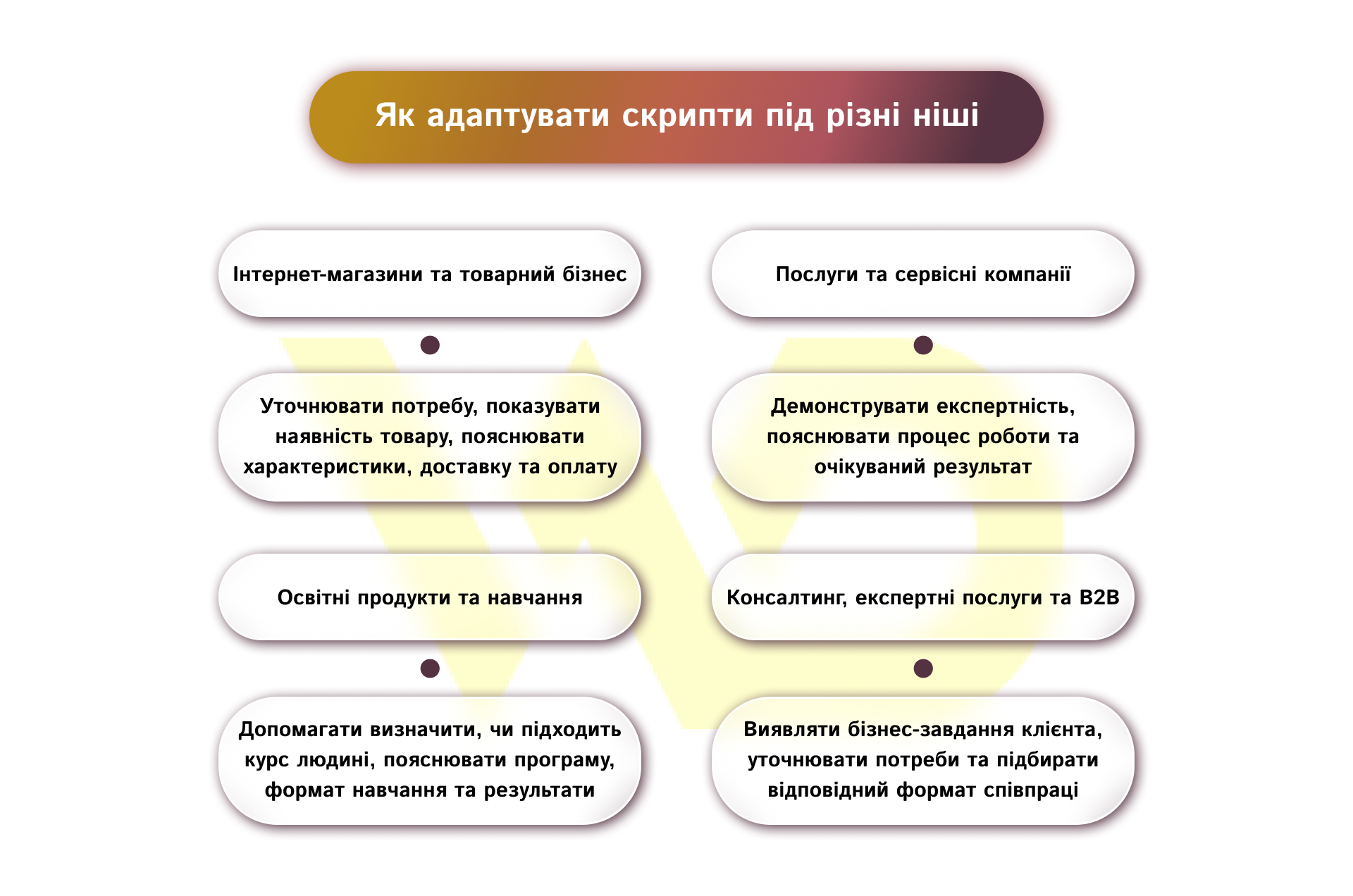
It’s best to start not with ready-made phrases, but with an analysis of the questions most frequently asked in your business. For one segment, it will be delivery and availability; for another, the program, work format, or results; and for a third, consultation terms or the level of support.
The more precisely you understand what exactly the customer wants to know, the easier it is to build a script that doesn’t just provide an answer but leads to a solution. This is the practical value of adaptation: the text becomes relevant to a specific audience.
Online stores and product-based businesses
In the retail business on direct, the client is most often looking for simple and quick answers. They are interested in availability, price, delivery, payment method, size, color, configuration, or warranty. Here, the script must be as clear and concise as possible, without unnecessary descriptions, but with complete information about what is important for the purchase. If the answers are long or vague, the person will easily go to another seller.
For this niche, it’s worth preparing separate scripts for clarifying specifications, comparing models, and responding to the question «What would you recommend?» A format that works well is when the manager doesn’t just name the product, but briefly explains who it’s suitable for and what problem it solves. This is especially important if the product range is broad and it’s difficult for the customer to choose between several options on their own.
Services and service companies
In the service sector, a script should focus not only on the sale itself but also on building trust. People are less likely to make «emotional» purchases here, so it’s important for them to understand who exactly will be providing the service, how the process works, how long the collaboration will last, and what results they can expect. In this case, a dry template won’t work, because the customer needs more than just terms and conditions they need a sense of confidence.
Therefore, for service niches, it’s helpful to have scripts that gently demonstrate expertise. It’s good when the response includes a brief explanation of the approach, an example of the workflow, or a benchmark for the outcome. If a person is hesitating, what matters to them is often not the price itself, but understanding exactly what they’re paying for. This needs to be taken into account when adapting the text.
Educational products and training
For courses, training sessions, consultations, or educational programs in direct, it’s important not to overwhelm the person with too many details right off the bat. The script should help them quickly understand who the product is for, what level of preparation is required, what format the training takes, and what the client will receive upon completion.
In this niche, it’s worth carefully crafting answers to questions about the program, access to materials, post-purchase support, and the results a student can achieve. Scripts that don’t promise abstract success but instead outline a structured path what the person will learn, how it will be presented, and why the format is a good fit work well. This kind of communication sounds professional and builds more trust.
Consulting, expert services, and B2B
In the consulting or B2B communication segment, the script should be more focused and strategic. Here, the client is usually not looking for an impulse purchase but is evaluating competence, the logic of the approach, and the potential benefit for their business. That is why in direct messaging, it is important not to rush but to first correctly understand the context of the inquiry.
For these niches, scripts that help identify business objectives, clarify the scope of the problem, and propose an appropriate format for interaction are useful. Instead of a direct sales pitch, a brief but substantive needs assessment works better in this case. The more accurately you demonstrate that you understand the client’s situation, the higher the likelihood of follow-up contact.
For a script to truly work, it must be checked for clarity and, crucially, for alignment with the brand’s tone of voice. For some niches, a warmer, friendlier approach is appropriate; for others, a calm, professional tone is best. It’s equally important to consider the average decision-making cycle: in some cases, the client buys immediately; in others, they need several interactions and clarifications.
How to test and update scripts
A sales script should not remain a static document. In real-life communication, it quickly becomes clear which phrasing works better, where people respond more willingly, and where the conversation stalls. That is why reviewing and updating scripts is not an optional extra but a mandatory part of sales work on Instagram.
Let’s look at what you should do regularly:
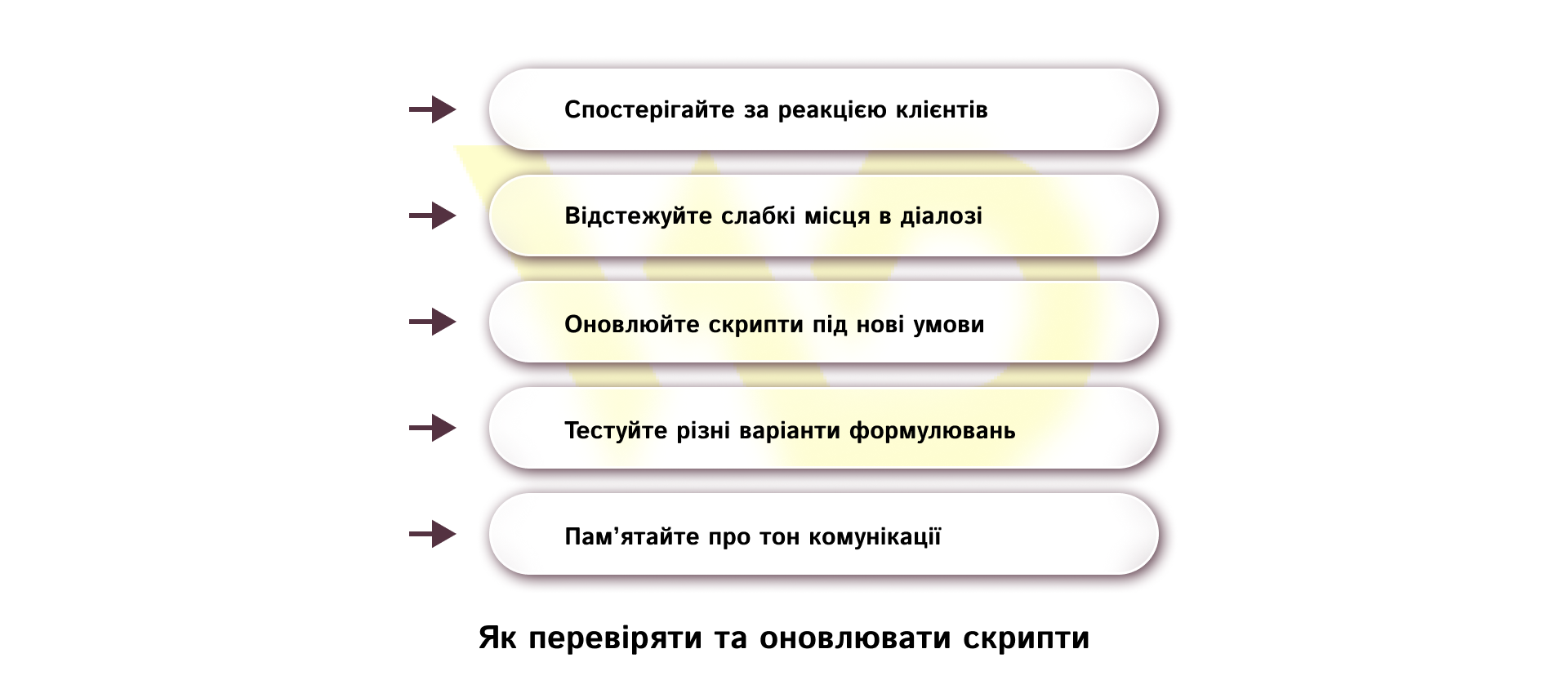
- Pay attention to how customers respond.
If customers consistently fail to respond after a certain phrase, end the conversation at the same stage, or ask the same questions, this is a sign that the script needs refinement. It’s also helpful to analyze intermediate reactions: whether a person initiates a dialogue, moves on to the next message, asks for clarification, or disappears after the first response. It’s these small signals that show how comfortable the customer is interacting with your communication script.
- Track weak points in the dialogue.
Not every problem in the script is related to the offer itself. Sometimes the issue is that the first message sounds too dry, clarifying the need is too complicated, or the response to a question takes too long. If there are «sticky» points in the dialogue, they need to be simplified. In direct, unnecessary complexity immediately reduces effectiveness.
When reviewing, pay attention to message length, the logic of transitions between stages, and tone. Sometimes simply replacing one phrase with a simpler one is enough to increase the number of responses.
- Update scripts to reflect new conditions.
You should review the script every time the product, price, collaboration format, or the brand’s communication itself changes. In such cases, the script needs to be adapted to the new context, not just «tweaked». Updates are also needed when new common questions from customers emerge. This is a good sign: your audience is already giving you clues about what exactly needs to be explained better. If these questions recur, they should be incorporated into the script so that the manager doesn’t waste time repeating the same explanations from scratch.
- Test different phrasing options.
One of the most useful approaches is to compare several versions of the same message. For example, check whether a short, direct phrasing works better, or a softer version with additional context. The effect can vary across different niches and at different stages of the conversation, so testing provides more objectivity than intuition.
It’s important not to change everything at once, but to change one element at a time: the greeting, a question, the closing phrase, or the call to action. This makes it easier to understand exactly what influenced the result. As a result, the script becomes not a static text, but a living tool that is gradually refined based on real conversations.
- Keep the tone of communication in mind.
When updating scripts, it’s easy to focus solely on conversion and forget about the feeling the customer gets when reading the message. But it’s often the tone that determines whether a person will want to continue the conversation. If the text sounds too formal, dry, or robotic, it can undermine trust even when the content is correct.
Therefore, when reviewing scripts, it’s important to consider both effectiveness and the human touch in delivery. A good script should help the manager speak confidently, but without pressure. It must be clear, relevant, and flexible enough to adapt to specific situations. This is how sales in direct become systematic rather than random.
Strong sales in direct are built on a combination of structure, relevance, and a human touch. When these three elements work together, the script ceases to be just a template and becomes a truly effective business communication tool.

commercial offer
Other articles by the author

12/08/2026
Understanding your audience forms the basis for every decision: from choosing the color scheme for your designs to setting up complex funnels in Meta Ads.

23/07/2026
Today, it’s not enough for businesses to simply adopt new tools; it’s important to understand how consumer psychology is changing.

15/07/2026
A digital marketer is a professional who promotes products, services, or the brand itself through digital communication channels.
Latest articles by #Useful tips
10/09/2026
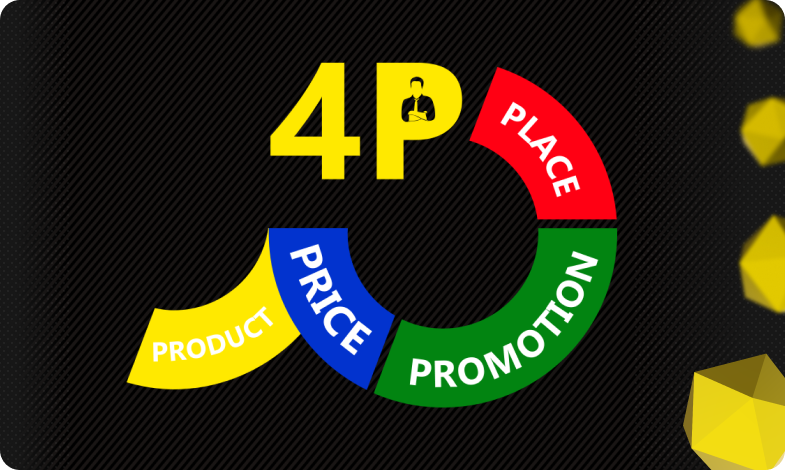
The 4P model serves as an architectural foundation that transforms disparate marketing activities into a single, manageable system.
08/09/2026
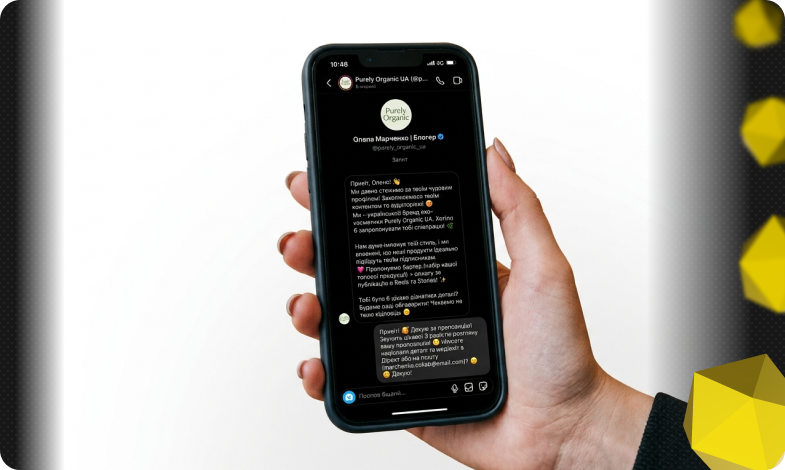
Today, an influencer is a distinct media platform with its own editorial policy, a keen understanding of its audience, and an established level of trust.

14/08/2026
While most brands focus their budgets on Instagram or Google Ads, Pinterest remains an underrated platform with an audience that has high purchasing power.