

 08/05/2026
  1651
1651

Інтернет-маркетинг
простою мовою
Content of the article
- /01 What are Highlights and why are they important for a brand
- /02 How highlights help drive sales
- /03 What collections should you have on your business profile
- /04 How to turn a story archive into a logical sales script
- /05 Titles, covers, and visual logic
- /06 How to keep your Highlights up to date
- /07 How to tell if Highlights are working
- /08 How to technically track the effectiveness of Stories Highlights
Instagram highlights: how to turn your story archive into a sales tool

For businesses, Instagram has long been not just a channel for posts, but also the place where customers form their first impression of a brand. That’s why Highlights should be viewed not as a decorative part of the profile, but as a permanent navigation system that helps quickly explain what you offer, why you can be trusted, and how to make a purchase or submit a request.
In this article, we’ll break down what Instagram Highlights are, how they work on a business profile, how to turn your Stories archive into a sales tool, and what mistakes prevent them from actually delivering value.
What are Highlights and why are they important for a brand
Highlights are collections of Stories that are pinned to your profile and remain available longer than regular Stories. According to Instagram’s help center, Stories disappear from the Feed, profile, and Direct after 24 hours unless they are added to Highlights. At the same time, the Stories archive allows you to save published stories so they can be reused. It is this difference that makes Highlights a valuable business tool: the archive preserves content, and people can view it in the Highlights section at the right moment.
So keep this in mind: the most useful information shouldn’t be buried in the feed or lost among new Stories.
When a person visits a profile, it’s convenient for them to immediately see separate sections about the product, terms of cooperation, reviews, delivery, or answers to frequently asked questions. This logic aligns with how Instagram describes the Stories archive, Highlights, and the professional capabilities of accounts.
How highlights help drive sales
The power of Highlights lies in the fact that they shorten the path from initial contact to action. A person shouldn’t have to gather information about the brand on their own from various posts and random Stories.
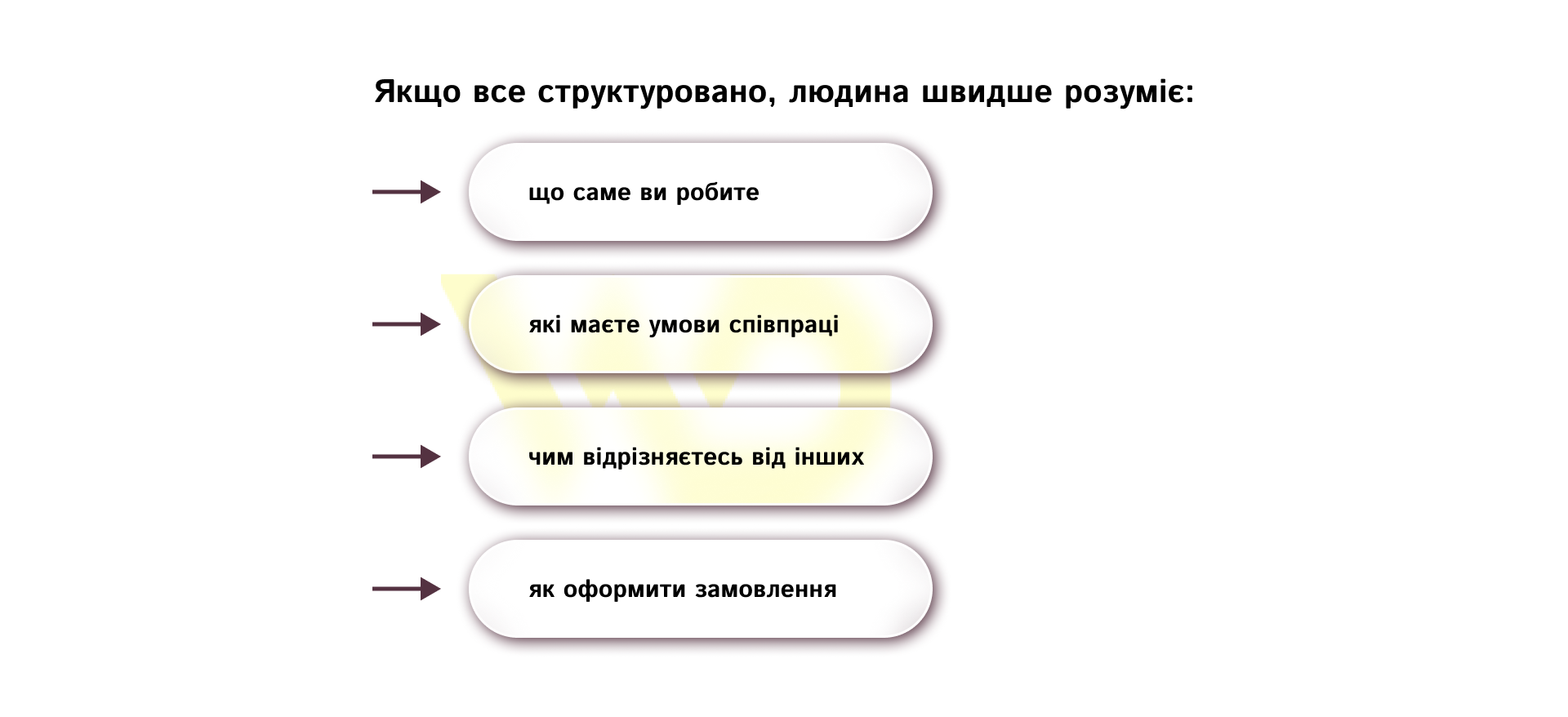
In this sense, it functions as a micro-sales funnel rather than a collection of individual stories.
In practice, this manifests in three ways: the brand becomes more understandable, trust is built faster, and responses to common objections don’t take up the manager’s time.
If a person sees a separate section in the profile with case studies, an explanation of the workflow, or real reviews, they receive enough signals to move forward without needing additional «warm-up» through lengthy explanations in Direct. This makes particular sense for professional accounts, as Instagram provides businesses and creator accounts with exclusive access to insights and other growth tools.
What collections should you have on your business profile
There is no universal set of Highlights for all niches, but the principle behind their creation is almost always the same. A profile should quickly answer a person’s basic questions and guide them to the next step. So, it’s better to build Highlights not around random Stories, but around the logic of the customer’s decision-making process, with the idea that this is a short navigation route.
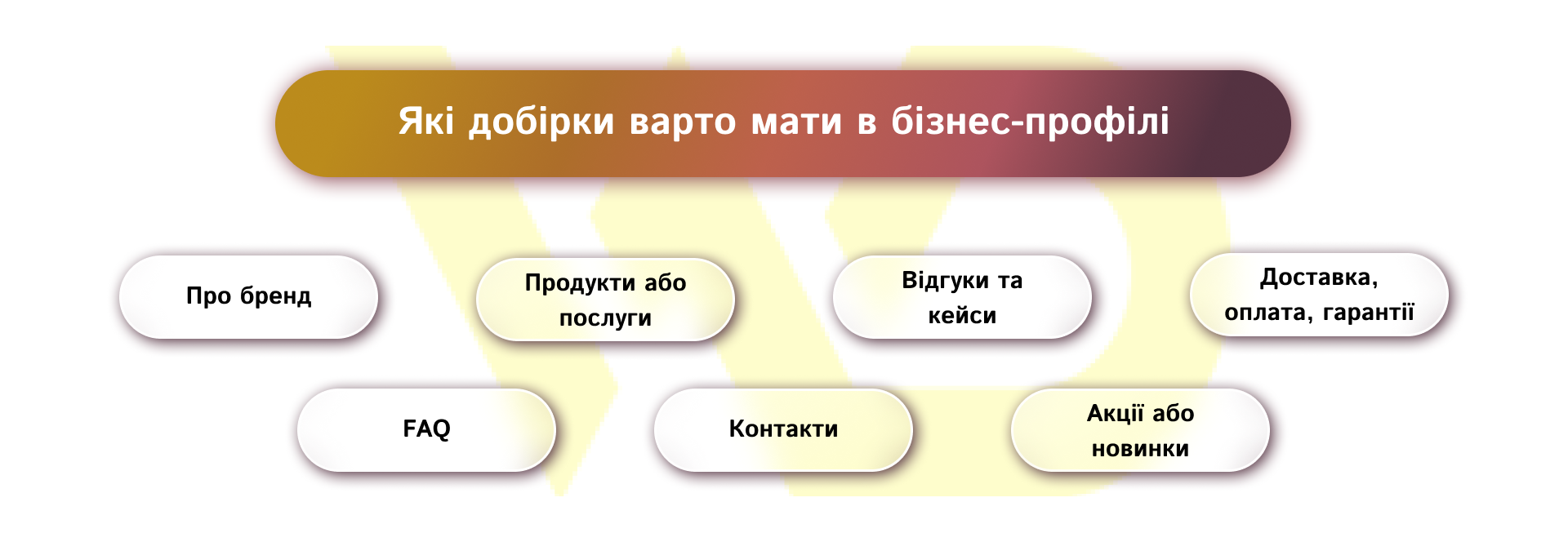
- About the brand. This section is necessary so that a person immediately understands who you are, what you do, and what value you provide. Here, it’s appropriate to showcase a brief company history, the team, operating principles, mission, or key advantages. Such a collection shapes the first impression and makes the profile more «alive».
- Products or services — one of the most important sections, as it directly answers the question of what the business sells. For a service company, this is where you can showcase collaboration models, project phases, the scope of services, and examples of solutions. For a store — main product categories, new arrivals, bestsellers, or seasonal offers.
- Reviews and case studies — a section that builds trust. People make decisions much more easily when they see real results, customer opinions, and proof of experience. «Before and after» case studies work particularly well for services, while for product-based businesses, reviews with photos, videos, or short customer comments are effective.
- Shipping, payment, and warranties. A practical section that addresses some concerns before customers even reach out. If a person doesn’t understand how to place an order, how long to wait for delivery, or what happens in case of an exchange, they often postpone the purchase. That’s why it’s best to present these terms in a separate section rather than burying them in the body of your posts.
- FAQ — a section with frequently asked questions. It saves time for both the brand and the customer. Here, you should include answers to everything people typically ask before buying: how to choose a product, how to sign up for a service, what restrictions apply, whether you handle specific requests, and what’s included in the price. This reduces the workload on the manager and simplifies communication.
- Contacts — a section designed to prompt action as quickly as possible. It’s important to clearly show how to reach you here: Direct, messaging apps, website, phone number, contact form, and the address of your physical location. If this section is well-organized, users won’t have to search for contact information throughout the entire profile.
- Promotions or New Arrivals is a section that isn’t relevant for every account. However, it works well for many businesses. It helps highlight current offers, new arrivals, seasonal products, or time-limited deals. The key is to update this section regularly; otherwise, it quickly loses its purpose.
These sections can be combined in different ways depending on the type of business. For example, a service company will prioritize case studies, work processes, customer reviews, and FAQs. An online store will focus on its product catalog, shipping, payment options, returns, and new arrivals. For an expert or personal brand, the focus is on personal information, results, collaboration formats, useful resources, and answers to frequently asked questions and objections. But in every case, the logic is the same: the content should not just save stories but help people understand the brand faster and make a decision.
How to turn a story archive into a logical sales script
Not every story should be moved to Highlights. For the Highlights section, you only need stories that have real value for sales or building trust. Random, situational, or overly personal content is best left in current Stories rather than mixed with the profile’s permanent structure.
For your Highlights to work as a sales tool, it’s not just the topic that matters, but also the order in which it’s presented.
The selection should guide the viewer through a simple logic: first a brief explanation, then an example or proof, followed by addressing any doubts, and concluding with a call to action.
For example, for a design studio, this could be a description of the approach, examples of work, reviews, and contact information; for a clothing store, it could be a model, size chart, delivery, exchange policy, and an order button. This sequence looks natural and works better than a collection of disjointed fragments.
Titles, covers, and visual logic
For Highlights to truly drive sales, they must be easy to read. Short titles, clear wording, and a consistent cover style help users avoid wasting time trying to decipher them. For a business profile, this is primarily a matter of navigation convenience, not just aesthetics, since a person needs to understand in a split second which section to open.
A minimalist approach works best: a unified icon system, clear contrast, a clean layout, and no unnecessary details. When a profile looks cohesive, it reinforces the sense of a well-organized brand. If the design is haphazard, users might assume — even before viewing the content that the business itself operates chaotically and that problems will arise when placing an order.
How to keep your Highlights up to date
You can’t create Highlights once and leave them unchanged. If your business changes prices, product range, delivery terms, operating hours, or service format, your Highlights need to be updated too. Otherwise, they quickly lose their value and start getting in the way instead of helping. In this sense, Highlights function as a working showcase, not an archive shelf.
Instagram also allows you to edit collections, add or remove Stories, and the archive itself stores content for reuse. But there’s an important caveat: if you remove a Story from the archive, it will also disappear from the Highlights where it was used. So, the archive and the Highlights should be viewed as a single system where each element affects the other.
How to tell if Highlights are working
The effectiveness of Highlights shouldn’t be judged by the number of views. A view alone doesn’t mean the collection influenced the user’s decision. For businesses, something else is far more important: whether the Highlights help users move more quickly from their first encounter with the profile to taking action.
Highlights serve as navigation and an «explanation» within the profile, so their effectiveness should be evaluated based on user behavior. The easiest way to determine whether the collections are structured correctly is through a few key indicators:
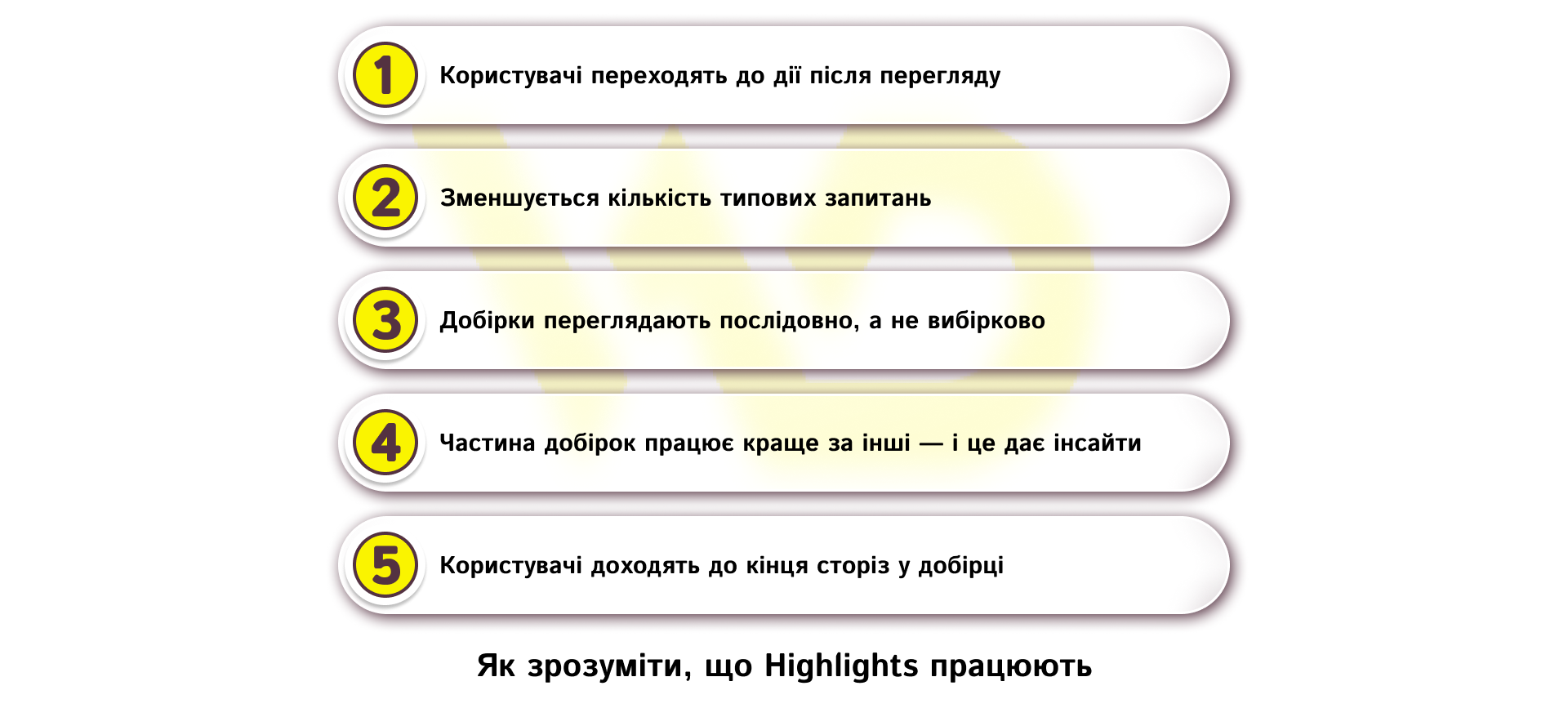
- Users take action after viewing.
If, after viewing the collections, people are more likely to message via Direct, click on links in the profile, or submit requests, it means that Highlights are fulfilling their purpose — helping users make a decision.
- The number of common questions decreases.
When well-designed «Delivery», «FAQ», or «Services» sections are truly effective, managers receive fewer repetitive questions. This is a direct indicator that the information is presented clearly and addresses basic concerns.
- Highlights are viewed sequentially, not selectively.
If a user opens several Highlights in a row (for example, «About the Brand» → «Services» → «Reviews»), it means that the profile structure is logical and guides them through the funnel.
- Some sections perform better than others and that provides valuable insights.
For example, if «Reviews» are opened more often than «Services», this may mean that the audience is initially looking for confirmation of trust. If, on the other hand, people go straight to «Services», it means demand is already established and it’s important to quickly provide a clear offer.
- Users scroll to the end of the stories in the collection.
If most people only view the first 1–2 stories and leave, it’s a sign that the information is presented in a complicated or uninteresting way. Strong Highlights hold attention until the end and logically lead to action.
It’s also worth paying attention to negative signals that are often overlooked:
-
- if collections are opened but no inquiries follow;
- if users are still asking questions whose answers are already in the current post;
- if old Stories remain unupdated.
All of this means that Highlights exist in name only but do not function as a tool.
How to technically track the effectiveness of Stories Highlights
Instagram Stories Highlights do not have separate analytics as a format, but their effectiveness can be assessed through related Stories metrics, user behavior, and external tools. This allows you to understand whether Highlights are working and to systematically optimize them.
The main source is the Stories statistics (Instagram Insights) from which Highlights are generated:
- Reach — how many unique users saw the story;
- Impressions — the total number of views;
- Exits — when users close the story;
- swipes forward/backward — indicate interest or, conversely, skipping;
- replies and reactions — an indicator of engagement.
To highlight the effectiveness of Highlights as a separate section, indirect methods are used.
- Profile Activity Analysis. Track profile visits after interacting with Stories and clicks on buttons (website, messengers). If these metrics increase after viewing Stories, Highlights are functioning as an entry point.
- Comparison of story series. Stories are grouped by topic (which then become highlights) and analyzed to determine where there are the fewest exits, the most reactions, and which series are watched all the way through. It is precisely these series that should be featured in the highlights.
- Link CTR. If your Stories include links, be sure to use UTM parameters and track traffic in Google Analytics. This helps you determine whether Highlights are actually driving traffic, even long after they’re posted.
- Delayed engagement. Highlights function as «long-form content». Therefore, it’s important to track the growth in followers after profile visits and messages in Direct following views of key highlights (e.g., «Pricing», «Services»).
What tools should you use
In addition to built-in analytics, you can track effectiveness more comprehensively using:
- Google Analytics — for analyzing traffic and user behavior on the website;
- Meta Business Suite — for deeper content analytics;
- Hootsuite and similar tools — to compare the effectiveness of different story series.
Remember: technical tracking only makes sense when it influences decisions regarding optimizing the structure of Highlights, prioritizing topics, repackaging content, or testing hypotheses.
Stories Highlights should be viewed as a permanent element of the funnel: they don’t generate immediate metrics, but they influence the user’s decision-making. So, the strongest Instagram profile isn’t the one with lots of Stories, but the one where information is organized into a clear system. In this format, Highlights cease to be a secondary detail and become an effective tool for business growth.

commercial offer
Other articles by the author

29/01/2026
Search Generative Experience (SGE) is Google's approach to search that uses generative artificial intelligence to generate concise, coherent answers to user queries.

23/09/2026
Access to technology is no longer a competitive advantage what matters is a team of experts’ ability to integrate these solutions into real-world business processes.
08/09/2026
Today, an influencer is a distinct media platform with its own editorial policy, a keen understanding of its audience, and an established level of trust.
Latest articles by #Useful tips
10/09/2026
The 4P model serves as an architectural foundation that transforms disparate marketing activities into a single, manageable system.
08/09/2026
Today, an influencer is a distinct media platform with its own editorial policy, a keen understanding of its audience, and an established level of trust.

14/08/2026
While most brands focus their budgets on Instagram or Google Ads, Pinterest remains an underrated platform with an audience that has high purchasing power.