

 07/09/2026
  993
993

Інтернет-маркетинг
простою мовою
Content of the article

What are hard skills and how to effectively develop them

When changing careers or looking for a new job, many candidates make the same mistake: they try to impress employers with generic phrases about their extensive experience or ability to learn quickly. However, in today’s job market, these abstract statements no longer work. It’s important for managers and recruiters to see the specific tools a person possesses and to understand exactly which business tasks they’re capable of accomplishing from day one.
In this article, we’ll explore what hard skills are, the different types, and how to structure their development so that training yields tangible professional results.
What are Hard Skills
Hard skills are specific, measurable professional and technical abilities required to perform specific work tasks and operate precise tools. Unlike personality traits, they can be acquired through training and practical experience, and they can be easily assessed using tests, practice exercises, or an evaluation of a completed portfolio.
However, in the real-world workplace, this term is often viewed in overly simplistic terms, with people confusing mere theoretical knowledge with the actual ability to perform.
For a better understanding, it’s helpful to visualize the process of mastering any profession as three consecutive stages of professional growth: knowledge, skill, and competence.
- Knowledge (theory). A person may have thoroughly read several textbooks on analytics, memorized the names of all the complex formulas in Excel, or know the principles of building basic HTML markup. However, this alone does not make them a specialist, since theory only describes how something should work under ideal conditions on paper.
- Skill (Hard Skill). A true hard skill emerges when a person sits down at their workstation and independently puts theory into practice without outside guidance. This is the ability to take a confusing array of raw data and quickly process it using the XLOOKUP function, or to manually build a responsive web component that will display correctly on any smartphone.
- Competence. This is the highest level of hard skill development, where a specialist doesn’t just know how to press the right buttons in a program but is consistently able to deliver the results the business needs. A competent specialist takes a holistic view of a task because they know exactly which tools to choose for a specific situation, what to do if the process doesn’t go as planned, and how to optimize the work of the entire system or team.
Thus, hard skills aren’t just the names of programs on a resume or the number of lectures attended they’re your practical ability to solve specific business problems. And the higher you climb the ladder from basic knowledge to comprehensive competence, the more valuable a professional you become in the market.
However, even the strongest technical skills rarely operate in a complete vacuum. To realize your full potential, you need to combine them effectively with another set of skills.
Hard Skills and Soft Skills: what’s the difference?
Lately, there’s been a notion that, due to the rapid development of technology, soft skills are completely replacing hard skills. This is a dangerous illusion. In a real-world work environment, these two sets of skills do not compete with each other but create a powerful synergistic effect.
|
Parameter |
Hard Skills |
Soft Skills |
|
Definition |
Technical and practical skills (examples) |
Behavioral and Communication Skills |
|
Specificity |
Tied to a specific profession or role |
Universal across any field |
|
Assessment |
Easily assessed through tests, coding, or case studies |
Assessed through observation and interviews |
|
Examples |
SQL, Figma, Python, Google Ads, Accounting |
Empathy, critical thinking, time management |
It is at this intersection that the concept of the T-shaped professional who is highly sought after by leading companies today emerges. The vertical line in the letter T symbolizes the depth of your hard skills your deep, narrow expertise in 1–2 key areas, such as writing complex code or building end-to-end analytics. The horizontal bar, on the other hand, represents well-developed soft skills and a basic understanding of related fields. Such a professional not only excels at their job but also easily finds common ground with colleagues from neighboring departments.
What are the Hard Skills in digital marketing
For a digital marketer, the set of hard skills depends on their specialization and the tasks they perform. An SEO specialist needs one set of competencies, a PPC specialist needs another, and a web analytics specialist needs yet another. At the same time, skills from several areas may overlap in their work.
For example, hard skills in digital marketing may include:
- SEO: working with the semantic core, on-page optimization, technical audits, and backlink profile analysis;
- contextual advertising: creating and configuring ad campaigns, working with audiences, keywords, bids, and ad copy;
- web analytics: setting up event and conversion tracking, analyzing traffic sources, working with data and reports;
- content marketing: creating content for search and marketing objectives, managing content plans, and analyzing content performance;
- email marketing: setting up email campaigns, segmenting the mailing list, creating automated workflows, and analyzing campaign results;
- working with marketing tools: using advertising platforms, analytics systems, CRM, and other services depending on your specialization.
So, when identifying your own hard skills, it’s worth focusing not so much on the list of tools you’ve mastered, but rather on the specific professional tasks you’re capable of performing independently.
How to effectively develop Hard Skills
Once you’ve identified the skill you need to develop and assessed your current level, the next question is how to structure your learning so that it yields practical results. Here, it’s important not to try to cover as much information as possible, but to proceed step by step.
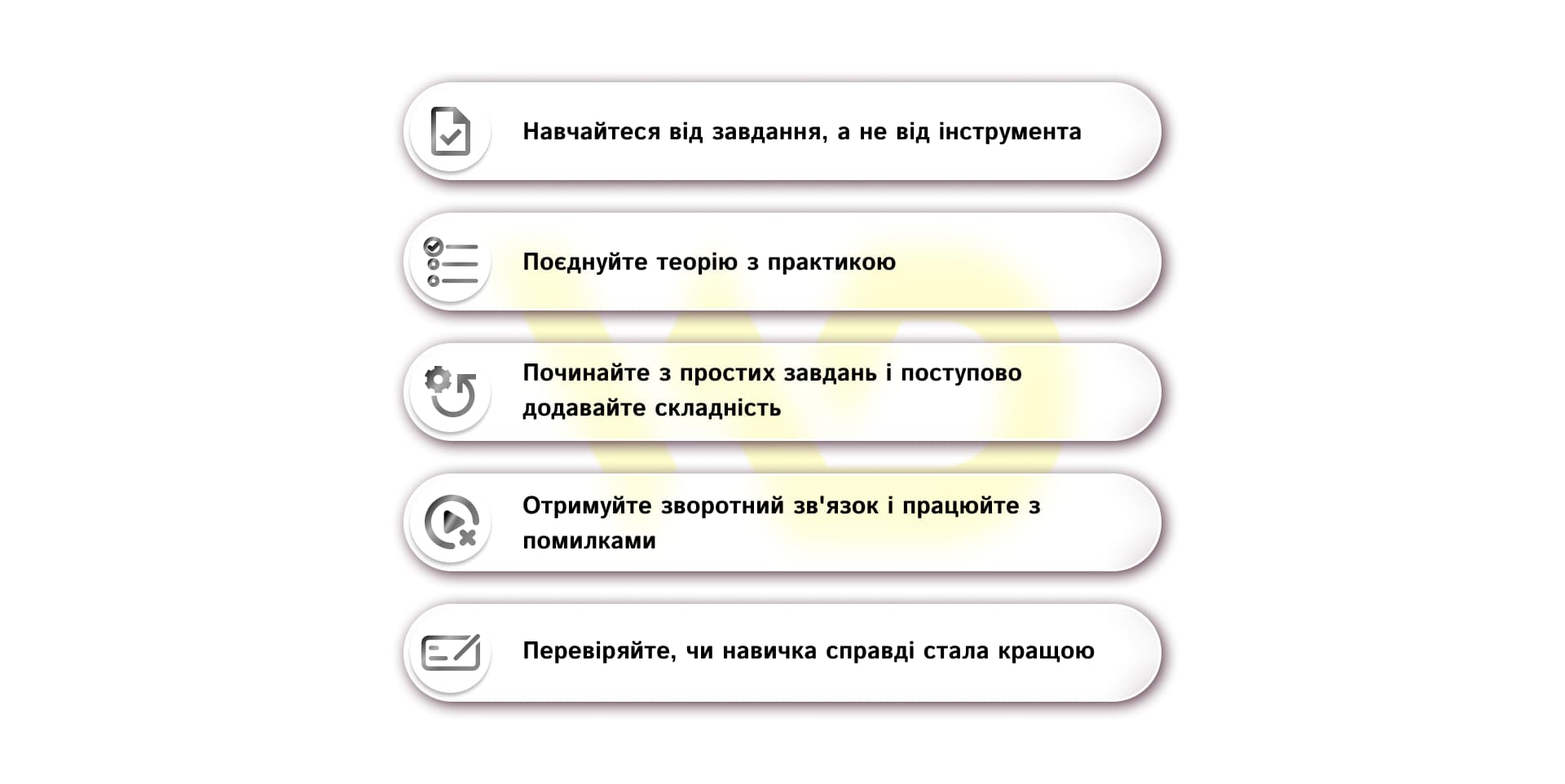
Learn from the task, not the tool
A common mistake is to start by learning the tool itself: taking a Google Ads course, mastering a new analytics service, or learning yet another graphic editor. But employers aren’t looking for knowledge of the interface they want the problem solved. That’s why, while learning, you should constantly ask yourself: What specific work task will I be able to perform after this module?
Combine theory with practice
Theoretical knowledge is needed only to understand how a process works. The best approach is to alternate learning with practice according to this pattern: learn the principle → try to apply it → get a result → analyze your mistakes. For example, after studying SEO principles, don’t immediately move on to the next learning module. It’s better to take a real or practice webpage, audit it, and formulate specific recommendations for optimization.
Start with simple tasks and gradually increase the difficulty
At the beginning of your learning journey, it’s perfectly fine to follow instructions or replicate examples. But if you stay at this level indefinitely, your skills won’t develop.
The next step is to complete similar tasks without relying on a ready-made algorithm. Then you can introduce constraints, analyze non-standard situations, and independently choose a solution.
For a marketer, this might look like this:
- Analyze a completed advertising campaign according to the instructions.
- Independently identify problems in a similar campaign.
- Identify the reasons for low effectiveness.
- Propose your own changes.
- Compare the result after making changes.
In this way, learning gradually shifts from repeating others’ actions to independent professional work.
Get feedback and work on your mistakes
Practice will be much more effective if you understand exactly what needs improvement. You can get feedback from a mentor, supervisor, or a more experienced colleague. It’s important not just to correct a specific mistake, but to understand its cause. If you chose the wrong keywords when drafting technical specifications for writers, you should figure out exactly which search query data you overlooked. This will help you apply what you’ve learned to future tasks.
Check whether your skill has actually improved
After a period of practice, repeat a task similar to the one you started with and assess your progress:
- Have you made fewer mistakes?
- Do you need fewer hints and tutorials?
- Do you find solutions faster?
- Can you explain your reasoning?
- Are you able to apply the same principle to a completely new situation?
If you can apply the principle you’ve learned to new input data, this indicates a deep mastery of a hard skill.
Effective development of hard skills isn’t about consuming as much content as possible, but rather about systematically completing professional tasks that gradually increase in difficulty, analyzing mistakes, and verifying results.

commercial offer
Other articles by the author

24/04/2026
That is why, in marketing, it is important not just to describe a product’s features, but to translate them into the language of needs.

22/04/2026
A portfolio is a collection of works, projects, case studies, and materials compiled in one place to demonstrate a professional’s expertise.

09/04/2026
All these schemes share a common goal: to obtain money or a user’s personal data. That is why it is important to carefully verify websites before entering any confidential information or making a payment.
Latest articles by #Useful tips

20/10/2026
Ben Hunt's model is a tool that helps break down a customer's path to purchase based on their level of awareness and select the right messages for each stage.

06/10/2026
From a business perspective, updating content is a sensible way to protect existing investments.

02/10/2026
For businesses, CPL is the primary metric for measuring how effectively ads and landing pages convert cold traffic into initial leads.