

 29/05/2026
  1485
1485

Інтернет-маркетинг
простою мовою
Content of the article

What is a shadow ban: causes and ways to get out of it
For businesses, social media is not just a platform for brand presence, but a channel that directly impacts reach, traffic, engagement, and sales. Therefore, when posts suddenly start appearing to a significantly smaller audience, it naturally causes concern. The term «shadow ban» is rarely used in the platforms’ public documentation. Instead, Meta, TikTok, and YouTube describe the mechanisms of recommendations, ranking, and content distribution restrictions based on quality, safety, and engagement signals. We’ll break down these features in detail in this article.
What is a shadow ban
A shadow ban is a colloquial term for a situation where an account’s content appears to remain in place, but its visibility in the feed, recommendations, search results, or under hashtags drops significantly. To the user, this looks like a «silent» restriction: the post is published but doesn’t get the usual number of views. In practice, this is most often not due to a single «ban», but rather to how the platform evaluates content based on signals of relevance, engagement, trust, and compliance with rules.
Meta explains that Facebook and Instagram algorithms evaluate content in the feed, Reels, Stories, and recommendations. If the system deems content to be low-quality, spammy, or potentially problematic, it may be shown to fewer people.
This is actually very important for businesses, because if content loses visibility, it loses it not just «for the sake of pretty statistics», but also for real results. Fewer impressions mean fewer profile visits, fewer direct messages, fewer leads from social media, and a weaker impact from regular content marketing.
TikTok and YouTube both emphasize that recommendations are based on user interests, viewing history, interactions, and other signals, which means that the quality and consistency of content directly impact visibility.
Why content loses reach
Most often, visibility does not drop suddenly, but as a result of repeated account behavior. Platforms closely monitor activity on business accounts. Meta reduces the distribution of content that the system deems problematic or low-quality, and also addresses the fight against spam content and attempts to artificially influence reach and engagement. TikTok, for its part, uses automated and manual reviews to detect violations of community guidelines.
The most common reasons for a drop in visibility
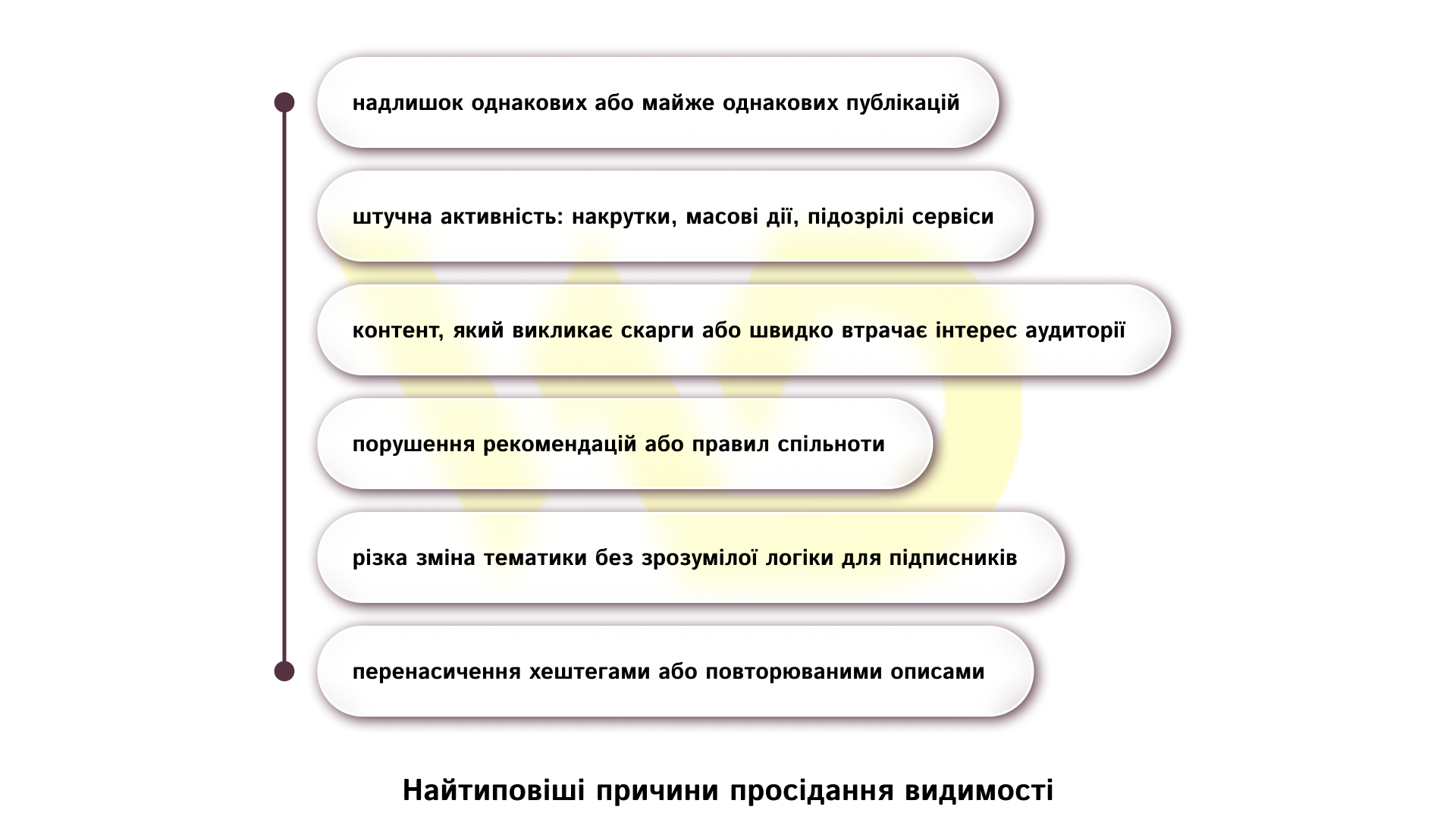
An excess of identical or nearly identical posts
When an account regularly posts repetitive content with minimal changes, the algorithm may perceive it as less valuable to the audience. As a result, such posts begin to receive lower reach, especially if followers no longer engage with them as actively.
Artificial activity: fake engagement, mass actions, suspicious services
Any attempts to artificially boost likes, followers, comments, or views can raise red flags with the platform. If the system detects unnatural behavior, it often reduces the visibility of the content to prevent the promotion of manipulative activity.
Content that draws complaints or quickly loses audience interest
If users frequently complain about posts or barely engage with them, this sends a negative signal to the algorithm. Similarly, a problem arises when content fails to hold attention and quickly ceases to be interesting to view.
Violations of guidelines or community rules
Even if content isn’t removed immediately, it may receive fewer impressions due to non-compliance with platform rules. This applies to material that raises doubts about safety, authenticity, or quality, as well as posts that border on spam or aggressive promotion.
A sudden change in topic without clear logic for followers
When an account suddenly shifts direction without explanation, the audience often reacts less enthusiastically because the new content no longer meets their expectations. For the algorithm, this can also signal that the profile has lost a clear focus and has therefore become less predictable for display.
Overuse of hashtags or repetitive descriptions
An excessive number of identical hashtags or boilerplate descriptions can look like an attempt to artificially expand reach. In practice, this often has the opposite effect: the content begins to be perceived as less natural and less relevant to the audience.
For a business account, this can seem very routine. For example, an online store regularly posts identical product cards with slightly altered captions, and then notices that Reels reach has plummeted. Or a local service starts using the exact same hashtags en masse on all its posts, and new posts barely show up in recommendations.
How to tell if the problem is a shadow ban
A drop in reach alone doesn’t necessarily prove a shadow ban. The reason could be seasonality, a change in topic, weaker creative, or even that the audience is simply tired of the same old format. But if impressions, clicks, views from recommendations, comment activity, and visibility via hashtags all drop at the same time that’s a reason for a thorough audit. It’s important to look at engagement, view history, and personalized signals holistically, rather than at a single metric in isolation
|
Symptom |
What this might mean |
How to check |
What it’s based on |
|
A sharp drop in impressions among a new audience |
Content is less likely to appear in recommendations |
Compare traffic sources across 7–14 posts |
Meta describes ranking through signals and recommendations. TikTok and YouTube also use personalization. |
|
Posts are seen mainly by followers |
Reduced reach in discovery signals |
Check the share of reach from non-followers |
TikTok/YouTube system recommendations depend on interests and interactions. |
|
Hashtags do not produce the expected effect |
Content is not considered relevant enough |
Compare post reach with different sets of tags |
Meta and TikTok emphasize relevance and quality signals. |
|
More significant drops specifically in Reels/Shorts/videos |
Weaker audience response to the format or topic |
Compare engagement, views, and repeat interactions |
Recommendations depend on user behavior. |
As we can see, there can be many options. Therefore, it’s worth carefully reviewing all possible causes before simply sitting and waiting for the shadow ban to be lifted.
What to do if you suspect a shadow ban
Start not with panic, but with an audit. First, check whether there were any violations of the platform’s rules, whether automated services are being used, or whether there is a repetitive spam pattern in posts, descriptions, and hashtags. If content has been removed or restricted, Instagram provides mechanisms to appeal decisions.
This is important for businesses: sometimes the problem isn’t with the entire account, but with specific posts or actions that have dragged down overall visibility.
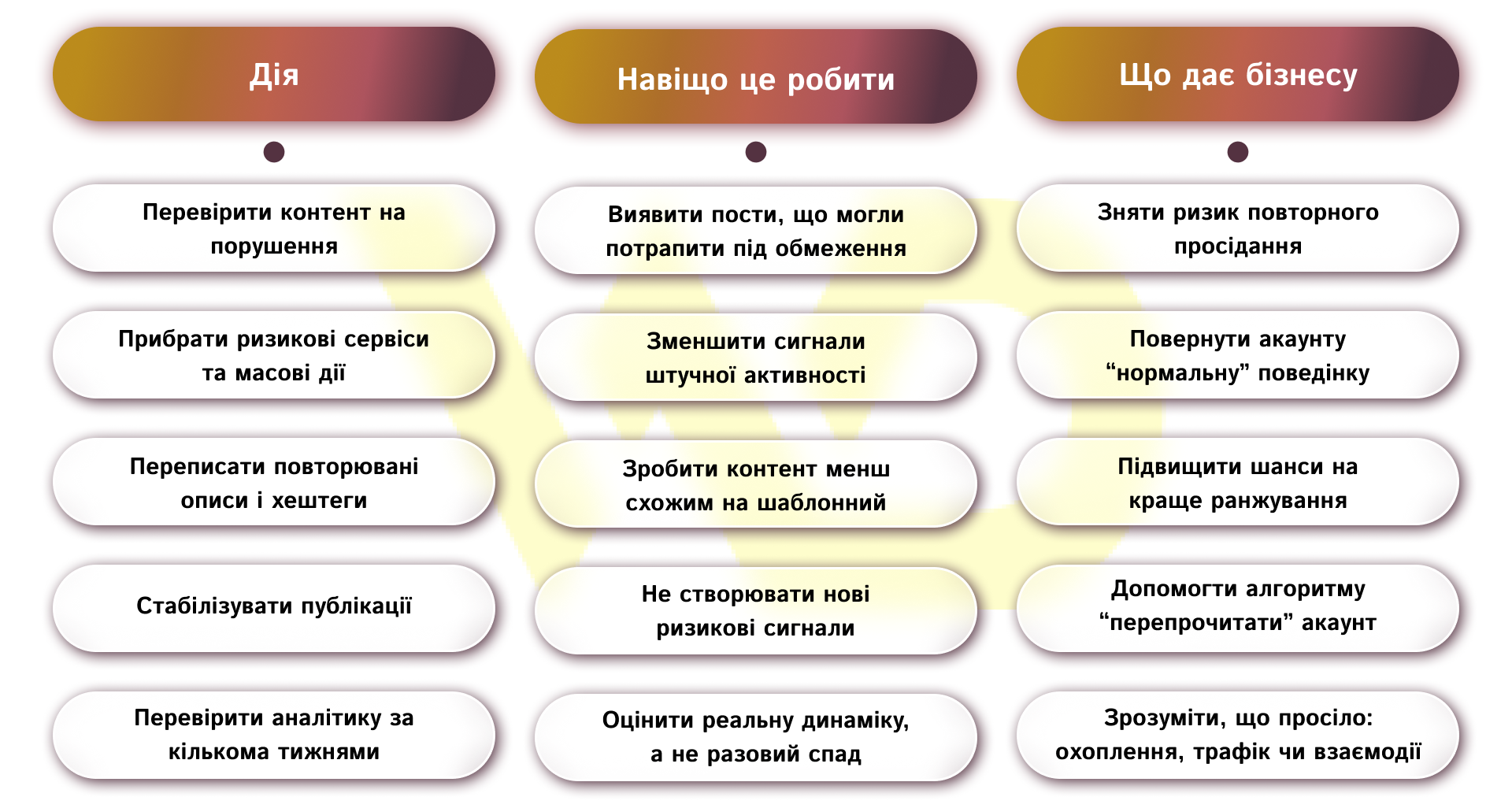
This sequence of actions will help identify the causes and restore your account with minimal losses.
How to restore visibility without rushing
After the audit, it’s best to move on to calm, consistent work with your content. For businesses, what works best isn’t an «aggressive relaunch», but a return to high-quality consistency. In your upcoming posts, it’s a good idea to emphasize the benefits:
- brief expert explanations;
- analysis of typical customer questions;
- real-world examples;
- useful tips;
- honest case studies.
This approach typically fosters better engagement and, consequently, algorithmic visibility. This aligns with what Meta, TikTok, and YouTube describe as the foundation of their recommendations: content is more likely to be displayed if it matches the audience’s interests and behavior.
To better understand this, let’s break it down with examples. If a service-based brand has been posting only promotional calls to action, it’s worth adding explanatory posts such as «how to choose», «what mistakes customers make», and «why the problem arises». For e-commerce, product reviews, comparisons, curated selections, and practical use cases become essential. If it’s a B2B company, short case studies, expert micro-analytics, and content that helps with decision-making work best. In each of these cases, the goal is the same: to restore the account’s consistent signals of usefulness and relevance.
What to do to avoid getting banned again
Prevention is always cheaper than recovery. If a brand regularly publishes original content, avoids questionable automation, doesn’t copy others’ posts verbatim, and doesn’t overload its profile with repetitive content, the risk of a visibility drop is lower.
What you can do to prevent a shadow ban:
- maintain a consistent style and logic in your content;
- don’t overuse hashtags and repetitive templates;
- follow the rules of the specific platform;
- analyze audience engagement, not just the number of posts;
- regularly check whether engagement metrics have changed without apparent cause.
Finally, it’s worth noting that a shadow ban in a business context should be viewed not as a mystery, but as a signal. The platform is indicating that content quality has declined, user interest has shifted, or there is a risk of rule violations. And here, the best strategy is not to look for a workaround, but to build a stronger account with original content, clean profile behavior, clear themes, and analytics that regularly indicate what exactly is working. It is precisely this model that gives a business stable visibility, rather than random spikes.

commercial offer
Other articles by the author

04/03/2026
TikTok provides a quick snapshot of attention and potential virality, but a clear strategy is needed to turn that attention into real business results.

04/09/2026
Instagram Shopping is a set of Meta features that allows businesses to integrate their product catalog with their social media profile.

15/07/2026
Today, a PM is not just an administrator who moves cards around in a task manager, but a strategic business partner who directly influences the company’s profitability.
Latest articles by #Useful tips

06/10/2026
From a business perspective, updating content is a sensible way to protect existing investments.
02/10/2026
For businesses, CPL is the primary metric for measuring how effectively ads and landing pages convert cold traffic into initial leads.

29/09/2026
A content pipeline transforms the creation of content from a spontaneous creative process into a managed production system. In such a system, AI serves as a powerful assistant.