

 17/11/2026
 748

Інтернет-маркетинг
простою мовою
Content of the article
- /01 Which marketing processes should be automated
- /02 Content and product catalog: how to speed up store population
- /03 SEO: how to optimize pages without mass text generation
- /04 AI in targeting and PPC: creative generation and A/B testing
- /05 Personalization and communication with customers
- /06 How to use AI for marketing data
- /07 How to choose AI tools for an online store
- /08 How to implement automation without unnecessary costs
- /09 How to evaluate the effectiveness of automation

Practical AI for e-commerce: what to automate in marketing today

The marketing team at online stores needs to regularly create product content, update ads, manage customer communications, and analyze sales. This creates an unnecessary workload and takes up extra time. Therefore, some of these tasks can be streamlined using artificial intelligence (AI) without increasing headcount. However, automation alone does not guarantee revenue growth. Its effectiveness depends on the right choice of tasks, data quality, and the team’s ability to utilize the results.
In this article, we’ll explore which e-commerce marketing processes should be automated today, how to choose AI tools, and how to evaluate their value for your business.
Which marketing processes should be automated
The most promising tasks for automation share several common characteristics: they occur regularly, rely on available data, and produce a clear, verifiable result.
For an initial screening, it’s enough to evaluate three criteria.

For example, drafting product descriptions can be a prime candidate: the text structure is repetitive, and the product specifications are known in advance. However, automatically adjusting prices based on incomplete information about demand and margins requires much more careful oversight.
Initially, it makes sense to assign routine tasks to AI:
- preparing standard materials:
- initial sorting of information;
- checking that fields are filled out;
- creating standard reports.
More complex tasks, such as defining an advertising strategy or approving commercial proposals, should remain the responsibility of specialists.
This approach helps focus resources on processes where automation can truly reduce the workload rather than create additional work.
Content and product catalog: how to speed up store population
Online stores regularly add new items, change product specifications, and update information about their product range.
Artificial intelligence helps solve this problem in several ways:
- Converting specifications into text. AI easily transforms a set of technical specifications into a coherent product description. For example, for a home appliance store, simply provide the system with the model’s name, power rating, dimensions, and materials and you’ll receive a draft following an approved structure.
- Creating formatted annotations. Accelerating the development of short annotations for catalogs, curated selections, and promotional materials, where it’s important to concisely present the main benefits of the products.
- Catalog standardization. If data comes from different suppliers, the AI identifies differences in wording, finds duplicates, suggests a unified format, and flags entries with incomplete information.
To achieve high-quality results, the team must define in advance a consistent tone of voice, acceptable length, structure, and internal terminology.
Despite the high speed of generation, using AI requires strict adherence to data handling rules:
- Prohibition on Assumptions («Hallucinations»). The language model must not invent missing properties on its own. If the input data lacks information about compatibility, materials, or configuration, the system must flag the information gap rather than generate an inaccurate description.
- Mandatory fact-checking. AI should be viewed as a tool to streamline work, not as a primary source of knowledge. The store owner or editor must review all generated text before publication.
This approach is fully in line with Shopify’s official recommendations for generating product descriptions: automated tools serve as aids for creating drafts, but the ultimate responsibility for the accuracy and quality of the content always rests with the seller.
SEO: how to optimize pages without mass text generation
Unlike creating product descriptions, SEO automation covers a broader range of tasks: from analyzing the catalog structure to generating metadata and setting up internal links. Artificial intelligence significantly speeds up analytical work where linguistic and content analysis is required:
- classification and clustering of search queries: AI helps group search terms by topic and identify categories that require expanded content;
- metadata generation: preparing options for meta titles and descriptions based on data from tables or exports from CMS or SEO services;
- detecting duplicates and identifying gaps: analyzing page content to find similar content and identify categories lacking substantive content.
Technical tasks (such as searching for empty fields, broken links, or exact duplicates) are cheaper and more accurate when performed using standard scripts and SEO scanners. AI should be used specifically where an assessment of meaning and context is required.
The main pitfall of SEO automation is the attempt to «flood» the search engine with thousands of generated pages. Scaling content does not equate to an increase in organic traffic.
It’s important to keep in mind:
- the principle of user benefit: a large amount of automatically generated text won’t result in high rankings if it lacks unique value;
- the risk of penalties: mass-producing pages without added value violates guidelines regarding scaled, low-quality content.
According to Google’s official guidelines on generative content, the search engine prioritizes the quality, expertise, and usefulness of content for people, regardless of how it was created.
Therefore, the practical goal of AI in SEO is to identify and fix specific website issues more quickly. AI provides analytics and recommendations, but the final decision on their implementation is always made by an SEO specialist, taking into account search intent and the audience’s needs.
AI in targeting and PPC: creative generation and A/B testing
Ad campaigns require constant updates to copy and banners, as audiences quickly grow tired of repetitive ads. Artificial intelligence speeds up the creation of creative variations and simplifies their adaptation to different formats (stories, feeds, banners).
| Areas of application | How AI helps in your work | Key considerations |
|---|---|---|
| Testing text hypotheses | Quickly generates dozens of headlines, short descriptions, and calls to action (CTA) for different value propositions | Formulate radically different angles (e.g., emphasizing price vs. emphasizing quality), rather than just changing 1–2 words |
| Adapting visual materials | Helps develop concepts, change backgrounds for product photos, and adapt formats for different placements | Check the visuals: AI can distort the shape, color, proportions, or configuration of the actual product |
| Platform-side optimization | Automatically adjusts the size, contrast, and placement of text blocks for a specific user (e.g., Meta Advantage+ creative tools) | Always verify that automatically generated offers match actual prices and product availability |
But there’s a pitfall to mass generation. A large number of similar variants does not equate to efficiency. If ads differ by only a few words, the team will spend time sorting through them but won’t gain actionable insights for budget optimization.
Before launching any ad, you must verify the accuracy of terms and prices (promotional offers, discounts, and descriptions), as well as ensure that the image matches the actual product if it was generated by AI.
The final choice of advertising strategy, calculation of the acceptable cost per acquisition (CPA), and evaluation of A/B test results always remain the responsibility of the marketing team.
Personalization and communication with customers
AI can help an online store tailor its communications to the specific stage of interaction with the customer. Instead of a single, one-size-fits-all message, the team can prepare different versions of emails and offers based on the categories viewed, order history, or a specific action taken on the website. For example, after purchasing a coffee machine, a customer could be offered compatible filters or cleaning supplies, if their use is recommended by the manufacturer. The system will help generate the message, but product compatibility, the relevance of the product range, and the appropriateness of the recommendation must be determined based on verified data.
Personalization doesn’t necessarily require a complex model. For the initial stage, recommendation rules may suffice: related products, similar items, alternatives to out-of-stock products, or curated selections within a category. It’s advisable to use AI where text adaptation, interest classification, or the generation of meaningful recommendations are required.
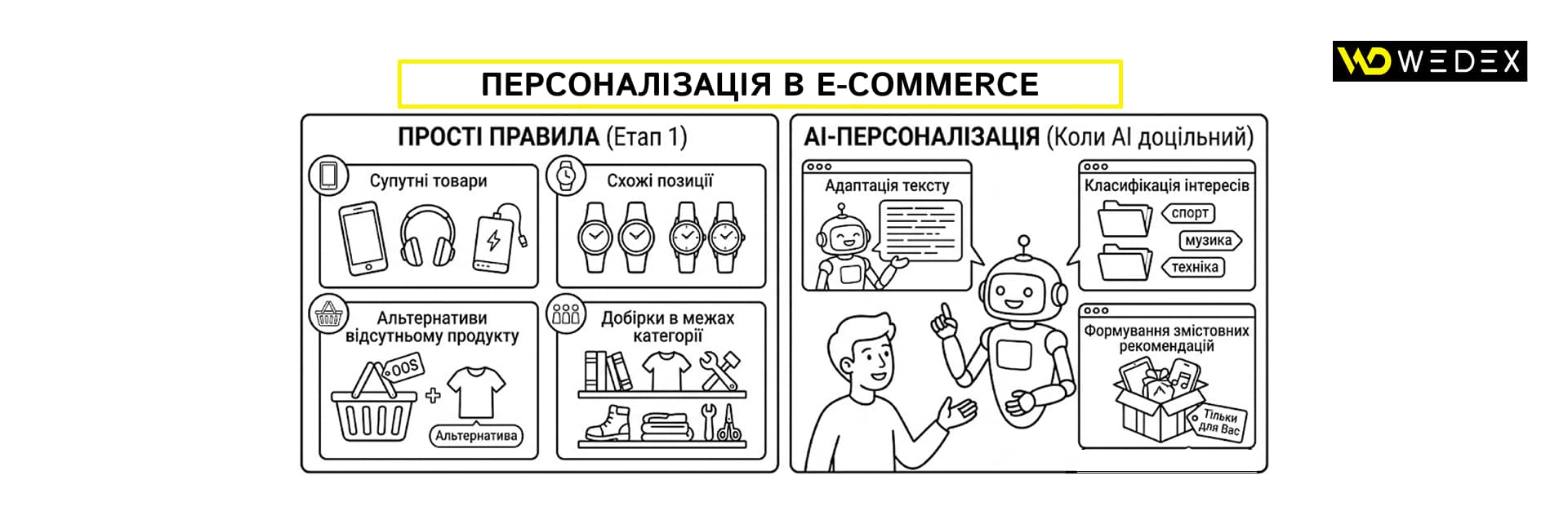
Another area is handling customer inquiries. AI can find answers in a knowledge base and draft responses to common questions about delivery, payment, returns, and product specifications. Complex complaints, warranty claims, and non-standard situations are best handled by a human employee.
The main prerequisite for such automation is up-to-date data on products and service policies. If information about returns, delivery times, or warranties is outdated, the system may repeatedly make the same mistake.
Personalization must also align with customer expectations and data processing regulations. Do not share personal or commercially sensitive information with third-party services without verifying their terms of use, storage, and access policies.
How to use AI for marketing data
E-commerce marketing generates large amounts of data from various sources: website traffic, product views, abandoned carts, advertising spend, and sales. Instead of spending hours compiling spreadsheets, artificial intelligence can be used to speed up analytical routines and quickly identify patterns.

Identifying the causes of anomalies and deviations
If traffic to a category has increased but the number of purchases has remained unchanged, AI will instantly generate a list of parameters to check:
- inventory levels;
- price changes;
- technical errors in the order form;
- off-target traffic from advertising channels.
This allows you to avoid wasting time on guesswork and instead proceed immediately with a clear audit plan.
Automation of reporting and calculations
Algorithms help create complex formulas for Google Sheets, group data according to specific criteria, and prepare textual explanations for charts intended for management or investors.
Formulating marketing hypotheses
AI systematizes the results for a selected period and suggests specific areas for optimizing conversions or ad campaigns. It identifies which elements of the sales funnel need refinement and which offers are worth testing on specific customer groups. This approach transforms dry reports into a clear action plan for A/B testing and marketing experiments.
Let’s look at the key requirements for obtaining accurate analytics.
- Data quality.
The quality of any AI-driven analytical conclusions depends entirely on the correct configuration of the source data. For example, in Google Analytics 4, e-commerce data is analyzed through special reports, but for this to work, events must be configured correctly specifically, adding a product to the cart and making a purchase. If tracking is flawed, the AI’s analytical results will be skewed.
- Taking the actual business context into account.
AI analyzes only the numbers in the uploaded file but lacks information about external factors: seasonal fluctuations, changes in the product lineup, delivery delays, acquiring issues, or force majeure events.
Therefore, AI is a tool for rapid initial analysis and generating hypotheses, but final conclusions and business decisions are always made after a specialist verifies the data.
How to choose AI tools for an online store
Once you’ve identified the process that needs to be automated, you can move on to selecting a tool. And keep in mind that a single, one-size-fits-all service won’t necessarily be the best solution for every area.
When comparing options, consider the following criteria:
| Suitability for the task | Does the service work with the required data, language, and output format? |
|---|---|
| Integrations | Can results be transferred to a content management system, spreadsheet, or advertising platform without unnecessary manual copying? |
| Data security | What information does the service collect, and what access and storage settings are available? |
| Result review | Can you review changes, approve content, and correct errors before publication? |
| Total cost | How much will the subscription, setup, integration, training, and ongoing support cost? |
A separate tool isn’t always necessary. If your store’s platform already has AI features, it’s worth testing them on real-world tasks first. For example, Shopify describes its Sidekick assistant, which helps manage store data and perform specific administrative tasks.
Choosing a service based solely on its feature list isn’t enough. Before scaling up its use, you need to make sure it delivers the desired results in your store’s specific environment.
How to implement automation without unnecessary costs
To assess the benefits of AI without significant upfront costs, start with a single process and a limited trial. This will help you evaluate not only the technology’s capabilities but also how it fits into your team’s workflow.
Implementation can be organized in five stages.
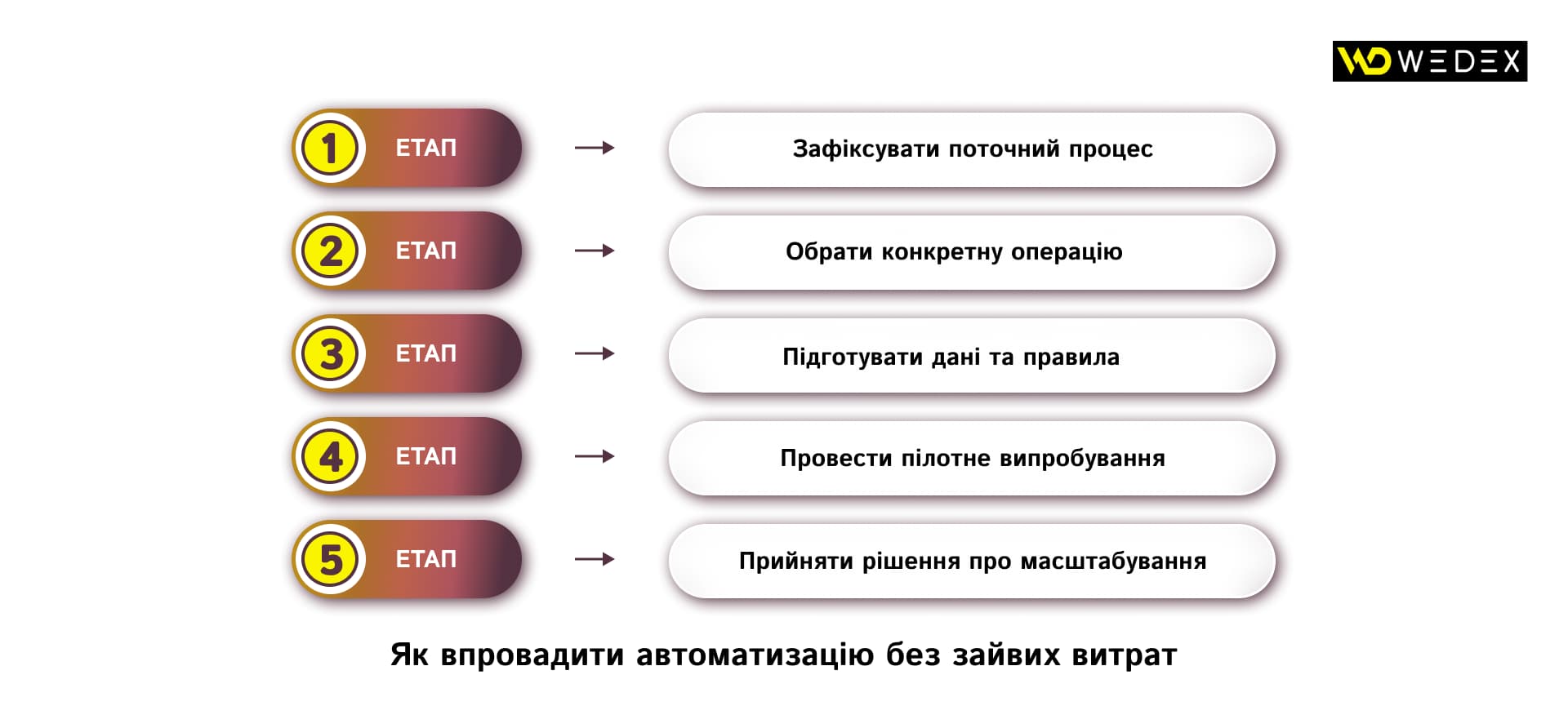
- Document the current process. Identify who performs the task, how much time it takes, and what problems arise most frequently.
- Select a specific task. For example, preparing drafts for a single product category or generating a weekly report on advertising campaigns.
- Prepare the data and rules. Define the output format, the required data sources, and the conditions under which the material can be used.
- Conduct a pilot test. Test the solution on a small sample and document any errors, execution time, and the scope of necessary corrections.
- Decide on scaling. If the results meet the requirements, gradually expand its use. If not, adjust the process or abandon the unsuccessful solution.
At this stage, it’s important to designate someone responsible for the automated process. This person must ensure the data remains up to date, respond to deviations, and monitor changes to operating rules. Without such a person, even a useful tool may continue to follow outdated instructions after changes to the product lineup or sales conditions.
How to evaluate the effectiveness of automation
The volume of generated content or the number of reports created, on their own, only indicate productivity but do not prove economic benefit. To understand whether automation has paid off, it’s worth evaluating specific metrics based on the nature of the work:
| Area | Key performance metrics |
|---|---|
| Product Content | Time required to prepare a single product description; percentage of materials requiring no significant editorial corrections. |
| SEO | Page completeness, number of structural issues resolved, organic traffic trends. |
| Advertising | Cost per acquisition (CPA), conversion rate (CR), return on ad spend (ROAS). |
| Personalization | Click-through rate (CTR) of recommendation blocks, conversion, and revenue from relevant scenarios. |
| Analytics | Time required to generate summary reports, reduction in the number of manual data operations. |
| Customer support | First Response Time (FRT), percentage of inquiries resolved without an agent’s involvement. |
To calculate time savings, compare the same volume of work before and after implementation. If preparing 100 product descriptions previously took 20 hours, and after automation 8 hours including verification the net savings amount to 12 working hours.
However, the financial assessment must also account for associated costs: service subscriptions, integration costs, configuration, and time spent on fact-checking. If time savings are offset by long-term error corrections, the actual financial benefit approaches zero.
Sales are always influenced by seasonality, prices, inventory levels, and advertising budgets. If revenue growth coincides with the launch of a promotion, this result cannot be attributed solely to the implementation of AI.
Therefore, the decision to scale up should be based on hard data, not on impressions of the tool. If AI truly reduces costs while maintaining quality, the process is worth expanding; if the benefits aren’t confirmed by metrics, the settings need to be revised.

commercial offer
Other articles by the author

23/07/2026
An RSS feed is a separate file containing a list of a website's latest posts. When a new article, news item, or other content appears on the site, information about it is automatically added to this feed.

27/07/2026
The role of a brand manager is multifaceted and encompasses the entire product life cycle.

19/06/2026
Crowd marketing involves placing useful, organic mentions of a brand, product, or service on platforms where your audience is already engaging.
Latest articles by #Useful tips

10/11/2026
Search visibility is a general metric that measures a website's presence in search engine results for a specific set of keywords.

29/10/2026
Effective business storytelling structures information in such a way that the reader can sense the brand's evolution and the logic behind its decisions.

06/10/2026
From a business perspective, updating content is a sensible way to protect existing investments.